
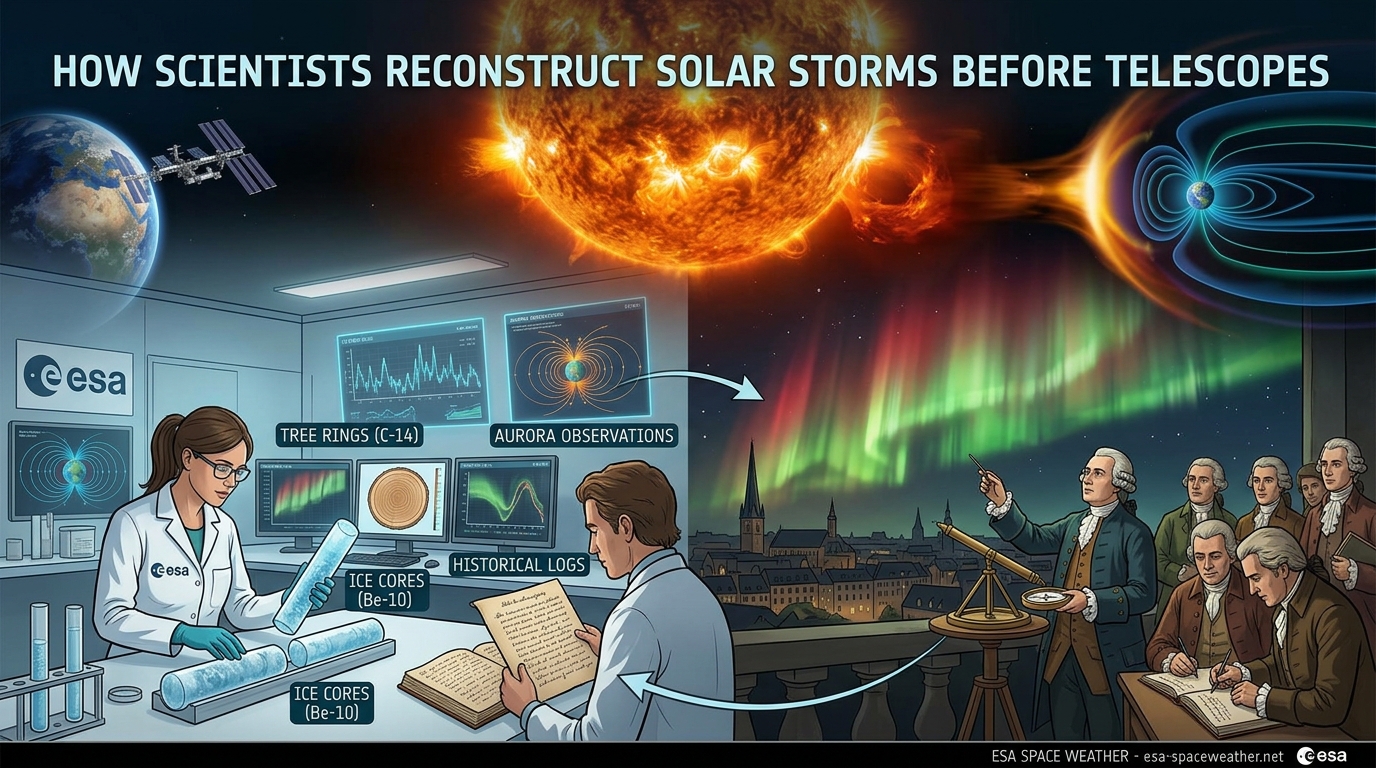
Long before the first telescope was pointed at the Sun in 1610, our planet was already keeping a meticulous diary of every solar storm that struck it. Trees recorded them in their rings. Ice sheets trapped their chemical signatures. Medieval monks documented their dazzling auroral displays in chronicles. Understanding how scientists reconstruct the history of solar storms before telescopes opens a window into thousands of years of solar activity that no human ever directly observed.
This matters more than you might think. The Sun is not a steady, unchanging star. It erupts, hurls plasma at Earth, and occasionally unleashes storms powerful enough to cripple modern civilization. By studying ancient solar events preserved in natural archives, researchers can estimate how often these extreme storms occur and what damage they might cause next time.
Table of Contents
What Are Solar Storms and Why Study Their Past
Solar storms are disturbances on the Sun that release enormous amounts of energy and charged particles toward Earth. They come in several forms. Solar flares are sudden flashes of radiation from the Sun’s surface. Coronal mass ejections (CMEs) are massive eruptions of plasma and magnetic field that can take one to three days to reach our planet. When these charged particles slam into Earth’s magnetic field, they trigger geomagnetic storms that can disrupt satellites, power grids, and communication systems.
The intensity of these events varies enormously. A minor geomagnetic storm might produce beautiful auroras with no practical impact. An extreme one could fry transformers across entire continents. The problem is that we have only been directly observing solar flares since 1859. That is a blink of an eye in the life of a 4.6-billion-year-old star.
Studying the history of space weather gives scientists a way to calculate the probability of future extreme events. If we know how frequently the Sun produced devastating storms over the past 10,000 years, we can better prepare our power grids, satellites, and communication networks for the next big one.
The Carrington Event: The First Recorded Solar Storm
The story of solar storm science begins with Richard Carrington, an English amateur astronomer. On the morning of September 1, 1859, Carrington was projecting an image of the Sun onto a screen to sketch sunspots. Suddenly, he saw two brilliant flashes of white light erupt from a large cluster of sunspots.
The Carrington Event, as it came to be known, was the first solar flare ever directly observed and recorded. But the truly remarkable part happened about 17 hours later. The largest geomagnetic storm in recorded history slammed into Earth. Auroras were visible as far south as Cuba and Hawaii. Telegraph systems sparked, caught fire, and continued operating even after being unplugged from their batteries.
The Carrington Event became the baseline against which all other solar storms are measured. But it raised an immediate question that scientists are still working to answer. Was 1859 the worst the Sun can do, or have even more powerful storms struck Earth in the distant past, before anyone was watching?
To answer that question, researchers had to find ways to detect solar storms from long before Carrington picked up his pencil. The answer lay not in the sky, but in trees, ice, and ancient documents.
How Scientists Reconstruct the History of Solar Storms Before Telescopes: The Core Methods
Scientists use three main categories of natural archives to reconstruct pre-telescopic solar storms. Each method captures a different piece of evidence, and together they create a remarkably detailed record stretching back thousands of years.
The first method is dendrochronology, the study of tree rings. The second is ice core analysis from polar ice sheets and high-altitude glaciers. The third is the examination of historical documents including medieval chronicles, monastery records, and early astronomical observations. Each of these approaches relies on a single shared principle. Extreme solar storms leave behind measurable chemical and visual traces that persist for centuries or millennia.
When a powerful solar storm hits Earth, high-energy particles called solar energetic protons bombard the upper atmosphere. These particles trigger nuclear reactions that produce radioactive isotopes, primarily carbon-14 and beryllium-10. These isotopes do not exist in significant quantities under normal conditions. A sudden spike in their concentration is a chemical fingerprint of an extreme solar event.
Tree Rings: Nature’s Time Capsules
Tree rings are the most precisely dated solar storm archive available to science. Every year, a tree grows a new ring. Wide rings indicate good growing seasons. Narrow rings indicate harsh ones. Because trees grow one ring per year, and because some trees live for thousands of years, scientists can count rings backward through time with extraordinary accuracy.
Here is where it gets remarkable. During an extreme solar storm, the surge of cosmic rays produces a spike in carbon-14 in the atmosphere. Trees absorb this carbon-14 along with normal carbon during photosynthesis. That carbon-14 gets locked into the cellulose of the ring that grew that exact year. When scientists core-sample ancient trees and measure the carbon-14 content of each individual ring, they can detect sudden spikes that correspond to massive solar proton events.
The process works like this. Researchers extract core samples from long-lived trees like bristlecone pines, which can survive for over 5,000 years. They also sample preserved ancient wood from bogs, archaeological sites, and riverbeds. Each ring is dated to its exact calendar year using a technique called dendrochronological cross-dating, where patterns of wide and narrow rings are matched across overlapping tree samples to build a continuous timeline.
Once each ring is dated, scientists measure its carbon-14 content using accelerator mass spectrometry. This technique can detect the tiny amounts of radioactive carbon produced by solar storms. A normal year shows a steady, predictable level of carbon-14. A year with an extreme solar storm shows a dramatic spike, sometimes 10 to 20 times above normal levels.
Tree rings offer one enormous advantage over other methods. Their dating is precise to the exact year. Ice cores can be off by several years due to compression and layer ambiguity. But a tree ring is a tree ring. If a carbon-14 spike appears in the ring dated to 774 AD, scientists can say with near-certainty that a major solar storm struck Earth in exactly that year.
Ice Cores: Frozen Records of Solar Activity
While tree rings capture carbon-14, ice cores capture a different isotope called beryllium-10. Polar ice sheets in Greenland and Antarctica accumulate layer upon layer of snow year after year, century after century. Each layer traps atmospheric particles, including beryllium-10 produced by solar particle bombardment.
When solar protons strike nitrogen and oxygen atoms in the upper atmosphere, they produce beryllium-10 atoms through nuclear spallation. These atoms attach to aerosol particles and gradually settle onto the polar ice. As snow accumulates and compresses into ice, the beryllium-10 is permanently preserved in distinct annual layers.
Scientists drill deep ice cores that can reach over 3 kilometers in length, containing records stretching back more than 100,000 years. Each core is carefully sectioned into thin slices. Each slice represents roughly one year of snowfall. The beryllium-10 concentration in each layer is then measured using accelerator mass spectrometry.
A sudden spike in beryllium-10 in an ice core layer signals that a powerful solar proton event occurred during that year. Because ice cores from both Greenland and Antarctica can be compared, scientists can verify that a detected event was global rather than a local atmospheric anomaly. If the same beryllium-10 spike appears in cores from both poles simultaneously, it strongly suggests a solar origin.
Ice cores have one advantage over tree rings. They extend much further back in time. The oldest ice cores contain records from over 800,000 years ago, while the oldest tree ring records go back about 12,000 years with overlapping samples. For detecting the most ancient and most extreme solar storms, ice cores are the only tool available.
Tree Rings vs Ice Cores: Comparing the Two Methods
Both tree rings and ice cores are essential for reconstructing solar storm history, but each has distinct strengths and limitations. Understanding how they complement each other reveals why scientists rely on both.
Tree rings provide annual precision. You can point to a specific ring and say, “This exact year had a solar storm.” The carbon-14 signal in trees is also very clean and well-understood. However, tree ring records are limited in how far back they extend. Even with preserved ancient wood and bristlecone pine samples, continuous records typically go back about 12,000 to 14,000 years.
Ice cores go much further back, sometimes hundreds of thousands of years. They also capture beryllium-10, which responds to solar particle events differently than carbon-14, providing an independent confirmation. But ice core dating is less precise. As snow compresses into ice, layers thin and merge. Wind can disturb the surface layers. For very old ice, dating uncertainty can range from decades to centuries.
The most powerful approach combines both. When researchers find a carbon-14 spike in tree rings at a known date and a matching beryllium-10 spike in ice cores from the same period, the evidence becomes extremely strong. This dual confirmation is how scientists identify confirmed Miyake Events with high confidence.
The Chemistry Behind Cosmogenic Isotopes
To truly understand how this all works, it helps to understand the chemistry of cosmogenic isotopes. These are radioactive atoms created when high-energy cosmic rays or solar particles collide with atoms in Earth’s atmosphere.
Under normal conditions, Earth is constantly bombarded by galactic cosmic rays from deep space. These cosmic rays produce a steady, low-level background of carbon-14 and beryllium-10. The rate of this background production varies slightly with the 11-year solar cycle because a stronger solar magnetic field deflects more cosmic rays away from Earth.
During an extreme solar storm, the rules change dramatically. A massive burst of solar energetic protons overwhelms the atmosphere. The proton flux can be hundreds or thousands of times greater than normal cosmic ray levels. This triggers a surge in nuclear reactions that produce a sudden, sharp spike in cosmogenic isotopes.
Carbon-14 is produced when neutrons from cosmic ray interactions collide with nitrogen-14 atoms in the atmosphere. The nitrogen-14 absorbs a neutron and loses a proton, transforming into radioactive carbon-14. This carbon-14 oxidizes to form carbon dioxide, which is then absorbed by plants during photosynthesis and locked into plant tissue.
Beryllium-10 forms through a different pathway. When cosmic ray particles or solar protons shatter oxygen and nitrogen nuclei in the atmosphere through a process called spallation, beryllium-10 atoms are among the fragments produced. These atoms attach to airborne particles and are deposited on the ground and ice surfaces through precipitation.
The half-life of carbon-14 is about 5,730 years. The half-life of beryllium-10 is about 1.39 million years. This means beryllium-10 persists far longer, making it useful for detecting very ancient events where carbon-14 would have long since decayed.
Miyake Events: The Largest Known Pre-Telescopic Storms
In 2012, a team led by physicist Fusa Miyake discovered something astonishing in tree ring data. A massive carbon-14 spike occurred in the year 774 AD. The spike was roughly 20 times larger than the annual variation expected from normal cosmic ray background. This meant the Earth had been struck by a solar proton event vastly more powerful than anything in the modern instrumental record.
This event, now called the Miyake Event of 774 AD, was initially met with skepticism. Some researchers proposed alternative explanations like a nearby supernova or a gamma-ray burst. But as more tree ring and ice core data came in from labs around the world, the solar storm hypothesis became the clear frontrunner. The beryllium-10 record from ice cores showed a matching spike in the same time period.
A second confirmed Miyake Event was identified in 993 AD. Researchers have since identified at least five confirmed or candidate Miyake Events using tree ring radiocarbon data. These events dwarf the Carrington Event in intensity. The 774 AD event was estimated to be at least 10 times more powerful than the 1859 storm, and potentially much more.
In 2026, researchers identified the oldest confirmed solar superstorm yet discovered. Using tree ring radiocarbon data, scientists detected an enormous carbon-14 spike dating to approximately 12,350 BC, during the end of the last Ice Age. This event was roughly 18 percent stronger than the 774 AD Miyake Event and about 500 times more powerful than the largest solar storm of the modern satellite era, which occurred in 2005.
To analyze these ancient events, scientists use models like SOCOL:14C-Ex, which simulates how carbon-14 is produced, transported, and deposited after a solar particle event. By feeding the measured carbon-14 spike data into the model, researchers can estimate the actual strength of the solar storm that produced it. These models suggest that the most extreme Miyake Events may have been tens to hundreds of times more energetic than the Carrington Event.
Medieval Chronicles and Historical Aurora Records
Not all evidence of pre-telescopic solar storms comes from laboratories. Some comes from the handwritten pages of medieval chronicles, monastery records, and court documents. For centuries, people across Europe and East Asia observed spectacular auroral displays and wrote about them, even though they had no idea what caused them.
Auroras are one of the most visible effects of geomagnetic storms. When charged particles from a solar storm interact with Earth’s magnetic field, they channel toward the poles and excite atmospheric gases, producing glowing lights. Normally, auroras are visible only at high latitudes. But during an extreme geomagnetic storm, the auroral zone expands dramatically. Auroras can be seen as far south as the Mediterranean, the Middle East, and subtropical China.
When medieval observers saw blood-red skies or dancing lights in regions where such phenomena were unknown, they often recorded them. Anglo-Saxon chronicles from England mention red crucifixes appearing in the sky. Chinese and Korean court astronomers recorded aurora-like phenomena in official astronomical records dating back over 2,000 years. Japanese poetry and diaries from the 8th and 10th centuries contain vivid descriptions of what appear to be extreme auroral displays.
Modern researchers systematically comb through these historical documents. They look for descriptions of red skies, unusual lights, and celestial phenomena that match the characteristics of intense auroras. When a historical aurora observation aligns in time with a carbon-14 spike in tree rings or a beryllium-10 spike in ice cores, the multiple lines of evidence reinforce each other powerfully.
This approach has limitations. Historical records are sparse before about 600 AD. Not all aurora descriptions are clear enough to distinguish from other phenomena like comets or unusual weather. And the vast majority of ancient observations come from Europe and East Asia, leaving gaps in other parts of the world. But for the period from roughly 600 AD to 1600 AD, historical chronicles add valuable human context to the scientific data.
What Would Happen if a Carrington-Level Event Hit Today
The reason all of this research matters becomes clear when you consider what a repeat of the Carrington Event or a Miyake Event would do to modern infrastructure. Our world is vastly more dependent on technology than it was in 1859.
A Carrington-level geomagnetic storm today could induce powerful electrical currents in long-distance power lines. These currents could overload and destroy large power transformers, which are custom-built, expensive, and can take months or years to replace. Wide areas could face extended blackouts lasting weeks or longer.
Satellites would be at serious risk. Increased atmospheric drag from the heated upper atmosphere could alter orbits. Radiation could damage or destroy satellite electronics. GPS navigation, satellite phone networks, and weather forecasting could all be disrupted.
High-altitude flights would face elevated radiation levels. Airlines might need to reroute polar flights to protect passengers and crew. Communication systems relying on high-frequency radio could be blacked out for hours or days.
A Miyake-level event, being many times more powerful, could cause even more severe and widespread damage. Understanding the frequency of these events through natural archive data is the foundation of all modern space weather risk assessment.
FAQs
Has a solar storm ever happened before?
Yes, solar storms have occurred throughout Earth’s entire history. Scientists have confirmed dozens of major solar storms hitting Earth over the past 10,000 years by analyzing carbon-14 spikes in tree rings and beryllium-10 in ice cores. The Carrington Event of 1859 was the first directly observed solar flare, but ancient natural archives show that far more powerful storms struck Earth in 774 AD, 993 AD, and as far back as 12,350 BC.
What would happen if we had a Carrington event today?
A Carrington-level event today could induce massive electrical currents in power grids, potentially destroying transformers and causing widespread blackouts lasting weeks or months. Satellites could be damaged or destroyed, GPS systems disrupted, high-frequency communications blacked out, and polar airline flights exposed to elevated radiation. The economic impact has been estimated in the trillions of dollars for a worst-case scenario.
How do ice cores and tree rings show a change in solar activity?
During extreme solar storms, high-energy particles produce radioactive isotopes like carbon-14 and beryllium-10 in the atmosphere. Trees absorb carbon-14 and lock it into annual rings, while beryllium-10 settles onto polar ice and gets trapped in annual ice layers. Scientists measure these isotope concentrations and detect sudden spikes that indicate powerful solar particle events in specific years.
How far back can we detect solar storms?
Tree ring radiocarbon records can detect major solar storms going back approximately 12,000 to 14,000 years using overlapping samples from living trees and preserved ancient wood. Ice cores from Greenland and Antarctica can detect beryllium-10 spikes from solar events going back over 100,000 years, though dating precision decreases significantly for very ancient ice. The oldest confirmed solar superstorm was detected in tree rings dating to about 12,350 BC.
What is a Miyake Event?
A Miyake Event is an extremely powerful solar proton event identified through massive carbon-14 spikes in tree rings. Named after physicist Fusa Miyake who discovered the first one in 774 AD, these events are estimated to be at least 10 times more powerful than the 1859 Carrington Event. At least five confirmed or candidate Miyake Events have been identified, including ones in 774 AD and 993 AD.
Can we predict extreme solar storms?
Scientists cannot yet predict the exact timing of individual extreme solar storms. However, by studying the frequency and intensity of pre-telescopic solar events recorded in tree rings and ice cores, researchers can estimate the statistical probability of future events. Current data suggests that Carrington-level storms occur roughly every 100 to 200 years, while Miyake-level events may occur every 1,000 to 3,000 years.
Conclusion
Learning how scientists reconstruct the history of solar storms before telescopes reveals one of the most ingenious detective stories in modern science. By reading the chemical signatures preserved in tree rings and ice cores, and by decoding the sky-watching records of medieval chroniclers, researchers have built a detailed record of solar activity stretching back thousands of years before the invention of the telescope.
This record tells us that the Carrington Event of 1859 was far from the worst the Sun can do. Events like the 774 AD Miyake Event and the 12,350 BC superstorm were orders of magnitude more powerful. Understanding their frequency is essential for protecting the technology that our civilization now depends on.
As research continues and new analytical techniques emerge, we will keep refining our picture of the Sun’s violent past. Every new ice core and every ancient tree ring sample brings us closer to answering the question that matters most. When will the next great solar storm arrive, and will we be ready for it?