
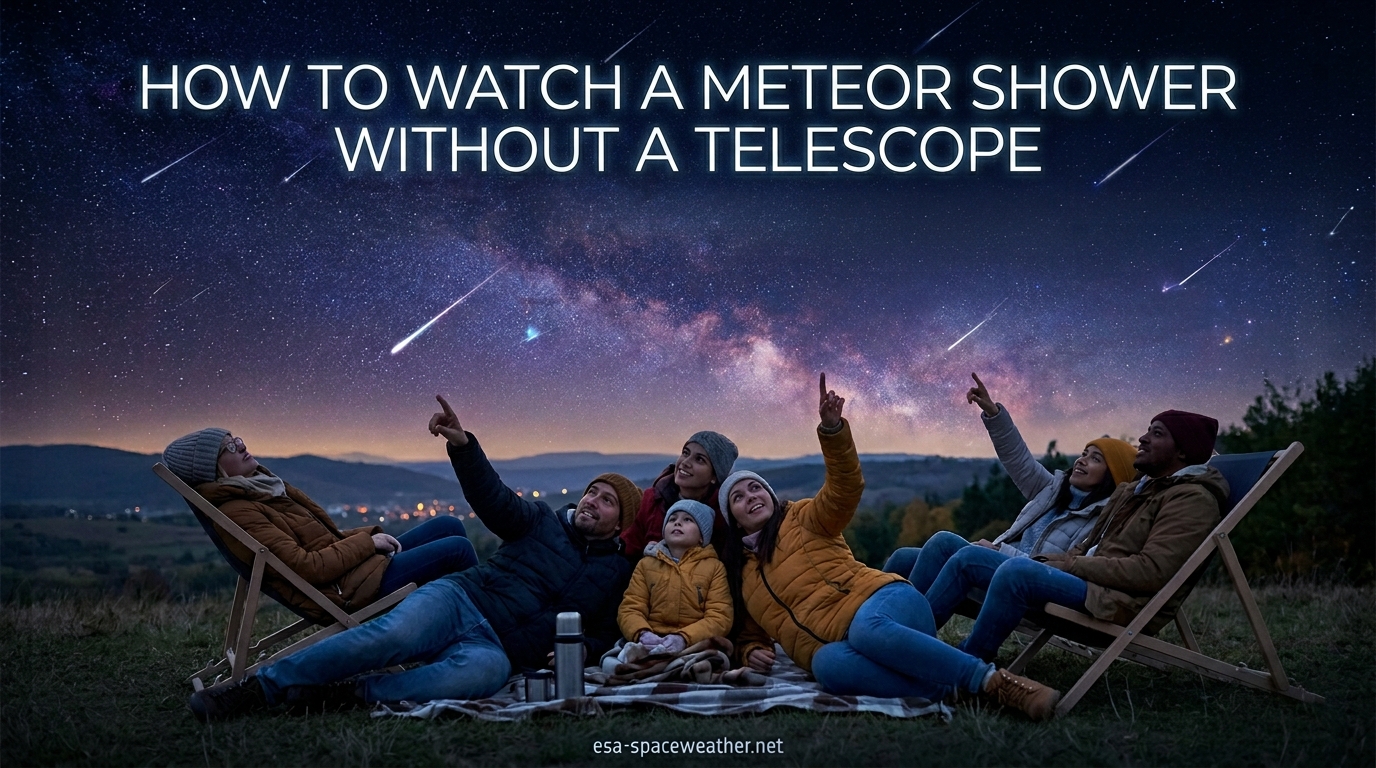
Yes, you can absolutely watch a meteor shower without a telescope or binoculars. In fact, your naked eye is the single best tool for observing meteors, and using optical equipment will actually make your experience worse. Meteors streak across large portions of the sky in random directions, and only your unaided eyes can take in enough sky at once to catch them.
If you are wondering how to watch a meteor shower without a telescope or binoculars, the answer comes down to four things: dark skies, dark-adapted eyes, comfortable seating, and patience. That is it. No gear required. Every experienced meteor observer on Earth will tell you the same thing.
I have spent countless nights watching meteor showers from backyards, remote dark sky sites, and even the shoulder of a highway. Some nights delivered dozens of brilliant fireballs. Other nights I saw three faint streaks in two hours. Both experiences were worth it. This guide walks you through everything you need to know to get the most out of your next meteor shower, no equipment necessary.
A meteor shower happens when Earth passes through a stream of debris left behind by a comet or asteroid. Those tiny particles, called meteoroids, slam into our atmosphere at speeds ranging from 25,000 to 160,000 miles per hour. The intense heat of atmospheric friction vaporizes them instantly, creating the bright streaks of light we call meteors or shooting stars. Because these streaks can appear anywhere in the sky, your eyes, with their roughly 100-degree field of view, are far superior to any telescope or binoculars for spotting them.
Table of Contents
Quick Tips: How to Watch a Meteor Shower Without a Telescope or Binoculars
If you only have 30 seconds, here are the essentials for naked eye meteor watching:
- Find the darkest location you can. Get away from city lights and streetlamps. Even a nearby park is better than a brightly lit backyard.
- Go out after midnight. Meteor rates climb steadily after midnight and peak in the hours before dawn, when your part of Earth faces into the debris stream.
- Allow 20 to 30 minutes for dark adaptation. Your eyes need this time to reach maximum sensitivity. Avoid all white light, including phone screens.
- Use a reclining chair or lie flat on a blanket. Neck strain from looking up while seated upright will end your session early.
- Look 45 degrees away from the radiant point. Meteors near the radiant have very short trails. At 45 degrees, you will see longer, more dramatic streaks.
- Dress warmer than you think necessary. Temperatures drop 15 to 30 degrees at night, even in summer. Bring layers, hats, and gloves.
- Stay at least one full hour. Meteors come in bursts followed by long lulls. Giving up after 15 minutes means you will miss most of the show.
These seven tips alone will put you ahead of 90 percent of first-time meteor watchers. The rest of this guide explains the reasoning behind each one and goes deeper into timing, location selection, and what to realistically expect.
Why Telescopes and Binoculars Actually Hurt Meteor Watching
This is the single biggest misconception in amateur astronomy. Telescopes and binoculars are extraordinary tools for planets, the moon, star clusters, and nebulae. But for meteor showers, they are worse than useless because they actively reduce what you can see.
The reason comes down to field of view. Your unaided eyes take in roughly 100 to 120 degrees of sky at once. A typical pair of binoculars shows you about 5 to 8 degrees. A telescope might show you half a degree or less. That means binoculars reduce your sky coverage by over 90 percent compared to your naked eye.
Meteors are unpredictable. They can appear anywhere in the sky at any moment, and most last only a fraction of a second. If you are looking through binoculars when a brilliant fireball streaks across the opposite side of the sky, you miss it entirely. I have read countless forum posts from disappointed beginners who brought a telescope to a meteor shower and saw nothing while friends next to them saw a dozen meteors with their bare eyes.
There is also the issue of speed. Meteors flash by in under a second, often in a quarter of a second. Your eye and brain can react to a flash anywhere in your peripheral vision. But through a telescope, you would have to be pointed exactly at the right spot at the exact instant a meteor crosses that tiny patch of sky. The odds are astronomically against you.
So if you already own a telescope or binoculars, leave them inside for meteor shower night. Bring them out the next clear night for Jupiter, Saturn, or the Orion Nebula instead.
Best Times to Watch Meteor Showers
Timing is everything in meteor watching, and the single most important rule is this: go out after midnight. Meteor rates are lowest in the evening hours and climb steadily through the pre-dawn hours.
The reason is simple geometry. In the evening, you are on the trailing side of Earth as it moves through space, meaning meteors have to catch up to your position. After midnight, you are on the leading edge, plowing directly into the stream of comet debris. Think of it like driving through rain: the front windshield gets hit much harder than the rear window.
For most meteor showers, the best viewing window runs from about 1:00 AM to just before dawn. This is when the radiant point, the spot in the sky from which meteors appear to radiate, is highest above the horizon. The higher the radiant, the more of the debris stream is visible from your location.
Beyond the time of night, you also want to target the peak night of a given shower. Each meteor shower has a narrow window of peak activity, usually lasting 12 to 24 hours, when Earth passes through the densest part of the debris stream. For major showers like the Perseids and Geminids, the night or two around the peak can also be productive, with rates dropping off gradually on either side.
One important note: check peak times in your local timezone. Some showers peak during daylight hours for certain regions, meaning your best viewing might be the night before or the night after the official peak date.
Finding a Dark Sky Location
Dark skies are the second most important factor after timing. The darker your sky, the more meteors you will see. Light pollution from cities, suburbs, and even rural security lights washes out faint meteors and dramatically reduces your visible count.
Astronomers use the Bortle scale to measure sky darkness, ranging from Class 1 (pristine dark sky, like a remote desert) to Class 9 (inner city skyglow). A Bortle Class 4 or better location will show you significantly more meteors than a suburban backyard. You can check your location’s Bortle class using light pollution maps available online, such as the interactive Light Pollution Map or the Dark Site Finder tool.
If you live in a city, even a short drive of 20 to 30 minutes away from the urban core can make a dramatic difference. Look for state parks, rural roads, or open fields away from direct light sources. Avoid locations near sports field lights, shopping centers, or major highways.
That said, you do not need to travel to a certified dark sky reserve to enjoy a meteor shower. I have seen brilliant fireballs from a suburban backyard during the Perseids. The brightest meteors punch through even moderate light pollution. You will simply see fewer of the faint ones, which means a lower total count but does not mean the experience is worthless.
If traveling to a dark site is not an option, do what you can at home. Turn off all exterior lights, ask neighbors to do the same, and position yourself so that any unavoidable light sources are behind you. Even shielding your eyes from direct light with your hands can help improve contrast.
How to Position Yourself: The 45-Degree Rule
Where should you look in the sky during a meteor shower? The answer surprises many beginners: not directly at the radiant point.
Every meteor shower has a radiant, a specific point in the sky from which all its meteors appear to originate. The Perseids radiate from the constellation Perseus, the Geminids from Gemini, the Leonids from Leo. But meteors do not just appear at the radiant. They streak outward from it in all directions, and the farther from the radiant a meteor appears, the longer its visible trail will be.
Experienced observers recommend looking about 45 degrees away from the radiant, at an altitude roughly halfway between the horizon and directly overhead (the zenith). At this angle, you get the best combination of meteor frequency and trail length. Meteors appearing near the radiant have very short trails because they are moving almost directly toward or away from you. Meteors at 45 degrees or more from the radiant travel across more of your field of view, creating longer, more dramatic streaks.
You do not need to know the exact radiant location to enjoy a meteor shower. Simply look up at a comfortable angle, roughly halfway between the horizon and straight overhead. If you are watching with a group, have each person face a different direction so the entire sky is covered. Someone will always shout “there’s one!” and everyone else can follow their pointing.
If you do want to find the radiant, a free stargazing app on your phone can help. But remember: check it before your session starts, then put the phone away. Every time you look at a bright screen, you reset your dark adaptation back to zero.
Dark Adaptation and Night Vision
Your eyes are remarkably sensitive to faint light, but only after they have had time to adjust. This process, called dark adaptation, takes at least 20 minutes and continues improving for up to 45 minutes. During this time, your pupils dilate and your retina’s rod cells ramp up their sensitivity to dim light.
The problem is that any exposure to bright light resets this process entirely. A single glance at your phone screen, a car headlight, or a porch light can undo 30 minutes of dark adaptation in seconds. This is the number one mistake beginners make, and it is completely avoidable.
Here is how to protect your night vision during a meteor shower. First, put your phone away before you start observing. If you must use it, dim the brightness to the lowest setting and use a red screen filter app. Red light affects your rod cells far less than blue or white light, which is why astronomers use red flashlights at observatories.
Second, avoid looking at any white light sources during your session. If a car drives by with headlights, close your eyes or look away. If you need to walk back to your car or house, use a red LED flashlight or cover a regular flashlight with red cellophane.
Third, be patient during the first 20 to 30 minutes. You may see only one or two meteors during this initial period, and that is normal. Once your eyes are fully adapted, you will start picking up fainter meteors that were invisible before. Many first-timers give up during this adjustment period and miss the best part of the night.
What to Bring: The Complete Checklist
Meteor watching requires almost no equipment, but the few items you do bring will make or break your comfort. Here is what to pack for a successful session:
- Reclining lawn chair or sleeping pad: This is the single most important item. Looking up while sitting upright causes neck pain within 15 minutes. A reclining chair or a flat pad on the ground lets you look up comfortably for hours.
- Sleeping bag or heavy blankets: Even in summer, nighttime temperatures can drop 20 degrees or more. A sleeping bag traps body heat and lets you focus on the sky instead of your shivering.
- Warm layers: Wear more clothing than you think you need. A warm hat, gloves, and thick socks are essential in spring, fall, and winter. In summer, bring a jacket regardless of how warm the daytime was.
- Hot drinks: A thermos of hot chocolate, tea, or coffee provides warmth and a psychological boost during slow periods.
- Snacks: You will be out for at least an hour, probably two or three. Bring easy-to-eat food that does not require bright light or utensils.
- Bug spray: In summer and early fall, mosquitoes at dark sky sites can be brutal. Apply repellent before your session so you do not need a light to reapply.
- Red flashlight: For navigating safely without ruining night vision. A regular flashlight with red cellophane works fine.
- Star chart or stargazing app (pre-loaded): Check the radiant location and major constellations before you start, then put the device away.
What you should NOT bring: telescopes, binoculars, bright flashlights, laptops, tablets, or any device with a glowing screen. All of these will either reduce what you can see or ruin the experience for people around you.
Moon Phase and Weather Considerations
The moon is the natural enemy of meteor watching. A bright full moon acts like natural light pollution, washing out all but the brightest meteors. During a full moon, you might see 80 to 90 percent fewer meteors than under a moonless sky.
Before you plan a meteor shower session, check the moon phase. The ideal scenario is a new moon or a crescent moon that sets early in the evening. A first quarter moon that sets before midnight still allows good viewing after it dips below the horizon. A last quarter or full moon that is up during your viewing window will significantly reduce your meteor count.
If the moon is up and bright, you can still watch, but set your expectations lower. One strategy experienced observers use is to position the moon behind a building, tree, or hill so its direct light does not reach your eyes. Being in the shadow of a barn or large wall can create a pocket of relatively dark sky even when the moon is up.
Weather matters just as much. Even a thin layer of clouds will block most meteors. Check the cloud forecast for your viewing location before heading out, and have a backup plan for the night before or after the peak. Websites and apps that show satellite imagery and hourly cloud cover predictions are more reliable than a simple “partly cloudy” forecast.
Setting Realistic Expectations: ZHR Explained
If you have read about meteor showers, you have probably seen numbers like “100 meteors per hour” or “ZHR 120.” These numbers come from a measurement called the Zenithal Hourly Rate, and they are one of the biggest sources of disappointment for first-time viewers.
ZHR is a theoretical maximum. It represents the number of meteors a single observer would see in one hour under perfect conditions: a perfectly dark sky, the radiant directly overhead, and perfect eyesight. In reality, you will almost never experience these conditions simultaneously.
Here is what ZHR means in practice. A shower with a ZHR of 100 might deliver 40 to 60 meteors per hour under a good dark sky with the radiant reasonably high. From a suburban backyard with moderate light pollution, that same shower might deliver 10 to 20 meteors per hour. If the moon is up, expect even fewer.
For beginners, I always recommend lowering expectations further. Plan on seeing 10 to 20 meteors in an hour, even from a good location. If you see more, you will be thrilled. If you see fewer, you will not be crushed. The forum posts I have read from first-timers almost all echo the same sentiment: “I only saw four or five, but they were absolutely brilliant.” A single bright fireball can make the entire night memorable.
The key is staying long enough. Meteors do not arrive at a steady rate. They come in clusters and bursts, sometimes with 10-minute gaps between them. If you leave after 15 minutes of nothing, you may have missed a burst that happened at minute 20.
Major Meteor Showers: Your Annual Calendar
There are dozens of minor meteor showers throughout the year, but a handful of major ones consistently deliver the best displays. Here is your guide to the most reliable showers visible each year, listed in calendar order.
Quadrantids (Early January)
The Quadrantids peak around January 3 to 4 each year with a ZHR of about 60 to 110. This shower is unusual because its peak is very narrow, lasting only about six hours instead of the typical one to two days. That means timing is critical, and the peak may fall during daylight hours for your location. The Quadrantids originate from an asteroid called 2003 EH1 and are known for producing bright fireballs. The radiant is in the northern sky near the former constellation Quadrans Muralis, between Bootes and Draco.
Lyrids (Late April)
The Lyrids peak around April 22 to 23 with a ZHR of about 18. While the rate is modest compared to the Perseids or Geminids, the Lyrids are reliable and have been observed for over 2,700 years, with records dating back to ancient China. They are known for occasional bright fireballs and about a quarter of Lyrid meteors leave persistent trains, glowing trails that linger for seconds after the meteor has vanished. The parent body is Comet Thatcher.
Eta Aquariids (Early May)
The Eta Aquariids peak around May 5 to 6 with a ZHR of about 50. This shower is produced by debris from Halley’s Comet, making it a favorite among sky watchers. The Eta Aquariids are best viewed from the Southern Hemisphere and tropical latitudes, where the radiant rises higher in the sky. Northern observers can still see them but at lower rates. These meteors are fast, entering the atmosphere at about 148,000 miles per hour, and often leave glowing trains.
Delta Aquariids (Late July)
The Southern Delta Aquariids peak around July 29 to 30 with a ZHR of about 20. This shower favors Southern Hemisphere observers but is visible from mid-northern latitudes as well. The meteors tend to be faint, so a dark sky is especially important. The Delta Aquariids overlap with the early Perseids, which means late July often produces a nice mix of meteors from two different showers.
Perseids (Mid-August)
The Perseids are the most popular meteor shower of the year, peaking around August 12 to 13 with a ZHR of about 100. They are beloved because they occur during warm summer nights in the Northern Hemisphere, making comfortable viewing easy for families and beginners. The Perseids are known for being fast (about 132,000 miles per hour) and bright, with many leaving persistent trains. The parent body is Comet Swift-Tuttle. The main drawback is that the August moon phase varies from year to year, and a bright moon can significantly reduce the show.
Orionids (Late October)
The Orionids peak around October 21 to 22 with a ZHR of about 20. Like the Eta Aquariids, they are produced by Halley’s Comet debris. The Orionids are fast meteors, hitting the atmosphere at about 148,000 miles per hour, and are known for producing bright fireballs. The radiant is near the constellation Orion, one of the most recognizable patterns in the winter sky, making it easy for beginners to orient themselves.
Leonids (Mid-November)
The Leonids peak around November 17 to 18 with a typical ZHR of about 15. This shower is famous for its spectacular storms, most notably the 1833 and 1966 storms that produced tens of thousands of meteors per hour. While storms are rare, the Leonids are the fastest meteors of any major shower, entering the atmosphere at about 162,000 miles per hour, which makes them prone to producing bright fireballs and long-lasting trains. The parent body is Comet Tempel-Tuttle.
Geminids (Mid-December)
The Geminids peak around December 13 to 14 with a ZHR of about 120, making them one of the strongest and most reliable showers of the year. They are unusual because they originate from an asteroid, 3200 Phaethon, rather than a comet. Geminid meteors are slower than most, about 79,000 miles per hour, which makes them easier to see and photograph. They are also known for being bright and sometimes yellowish or even slightly green in color. The main challenge is that December nights are cold, especially in northern latitudes, so proper clothing is essential.
Ursids (Late December)
The Ursids peak around December 22 to 23 with a modest ZHR of about 10. This shower is often overlooked because it follows the spectacular Geminids by just over a week and falls near the winter solstice when nights are longest and coldest. However, the Ursids are reliable and occasionally produce unexpected outbursts. The radiant is near the Little Dipper in Ursa Minor, and the parent body is Comet Tuttle.
For beginners, I recommend starting with the Perseids in August or the Geminids in December. These two showers consistently deliver the highest rates and the brightest meteors, giving you the best chance of a memorable first experience.
Can I see the meteor shower without a telescope?
Yes, you can see meteor showers without a telescope. In fact, the naked eye is the best tool for meteor watching because meteors can appear anywhere across the entire sky. Telescopes show only a tiny fraction of the sky, causing you to miss most meteors.
Do you need a telescope to watch a meteor shower?
No, you do not need a telescope or any equipment to watch a meteor shower. Telescopes and binoculars actually hurt your viewing experience because they restrict your field of view to a small patch of sky. All you need is a dark location, dark-adapted eyes, and patience.
What is the best way to view a meteor shower?
The best way to view a meteor shower is to lie on a reclining chair or blanket under a dark sky, give your eyes 20 to 30 minutes to adapt to the dark, look about 45 degrees away from the radiant point, and stay for at least one full hour. Avoid phones and all bright lights during your session.
Which way should I face to see the meteor shower?
Face about 45 degrees away from the shower’s radiant point, looking roughly halfway between the horizon and straight overhead. Meteors near the radiant have very short trails, while meteors farther from the radiant travel across more sky and produce longer, more visible streaks. If you do not know where the radiant is, simply look up at a comfortable angle.
What time is best to watch the meteor shower tonight?
The best time to watch any meteor shower is after midnight, with peak rates typically occurring between 1:00 AM and dawn. After midnight, your location on Earth faces directly into the debris stream, similar to how a car’s front windshield catches more rain than the rear window.
How can I get the best view of a meteor shower?
To get the best view of a meteor shower, combine a dark sky location, viewing after midnight, 30 minutes of dark adaptation, comfortable reclining seating, warm clothing, and at least one hour of patient watching. Check the moon phase beforehand and avoid nights with a bright full moon.
Can I use my phone as a telescope?
You can use stargazing apps on your phone to find constellations and locate the radiant point of a meteor shower, but a phone cannot replace a telescope and should not be used during active meteor watching. Phone screens emit bright light that resets your dark adaptation, making it harder to see faint meteors.
What are the best tips for observing a meteor shower?
The best tips for observing a meteor shower are: find the darkest location possible, go out after midnight, allow 20 to 30 minutes for dark adaptation, use a reclining chair, look 45 degrees from the radiant, dress warmly, avoid all screens and white lights, and stay at least one hour to account for natural lulls in meteor activity.
Conclusion
Learning how to watch a meteor shower without a telescope or binoculars is refreshingly simple. Find dark skies, go out after midnight, let your eyes adjust for 30 minutes, lie back comfortably, look up, and stay for at least an hour. No gear, no apps during viewing, no expensive equipment.
Your naked eyes are the perfect meteor-watching instrument because they give you the wide field of view that meteors demand. Telescopes and binoculars only shrink what you can see. The real tools of meteor watching are patience, warm clothing, and realistic expectations.
Mark your calendar for the next Perseids in August or Geminids in December. Check the moon phase, grab a reclining chair and a thermos of hot chocolate, and head to the darkest spot you can find. The sky is putting on a show, and all you need to enjoy it is to look up.