
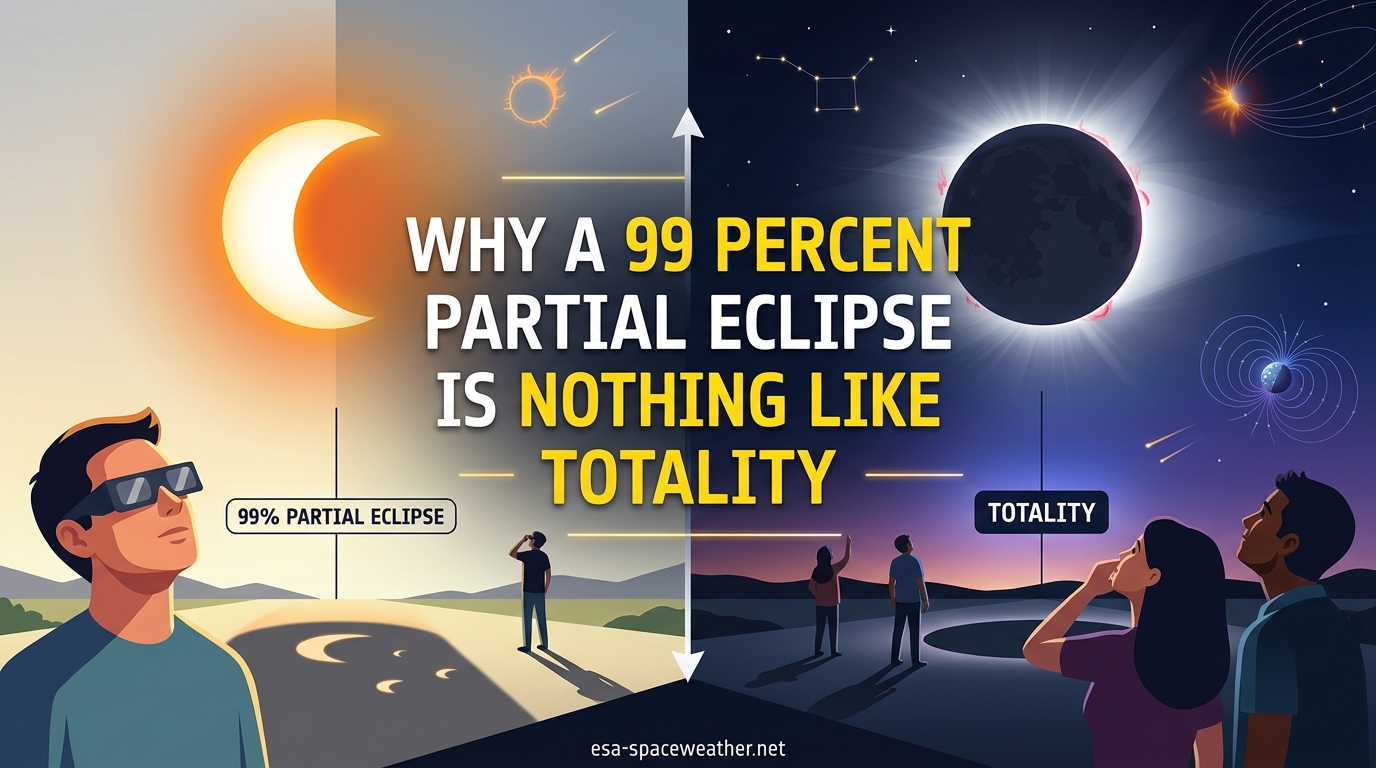
If you are told a location will experience a 99 percent partial eclipse, you might assume that is close enough to totality. It is not. A 99 percent partial eclipse is nothing like totality – and understanding why could change how you plan your next eclipse trip entirely. The difference between covering 99 percent of the Sun and covering 100 percent is not a small one. It is the difference between an interesting afternoon and one of the most profound experiences a human being can have.
Our team at esa-spaceweather.net has spent years studying eclipse phenomena, reading accounts from eclipse chasers who have seen dozens of total eclipses, and reviewing the science behind why this gap exists. Here is the truth: a 99 percent partial eclipse will dim the sky slightly and give you a thin crescent of sunlight to view through eclipse glasses. Totality plunges you into darkness, reveals the solar corona with your naked eyes, and changes the temperature, the wildlife, and your emotional state in minutes. The gap between 99 percent and 100 percent is not incremental. It is a cliff.
Table of Contents
The Bottom Line Up Front
A 99 percent partial eclipse is nothing like totality because the remaining 1 percent of sunlight is still roughly one million times brighter than the full moon. That brightness keeps the sky bright, hides the solar corona completely, and prevents every phenomenon that makes totality remarkable. Totality is not merely a brighter version of a partial eclipse. It is an entirely different category of experience.
The everyday Sun at full brightness is about 400,000 to one million times brighter than the full moon. Even when the Moon covers 99 percent of the Sun’s disk, the remaining 1 percent still outshines the Moon by a factor of four thousand to ten thousand. Your eyes cannot adjust to compensate for that level of brightness. The result is an experience that looks nothing like totality in any measurable way.
Why the Brightness Cliff Makes 99 Percent Nothing Like Totality
The most critical fact to grasp is that the Sun is roughly one hundred thousand times brighter than its own corona. The corona is the Sun’s faint outer atmosphere – the wispy, pearly structure that becomes visible only during totality. Dr. Angela Speck of UTSA and the American Astronomical Society uses an analogy that makes this immediately clear. Imagine your phone screen in bright sunlight. You can barely see it, right? Now turn off the overhead lights in a dark room. That phone screen suddenly glows brilliantly. The corona during totality is like that phone in a dark room. During a 99 percent eclipse, the corona is still staring into a very bright room.
At 99.9 percent coverage, there is still one one-thousandth of the Sun visible. That one one-thousandth is still roughly one thousand times brighter than the full moon. The corona, by comparison, is about as bright as the full moon. Even at 99.9 percent coverage, the remaining sunlight outshines the corona by a thousand times. Your eyes simply cannot adapt fast enough to reveal it. This is why the brightness drop feels like a cliff rather than a slope.
Your pupils play a role in this illusion. As the Moon gradually covers the Sun during the hours before totality, your pupils dilate to let in more light – just as they do at dusk. This dilation happens slowly enough that your eyes never fully adjust to the changing light level. By the time you reach 99 percent coverage, your eyes have already adapted somewhat, but the sunlight is still so intense that the dilation cannot compensate. Then, in the final seconds before totality, the last sliver of the photosphere vanishes. The brightness plummets by two to three orders of magnitude almost instantly. Your dilated pupils, now fully adjusted to the sudden darkness, flood your retina with the corona’s faint glow. That is the moment. That is why totality feels like someone flipped a switch.
Dr. Rick Fienberg of the American Astronomical Society Solar Eclipse Task Force puts it bluntly: “There is no such thing as 99 percent total solar eclipse.” Fred Espenak, the retired NASA astrophysicist who runs MrEclipse.com and has witnessed more than thirty total eclipses, echoes the sentiment with his “100 percent or nothing” philosophy. These are not casual observers. They are scientists who have dedicated their careers to understanding eclipses, and their message is consistent.
What a 99 Percent Partial Eclipse Actually Looks Like
So what does a 99 percent partial eclipse look like in practice? Imagine an overcast day. The sky has that flat, gray quality. Light scatters through the clouds, but it never gets truly dark. Streetlights do not turn on. You do not need a jacket because the temperature barely shifts. Birds keep singing. If you were not looking through eclipse glasses at the right moment, you might not even notice anything unusual.
Looking through eclipse glasses at 99 percent, you see a thin crescent of the Sun’s surface. The crescent is beautiful in its own way – a sharp, golden arc against the black filter. The sky above you stays bright blue or pale gray. Stars remain invisible. The solar corona, which is the defining feature of totality, stays completely hidden. People sometimes report that the light feels “different” – a little flatter, a little less harsh – but that is the extent of it. You will not see shadow bands racing across the ground. You will not see the 360-degree sunset colors on the horizon. You will not experience the primal shift in atmosphere that eclipse chasers describe.
At 90 percent, the difference is even less dramatic. The crescent is slightly wider. The sky might dim to the level of a hazy afternoon. You might notice that colors look a bit washed out. But the experience will not linger in your memory the way totality does. At 75 percent, you would need to pay close attention to notice the difference from a normal day. This gradual curve is the deceptive part of the brightness cliff. From a distance, the decline from 100 percent to 75 percent looks smooth. Up close, the last few percentage points are where everything changes.
What Totality Uniquely Delivers
Totality is not simply a darker partial eclipse. It is a category shift. When the Moon’s umbra reaches your location – the central, fully shadowed part of its shadow – the Sun’s bright face vanishes in a matter of seconds. The transition is sudden and unmistakable. People who have experienced it use words like “supernatural,” “dream-like,” and “blacker than black velvet” to describe the darkness. One Physics StackExchange user called it “blacker than a mineshaft.” Another said it felt like someone turned off the lights.
Here is what totality delivers that no partial eclipse can replicate, regardless of coverage percentage:
First, the solar corona becomes visible to the naked eye. This is the Sun’s outer atmosphere, made of ionized gas streaming millions of kilometers into space. During totality, it appears as a delicate, pearly-white halo surrounding the dark disk of the Moon. The corona’s structure changes from eclipse to eclipse, following the Sun’s eleven-year activity cycle. At solar minimum, it appears as a symmetrical ring concentrated near the Sun’s equator. At solar maximum, it stretches into wispy streamers in every direction. No partial eclipse, even at 99.9 percent, can reveal the corona.
Second, the diamond ring effect appears in the final seconds before and after totality. As the last bead of sunlight escapes through a valley on the Moon’s edge, it creates a single brilliant point of light beside the dark lunar disk. The effect is fleeting – lasting only a few seconds – and it is one of the most photographed moments in eclipse history. Before the diamond ring, Baily’s beads may appear: individual points of sunlight shining through lunar valleys along the edge of the Moon. Both effects require the Sun to be at least 99.9 percent covered, and even then they are only visible in the narrow window around exact totality.
Third, the chromosphere becomes visible. This is a thin layer of the Sun’s atmosphere, roughly two thousand kilometers thick, that glows with a deep reddish-pink color. It appears as a thin band around the edge of the Moon just after the diamond ring fades and before the corona dominates the view. Like the corona, the chromosphere is completely invisible during a partial eclipse.
Fourth, the environment transforms. During totality, temperatures can drop by as much as fifteen degrees Fahrenheit. Birds stop singing and roost. Crickets begin chirping as though night has fallen. Cows sometimes return to barns. Shadows sharpen into an eerie clarity as the last direct sunlight disappears. Shadow bands – faint, rippling lines of alternating light and dark – may dance across the ground in the moments before and after totality, caused by atmospheric turbulence in the final sliver of sunlight. None of these phenomena occur at 99 percent coverage because the sunlight level never drops low enough to trigger them.
Fifth, planets and bright stars become visible. During a total solar eclipse, the sky darkens enough for Venus, Jupiter, and occasionally Mercury to appear in the daytime sky. The brightest stars near the Sun’s position may become visible as well. This does not happen during a partial eclipse at any coverage level short of totality.
Finally, the emotional impact is unlike anything else in nature. People who have experienced totality describe it as primal, overwhelming, and deeply moving. The sudden darkness in the middle of the day triggers a visceral response that seems to bypass rational thought. Some people cry. Others stand in silence. The experience lingers in memory for decades. This emotional dimension is not a side effect of the astronomical event. It is a core part of what totality is.
The Path of Totality: How Narrow and Why It Matters
The reason so few people experience totality comes down to geometry. The Moon’s umbral shadow – the fully dark central shadow – is narrow. On Earth’s surface, the path of totality is typically about one hundred to one hundred fifteen miles wide. It stretches across the globe for roughly nine thousand miles, but the area covered by the path represents less than one percent of Earth’s total surface. Standing outside that path, even a mile outside, means you will see a partial eclipse and nothing more.
The width of the path varies depending on the distances between the Earth, Moon, and Sun. When the Moon is closer to Earth in its elliptical orbit, the path widens. When the Moon is farther away, the path narrows. The duration of totality also depends on your position within the path. At the centerline, totality lasts the longest – up to about seven and a half minutes for the most favorable eclipses. Near the edge of the path, totality can last just a few seconds. Even those few seconds are still totality, and they are still incomparably different from the 99 percent partial eclipse available just outside the path.
There is a concept eclipse chasers call the “grazing zone.” This is a narrow strip, roughly one to three miles wide, near the edge of the predicted path where eclipse maps become unreliable. Topography, elevation, and the exact shape of the Moon’s limb can shift the edge of totality by miles. If you are positioned in the grazing zone, you might experience totality or you might not – it depends on precise conditions that are difficult to predict. For anyone serious about experiencing totality, the centerline is the safest bet. The difference between a one-second grazing totality and zero totality is the same cliff that separates 99 percent from 100 percent.
The “99 Percent Totality” Marketing Myth
If 99 percent is so different from totality, why do so many venues near but outside the path advertise “99 percent eclipse” events? The answer is marketing. Hotels, campgrounds, civic event organizers, and even real estate developers near the edge of the path have been known to promote their locations as offering a “99 percent eclipse experience.” The framing implies that their location is close enough to the path to be essentially the same. It is not.
Rick Fienberg has called this practice misleading. “There is no such thing as a 99 percent total solar eclipse,” he told reporters ahead of the April 2024 eclipse. The distinction matters because people who travel to these events expecting a totality-like experience will be disappointed. The sky will dim slightly. The crescent Sun will be visible through glasses. And that will be the end of it. They will miss the event that everyone in the path is talking about.
This is not to say that 99 percent partial eclipses have no value. They are accessible to millions more people than totality. They are interesting and scientifically meaningful. But they should not be marketed as equivalent to totality, and travelers should not settle for them if totality is within reach.
Safety Considerations: When Eclipse Glasses Come Off
Eclipse safety adds another layer to the 99 percent versus totality discussion. During a partial eclipse – even at 99 percent – you must wear ISO-certified eclipse glasses or use a solar filter on any optical device. Looking at the Sun without protection at any coverage level below 100 percent can cause permanent retinal damage. The danger is not just at peak coverage. It exists throughout the entire partial phase before and after totality.
The only moment when it is safe to look at the Sun with the naked eye is during the brief window of totality itself. Not at 99 percent. Not at 99.9 percent. Only when the Sun is completely and entirely covered by the Moon. The transition is abrupt. As soon as the first bead of sunlight reappears at the end of totality, you must immediately look away or put your glasses back on. Many eclipse chasers follow a simple rule: keep glasses on until the crowd around you gasps at totality, then take them off. Put them back on the moment you hear someone say “here comes the sunlight.”
Cameras, binoculars, and telescopes require their own solar filters at all times except during totality. Even a camera pointed at the Sun without a proper filter can damage the sensor and, if you look through the viewfinder, your eyes. If you are photographing totality, you will need to remove the solar filter during totality to capture the corona, then replace it the moment totality ends. Practice this sequence before the eclipse.
What a Partial Eclipse Still Offers
None of this means that partial eclipses are worthless. A 99 percent partial eclipse is still a striking astronomical event. The crescent Sun through properly filtered glasses is beautiful. The subtle dimming of the sky is noticeable. It is an opportunity to look up and think about the mechanics of the solar system. Millions of people will experience the next partial eclipse where they live, and that is a good thing. Broad public engagement with astronomy matters.
But there is a difference between enjoying a partial eclipse and mistaking it for totality. The former requires glasses and curiosity. The latter requires being in the path of totality, and it rewires your understanding of what an eclipse can be. If totality is within a few hours’ drive of your location, the effort to get there is worth making. If the next total eclipse visible from your region is years away, planning a trip to the path is one of the best investments in a lifetime experience you can make.
Looking Ahead: The Next Total Solar Eclipses
The next total solar eclipse visible from North America occurs on August 23, 2044, crossing mostly western Canada and the United States. For viewers in the United States, that means a seventeen-year wait following the 2017 and 2024 eclipses. Globally, the 2026 total eclipse will be visible across the Arctic, Greenland, Iceland, and northern Spain. The 2027 eclipse will produce six minutes of totality along a path crossing North Africa and the Middle East. Each of these events will have a narrow path of totality surrounded by a vast area of partial eclipse. The people in that vast area will see a dimming sky. The people in the path will see something else entirely.
Frequently Asked Questions
Can you look at an eclipse at 100% totality?
You can only look at a solar eclipse directly without eye protection during totality – the brief period when the Moon completely covers the Sun’s bright face. The moment any part of the Sun is visible again, you must immediately look away or use eclipse glasses.
What does a 90% eclipse look like?
At 90% eclipse, the Sun appears as a thin crescent through eclipse glasses. The sky may dim slightly – comparable to a lightly overcast day – but it will not get dark. Stars and planets will not appear, and the solar corona remains invisible. The environment changes so little that you might not notice an eclipse is happening if you were not looking.
What is the difference between a total and partial eclipse?
A total solar eclipse occurs when the Moon completely blocks the Sun, plunging the daytime sky into darkness and revealing the solar corona. A partial eclipse occurs when the Moon only covers part of the Sun. Even at 99% coverage, the remaining sunlight is still a million times brighter than the full moon, keeping the sky bright and hiding the corona entirely.
Is a partial eclipse worth seeing?
A partial solar eclipse is worth seeing – it is an interesting celestial event and more accessible since its path covers a much larger area. However, it is important to understand that even a 99% partial eclipse will not produce the darkness, the corona, or the transformative experience of totality. If totality is within reasonable travel distance, the journey is overwhelmingly worth it.
How dark does a 99 percent partial eclipse get?
A 99% partial eclipse does not get dark. The sky remains bright – comparable to an overcast day or the light level just before sunset. You cannot see stars, the solar corona stays hidden, and streetlights will not turn on. The light drop is so gradual that your pupils dilate to compensate, masking the dimming until the final seconds.
If totality is within reach, go to the path. A 99 percent partial eclipse is an interesting astronomical event. Totality is a life-changing one. The difference between 99 percent and 100 percent is not a matter of degree. It is the difference between watching from the parking lot and standing in the stadium. Plan accordingly, protect your eyes, and if you ever have the chance to experience totality – take it.