
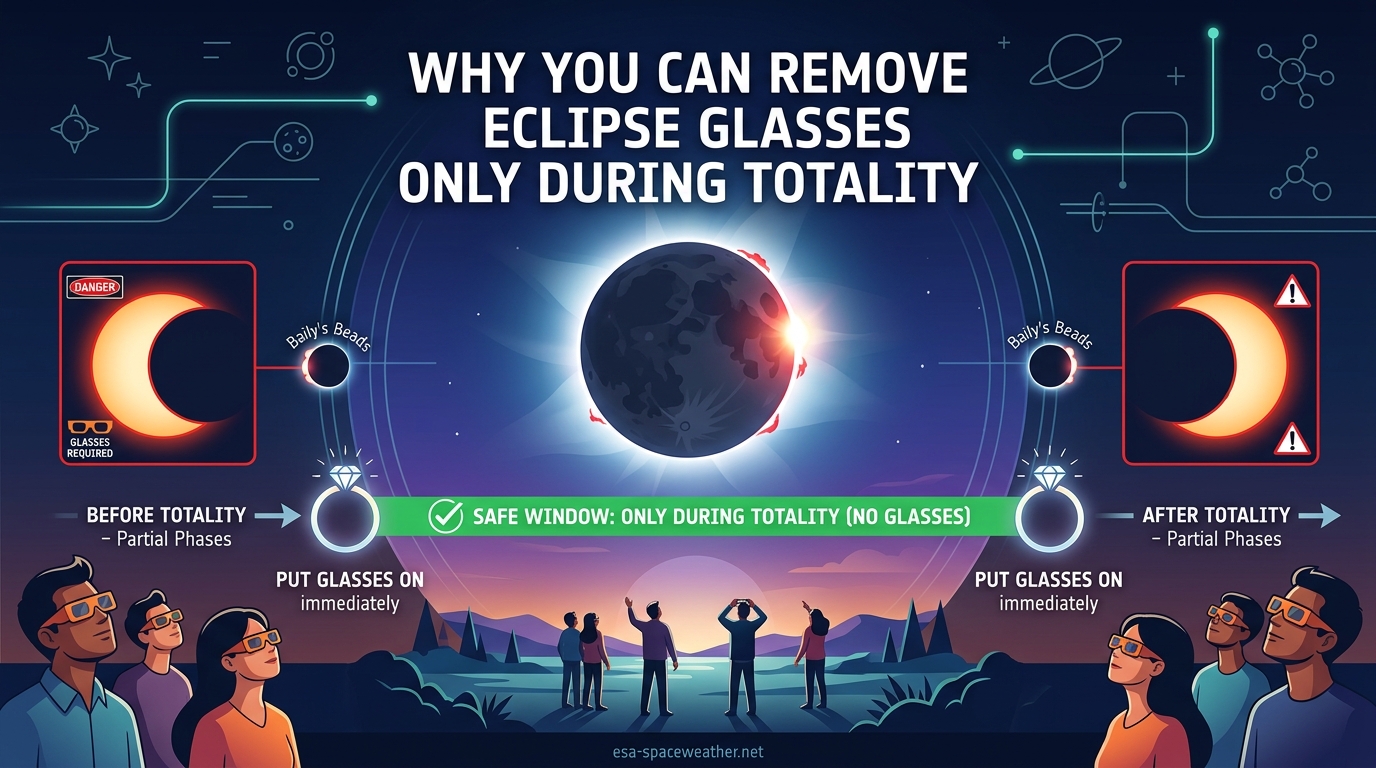
You can remove your eclipse glasses only during the brief window of totality, when the Moon completely blocks the Sun’s bright face, and only if you are inside the path of totality. During every other phase of a solar eclipse, even 99% coverage, looking at the Sun without certified eye protection can cause permanent retinal damage.
I have chased total solar eclipses across three continents, and the moment of totality never stops being breathtaking. The sky darkens to deep twilight, planets appear, and the Sun’s ghostly corona shimmers in the sky. But knowing exactly when to take off your eclipse glasses and when to put them back on is the single most important safety skill you need.
This guide explains precisely when it is safe to remove eclipse glasses, how to recognize totality has arrived, and the science behind why even one second of unprotected viewing during the partial phase can change your vision forever.
Table of Contents
When Is It Safe to Remove Eclipse Glasses During Totality?
The only moment it is safe to remove eclipse glasses during a solar eclipse is during totality, the brief period when the Moon entirely covers the Sun’s bright disk. This window can last anywhere from a few seconds to about 7.5 minutes depending on the specific eclipse, your location, and atmospheric conditions.
For this to apply, you must be physically located inside the path of totality, the narrow band of Earth where the Moon’s shadow falls completely. If you are outside this path, even at 99.9% coverage, there is no totality and no safe moment to remove your glasses.
During totality, the Sun’s photosphere, the blindingly bright surface, is fully hidden behind the Moon. What remains visible is the corona, the Sun’s outer atmosphere, which is roughly as bright as a full moon. That is why naked-eye viewing is safe at this moment and only this moment.
When totality ends, the first sliver of the Sun’s surface reappears from behind the Moon. At that instant, you must put your eclipse glasses back on immediately. Even the thinnest crescent of the Sun emits enough concentrated light to damage your retina.
How to Know When Totality Has Arrived
This is the question I hear most often from first-time eclipse viewers, and it is where the most dangerous confusion lives. The good news is that totality announces itself in unmistakable ways, and you can use your eclipse glasses as the definitive indicator.
The Glasses-As-Indicator Method
Here is the simplest test: look through your eclipse glasses at the Sun. If you can see any part of the Sun’s disk at all, even a tiny sliver or a thin crescent, it is NOT totality and your glasses must stay on. When true totality arrives, the Sun will completely disappear when you look through the glasses.
This is a foolproof method because ISO 12312-2 certified eclipse glasses block 99.999% of visible light. The Sun is the only object bright enough to see through them. When the Sun is fully blocked by the Moon, you will see nothing at all through the lenses. That darkness behind your glasses is your signal that totality has begun.
Other Totality Cues
You will also notice dramatic environmental changes. The sky transitions from daylight to a deep, twilight blue. The horizon may glow with sunset colors in every direction. Temperature drops noticeably, sometimes by 10 to 15 degrees Fahrenheit. Birds stop singing, and some animals settle in as if night is falling.
Most strikingly, the Sun’s corona becomes visible to your naked eye. It appears as a pearly white halo surrounding the black disk of the Moon. You may see pink or reddish solar prominences along the Moon’s edge.
The Transition Is Fast
Experienced eclipse chasers on Astronomy StackExchange emphasize that the shift from 99% partial to 100% total is extremely rapid. Baily’s beads, the last points of sunlight shining through lunar valleys, vanish in seconds. The diamond ring effect flares and disappears. If you are not paying attention, you can miss the transition entirely.
This is why I recommend setting a timer based on your exact location’s predicted totality times. Apps like NASA’s Eclipse Explorer and local astronomical society resources provide precise start and end times down to the second for your coordinates.
The Critical Difference Between 99% and 100% Coverage
This section addresses what forum discussions reveal as the single most dangerous misconception in eclipse safety. A 99% partial solar eclipse is not 99% as safe as totality. It is 100% unsafe for naked-eye viewing.
Here is why: at 99% coverage, the visible crescent of the Sun is still intense enough to cause solar retinopathy. The Sun’s surface brightness does not change during a partial eclipse. Only the shape of what you see changes, from a full disk to a thinning crescent. That thin crescent is still radiating the same blinding energy per square arcsecond as the full Sun.
In practical terms, a 99% partial eclipse is roughly 10,000 times brighter than totality. The reduction in total light output is misleading because the remaining sliver is concentrated and intense. Think of it like looking at a welding arc versus a bonfire. Even a tiny welding arc will damage your eyes instantly.
People at 98% or 99% coverage locations sometimes assume they are close enough to the path of totality to experience it. They do not. The visual experience at 99% is dramatically different from 100%. The sky dims slightly but does not go dark. The corona never becomes visible. No planets appear. No temperature drops sharply.
If you want to remove your eclipse glasses, you must travel to the path of totality. There is no close enough. You are either in it or you are not.
The Four Eclipse Contacts and When to Remove Eclipse Glasses
Astronomers track a total solar eclipse through four contact points. Understanding these helps you time your glasses removal and replacement with precision.
First contact (C1): The Moon begins to cross in front of the Sun. The partial phase begins. Your eclipse glasses must be on for all viewing from this point forward.
Second contact (C2): The Moon fully covers the Sun. Totality begins. This is the moment you can safely remove your eclipse glasses. Baily’s beads disappear, the diamond ring fades, and the corona emerges.
Third contact (C3): The Moon begins to uncover the Sun. Totality ends. The diamond ring reappears as the first bead of sunlight emerges from behind the Moon. You must put your eclipse glasses back on immediately, before this happens if possible.
Fourth contact (C4): The Moon completely exits the Sun’s disk. The eclipse is over. Glasses remain on for any direct solar viewing through this point.
The safe window is exclusively between C2 and C3. Most totalities last between 1 and 4 minutes, though some can stretch to over 7 minutes. Know your local duration before eclipse day.
Why Solar Retinopathy Is Painless and Dangerous
The reason people accidentally damage their eyes during eclipses is that the damage does not hurt. This is not a warning that means you might feel discomfort if you look too long. The damage is completely silent, and that silence is exactly what makes it so dangerous.
The Retina Has No Pain Receptors
Your retina, the light-sensitive tissue at the back of your eye, contains no pain-sensing nerves. You could stare at the Sun and feel absolutely nothing while photochemical and thermal processes destroy your retinal cells. The rods and cones in the macula, the central part of your retina responsible for sharp central vision, simply burn out.
This is fundamentally different from touching a hot stove, where pain makes you pull away instantly. With solar exposure, there is no reflex to look away. People can stare at the Sun for 30 seconds or more without any physical discomfort while accumulating permanent damage.
How the Damage Happens
Solar retinopathy occurs through two mechanisms. First, photochemical damage happens when intense visible light triggers chemical reactions that destroy photoreceptor cells. Second, thermal damage occurs when near-infrared radiation heats the retinal tissue, essentially cooking the cells at the focal point.
The Sun’s ultraviolet radiation also plays a role, though the lens of the eye absorbs most UV. The primary culprits are visible blue-green light and infrared energy, both of which pass through the eye and concentrate on the retina.
Symptoms Appear Hours Later
Symptoms of solar retinopathy typically appear 4 to 12 hours after exposure, not immediately. This delayed onset is another reason people underestimate the danger. You might think you got away with a quick glance, only to wake up the next morning with a permanent blind spot in your central vision.
Common symptoms include a central scotoma (a blind or dark spot in the center of your visual field), distorted vision where straight lines appear wavy, changes in color perception, and increased sensitivity to light. Some people recover partial vision over weeks or months, but the damage is often permanent.
The American Academy of Ophthalmology and the American Astronomical Society both stress that there is no safe exposure time for looking at the Sun without proper filtration. Not one second, not a fraction of a second.
The Diamond Ring Effect and Baily’s Beads
Two visual phenomena bracket the safe viewing window, and understanding them could save your eyesight. These are among the most beautiful moments of any total solar eclipse, but they also serve as critical timing signals.
Baily’s beads occur when sunlight streams through the valleys between mountains on the Moon’s rugged edge. They appear as a series of bright points of light along the lunar limb just before totality begins and again just after it ends. Named after English astronomer Francis Baily, these beads shrink and disappear as the Moon’s disk becomes perfectly aligned.
The diamond ring effect is the final, dazzling burst of sunlight that appears just before totality and the first burst that appears after totality. It looks like a brilliant diamond set against the ring of the corona. This is nature’s stopwatch.
Here is what I tell first-time viewers: when you see the diamond ring forming as you approach totality, keep your glasses on until the diamond completely vanishes. When totality ends and you see the diamond ring reappear, your glasses go on before the diamond fully forms. Experienced observers often put their glasses back on at the very first hint of Baily’s beads returning, because the transition happens in under two seconds.
The Reddit eclipse community has a useful rule of thumb: if you see the diamond ring and think it is beautiful, that is fine during totality. If you see it and your glasses are off, you are already at the limit of safe viewing. Act immediately.
What NOT to Do During a Solar Eclipse
Certain viewing methods and behaviors consistently cause eye injuries during eclipses. Knowing what to avoid is just as important as knowing what to do.
Never use regular sunglasses. Even the darkest sunglasses, including those rated for UV protection, are nowhere near strong enough for solar viewing. Sunglasses typically transmit 15 to 30% of visible light. Eclipse glasses transmit 0.0001%. Stacking multiple pairs of sunglasses does not make them safe either.
Never look through optical devices without solar filters. Binoculars, telescopes, and camera lenses concentrate sunlight dramatically. Looking at the Sun through unfiltered optics, even for an instant, can cause instantaneous and severe eye injury. Solar filters must be attached to the front of any optical instrument before it is pointed at the Sun.
Never use damaged eclipse glasses. If your eclipse glasses have scratches, punctures, tears, or any signs of damage to the solar film, do not use them. Discard them immediately. Even a pinhole defect can allow concentrated sunlight through to your retina.
Never use uncertified or counterfeit glasses. Only use glasses that explicitly state they meet the ISO 12312-2 international standard and come from a reputable vendor verified by the American Astronomical Society. Counterfeit glasses printed with fake ISO markings have been a serious problem at past eclipses.
Never assume a phone camera protects you. Looking at the Sun through your phone screen does not protect your eyes. The Sun’s rays enter through the camera lens but your eyes are still exposed to ambient light. Additionally, concentrated sunlight through a phone camera lens can damage the camera sensor itself.
ISO 12312-2 Standard and Safe Solar Viewing
The ISO 12312-2 standard is the international specification for filters designed for direct observation of the Sun. It was developed by the International Organization for Standardization and defines the exact transmission requirements for safe solar viewing.
Glasses meeting this standard block 99.999% of visible light and reduce transmitted energy to safe levels across ultraviolet, visible, and infrared wavelengths. The standard also specifies that the filters must be free of defects that could compromise their protective function.
How to Verify Your Glasses
Look for the ISO 12312-2 marking printed on the glasses or packaging. Then cross-check the manufacturer against the American Astronomical Society’s list of reputable vendors, which they maintain at eclipse.aas.org. The AAS verifies that listed suppliers actually test their products to meet the standard.
Inspecting and Maintaining Your Glasses
Before each use, hold your eclipse glasses up to a bright indoor light. You should see nothing or at most a very faint, diffuse glow. If you can see any distinct light source through the lenses, the glasses are compromised and must not be used.
Check the solar film for scratches, wrinkles, punctures, or separation from the frame. If you stored glasses from a previous eclipse, inspect them carefully. Eclipse glasses do not technically expire if stored properly in a cool, dry place away from direct sunlight, but older glasses should be examined with extra scrutiny.
When sharing glasses among a group, establish a clear handoff protocol. One person looks, then passes the glasses before the next person looks. Never have multiple people trying to share a single pair simultaneously.
Safe Indirect Viewing Methods
If you do not have certified eclipse glasses, indirect viewing methods let you safely observe the eclipse without ever looking at the Sun. These are excellent alternatives, especially for large groups or families with limited glasses.
Pinhole Projector
The classic pinhole projector takes 30 seconds to make. Take two pieces of stiff white cardboard. Poke a small round hole (about 2 to 3 millimeters across) in one piece using a pin or nail. With your back to the Sun, hold the perforated card up so sunlight passes through the hole and falls onto the second card held behind it. You will see a projected image of the Sun’s crescent shape during the partial phases. Never look through the pinhole at the Sun.
Colander Projection
A kitchen colander with round holes acts as a multi-hole pinhole projector. Hold it with your back to the Sun and let the light fall onto a white surface or piece of paper on the ground. Each hole projects its own image of the crescent Sun, creating dozens of tiny eclipses.
Waffle-Fingers Technique
Cross your hands so your fingers overlap at right angles, creating small gaps between them. Hold them with your back to the Sun and look at the shadow they cast on the ground. The gaps between your fingers act as pinholes, projecting crescent images of the Sun.
None of these methods involve looking at the Sun directly. They are safe for the entire duration of the eclipse, including partial phases, and require no special equipment.
Tips for Viewing With Children
Children need extra attention during eclipses because they may not understand the danger or recognize when totality begins and ends. The American Astronomical Society recommends supervising children at all times during eclipse viewing.
Practice using eclipse glasses with children before eclipse day. Have them put the glasses on indoors and look at a bright lamp to get comfortable with the experience. On eclipse day, an adult should be responsible for signaling when glasses come off and when they go back on.
For young children, consider indirect viewing methods like the pinhole projector as the primary activity. Save direct viewing for the brief totality window with close adult supervision.
FAQs
Can you take eclipse glasses off during totality?
Yes, you can remove eclipse glasses during totality, but only if you are inside the path of totality where the Moon completely blocks the Sun. When the Sun is no longer visible through your eclipse glasses, it is safe to look at the corona with your naked eye. You must put your glasses back on the instant totality ends, marked by the diamond ring effect reappearing.
How do you know when totality has started?
The simplest way to know totality has started is to look through your eclipse glasses. If you cannot see the Sun at all through the lenses, totality has begun. You will also notice the sky darkening dramatically, the temperature dropping, and the corona becoming visible to your naked eye.
What happens if you look at the sun during the partial phase?
Looking at the Sun during any partial phase can cause solar retinopathy, a condition where the retina is permanently damaged by concentrated solar radiation. Because the retina has no pain receptors, you will not feel the damage happening. Symptoms typically appear hours later and can include blind spots, distorted vision, and permanent central vision loss.
Is 99% solar eclipse safe to look at without glasses?
No, a 99% partial solar eclipse is not safe to view without eclipse glasses. At 99% coverage, the visible crescent of the Sun is still intense enough to cause permanent eye damage. Only 100% totality inside the path of totality allows safe naked-eye viewing. If you are outside the path of totality, you must keep your eclipse glasses on for the entire event.
How long does totality last during a solar eclipse?
Totality can last anywhere from a few seconds to a maximum of about 7.5 minutes. Most totalities last between 1 and 4 minutes. The exact duration depends on the specific eclipse, your location within the path of totality, and how close you are to the center line. Check local predictions for your precise totality window before eclipse day.
Can eclipse blindness be cured?
There is no proven cure for solar retinopathy. Some people experience partial recovery of vision over weeks or months as swelling subsides, but the underlying retinal damage is typically permanent. Prevention through proper use of ISO 12312-2 certified eclipse glasses is the only reliable protection. If you suspect solar eye damage, see an ophthalmologist immediately.
Conclusion
The rule for when it is safe to remove eclipse glasses during totality is simple: glasses off only when the Moon completely blocks the Sun, glasses back on the instant the first sliver of sunlight returns. Use your eclipse glasses as the test. If you can see the Sun through them, keep them on.
Remember that this applies only inside the path of totality. At 99% coverage or anywhere outside the path, there is no safe moment to remove your glasses. Solar retinopathy is painless, permanent, and irreversible. The few minutes of totality are spectacular, but protecting your eyesight for the rest of your life matters more.
Inspect your ISO 12312-2 certified glasses before eclipse day, set a timer for your local totality window, and practice the glasses-on, glasses-off sequence with your family. When totality arrives and the corona appears, you will know exactly when it is safe to remove your eclipse glasses and when it is time to put them right back on.