
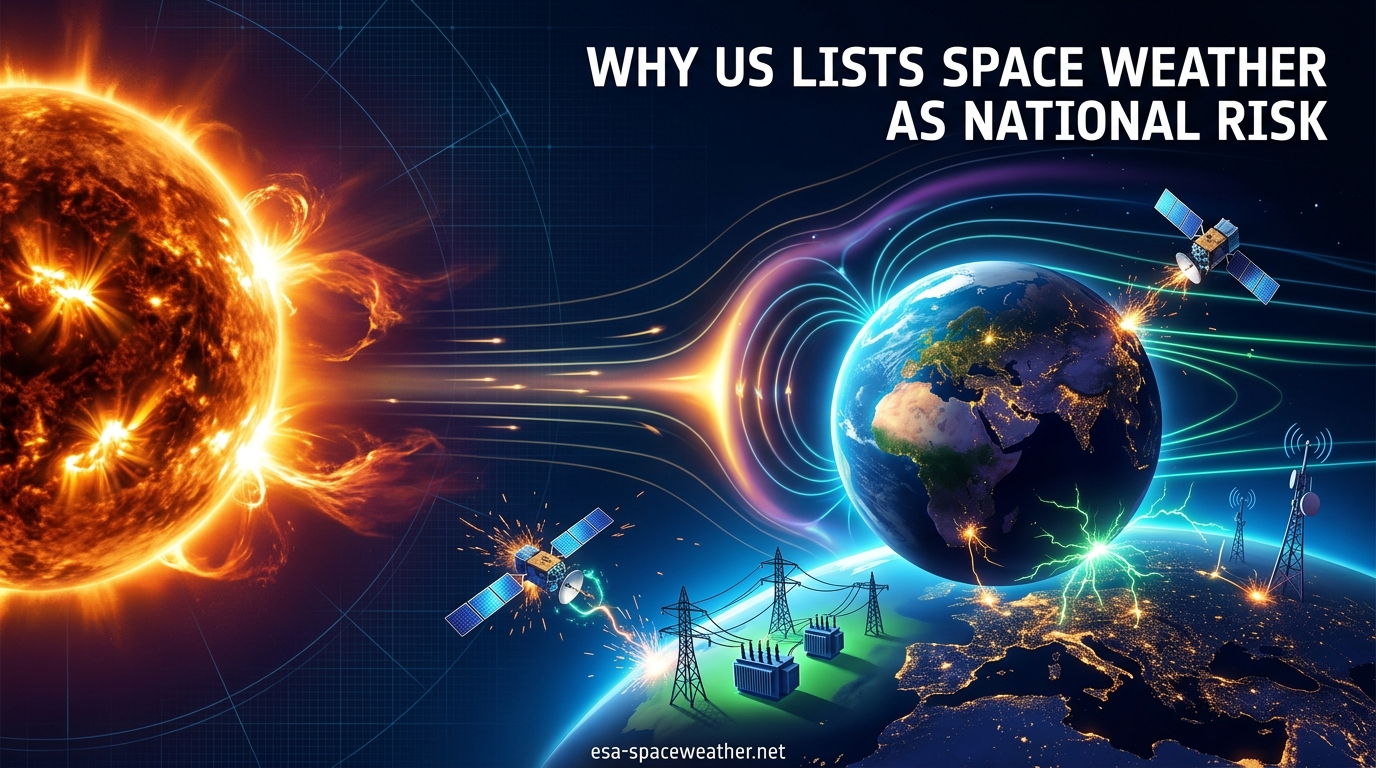
In 2026, the question of why the US lists space weather as a national risk matters more than ever. We are near solar maximum, the peak of the Sun’s roughly 11-year activity cycle. That means more solar flares, more coronal mass ejections, and a higher probability of a severe geomagnetic storm striking Earth. The May 2024 Gannon storm proved these events are not theoretical. They are already happening.
This article breaks down what space weather actually is, why the federal government classifies it as a national security threat, which pieces of critical infrastructure are most vulnerable, and what the government and ordinary citizens can do about it.
Table of Contents
What Is Space Weather?
Space weather refers to disturbances in the space environment driven by the Sun’s activity. The Sun constantly emits a stream of charged particles called the solar wind. But during periods of high activity, the Sun can erupt with much more energy in the form of solar flares and coronal mass ejections, or CMEs.
A solar flare is a sudden, intense burst of electromagnetic radiation from the Sun’s surface. It travels at the speed of light and reaches Earth in about eight minutes. Flares can cause radio blackouts on the sunlit side of the planet, disrupting high-frequency radio communications used by aviation, maritime operators, and emergency responders.
A coronal mass ejection is different. A CME is a massive expulsion of plasma and magnetic field from the Sun’s corona. When a CME is directed at Earth, it arrives within one to three days. When it collides with Earth’s magnetic field, it triggers a geomagnetic storm that can induce electrical currents in long conductors such as power lines, pipelines, and telecommunication cables. These are called geomagnetically induced currents, or GICs, and they are the primary mechanism by which space weather damages infrastructure on the ground.
Solar radiation storms are a third category. These are bursts of energetic protons that can endanger astronauts, passengers on high-altitude polar flights, and satellite electronics. Together, these three phenomena, flares, CMEs, and radiation storms, make up the core of what scientists and policymakers call space weather.
Why the US Lists Space Weather as a National Risk
The short answer is that a severe space weather event could cause widespread, long-lasting damage to multiple critical infrastructure sectors simultaneously. Unlike a hurricane or earthquake, which strike a specific region, a major geomagnetic storm affects an entire hemisphere at once. The entire continental United States could be hit in a single event.
The federal government formally recognized this threat through a series of policy actions. The National Space Weather Strategy and Action Plan, first released in 2015 and updated through subsequent implementation plans, established space weather as a national priority. The PROSWIFT Act, signed into law in 2020, codified this into law by mandating improved forecasting, interagency coordination, and private sector engagement.
The Department of Homeland Security, through CISA, has identified space weather as a risk to all 16 critical infrastructure sectors. The logic is simple. Every sector depends on electricity, GPS timing signals, and satellite communications. If a geomagnetic storm takes down the power grid or disrupts GPS for days, the cascading effects across banking, water treatment, transportation, healthcare, and emergency services would be devastating.
That cascading risk across interconnected systems is exactly why the US lists space weather as a national risk. It is not about one damaged satellite or one blackout. It is about the potential for simultaneous, nationwide disruption of the systems that keep modern society functioning.
Historical Precedent: When Space Weather Struck Hard
The Carrington Event of 1859
The most powerful space weather event in recorded history is the Carrington Event of September 1859. British astronomer Richard Carrington observed a brilliant white-light solar flare on the Sun’s surface. Roughly 17 hours later, the resulting CME slammed into Earth’s magnetic field.
The aurora borealis was visible as far south as Cuba, Hawaii, and Rome. Telegraph systems across North America and Europe malfunctioned dramatically. Operators received electric shocks. Telegraph paper spontaneously caught fire. Some telegraph stations reportedly continued sending and receiving messages even after being disconnected from their power supplies, powered entirely by the electrical currents induced in the wires by the geomagnetic storm.
If a Carrington-level event struck today, the consequences would be orders of magnitude worse. In 1859, the most advanced technology was the telegraph. Today, the world runs on interconnected power grids, satellite networks, GPS systems, and digital infrastructure that did not exist. Estimates from various studies suggest a Carrington-level storm could cause between $1 trillion and $3 trillion in damages, with recovery taking months to years for some affected systems.
The March 1989 Quebec Blackout
The Carrington Event is often dismissed as ancient history. The March 1989 Quebec blackout is not. On March 13, 1989, a severe geomagnetic storm struck Earth. Geomagnetically induced currents flooded the Hydro-Quebec power grid, causing protective relays to trip and the entire grid to collapse in just 90 seconds.
Six million people in Quebec lost power for up to nine hours. The blackout shut down schools, businesses, and public transit. Across the border, the storm also damaged a transformer at a nuclear power plant in New Jersey and caused grid fluctuations across the entire northeastern United States.
The Quebec blackout proved that space weather could bring down a modern power grid. It was a wake-up call that directly led to new reliability standards and monitoring programs.
The May 2024 Gannon Storm
The most recent reminder came in May 2024. A series of powerful solar eruptions produced the strongest geomagnetic storm since 2003, reaching G5 on the NOAA Space Weather Scale. The event, named the Gannon storm in honor of space weather researcher Jennifer Gannon, produced auroras visible across all 50 states.
The storm caused real damage. GPS-guided farming equipment in the Midwest experienced accuracy degradation during peak planting season. Some farmers reported losses because their precision agriculture systems could not operate correctly. Starlink reported increased satellite drag and lost satellites due to atmospheric expansion. Power grid operators implemented emergency procedures, though widespread blackouts were avoided.
The Gannon storm was not a Carrington-level event, but it demonstrated that even a G5 storm in the modern era creates measurable economic damage. It reinforced why space weather preparedness is treated as a national priority.
Halloween Storms of 2003
In October and November 2003, a series of major solar flares and CMEs struck Earth in what became known as the Halloween Storms. The events forced airlines to reroute transpolar flights, caused satellite operators to put spacecraft into safe mode, and disrupted HF radio communications globally. The Japanese ADEOS-2 satellite was permanently disabled. The storm even affected the accuracy of the Global Positioning System for several hours.
Together, these historical events show a clear pattern. Space weather is not a hypothetical future risk. It has caused real, documented damage to modern infrastructure multiple times.
Critical Infrastructure at Risk from Space Weather
Understanding why the US lists space weather as a national risk requires understanding what is actually at stake. Here are the major infrastructure sectors most vulnerable to a severe geomagnetic storm.
1. Electric Power Grids
The electric power grid is the single most critical infrastructure at risk from space weather. When a geomagnetic storm strikes, it induces electrical currents in long transmission lines and transformers. These geomagnetically induced currents can overload and destroy high-voltage transformers that take months or years to replace.
The bulk-power system in North America relies on thousands of large transformers. Most are not manufactured in the United States. Lead times for replacement units can exceed 12 to 24 months. A severe storm that damaged hundreds of transformers simultaneously could leave large regions without power for extended periods.
FERC and NERC have responded with mandatory reliability standards. The TPL-007-4 standard requires grid operators to assess vulnerability to benchmark geomagnetic disturbances and take corrective action where needed. However, critics argue these standards may underestimate extreme events.
2. GPS and Positioning, Navigation, and Timing
The Global Positioning System is so embedded in daily life that most people do not realize how much depends on it. GPS provides timing signals that synchronize cellular networks, financial transaction timestamps, and the electrical grid itself. A disruption to GPS timing would cascade across multiple infrastructure sectors almost immediately.
Space weather disrupts GPS in two ways. First, solar flares cause ionospheric disturbances that degrade GPS signal accuracy. Second, solar radio bursts can directly interfere with GPS receiver frequencies. During the 2003 Halloween Storms, GPS accuracy degraded significantly for hours.
CISA has identified PNT resilience as a national priority precisely because so many sectors depend on GPS timing. The financial sector relies on GPS timestamps for transaction ordering. Power grid synchronization uses GPS clocks. Telecommunications networks use GPS for cell tower coordination. Losing GPS timing would create chaos across banking, communications, and energy.
3. Satellite Communications
Satellites are directly exposed to space weather. Solar radiation storms can damage satellite electronics, cause single-event upsets in onboard computers, and degrade solar panels. Increased atmospheric drag from geomagnetic storms causes low-Earth orbit satellites to lose altitude, requiring station-keeping maneuvers or facing premature reentry.
The May 2024 Gannon storm demonstrated this clearly. Starlink lost satellites due to atmospheric expansion. Satellite operators worldwide had to take protective action, including putting spacecraft into safe modes and delaying maneuvers.
Satellite communications support everything from television broadcasting to military operations to remote internet access. A severe storm that disabled multiple satellites simultaneously would disrupt communications globally.
4. Aviation
Aviation is vulnerable to space weather in several ways. During solar radiation storms, passengers and crew on high-altitude polar flights receive increased radiation exposure. Airlines routinely reroute transpolar flights to lower latitudes during radiation events, adding time, fuel costs, and logistical complexity.
HF radio communications, which are essential for transoceanic flights, are disrupted by solar flares and ionospheric disturbances. During a major radio blackout event, aircraft over oceans lose contact with air traffic control. The May 2024 storm caused widespread HF communication disruptions across multiple regions.
5. Banking and Financial Systems
No competitor adequately covers this, but the financial sector is deeply exposed to space weather risk. Financial transactions depend on GPS timestamps for ordering and settlement. High-frequency trading systems rely on precise timing down to nanoseconds. A GPS timing disruption could halt electronic trading and create settlement uncertainty.
Beyond timing, banking depends on satellite communications for branch connectivity in remote areas, power grids for data centers, and telecommunications for ATM and payment processing networks. A cascading infrastructure failure from a severe storm would affect banking operations within hours.
6. Water Treatment and Distribution
Water and wastewater systems rely on electricity for pumping, treatment, and distribution. They also use GPS for timing of automated control systems. An extended power outage from a geomagnetic storm would affect water availability within 24 to 48 hours in many municipalities, as backup generators have limited fuel reserves.
7. Oil and Gas Pipelines
Geomagnetically induced currents flow through long pipelines as well as power lines. These currents interfere with cathodic protection systems designed to prevent pipeline corrosion. Over time, repeated exposure can accelerate pipeline degradation and increase the risk of leaks or failures.
The Economic Cost of a Severe Space Weather Event
Pinning down exact economic impact estimates is challenging because no modern Carrington-level event has occurred. However, multiple studies and government assessments provide a range.
A 2017 study published in the journal Space Weather estimated that a prolonged power outage from a extreme geomagnetic storm could cost the U.S. economy up to $41.5 billion per day. The Lloyds of London insurance market estimated that a Carrington-level event could cause $2.6 trillion in global damage. Other estimates from academic and government sources range from $1 trillion to $3 trillion in total economic impact.
The economic damage comes not just from infrastructure repair but from business interruption. Manufacturing shutdowns, supply chain disruptions, food spoilage from lost refrigeration, healthcare service interruptions, and fuel distribution failures all compound the cost.
What makes space weather economically unique is the simultaneity. A hurricane damages one region. A Carrington-level storm could affect the entire country at once, making mutual aid agreements between utilities far less effective because everyone needs help at the same time.
NOAA Space Weather Scales: How the Government Measures Threat
NOAA’s Space Weather Prediction Center uses a three-category scale system to communicate the severity of space weather events. Each scale runs from 1 (minor) to 5 (extreme).
The R-scale measures radio blackouts caused by solar flares. R1 describes minor degradation of HF radio on the sunlit side. R5 describes complete HF radio blackout for hours. The R-scale is driven by X-ray flux measurements from GOES satellites.
The S-scale measures solar radiation storms, which are bursts of energetic protons. S1 poses minor risk to satellites and high-altitude operations. S5 describes extreme radiation that could endanger astronauts and cause widespread satellite problems. Solar radiation storms are particularly dangerous for polar flight routes.
The G-scale measures geomagnetic storms, which is the category most relevant to power grid risk. G1 describes minor disturbances with possible weak power grid fluctuations. G5 describes extreme storms that can cause widespread voltage control problems, collapse of entire grid systems, and damage to transformers. The May 2024 Gannon storm reached G5. The Carrington Event is estimated at G5 on a scale that does not fully capture its intensity.
These scales are how NOAA communicates risk to grid operators, satellite companies, airlines, and emergency managers. When a G4 or G5 watch is issued, infrastructure operators activate their space weather response procedures.
How the US Government Responds to Space Weather
The National Space Weather Strategy and Action Plan
The National Space Weather Strategy and Action Plan was first published in 2015 by the National Science and Technology Council. It established six strategic goals covering forecasting, observation, infrastructure protection, research, international cooperation, and workforce development. An updated implementation plan released in late 2023 provided specific agency assignments and milestones.
This strategy is what formally elevated space weather to the level of other national risks. It required federal agencies to treat space weather preparedness as a core mission, not a niche scientific concern.
The PROSWIFT Act
The Promoting Research and Observations of Space Weather to Enhance the Understanding of Predictions and Timelines Act, known as the PROSWIFT Act, was signed into law in October 2020. It is the first federal law specifically dedicated to space weather preparedness.
PROSWIFT mandates a whole-of-government approach to space weather. It requires NOAA to develop and operate a national space weather observation and forecasting capability. It directs NASA to conduct space weather research and develop new observation platforms. It requires the formation of a Space Weather Advisory Group that includes private sector representatives. And it mandates that space weather be treated as part of the national critical infrastructure protection framework.
The law also requires agencies to develop a space weather research-to-operations pipeline, ensuring that scientific advances translate into improved forecasting and operational capabilities.
NOAA Space Weather Prediction Center
The NOAA Space Weather Prediction Center, located in Boulder, Colorado, is the nation’s primary space weather forecasting facility. SWPC operates 24 hours a day, 365 days a year. It issues alerts, watches, and warnings for solar flares, radiation storms, and geomagnetic events.
SWPC serves as the official source of space weather information for the federal government, military, and civilian infrastructure operators. During the May 2024 Gannon storm, SWPC alerts gave grid operators and satellite companies critical lead time to implement protective measures.
FERC and NERC Reliability Standards
The Federal Energy Regulatory Commission and the North American Electric Reliability Corporation have developed mandatory standards for power grid resilience to geomagnetic disturbances. The TPL-007 standard requires grid operators to conduct vulnerability assessments using a benchmark geomagnetic disturbance and implement mitigation measures where needed.
These standards represent the first mandatory federal requirements for space weather resilience in the power sector. They are a direct response to the lessons learned from the 1989 Quebec blackout and subsequent risk assessments.
FEMA and Emergency Preparedness
FEMA offers a free online course, IS-66, titled Preparing the Nation for Space Weather Events. The course covers space weather science, federal response roles, and state and local preparedness planning. It is designed for emergency managers, first responders, and government officials.
FEMA’s inclusion of space weather in its training curriculum signals that the agency treats it as a real emergency planning scenario, not a fringe concern.
CISA and Critical Infrastructure Protection
The Cybersecurity and Infrastructure Security Agency coordinates national efforts to protect critical infrastructure from space weather impacts. CISA works with the Space ISAC, a private-sector information sharing organization, to disseminate threat intelligence to infrastructure operators.
CISA has published guidance identifying PNT dependencies across all 16 critical infrastructure sectors and has worked to promote backup timing capabilities to reduce GPS dependency.
The Space Weather Advisory Group
The Space Weather Advisory Group, established under PROSWIFT, brings together representatives from government, academia, and the commercial space industry. It advises the White House on space weather policy priorities and helps bridge the gap between research and operations.
What You Can Do: Individual Space Weather Preparedness
No competitor in our research covers individual preparedness for space weather. This is a significant gap because ordinary citizens are the ones who experience the consequences of a severe event. Here is practical guidance based on FEMA recommendations and emergency management best practices.
Treat space weather preparedness the same as preparing for any extended power outage. Keep at least 72 hours of non-perishable food, water (one gallon per person per day), and essential medications on hand. Have a battery-powered or hand-crank radio to receive emergency information if cell towers lose power.
Keep cash on hand. If power and communications are down, electronic payment systems and ATMs will not work. Gas stations require electricity to pump fuel, so keep your vehicle at least half full during periods of elevated space weather activity.
Have alternative lighting ready. Flashlights with spare batteries, headlamps, and solar-charged lanterns are all good options. Avoid candles due to fire risk.
If you rely on electrically powered medical equipment, talk to your healthcare provider about backup options and register with your utility company for priority restoration status.
You can monitor space weather conditions yourself. The NOAA Space Weather Prediction Center website at swpc.noaa.gov provides free real-time alerts. SWPC offers email and SMS notification services for subscribers. During elevated activity, check the 3-day forecast for G-scale conditions.
Common Questions About Space Weather as a National Risk
Is a solar flare going to hit Earth in 2026?
Solar flares and coronal mass ejections occur regularly and frequently strike Earth with minimal impact. Scientists at the NOAA Space Weather Prediction Center monitor solar activity 24 hours a day. While we are near solar maximum in 2026, which increases the likelihood of moderate events, no Carrington-level storm is currently predicted. Routine space weather is normal. The national risk designation concerns extreme, rare events.
How does space weather affect us?
Space weather affects us in several ways. Severe geomagnetic storms can induce electrical currents in power lines that damage transformers and cause blackouts. Solar flares disrupt HF radio communications used by aviation and emergency services. Solar radiation storms increase radiation exposure for astronauts and polar-flight passengers. GPS accuracy degrades during ionospheric disturbances. Satellite electronics can be damaged, affecting communications, weather forecasting, and internet services.
Is FEMA IS-66 preparing the nation for space weather events?
Yes. FEMA IS-66 is a free online course titled Preparing the Nation for Space Weather Events. It covers space weather science, federal government roles, and local preparedness planning. It is designed for emergency managers, first responders, and government officials. The course reflects the National Space Weather Strategy and Implementation Plan requirements for building a culture of preparedness.
Is it true that a solar storm will hit Earth?
Yes, solar storms hit Earth frequently, but most are minor and go unnoticed. Space weather events range from routine solar wind variations to severe geomagnetic storms. The May 2024 Gannon storm was the strongest in over two decades and reached G5 on the NOAA scale. The concern is not about routine space weather but about an extreme Carrington-level event that could cause widespread infrastructure damage.
The Bottom Line on Space Weather as a National Risk
The reason the US lists space weather as a national risk comes down to three facts. A severe geomagnetic storm could simultaneously damage power grids across the entire continent. Every critical infrastructure sector depends on electricity and GPS timing. And the historical record, from the 1859 Carrington Event to the 1989 Quebec blackout to the 2024 Gannon storm, proves these events are real and recurring.
The good news is that the federal government has not been idle. The PROSWIFT Act, the National Space Weather Strategy, FERC reliability standards, and NOAA’s 24/7 forecasting operations represent meaningful progress. The bad news is that an extreme event would still cause enormous damage, and many infrastructure sectors remain underprepared.
If you take away one thing, let it be this. Space weather is not science fiction. It is a documented, recurring natural hazard with the potential for catastrophic national impact. The government’s national risk classification is a rational response to a real and present threat.