
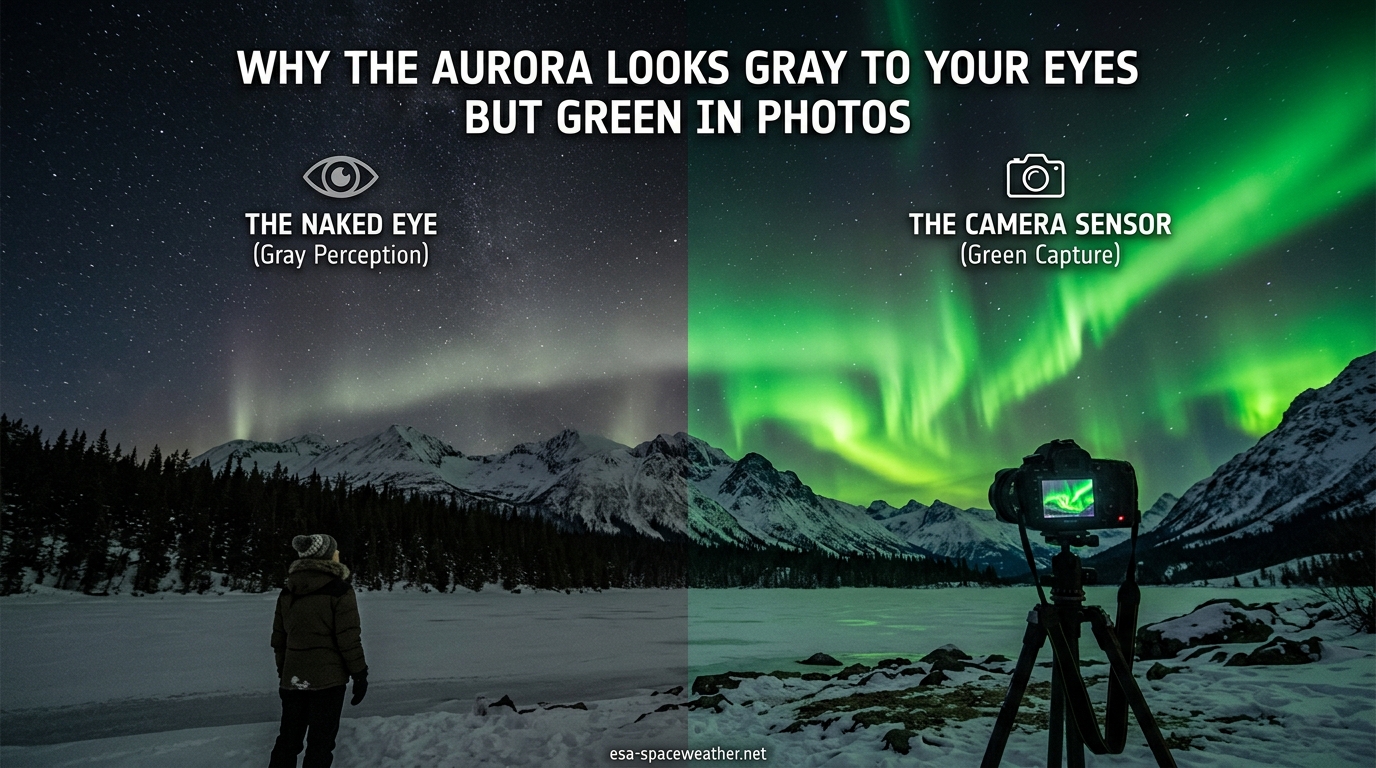
You step outside into the freezing Arctic night. The forecast promised a strong geomagnetic storm. You look up and see… a faint grayish-white cloud drifting across the sky. But then your friend snaps a photo, and the screen explodes with vivid green curtains of light. Sound familiar? This is the classic experience of aurora chasing, and there is a perfectly good scientific reason why the aurora looks gray to your eyes but green in photos.
The short answer comes down to human biology. Your eyes have two types of light-detecting cells: rod cells (which work in dim light but only see in black and white) and cone cells (which detect color but need much more light to activate). Aurora light is usually too faint to trigger your cone cells, so your rods take over and you perceive a gray or white glow. A camera sensor, on the other hand, can gather light over several seconds of exposure and accumulate enough photons to render full color.
In this guide, we will break down exactly why this happens, what you can realistically expect to see with your own eyes, and how to give yourself the best chance of spotting real color in the northern lights.
Table of Contents
Why Does the Aurora Look Gray to My Eyes?
The reason the aurora looks gray or white to your eyes comes down to one simple fact: the light is too dim for your color vision to work. Human eyes rely on two different types of photoreceptors in the retina, and they switch on under very different conditions.
Your cone cells handle color vision. They sit mostly in the fovea, the central part of your retina, and they need a decent amount of light to function. There are three types of cones, each sensitive to different wavelengths corresponding roughly to red, green, and blue. Together they let you perceive the full spectrum of color in daylight.
Your rod cells handle low-light vision. They are far more sensitive than cones, capable of detecting a single photon under ideal conditions. But rods share a single type of light-sensitive pigment called rhodopsin. That means rods cannot distinguish between different wavelengths. They only tell your brain how bright something is, not what color it is. Everything your rods detect appears in shades of gray.
Most aurora displays, especially at mid-latitudes, emit light that is bright enough for rods but too faint for cones. Your brain receives brightness information but no color data. The result is a gray, white, or silvery glow that may look like a pale cloud or a faint mist.
This is why so many first-time aurora chasers feel disappointed. Reddit users on r/VisitingIceland and r/askastronomy frequently share the same story: they expected the lush green curtains they saw in photos and instead saw what looked like a dim white cloud. One traveler on a flight over Quebec reported that the aurora looked completely white to the naked eye, while long-exposure photos captured brilliant green.
Why Do Cameras Capture More Color Than Our Eyes?
Cameras capture more aurora color than your eyes because they can collect light over time. Your eye takes in light in real time, processing a continuous stream of photons at a fixed rate. A camera sensor, by contrast, can leave its shutter open for seconds or even minutes, accumulating photons and building up an image that is far brighter and more colorful than anything your eye could perceive in the moment.
Think of it like filling a bucket with rain. Your eye is a small cup held out for a fraction of a second. A camera with a long exposure is a large bucket left out for 10 seconds. The bucket collects far more water, and the resulting image reflects all that accumulated light.
Most aurora photos are shot with shutter speeds between 2 and 25 seconds, ISO settings from 1600 to 6400, and wide-open apertures around f/1.4 to f/2.8. These settings let the sensor gather an enormous amount of light compared to what your eye collects in real time. The camera sensor is also far more efficient at the red and green wavelengths that dominate aurora emissions than your dark-adapted rods are at signaling color.
This is why the camera vs eye aurora difference is so dramatic. The camera is not making anything up or adding fake color. It is simply recording light that is genuinely there but too faint for your biological photoreceptors to process as color in real time.
Rod Cells vs Cone Cells: The Science Explained
To really understand why the aurora looks gray to eyes but green in photos, it helps to look at rod cells and cone cells side by side. These two photoreceptor types evolved for very different purposes.
Rod cells number around 120 million in each eye. They are concentrated in the peripheral retina, not the fovea, which is why you sometimes see faint objects better when you look slightly to the side of them. This technique, called averted vision, is well known among astronomers and aurora chasers. Rods peak in sensitivity at around 500 nanometers, which happens to be in the blue-green part of the spectrum, close to the 557.7-nanometer wavelength emitted by excited oxygen atoms that produces the green aurora.
Cone cells number around 6 million per eye. They are densely packed in the fovea and handle all color perception. But cones need roughly 10 to 100 times more light than rods to activate. In the dim conditions of an aurora display, especially a moderate one, there simply are not enough photons reaching the retina to switch the cones on.
There is also the matter of adaptation. It takes your rod cells about 7 minutes to begin adapting to darkness and roughly 30 to 40 minutes to reach full sensitivity. This is why experienced aurora chasers avoid looking at their phone screens or use only red light flashlights. White light resets the adaptation process and effectively blinds your rods for another half hour.
So when people ask why the aurora looks gray to their eyes, the answer is straightforward: their cones are not getting enough light to fire, and their rods, which are doing all the work, can only report brightness in shades of gray.
What You See vs What the Camera Captures
The difference between what you see and what a camera captures during an aurora can be dramatic. Here is a realistic comparison based on reports from aurora chasers and photographers.
A weak to moderate aurora at mid-latitudes often appears as a faint white or gray-green glow low on the northern horizon. Structure may be visible as subtle bands or arcs, but color is usually absent to the naked eye. A camera with a 10-second exposure at ISO 3200 will capture the same scene as a vivid green arc with visible structure and movement.
A strong aurora at high latitudes, especially during an active substorm, can produce enough light to trigger cone cells. Observers in Alaska, northern Canada, Iceland, and Norway during strong displays frequently report seeing clear green, and sometimes hints of pink or red at the edges of the curtains. Even in these cases, the color is less saturated and less widespread than what a camera records.
During the great red aurora of May 2024, triggered by an extreme geomagnetic storm, many observers at mid-latitudes reported seeing genuine red and pink colors with the naked eye for the first time. The aurora was bright enough to fully activate cone cells across much of the Northern Hemisphere.
When Can You Actually See Aurora Colors?
You can see aurora colors with your naked eye when the display is bright enough to activate your cone cells. This typically happens during strong geomagnetic storms or at high latitudes where the auroral oval sits directly overhead.
The brightness of an aurora depends on several factors. The KP index, a measure of geomagnetic activity on a scale from 0 to 9, gives a rough indication. At KP 3 or below, the aurora is usually too faint for naked-eye color at mid-latitudes. At KP 5 or higher, the chances of seeing some green increase significantly, especially if you are far from light pollution.
Latitude plays a massive role. Under the auroral oval, which covers places like Tromso in Norway, Fairbanks in Alaska, and Yellowknife in Canada, even moderate displays can appear green to the naked eye because the aurora is brighter when viewed from directly beneath it. At lower latitudes, you are seeing the aurora through more atmosphere at an angle, which dims it considerably.
The intensity of the substorm also matters. Aurora displays are not static. They build slowly, then suddenly intensify during a substorm expansion phase. During the peak of a substorm, the aurora can brighten dramatically for several minutes, and this is when you are most likely to perceive color without a camera.
Other Aurora Colors and When You See Them
Green is the most common aurora color, produced by atomic oxygen at altitudes around 100 to 300 kilometers emitting light at 557.7 nanometers. But the aurora can produce other colors under the right conditions.
Red aurora is produced by atomic oxygen at very high altitudes, above 200 kilometers. The great red aurora events, like the May 2024 storm, are relatively rare and usually associated with extreme geomagnetic activity. Red can appear at the tops of tall auroral rays or as a diffuse red glow across the sky during major storms.
Pink or magenta appears at the lower borders of strong green auroral curtains. This color comes from a mix of red and green emissions and is sometimes visible to the naked eye during intense displays, especially at high latitudes.
Blue and purple auroras are produced by molecular nitrogen at lower altitudes. They are among the rarest colors and typically appear only during very active displays. Blue aurora is the rarest color most observers will encounter.
Tips to Maximize Aurora Color Visibility
If you want to give yourself the best chance of seeing real color in the aurora with your own eyes, here are some practical techniques that experienced chasers use.
Get as far from light pollution as possible. Even small towns emit enough stray light to reduce your eye’s dark adaptation. Drive at least 20 to 30 minutes away from any city and find a location with a clear view of the northern horizon.
Allow 30 to 40 minutes for full dark adaptation. Do not look at your phone during this time. If you need light, use a red light flashlight or a red cellophane cover on your screen. Red light does not reset rod adaptation the way white light does.
Use averted vision. Look slightly to the side of where you think the aurora is brightest. Your peripheral rods are more sensitive than the cones in your central vision, and you may detect faint structure or even hints of color this way.
Try the flashlight trick. Some aurora chasers report that briefly shining a white light at the aurora can momentarily switch cone cells on and let you briefly perceive color. The effect is short-lived and controversial, but some swear by it. Shield your eyes afterward to allow re-adaptation.
Travel to high latitudes during geomagnetic storms. Being under the auroral oval during a KP 5 or higher event dramatically increases your odds of seeing color with the naked eye. Check space weather forecasts and aurora prediction apps before planning your trip.
FAQs
Why does the aurora look grey?
The aurora looks grey because the light it emits is usually too dim to activate your color-detecting cone cells. Your rod cells, which handle night vision but only see in black and white, take over and report the aurora as a gray or white glow. Only during strong displays is there enough light for cones to detect color.
Why do the Northern Lights look green in photos?
Cameras capture green in aurora photos because they can collect light over several seconds of exposure. A long exposure at high ISO gathers far more photons than your eye processes in real time, allowing the camera sensor to record the green wavelength emitted by oxygen atoms that your eyes are too insensitive to perceive as color.
What is the rarest color to see in the aurora borealis?
Blue and purple are the rarest aurora colors. They are produced by molecular nitrogen at lower altitudes and typically appear only during very active geomagnetic displays. Red aurora is also uncommon and usually occurs during extreme storms. Green is by far the most common aurora color.
Can the Northern Lights be gray?
Yes, the northern lights frequently appear gray or white to the naked eye. This is the normal experience for most viewers, especially at mid-latitudes or during moderate displays. The aurora is still emitting green light, but it is too faint for your color vision to detect.
Can you see the colors of the Northern Lights with your eyes?
Yes, but only when the aurora is bright enough. During strong geomagnetic storms or at high latitudes under the auroral oval, the display can produce enough light to activate cone cells and reveal green, and sometimes pink or red. Most displays at mid-latitudes will look gray or white without a camera.
Conclusion
Understanding why the aurora looks gray to your eyes but green in photos comes down to a fundamental difference between human vision and camera technology. Your rod cells are remarkable low-light detectors, but they cannot see color. Your cone cells can see color, but they need more light than most aurora displays can provide. Cameras bridge that gap by collecting light over time and revealing the true colors that are genuinely present in the sky.
This does not mean the naked-eye experience is disappointing. There is something deeply moving about standing under a silent, shifting gray curtain of light and knowing that photons from charged solar particles are raining down through the atmosphere just a few hundred kilometers above your head. The gray glow is real, and the green in photos is real too. They are just two different ways of perceiving the same phenomenon.
If you are planning an aurora trip, set your expectations honestly. Bring a camera if you want to capture the green. But also take time to simply watch with your own eyes, fully dark-adapted, away from city lights. And if you are lucky enough to catch a strong storm, you just might see that green with your own eyes after all.