
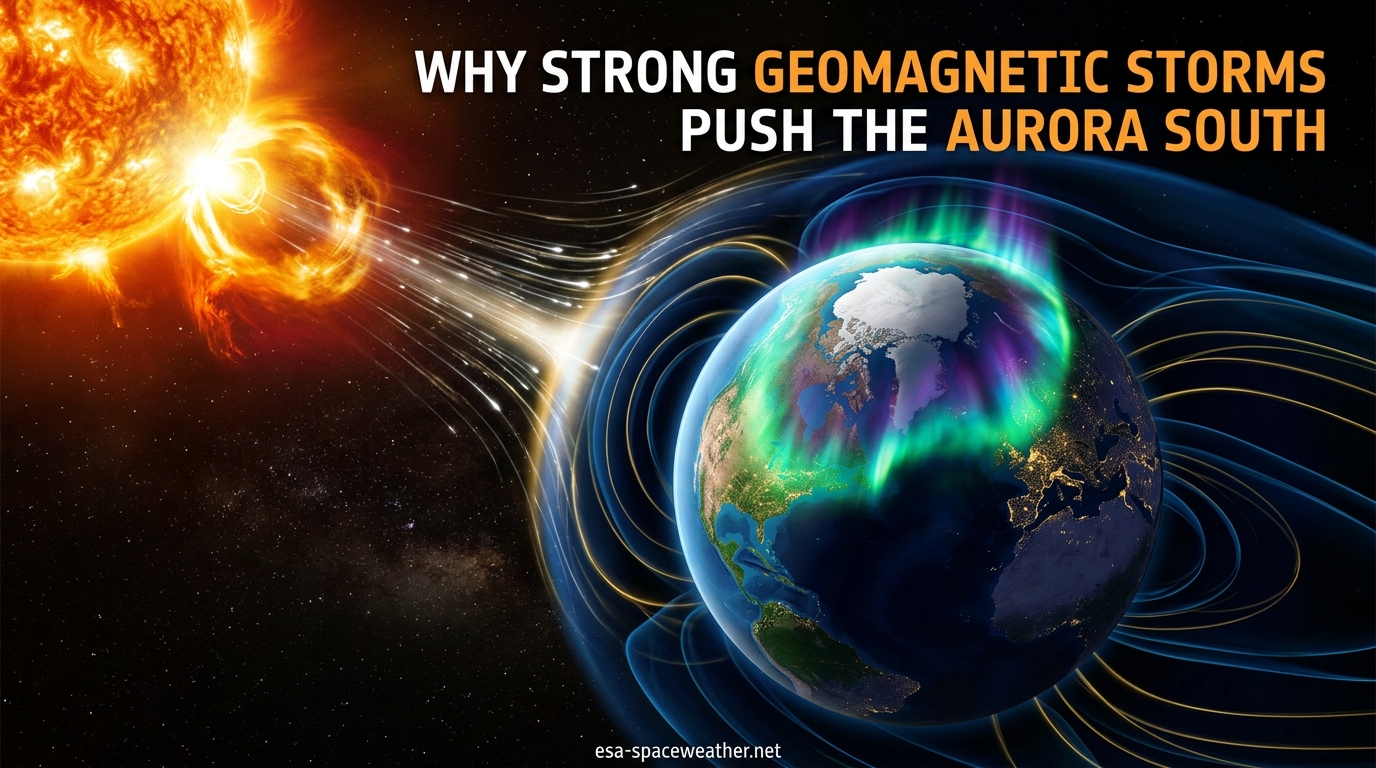
It sounds like a contradiction, doesn’t it? The headlines blare that a powerful geomagnetic storm will make the northern lights visible as far south as Texas or Florida. You rush outside, crane your neck toward the horizon, and see nothing but a dull gray sky. If the storm was so strong, why couldn’t you see the aurora?
The answer lies in a counterintuitive reality of space weather. Strong geomagnetic storms do push the aurora farther south, but they also stretch it thinner, dimmer, and lower on the horizon for viewers at those southern latitudes. Understanding why strong geomagnetic storms push the aurora too far south to see it well requires digging into the physics of the auroral oval, the behavior of Earth’s magnetosphere during extreme space weather, and the practical limitations of human vision at lower latitudes.
Our team has spent years tracking coronal mass ejections, monitoring Kp index spikes, and chasing auroras from Iceland to the American Midwest. Along the way, we’ve learned that the most spectacular aurora displays are almost never at the southern edge of visibility. They happen deep inside the auroral oval, where the lights dance directly overhead in vivid green, magenta, and red.
In this guide, we’ll break down exactly what happens when a geomagnetic storm expands the auroral oval equatorward, why that expansion degrades viewing quality for southern observers, and how to find the sweet spot for actually seeing the show. Whether you’re an avid aurora chaser or someone who stepped outside during the May 2024 storm and saw nothing, this article will explain the science behind the disappointment.
Table of Contents
Why Strong Geomagnetic Storms Push the Aurora Too Far South to See It Well: The Short Answer
Here is the core mechanism in brief. The aurora forms inside a ring-shaped zone called the auroral oval, which normally sits at high latitudes around 65 to 75 degrees. When a strong geomagnetic storm hits Earth, increased energy from the solar wind forces this oval to expand toward the equator. A G4 or G5 storm can push the aurora’s southern edge down to 40 degrees latitude or even lower, making it technically visible from states like Oklahoma, Alabama, and the Carolinas.
However, the aurora at that southern edge is fundamentally different from the aurora seen inside the oval. It appears low on the northern horizon rather than overhead. It is typically diffuse and faint rather than structured and bright. Light pollution from cities washes out what little glow exists. And because the aurora is so far from the viewer’s magnetic zenith, the atmosphere scatters much of its light before it reaches the eye.
In other words, the storm pushes the aurora south, but it also spreads the same amount of energy across a much larger area. Think of it like spreading peanut butter across a bigger piece of bread. The total amount of peanut butter hasn’t changed, but each bite now has less on it. That’s what happens to the aurora during extreme geomagnetic storms, and it’s the primary reason southern viewers walk away disappointed.
What Is the Aurora?
The aurora is a natural light display created when charged particles from the Sun collide with gases in Earth’s upper atmosphere. In the Northern Hemisphere, we call it the aurora borealis, or northern lights. In the Southern Hemisphere, it is known as the aurora australis, or southern lights. Both phenomena are driven by the same physics.
Here’s how it works step by step. The Sun constantly emits a stream of charged particles called the solar wind. These particles travel through space and eventually reach Earth, where our planet’s magnetic field deflects most of them around the planet like water flowing around a stone in a river. But some particles get funneled along magnetic field lines toward the polar regions.
When those particles reach the ionosphere, roughly 60 to 250 miles above the surface, they slam into oxygen and nitrogen molecules. The energy from each collision excites the molecules, causing them to release photons of light. Oxygen at high altitudes produces red aurora, oxygen at lower altitudes produces the familiar green aurora, and nitrogen produces blue and purple hues.
The result is a glowing, shifting curtain of light that dances across the polar sky. Under quiet geomagnetic conditions, this light show stays confined to a narrow band near the magnetic poles. But during a geomagnetic storm, everything changes.
The Auroral Oval: Where the Aurora Normally Lives
The aurora does not appear randomly across the sky. It forms within a specific geographic zone called the auroral oval, a ring-shaped band that encircles each of Earth’s magnetic poles. This oval exists because charged particles are guided along magnetic field lines that converge near the poles, creating a concentrated zone of atmospheric excitation.
Under normal conditions, the northern auroral oval sits roughly between 65 and 75 degrees north latitude. That band covers places like northern Scandinavia, Iceland, northern Canada, Alaska, and Siberia. If you live in Tromso, Norway, or Fairbanks, Alaska, you can see the aurora on almost any clear, dark night, even when geomagnetic activity is low.
The oval is not a fixed shape. It shifts and pulses with changing solar wind conditions, growing wider on the side facing the Sun and narrower on the night side. During minor geomagnetic disturbances, the oval might dip slightly equatorward, making the aurora visible from places like northern Scotland or southern Scandinavia that normally miss out.
The key point is that the auroral oval is the zone of strongest auroral activity. Inside the oval, the aurora appears overhead, bright and structured, with distinct arcs, rays, and curtains. Outside the oval, there is essentially nothing to see. And during a major geomagnetic storm, the oval expands dramatically, pushing that boundary of visible aurora much farther south than usual.
What Causes a Geomagnetic Storm?
A geomagnetic storm is a temporary disturbance of Earth’s magnetosphere caused by solar activity. The two primary triggers are coronal mass ejections (CMEs) and coronal holes that produce high-speed solar wind streams. Both originate from the Sun, but they behave differently.
A coronal mass ejection is a massive eruption of plasma and magnetic field from the Sun’s corona. When a CME is directed at Earth, it can travel at speeds exceeding 1,500 miles per second and arrive within 15 to 30 hours of leaving the Sun. Upon impact, the CME compresses Earth’s magnetosphere and dumps enormous amounts of energy into it.
But a CME alone doesn’t guarantee a geomagnetic storm. The critical factor is the orientation of the interplanetary magnetic field, or IMF, embedded within the solar wind. If the IMF points northward, Earth’s magnetic field easily deflects the solar wind and little happens. But if the IMF turns southward, the opposite magnetic polarities connect, allowing energy and particles to flow directly into Earth’s magnetosphere through a process called magnetic reconnection.
This southward IMF alignment is the key that unlocks the magnetosphere. When it occurs, energy pours into the magnetotail on the night side of Earth, building up until it is suddenly released in an event called a substorm. That release accelerates electrons along magnetic field lines toward the polar regions, intensifying the aurora and pushing it equatorward.
Coronal holes provide a second mechanism. These are regions where the Sun’s corona is darker and cooler, allowing high-speed solar wind to escape. When a coronal hole rotates to face Earth, the resulting high-speed stream can cause moderate geomagnetic storms that last for several days. These storms tend to be less intense than CME-driven storms but can still expand the auroral oval noticeably.
The Sun goes through an approximately 11-year cycle of activity called the solar cycle. During solar maximum, which we are experiencing now in the 2026 timeframe, CMEs and solar flares occur much more frequently. This is why aurora sightings at lower latitudes have become more common and more newsworthy in recent years.
The Kp Index: Measuring Geomagnetic Activity
The Kp index, or planetary K-index, is the standard measure of global geomagnetic activity. It runs on a scale from 0 to 9, with higher numbers indicating stronger disturbances. The index is calculated from data collected by magnetometers at 13 monitoring stations worldwide, providing a single number that represents the overall level of geomagnetic disturbance.
Each Kp value corresponds roughly to how far south the auroral oval extends. Here is a practical reference:
- Kp 0-2: Aurora confined to high latitudes, visible only from places like northern Scandinavia, Alaska, and northern Canada.
- Kp 3: Aurora visible from southern Scandinavia, Scotland, and the northernmost tier of U.S. states near the Canadian border.
- Kp 4: Aurora dips to roughly 60 degrees magnetic latitude, visible from places like Minneapolis, Seattle, and Glasgow under dark skies.
- Kp 5 (G1 storm): Aurora reaches roughly 57 degrees magnetic latitude, visible from the northern Midwest and Pacific Northwest.
- Kp 6 (G2 storm): Aurora reaches roughly 54 degrees, visible from Oregon, Idaho, Wyoming, and the northern UK.
- Kp 7 (G3 storm): Aurora reaches roughly 50 degrees, visible from northern California, Utah, Missouri, and central England.
- Kp 8 (G4 storm): Aurora reaches roughly 45 degrees, visible from the middle of the U.S., including Oklahoma, Arkansas, and parts of the Mediterranean.
- Kp 9 (G5 storm): Aurora reaches roughly 40 degrees or lower, visible from Texas, Florida panhandle, southern Europe, and northern Africa.
This scale tells you where the aurora might be visible, but it says nothing about how well you will see it. That distinction is where most aurora frustration originates.
Why Strong Geomagnetic Storms Push the Aurora Too Far South to See It Well
Now we arrive at the heart of the matter. The auroral oval expands during geomagnetic storms, but the relationship between storm intensity and viewing quality is not linear. In fact, for viewers at southern latitudes, stronger storms can paradoxically produce worse viewing experiences than moderate ones. Here is why.
Reason 1: The Aurora Is Low on the Horizon
When you stand at 40 degrees latitude and the auroral oval extends to 50 degrees, you are looking at the aurora from roughly 700 miles away. That means the lights appear very low on the northern horizon rather than overhead. Anything blocking that horizon, whether it is trees, hills, buildings, or even the curvature of Earth itself, can completely hide the display.
From inside the auroral oval, the aurora fills the sky above you. From the southern edge, you might only see a faint green or red glow sitting right at the horizon line. Many people mistake this for city light glow or distant cloud illumination and never realize they are looking at the aurora.
Reason 2: The Aurora Becomes Diffuse and Faint
As the auroral oval expands equatorward, the aurora at its southern boundary is fundamentally different in character from the aurora at its core. Inside the oval, the aurora forms bright, structured arcs and curtains with sharp edges and rapid movement. At the southern edge, the aurora tends to be diffuse, meaning it is a faint, formless glow with no distinct structure.
This happens because the electron precipitation that creates the aurora is strongest along the central axis of the oval. At the edges, fewer electrons are reaching the atmosphere, and those that do have lower energy. The result is a dim, washed-out glow that is barely visible to the naked eye, especially when competing with atmospheric scattering at low viewing angles.
Reason 3: Light Pollution Is Devastating at Low Latitudes
Light pollution affects aurora viewing everywhere, but its impact is disproportionately severe at lower latitudes. When the aurora is directly overhead, even a moderately light-polluted sky won’t completely hide it because the aurora is bright enough to compete. When the aurora is a faint glow on the horizon, even modest light pollution will wash it out entirely.
The southern tier of the United States and most of central and southern Europe is densely populated and heavily light-polluted. This means that even when a G5 storm pushes the aurora to 40 degrees latitude, the vast majority of people living at that latitude cannot see it because their skies are too bright. Aurora chasers on Reddit frequently report this exact frustration: a major storm hits, they step outside, and the suburban glow of streetlights, shopping centers, and highways makes the aurora invisible.
Reason 4: Atmospheric Scattering at Low Angles
Light from the aurora at the horizon passes through a much thicker slice of Earth’s atmosphere than light from an overhead aurora. This is the same reason sunsets are red and dimmer than the noon Sun. The atmosphere scatters shorter wavelengths of light, particularly blue and green, meaning that the green aurora at the horizon has much of its light scattered away before it reaches your eyes.
What’s left is often a dim red or pinkish glow from high-altitude oxygen emissions, which are already faint to begin with. Photographers can capture this with long exposures, but the naked eye frequently sees nothing at all.
Reason 5: Diffuse Red Aurora at the Equatorward Edge
During extreme storms, the southernmost visible aurora often takes the form of a diffuse red glow high in the atmosphere. This red aurora is produced by high-altitude atomic oxygen at altitudes above 150 miles. While it can extend remarkably far south, it is extremely faint and almost impossible to see with the naked eye except under the darkest possible skies.
Many people during the May 2024 storm reported seeing a pinkish or reddish glow that they assumed was the aurora. In some cases they were right. But diffuse red aurora is a far cry from the vivid green curtains that most people picture when they hear “northern lights.”
The NOAA Space Weather Scale and Aurora Visibility
NOAA’s Space Weather Prediction Center uses a 5-level scale to classify geomagnetic storms, from G1 (minor) to G5 (extreme). Each level is tied to a specific Kp threshold and a corresponding aurora visibility latitude. Here is what each level means for aurora watchers.
G1 (Kp 5) – Minor Storm: Aurora visible from northern tier U.S. states and Scotland. Not particularly unusual. Viewing quality at the southern edge is poor, with a faint glow on the horizon under dark skies.
G2 (Kp 6) – Moderate Storm: Aurora pushes to roughly 54 degrees magnetic latitude. Visible from the Pacific Northwest, northern Plains, and most of the UK. Still a horizon-only event for southern viewers, but photographers can capture decent shots.
G3 (Kp 7) – Strong Storm: Aurora reaches roughly 50 degrees, making it visible from northern California through the central Midwest and into central Europe. At this level, the aurora may show some structure and color to the naked eye from dark-sky locations.
G4 (Kp 8) – Severe Storm: Aurora extends to about 45 degrees, reaching the middle of the United States. Visible from Oklahoma, Arkansas, Tennessee, and the Carolinas. This is where social media explodes with aurora photos, but most of those images come from cameras, not naked-eye observations.
G5 (Kp 9) – Extreme Storm: Aurora reaches 40 degrees or lower. Visible from Texas, the Florida panhandle, southern Europe, and northern Africa. These events are rare, occurring perhaps once per solar cycle. Even at this level, the aurora at the southern edge is typically faint and diffuse.
Historic Geomagnetic Storms: Lessons From the Past
History gives us several powerful examples of extreme geomagnetic storms that pushed the aurora remarkably far south, along with the viewing realities that came with them.
The Carrington Event of 1859: The most powerful geomagnetic storm on record. Auroras were reported from Cuba, Hawaii, and even as far south as Queensland, Australia. Observers in the Caribbean reported the aurora was bright enough to read a newspaper by at night. This remains the benchmark for extreme space weather, though no photographs exist from that era to document the visual quality.
The March 1989 Quebec Storm: A powerful coronal mass ejection knocked out power to 6 million people across Quebec for nine hours. The aurora was visible as far south as Texas and Florida. Observers in the southern U.S. reported seeing red and pink glows on the northern horizon, but the most dramatic displays were concentrated at mid-latitudes where the aurora appeared overhead.
The May 2024 Storm: One of the strongest storms in decades, reaching G5 intensity. The aurora was visible from all 50 U.S. states and across Europe. Social media was flooded with images of pink and green skies from locations that had never seen the aurora before. But many of those images were long-exposure photographs that captured far more than the human eye could perceive. Countless viewers stepped outside and saw nothing, despite living within the theoretical visibility zone.
The 2024 event perfectly illustrates the core paradox. The storm was undeniably powerful. The aurora was undeniably present at low latitudes. But the experience for most southern viewers was underwhelming or nonexistent, because of all the factors we have discussed: horizon angle, diffuse glow, light pollution, and atmospheric scattering.
The October 2024 Storms: A pair of G4 storms hit Earth in quick succession during October 2024, once again pushing auroras to mid-latitudes across North America and Europe. These storms reinforced a pattern that aurora chasers had already noticed: even strong storms frequently disappoint viewers at southern latitudes, while delivering jaw-dropping displays for those inside the auroral oval.
The Sweet Spot: Where You Should Actually Be
If strong storms push the aurora south but make it harder to see at the edges, where is the best place to view the aurora during a geomagnetic storm? The answer is what experienced aurora chasers call the sweet spot.
The sweet spot is roughly 500 to 1,000 miles south of the auroral oval’s core, not at the extreme southern edge. During a G3 storm, the oval’s core sits around 55 to 60 degrees magnetic latitude. The sweet spot would be around 50 to 52 degrees, placing you in locations like southern Canada, the northern UK, or southern Scandinavia. From there, the aurora appears high enough in the sky to clear the horizon while retaining enough brightness and structure to be spectacular.
During a G5 storm, the oval’s core moves to around 50 degrees, making the sweet spot somewhere around 45 degrees. That covers the northern tier of the United States, central Europe, and similar latitudes. Viewers at these locations often get the best of both worlds: a strong, structured aurora that fills a significant portion of the sky.
The worst place to be is right at the southern edge of visibility. You’ll be told the aurora is visible from your location, and technically it is. But you’re looking at a faint glow on the horizon through light pollution and atmospheric haze. It’s like being told a concert is happening in your city, only to discover you’re sitting outside the venue looking at the building.
Practical Tips for Viewing Aurora at Lower Latitudes
If you live at a mid or low latitude and want to maximize your chances of seeing the aurora during the next geomagnetic storm, here are practical steps that experienced chasers swear by.
First, get away from light pollution. This is the single most important factor. Drive at least 30 miles from any city, find a dark-sky location, and give your eyes at least 20 minutes to dark-adapt. Even a faint aurora glow becomes visible under truly dark skies.
Second, find a clear view of the northern horizon. You need an unobstructed sightline looking north, free of trees, hills, and buildings. A lakeshore or open field facing north is ideal.
Third, use a camera. Modern smartphone cameras and DSLRs can capture aurora colors that are completely invisible to the naked eye. Set your phone to night mode or use a 3 to 5 second exposure on a tripod. What looks like an empty sky to your eye may reveal vivid green and pink aurora on the screen.
Fourth, monitor the Kp index in real time. The NOAA Space Weather Prediction Center provides 30-minute forecasts of aurora visibility. Apps like My Aurora Forecast and AuroraWatch UK send alerts when geomagnetic activity spikes in your region.
Fifth, manage your expectations. If you’re at the southern edge of visibility, you are unlikely to see dancing curtains of green light overhead. You’re more likely to see a faint glow, a pinkish tint, or nothing at all with your eyes but something on camera. Knowing this in advance prevents the disappointment that catches so many first-time aurora hunters off guard.
Common Misconceptions About Aurora Visibility
Several persistent myths about aurora visibility contribute to the confusion. Let’s clear them up.
Misconception 1: “If the Kp index is high enough, the aurora will be spectacular everywhere it’s visible.” False. A high Kp index means the aurora extends farther south, but the quality of the display at the southern edge is always degraded. The best displays happen inside the oval, not at its edges.
Misconception 2: “If I can’t see the aurora, it isn’t there.” Also false. The aurora may be present but too faint for the naked eye. Long-exposure photography frequently reveals aurora that is completely invisible without a camera.
Misconception 3: “Stronger storms always mean brighter aurora.” Not necessarily at any given location. Stronger storms mean the aurora covers a wider area, but the total energy is spread across that larger region. At the edges, brightness can actually decrease compared to what a moderate storm delivers overhead at a high-latitude location.
Misconception 4: “Earth’s weakening magnetic field means auroras will become more visible at low latitudes.” Earth’s magnetic field is indeed weakening, but this is a gradual process measured over decades and centuries. It does not cause individual storms to push the aurora farther south on any timescale relevant to aurora chasers.
Solar Cycle Context: Why Aurora Sightings Are More Frequent Now
We are currently in the active phase of Solar Cycle 25, which means the Sun is producing more sunspots, more solar flares, and more coronal mass ejections than it was a decade ago. Solar maximum was expected around 2024 to 2026, and the increased activity has delivered a string of powerful geomagnetic storms.
This explains why aurora sightings at lower latitudes have become more common in recent years. It’s not because the fundamental physics has changed. It’s simply that there are more storms happening, which means more opportunities for the auroral oval to expand southward.
For aurora enthusiasts, this period represents the best opportunity in over a decade to see the northern lights from unusual locations. But it also means more people are being introduced to the disappointment of faint, horizon-hugging aurora that doesn’t match the spectacular images flooding social media.
The key takeaway is that the solar cycle affects how often storms occur, not how the aurora behaves at different latitudes during any given storm. The relationship between aurora quality and viewer latitude remains the same regardless of whether we’re in solar minimum or solar maximum.
Aurora Colors and Altitude: What You’re Actually Seeing
The colors of the aurora tell you something about the altitude and energy of the particles creating them. Understanding this helps explain why southern-edge aurora often looks different from what you might expect.
Green aurora, the most common and recognizable color, is produced by atomic oxygen at altitudes between roughly 60 and 150 miles. This is the color most visible to the human eye and the one people typically associate with the northern lights.
Red aurora comes from atomic oxygen at higher altitudes, above 150 miles. It is much fainter than green aurora and is the color most frequently seen at the southern edge of the auroral oval during extreme storms. Diffuse red aurora can extend hundreds of miles equatorward of the green aurora, but it is barely visible to the naked eye.
Purple and blue aurora are produced by molecular nitrogen at lower altitudes, typically below 60 miles. These colors usually appear during very active aurora, at the lower edge of auroral curtains. They are rarely seen at southern latitudes because they require high-energy particle precipitation that concentrates near the oval’s core.
Pink aurora, which many people reported seeing during the May 2024 storm, is often a visual blend of red and green emissions or the result of nitrogen emissions mixing with oxygen at certain altitudes. It tends to be faint and is more easily captured by cameras than by the naked eye.
How to Forecast Aurora for Your Location
Forecasting the aurora is part science and part patience. Here are the tools and methods that experienced aurora chasers use.
The NOAA Space Weather Prediction Center provides a 30-minute aurora forecast that shows the current extent of the auroral oval in near real time. This is the most authoritative short-term forecast available and should be your primary resource.
For longer-range planning, monitor solar observatories like the Solar Dynamics Observatory and the STEREO spacecraft, which can detect CMEs heading toward Earth. When a major CME is observed, forecasters can estimate its arrival time and potential intensity 1 to 3 days in advance.
The Kp index forecast from NOAA gives a 3-day outlook of expected geomagnetic activity. While not precise enough to guarantee a sighting, it tells you when to start paying closer attention.
Real-time magnetometer data from stations like the IMAGE network in Scandinavia or INTERMAGNET can show you when a geomagnetic disturbance is actually underway, often before the Kp index catches up.
For smartphone users, apps like My Aurora Forecast, Aurora, and SpaceWeatherLive provide push notifications when geomagnetic activity reaches thresholds you set for your location. These are especially useful for catching sudden substorms that develop with little warning.
FAQs
Why can the aurora be seen so far south during geomagnetic storms?
During a strong geomagnetic storm, increased energy from the solar wind forces the auroral oval to expand toward the equator. A G4 or G5 storm can push the oval from its normal position near 65 degrees latitude down to 45 or even 40 degrees, making the aurora technically visible from mid-latitude regions that never see it under normal conditions.
Can geomagnetic storms make auroras more visible?
Geomagnetic storms make auroras visible across a wider geographic area, but not necessarily more visible at any given location. At the southern edge of visibility, the aurora is typically faint, diffuse, and low on the horizon. The most vivid and structured aurora remains concentrated inside the auroral oval at high latitudes.
What does a geomagnetic storm do to the human body?
Geomagnetic storms have no direct effect on the human body. Earth’s atmosphere protects us from the charged particles that create auroras. The storms can affect technology, including power grids, GPS systems, satellite communications, and radio signals, but they pose no health risk to people on the ground.
How far south can you see the northern lights during a major storm?
During an extreme G5 storm with a Kp index of 9, the aurora can potentially be seen as far south as 40 degrees latitude. In the United States, that includes states like Oklahoma, Arkansas, Tennessee, and the Carolinas. In Europe, it covers most of the continent. However, visibility at those latitudes is typically faint and requires dark skies and a clear northern horizon.
Why does the aurora borealis happen mainly in the north?
The aurora forms within the auroral oval, a ring of auroral activity centered on Earth’s magnetic poles. Charged particles from the solar wind are guided along magnetic field lines toward the poles, where they collide with atmospheric gases and create light. Because the northern magnetic pole is in the Arctic, the northern lights are primarily a high-latitude phenomenon.
What is the Kp index and how does it affect aurora visibility?
The Kp index is a 0 to 9 scale measuring global geomagnetic activity. Each Kp level corresponds to how far south the auroral oval extends. At Kp 5, the aurora reaches the northern U.S. border. At Kp 9, it can reach as far south as Texas and Florida. Higher Kp values mean wider aurora coverage but not necessarily better viewing quality at the southern edge.
Why were the northern lights visible so far south in 2024?
In May 2024, a powerful coronal mass ejection from the Sun triggered a G5 geomagnetic storm, the strongest in decades. We are also in the active phase of Solar Cycle 25, meaning the Sun is producing more frequent and intense solar storms. The combination pushed the auroral oval far enough south that the northern lights were visible from all 50 U.S. states.
Conclusion
Understanding why strong geomagnetic storms push the aurora too far south to see it well comes down to one core principle: expansion dilutes intensity. The auroral oval grows wider during major storms, spreading the same energy across a larger geographic area. At the southern edge, the aurora is real but faint, diffuse, and low on the horizon, frequently invisible to anyone near city lights.
If you want the best possible aurora experience during a geomagnetic storm, position yourself inside or near the auroral oval rather than at its extreme southern edge. Find dark skies, use a camera, and keep your expectations grounded in the physics of what is actually happening above you. The northern lights are one of nature’s most awe-inspiring displays, and understanding the science behind them only makes the experience richer.