
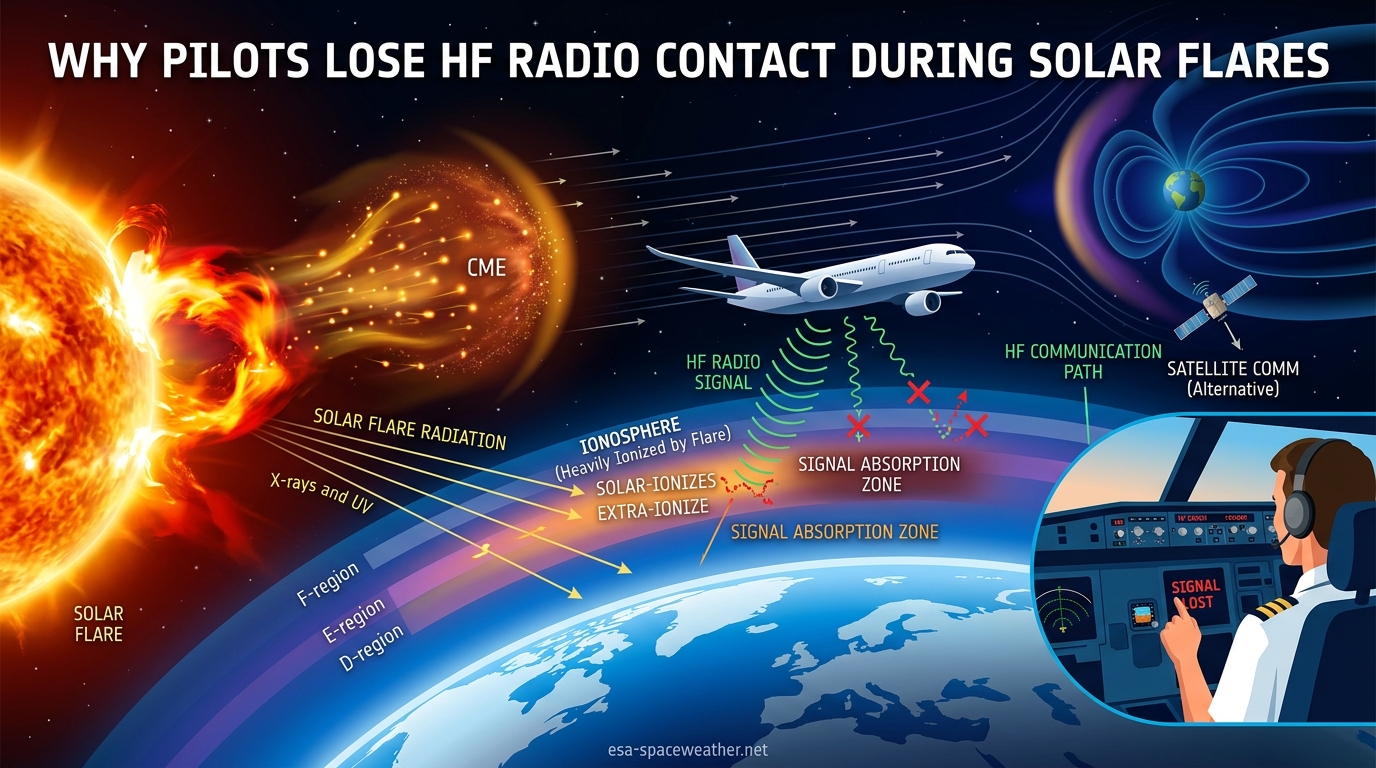
Imagine cruising at 38,000 feet over the North Atlantic, hours from the nearest land-based radio tower, when your high-frequency (HF) radio suddenly goes silent. No static, no atmospheric noise, just nothing. You switch frequencies, try backup bands, and still get nothing. This is not a equipment failure. The Sun has just unleashed a solar flare, and the ionosphere above you is now swallowing every HF signal you transmit.
This scenario is not science fiction. It happens regularly during periods of high solar activity, and understanding why pilots lose HF radio contact during solar flares is one of the most practically important topics in aviation space weather. Every commercial pilot flying transoceanic routes, every dispatcher planning polar crossings, and every air traffic controller managing oceanic airspace needs to understand this phenomenon.
Our team has analyzed data from NOAA’s Space Weather Prediction Center, real pilot discussions from aviation forums, and decades of space weather research to break down exactly what happens when a solar flare knocks out HF communication. We will cover the physics behind D-layer absorption, the NOAA R-scale blackout classification, which frequencies die first, how long blackouts last, and what pilots can actually do when the radio goes dead.
Whether you are a commercial airline pilot, a flight dispatcher, a ham radio operator who also flies, or simply someone fascinated by space weather, this guide will give you the complete picture of how solar activity disrupts aviation communication and what can be done about it.
Table of Contents
The Short Answer
Pilots lose HF radio contact during solar flares because intense X-ray radiation from the Sun dramatically increases ionization in the D-layer of Earth’s ionosphere (60 to 90 km altitude). This surge in electron density causes HF radio signals in the 3 to 30 MHz range to be absorbed rather than reflected back to Earth, creating a radio blackout on the sunlit side of the planet that can last from minutes to several hours.
What Are Solar Flares?
Solar flares are sudden, intense bursts of electromagnetic radiation from the Sun’s surface, typically originating in magnetically active regions around sunspots. They release energy across the entire electromagnetic spectrum, but it is the X-ray and extreme ultraviolet (EUV) radiation that causes radio disruptions on Earth.
The energy released in a single major solar flare can be equivalent to millions of 100-megaton hydrogen bombs detonating simultaneously. That energy travels outward in all directions at the speed of light, reaching Earth in approximately eight minutes.
NOAA classifies solar flares by their peak X-ray flux measured in the 0.1 to 0.8 nanometer band by GOES satellites. The classification system uses five letter categories, each representing a tenfold increase in energy over the previous one.
- A-class: Background level, no noticeable effects on radio
- B-class: Very small flares, minimal impact
- C-class: Small flares, minor HF degradation possible
- M-class: Medium flares, brief radio blackouts on the dayside
- X-class: Major flares, significant to complete HF blackout possible
Each letter class is further divided on a linear scale from 1 to 9. An M5 flare is five times more powerful than an M1, and an X2 flare is twice as powerful as an X1. The most powerful flare ever recorded was an estimated X28 during the 2003 Halloween storms, which saturated the GOES sensors.
What Happens to HF Radio During a Solar Flare?
The answer to why pilots lose HF radio contact during solar flares begins with a chain of events that takes just eight minutes to unfold. When a powerful solar flare erupts on the Sun, its X-ray radiation crosses the 150 million kilometers to Earth at light speed and slams into the upper atmosphere.
Under normal conditions, HF radio signals travel long distances by bouncing off the ionosphere and reflecting back to Earth, a process called skywave propagation. This is what allows pilots over the middle of the Pacific Ocean to communicate with controllers thousands of kilometers away. Without this reflective layer, HF signals would shoot straight into space and be lost.
During a solar flare, the increased X-ray flux fundamentally changes the ionosphere’s behavior. The normally weak D-layer at the bottom of the ionosphere suddenly becomes extremely dense with free electrons. Instead of reflecting HF signals, this enhanced D-layer absorbs them completely. The signal energy is dissipated through collisions between the oscillating electrons and surrounding neutral gas molecules.
This phenomenon is known as a Sudden Ionospheric Disturbance, or SID. It is also called a shortwave fadeout (SWF) because the effect is a sudden, simultaneous collapse of HF signals across multiple frequency bands. Pilots often describe it as an eerie silence where normally busy oceanic HF frequencies go completely dead.
One critical characteristic of SID-related blackouts is that they only affect the sunlit hemisphere. If your flight is on the night-side of Earth, HF communication continues normally because the D-layer dissipates without solar X-ray input. The day-night terminator, the line separating day from night on the planet’s surface, becomes the boundary between communication and silence.
Another important feature is that there is no warning. Because X-rays travel at the speed of light, the radio blackout arrives at the exact same moment as the first indication that a flare has occurred. Unlike geomagnetic storms, which arrive one to three days after the flare, X-ray blackouts are instantaneous. Pilots and dispatchers cannot react in advance. They can only respond once the blackout has already begun.
The Science: How Solar Flares Disrupt the Ionosphere
To understand the mechanism behind HF radio blackouts, we need to look at the ionosphere itself. The ionosphere is a region of Earth’s upper atmosphere spanning roughly 60 to 1,000 km altitude where solar radiation ionizes atmospheric gases, creating a layer of free electrons and ions.
The Ionosphere: Earth’s Radio Mirror
The ionosphere is divided into several distinct layers, each with different properties and behaviors. These layers form because different wavelengths of solar radiation penetrate to different depths in the atmosphere before being absorbed.
The D-layer sits at the bottom, between 60 and 90 km altitude. Under normal daytime conditions, it is weakly ionized by solar Lyman-alpha radiation and a small amount of soft X-rays. At night, with no solar input, the D-layer essentially disappears as ions and electrons recombine. The D-layer is normally a minor nuisance for HF radio, causing some signal absorption during daytime hours.
The E-layer, from 90 to 150 km, is more strongly ionized and can reflect medium-frequency HF signals. It is most useful during the day and weakens significantly after sunset.
The F-layer is the most important for long-distance HF communication. During the day, it splits into two sub-layers: the F1 layer at 150 to 220 km and the F2 layer at 220 to 500 km. The F2 layer has the highest electron density in the ionosphere and is responsible for reflecting HF signals over transcontinental and transoceanic distances. It persists at night, though at reduced intensity.
Under normal conditions, an HF signal from an aircraft over the ocean travels upward, passes through the weakly absorbing D-layer, reflects off the F2 layer, and returns to Earth hundreds or thousands of kilometers away. This is the mechanism that makes long-distance aviation communication possible.
The D-Layer: The Hidden Culprit Behind Radio Blackouts
During a solar flare, everything changes at the D-layer level. The intense X-ray burst penetrates to 60 to 90 km altitude and violently ionizes the neutral nitrogen and oxygen molecules there. Electron density in the D-layer can increase by a factor of 10 to 100 within seconds.
This is the key to why pilots lose HF radio contact during solar flares. The D-layer transforms from a thin, weakly absorbing region into a thick, opaque barrier. It now sits directly below the F2 layer and blocks HF signals from ever reaching the reflective layer they depend on for long-distance propagation.
Think of it like a one-way mirror flipping its polarity. Under normal conditions, HF signals pass through the D-layer with minimal loss and bounce off the F2 layer above. During a flare, the D-layer becomes a wall that absorbs the signal before it can reach the reflecting layer above.
The process involves a phenomenon called collision frequency. In the dense lower atmosphere at D-layer altitudes, there are still significant numbers of neutral gas molecules. When solar X-rays create a surge of free electrons, those electrons begin oscillating in response to passing radio waves. As they oscillate, they collide with neutral molecules, transferring the radio wave’s energy into heat. The signal is literally converted into thermal energy and lost.
This is different from what happens at higher altitudes. In the F2 layer, the atmospheric density is so low that electrons can oscillate freely without colliding with anything. Radio waves pass through or reflect without energy loss. The D-layer’s proximity to denser atmosphere is what makes it destructive to HF signals during solar flares.
How the D-Layer Absorbs HF Radio Signals
The absorption of HF radio signals in an enhanced D-layer follows a specific mathematical relationship known as the f-squared law. This principle is central to understanding which frequencies survive and which disappear during a solar flare blackout.
The f-squared law states that D-layer absorption is inversely proportional to the square of the radio frequency. In practical terms, lower frequencies experience dramatically more absorption than higher frequencies. An HF signal at 5 MHz might be completely absorbed while a signal at 20 MHz sails through relatively unscathed.
This means that during a moderate solar flare, lower HF bands go dark first while higher bands may continue to work. A pilot who knows this principle can sometimes restore communication by switching to a higher frequency band, though during strong events even the highest HF frequencies become unusable.
The absorption formula can be simplified as follows: if you double the frequency, the absorption drops by a factor of four. This is why 160-meter and 80-meter amateur bands are the first to fail during a flare, while 10-meter and 15-meter bands can survive moderate events. For aviation, the relevant HF frequencies used for oceanic communication span from about 2.8 MHz to 18 MHz, meaning the full range of operational frequencies can be affected by large flares.
Ham radio operators who are also pilots describe this pattern firsthand in online forums. The consistent observation is that during a Sudden Ionospheric Disturbance, the lower bands die within seconds while the higher bands may hold on for minutes or survive the event entirely. This real-world experience perfectly matches the theoretical predictions of the f-squared law.
The NOAA Radio Blackout Scale (R-Scale)
NOAA’s Space Weather Prediction Center uses a standardized five-level scale to classify radio blackout severity. The NOAA R-scale, officially called the Space Weather Scale for Radio Blackouts, runs from R1 (Minor) to R5 (Extreme) and provides a common language for communicating the severity of HF communication disruptions.
R1 (Minor) Through R5 (Extreme) Severity Levels
Each level on the R-scale corresponds to a specific flare class, X-ray flux level, and expected impact on HF communication. Understanding these levels helps pilots and dispatchers assess the operational risk during solar events.
R1 (Minor): Associated with M1-class flares and X-ray flux levels of 0.0001 to 0.0005 milliwatts per square centimeter in the 0.1 to 0.8 nm band. At this level, weak or brief degradation of HF radio communication occurs on the sunlit side of Earth. There may be occasional loss of radio contact on the lowest HF frequencies. For most pilots, operations continue normally with minor inconvenience.
R2 (Moderate): Triggered by M5-class flares with flux levels of 0.0005 to 0.001 mW/cm2. Limited blackout of HF radio communication occurs on the sunlit side, lasting about 10 minutes. Some loss of contact on lower HF bands for sunlit routes, but higher frequencies typically remain functional. Transoceanic pilots may need to switch to backup frequencies.
R3 (Strong): Caused by X1-class flares with flux of 0.001 to 0.002 mW/cm2. This produces a wide-area blackout of HF radio communication on the sunlit side, lasting about an hour. Significant degradation across most HF bands for flights on the dayside hemisphere. Pilots may experience partial to complete loss of HF contact with oceanic ATC.
R4 (Severe): Associated with X10-class flares and flux levels of 0.002 to 0.01 mW/cm2. HF radio communication blackout occurs across most of the sunlit side of Earth, lasting one to two hours. Near-complete loss of HF communication for all dayside aviation routes. SATCOM becomes the primary communication method. Polar route disruption is likely.
R5 (Extreme): Triggered by X20-class flares or larger with flux exceeding 0.01 mW/cm2. Complete HF radio blackout on the entire sunlit side of Earth lasting two to four hours or longer. All HF communication is lost for flights on the dayside hemisphere. This level is rare but has occurred during major events like the 2003 Halloween storms and the 1989 March storm.
For aviation operations, the practical threshold where serious disruption begins is R3. At R1 and R2, experienced pilots can manage with frequency changes and minor delays. At R3 and above, operational impact becomes significant and dispatch teams need to consider route adjustments, particularly for flights crossing the dayside Atlantic or Pacific.
Which HF Frequency Bands Are Most Affected?
The frequency-dependent nature of D-layer absorption means that not all HF bands suffer equally during a solar flare. Understanding which frequencies are most vulnerable helps pilots make informed decisions about frequency selection during degraded conditions.
Frequency-Dependent Absorption: The f-Squared Law in Practice
The relationship between frequency and absorption follows the inverse-square law mentioned earlier. Here is how different HF bands typically respond during a moderate to strong solar flare event.
Lower frequencies (2 to 5 MHz, corresponding to aviation bands near the bottom of the HF range) are hit hardest. These frequencies experience maximum absorption and are typically the first to go completely silent. Even during minor R1 events, degradation may be noticeable on these bands.
Mid-range frequencies (5 to 10 MHz) suffer significant degradation during moderate events. This range includes some of the primary aviation oceanic frequencies used for transatlantic and transpacific communication. During R3 or stronger events, these frequencies may become completely unusable.
Higher frequencies (10 to 18 MHz) are more resilient but not immune. They may continue to function during R1 and R2 events and partially survive R3 events. However, during R4 and R5 blackouts, even these bands can be absorbed entirely by an extremely enhanced D-layer.
Above approximately 30 MHz, signals enter the VHF range and are no longer affected by D-layer absorption in the same way. However, VHF is line-of-sight only, meaning it cannot be used for long-distance communication beyond the visible horizon. This is why HF radio remains essential for oceanic operations despite its vulnerability to space weather.
Why Lower Bands Die First During a Blackout
The physics behind why lower HF frequencies fail first comes down to how radio waves interact with free electrons in the ionosphere. Lower frequency signals have longer wavelengths, which means they cause electrons to oscillate through larger arcs. These larger oscillations result in more frequent and more energetic collisions with neutral gas molecules.
At higher frequencies, the shorter wavelength means electrons move through smaller arcs and experience fewer collisions per cycle. Less collision frequency means less energy is transferred from the radio wave to the surrounding atmosphere, so more signal survives.
For pilots, the practical takeaway is clear. If you notice HF communication degrading, try switching to a higher frequency band before assuming your equipment has failed. This is standard advice from experienced oceanic pilots who have lived through multiple solar flare events.
However, there is a practical limit. At very high HF frequencies, the Maximum Usable Frequency (MUF) becomes the limiting factor. The MUF is the highest frequency that the F2 layer can reflect back to Earth for a given communication path. If you go too high in frequency, the signal punches through the ionosphere entirely and disappears into space. During a flare, the usable frequency window between D-layer absorption (bottom limit) and MUF (top limit) can narrow dramatically or close entirely.
Why Pilots Are Particularly Vulnerable
Solar flares affect everyone who uses HF radio, from ham radio operators to military communications to maritime shipping. But pilots face a unique set of vulnerabilities that make HF radio blackouts especially dangerous for aviation operations.
HF Radio as Primary Communication on Transoceanic Routes
Over land, pilots communicate with air traffic control using VHF radio, which provides clear, reliable line-of-sight communication to ground stations. But VHF signals only travel in straight lines and cannot follow the curvature of the Earth beyond about 200 nautical miles from the transmitter.
Over the oceans, there are no ground stations within VHF range for most of the flight. A aircraft crossing the Atlantic, Pacific, or Indian Ocean depends on HF radio to maintain contact with oceanic air traffic control centers. HF signals bounce off the ionosphere, allowing communication over distances of thousands of kilometers.
Satellite communication (SATCOM) has become increasingly common on modern aircraft and provides an alternative to HF. However, SATCOM is not universally available on all aircraft, and it can be affected by certain types of space weather as well. HF radio remains the mandatory backup communication system required by international aviation regulations for all transoceanic flights.
When a solar flare knocks out HF, pilots on oceanic routes can find themselves in a communication gap. If SATCOM is available, they can switch to satellite. But if SATCOM is also degraded or unavailable, the aircraft may be left with no real-time communication link to ATC for the duration of the blackout.
From pilot forums, the consensus is clear. Pilots on transoceanic routes are acutely aware of HF radio dependency and treat space weather forecasts as an important part of their pre-flight planning, even if formal training on the topic is limited.
Polar Routes and High-Latitude Operations
Flights operating on polar routes face an even greater risk from space weather. Cross-polar routes connecting North America with Asia and Europe have become increasingly common because they offer shorter flight times and significant fuel savings. But these routes pass through regions where space weather impacts are most severe.
The polar regions are particularly vulnerable for two reasons. First, the Earth’s magnetic field funnels solar energetic particles toward the poles, creating additional ionospheric disturbances beyond what solar flare X-rays cause alone. This leads to Polar Cap Absorption (PCA) events, which can extend radio blackouts for hours or even days after the initial flare.
Second, the availability of satellite communication is reduced at high latitudes. Many satellite communication systems use geostationary satellites that orbit above the equator. From a position near the North Pole, these satellites are barely above the horizon, and their signals can be unreliable or unavailable.
Dispatchers and route planners closely monitor space weather conditions when polar routes are in use. During significant solar events, airlines routinely reroute polar flights to lower latitudes, adding hours of flight time and thousands of dollars in fuel costs. The 2003 Halloween Storms caused widespread polar route disruptions, and the experience prompted airlines to develop more robust space weather contingency protocols.
Some experienced pilots on polar routes have described the experience of HF blackout in forums. The pattern is consistent: signals vanish suddenly across all HF bands, SATCOM may degrade, and the aircraft is temporarily isolated from ground communication. These pilots emphasize the importance of staying calm, maintaining the flight plan, and monitoring for recovery of HF bands as the flare subsides.
How Long Do Radio Blackouts Last?
The duration of an HF radio blackout depends primarily on the intensity of the solar flare and how long the X-ray flux remains elevated. Because the D-layer responds almost instantly to changes in solar X-ray input, recovery tracks closely with the flare’s decay.
For R1 (Minor) events, HF degradation typically lasts 10 to 30 minutes. Lower bands may be affected while higher bands continue to work with minor signal loss.
For R2 (Moderate) events, partial blackout conditions last approximately 30 to 60 minutes. Most HF bands are degraded on the sunlit side, with gradual recovery beginning once the flare’s X-ray output begins to decline.
For R3 (Strong) events, significant blackout conditions persist for one to three hours. Nearly all HF bands are unusable on the dayside during peak intensity, with higher bands recovering first as X-ray flux decreases.
For R4 and R5 (Severe to Extreme) events, complete HF blackout can last three to six hours or occasionally longer. Full recovery may take additional time as the D-layer slowly returns to its pre-flare state.
It is important to note that recovery is gradual, not sudden. As the flare’s X-ray flux decays, the D-layer electron density decreases, and absorption lessens. Higher frequencies become usable first, followed progressively by lower frequencies. Pilots monitoring for recovery should check higher HF bands first and work downward.
The blackout is also limited to the sunlit hemisphere. As Earth rotates, a region that was on the day-side during the flare will eventually rotate into darkness. Once the D-layer is no longer illuminated by solar X-rays, it dissipates within minutes to tens of minutes, and normal HF propagation resumes.
Beyond the Flare: Proton Events and Polar Cap Absorption
The X-ray-induced radio blackout described so far is not the only space weather threat to HF communication. A separate and potentially longer-lasting disruption comes from solar energetic proton (SEP) events, which can cause Polar Cap Absorption (PCA).
While X-rays travel at the speed of light and cause immediate blackouts, solar energetic protons are charged particles that travel much slower, typically reaching Earth within 30 minutes to several hours after a major flare. These protons are guided by Earth’s magnetic field toward the polar regions, where they ionize the D-layer at altitudes of 50 to 90 km.
The result is an extended D-layer absorption event focused on the polar caps. Unlike X-ray blackouts, which only affect the sunlit hemisphere, PCA events can affect both the day and night sides of the polar regions. This makes them particularly dangerous for polar aviation routes.
PCA events can last from hours to days. Minor PCA events may last 6 to 12 hours, while major events associated with large proton storms can persist for 2 to 5 days. The 2003 Halloween Storms produced a massive PCA event that disrupted polar HF communication for nearly a week.
For aviation, this distinction matters enormously. A pilot on a transatlantic route might experience a brief HF blackout from an X-class flare and recover within a couple of hours. But a pilot on a polar route during a major proton event could face extended communication disruptions lasting the entire duration of their flight and beyond.
NOAA tracks these proton events through its GOES satellite particle detectors and issues advisories when proton flux exceeds threshold levels. The NOAA Space Weather Scales include a separate S-scale (S1 through S5) for solar radiation storms, which corresponds to the severity of proton events and their associated PCA risk.
Historical Examples of Aviation HF Disruption
To understand the real-world impact of solar flare radio blackouts on aviation, it helps to look at documented events. These case studies illustrate the operational consequences and show why space weather preparedness matters for the aviation industry.
The 2003 Halloween Storms: In late October and early November 2003, the Sun produced a series of powerful solar flares, including an estimated X28-class event on November 4 that saturated the GOES X-ray sensors. These flares caused widespread HF radio blackouts across the sunlit hemisphere and triggered a massive solar radiation storm that produced extended Polar Cap Absorption. Airlines were forced to reroute polar flights to lower latitudes for several days, with some carriers reporting additional fuel costs exceeding $100,000 per diverted flight. This event is frequently cited as the wake-up call that prompted the aviation industry to take space weather seriously.
September 2017 Solar Events: During an active period in early September 2017, the Sun produced a series of X-class flares, including an X9.3 event on September 6 and an X8.2 event on September 10. These flares caused significant HF radio blackouts and disrupted communication for aircraft operating on sunlit transatlantic and transpacific routes. Of particular note, the communication disruptions coincided with hurricane relief operations in the Caribbean following Hurricanes Irma and Maria. Emergency communication channels relied on HF radio, and the solar flare blackouts complicated coordination of disaster response aircraft operating in the region.
Solar Cycle 25 Activity: As Solar Cycle 25 progressed toward its maximum, several notable events demonstrated that HF disruption remains an ongoing concern. M-class and X-class flares during active periods in 2023 and 2024 caused repeated R2 and R3 radio blackouts affecting transoceanic aviation routes. These events served as practical reminders that even with modern satellite communication systems, HF radio remains a critical vulnerability during space weather events.
One consistent theme from these historical events is that the aviation community is often caught off guard by the suddenness of HF blackouts. Because X-ray-induced blackouts arrive with no warning, the emphasis has shifted toward improving real-time monitoring and developing better operational response protocols rather than trying to predict individual flare events.
Solar Cycle Context: When Is Risk Highest?
Solar activity follows an approximately 11-year cycle known as the solar cycle, alternating between periods of high activity (solar maximum) and low activity (solar minimum). Understanding where we are in the solar cycle helps pilots and dispatchers assess their long-term risk profile for HF radio disruptions.
During solar minimum, the Sun is relatively quiet. Few sunspots are visible, solar flares are rare, and HF radio operates with minimal space weather interference. During these periods, pilots may go months or years without experiencing a significant solar flare-related blackout.
During solar maximum, the situation reverses dramatically. Sunspot numbers peak, multiple active regions can produce flares simultaneously, and M-class and X-class flares become weekly or even daily occurrences. During the peak of a solar cycle, pilots on oceanic routes can expect to encounter minor to moderate HF degradation on a regular basis and should be prepared for occasional significant blackouts.
Solar Cycle 25 began in late 2019 and has been progressing toward its maximum, expected in the 2026 timeframe. This means that aviation operations in the current period face elevated space weather risk compared to the relatively quiet years of the previous solar minimum. Flight planning that includes space weather awareness is particularly important during this active phase.
It is worth noting that the severity of individual flares does not always correlate perfectly with the solar cycle phase. Major X-class flares can occur outside of solar maximum, though they are less frequent. The 2017 September flares, for example, occurred during the declining phase of Solar Cycle 24 but were among the strongest of that cycle.
What Pilots and Dispatchers Can Do
While solar flare HF blackouts cannot be prevented, their operational impact can be significantly reduced through preparation, monitoring, and established response procedures. Here is a practical guide for aviation professionals.
Operational Strategies During Blackouts
If you experience sudden loss of HF communication during daylight hours, consider the possibility of a solar flare blackout. Check multiple HF frequencies before assuming equipment failure. If all bands are dead, switch to the highest available HF frequency, as higher bands are last to be affected and first to recover.
If HF remains unavailable, switch to satellite communication (SATCOM) if your aircraft is equipped. SATCOM is not affected by solar flare X-ray radiation and provides reliable communication independent of the ionosphere. Instruct dispatch to relay position reports and ATC instructions via satellite.
If SATCOM is also unavailable or degraded, follow established procedures for loss of communication. Squawk 7600 on your transponder, continue on your filed flight plan, and monitor emergency frequencies. Maintain your last assigned altitude and route unless safety requires deviation.
Monitor for HF recovery by periodically checking higher HF frequencies. Recovery typically begins at the highest bands and progresses downward. Once a usable frequency is found, re-establish contact with the appropriate oceanic ATC frequency and resume normal position reporting.
For dispatchers, the key strategy is advance awareness. Monitor space weather forecasts during flight planning and brief crews on expected HF conditions for their route. If a significant solar event is in progress or expected, consider whether route modifications or timing adjustments are warranted, particularly for polar operations.
Monitoring Tools: D-RAP, GOES X-Ray Flux, and ICAO Advisories
Several tools are available for monitoring space weather conditions that affect HF radio communication. Knowing how to access and interpret these resources is essential for both pilots and dispatchers.
The NOAA D-RAP (D-Region Absorption Prediction) model is the primary tool for assessing real-time D-layer absorption conditions. D-RAP displays a global map showing the predicted absorption impact on HF radio signals at different frequencies. It updates continuously and shows both the geographic extent and severity of absorption events. For aviation users, D-RAP provides a quick visual assessment of whether HF communication is likely to be affected along a planned route.
The GOES X-ray flux monitor provides real-time measurements of solar X-ray output in the 0.1 to 0.8 nm band. This is the data that determines solar flare classification (A, B, C, M, X). NOAA’s SWPC website displays a live X-ray flux plot that shows flare events as they happen. A sudden spike on this plot corresponds to the beginning of an HF radio blackout on the sunlit hemisphere.
ICAO, the International Civil Aviation Organization, operates a space weather advisory system that provides aviation-specific space weather information. These advisories are issued by designated space weather centers and follow a standardized format that pilots and dispatchers can quickly interpret. The advisories cover HF communication degradation, satellite navigation errors, and radiation hazards. While the system is relatively new compared to traditional meteorological advisories, it represents an important step toward integrating space weather into standard aviation operations.
The NOAA SWPC website also provides a three-day forecast of space weather conditions, including predicted R-scale levels. While this forecast cannot predict individual solar flares (because flares are inherently unpredictable on timescales shorter than hours), it does identify periods when active sunspot regions are facing Earth and the probability of flare activity is elevated.
For practical use, dispatch teams should incorporate space weather monitoring into their daily flight planning routine. Checking D-RAP, the GOES X-ray flux plot, and any active ICAO space weather advisories should be as routine as checking surface weather conditions at destination airports.
FAQs
Do solar flares affect radio signals?
Yes. Solar flares emit bursts of X-ray radiation that reach Earth in about 8 minutes and dramatically increase ionization in the D-layer of the ionosphere. This causes HF radio signals in the 3 to 30 MHz range to be absorbed rather than reflected, resulting in a radio blackout on the sunlit side of the planet lasting from minutes to several hours.
How do solar flares affect airline pilots?
Solar flares can cause partial or complete loss of HF radio communication for pilots, especially on transoceanic and polar routes where VHF line-of-sight radio cannot reach ground stations. During an R3 or stronger radio blackout, pilots on the sunlit side of Earth may lose all HF contact with air traffic control, forcing reliance on satellite communication or pre-filed flight plans.
Would radios work after a solar flare?
Yes, HF radio communication recovers after a solar flare passes. Recovery time depends on flare intensity: R1 blackouts last 10 to 30 minutes, R2 lasts 30 to 60 minutes, R3 lasts 1 to 3 hours, and R4 to R5 events can persist for 3 to 6 hours or longer. Higher HF frequency bands recover first, followed progressively by lower bands.
What is D-layer absorption?
D-layer absorption is the process where increased ionization in the lowest layer of the ionosphere (60 to 90 km altitude) absorbs HF radio signals instead of allowing them to reflect off higher layers. During a solar flare, X-ray radiation causes electron density in the D-layer to spike by a factor of 10 to 100, transforming it from a weak absorber into an opaque barrier that swallows HF signals.
How long does HF radio blackout last?
HF radio blackout duration depends on the NOAA R-scale severity level. R1 (Minor) events last about 10 to 30 minutes, R2 (Moderate) last 30 to 60 minutes, R3 (Strong) last 1 to 3 hours, R4 (Severe) last 1 to 2 hours of complete blackout, and R5 (Extreme) can cause total HF blackout for 2 to 4 hours or more on the sunlit hemisphere.
Do solar flares affect VHF radio on airplanes?
No, solar flares do not directly affect VHF radio communication on aircraft. VHF frequencies (118 to 137 MHz) are well above the HF range and are not absorbed by the D-layer during solar flare events. However, VHF is limited to line-of-sight range of about 200 nautical miles, so it cannot replace HF radio for long-distance oceanic communication where HF blackout impact is most severe.
Conclusion
Understanding why pilots lose HF radio contact during solar flares comes down to one fundamental mechanism: solar X-ray radiation supercharges the D-layer of the ionosphere, transforming it from a thin, weakly absorbing region into a thick barrier that swallows HF signals in the 3 to 30 MHz range. This process happens in eight minutes, affects only the sunlit hemisphere, and can last anywhere from minutes to hours depending on flare intensity.
For pilots flying transoceanic and polar routes, this is not an abstract scientific concept. It is an operational reality that can silence their primary communication link without warning. The key to managing this risk is awareness, preparation, and knowing what tools and procedures are available when the radio goes quiet. By monitoring space weather forecasts, understanding the NOAA R-scale, and having backup communication strategies in place, aviation professionals can navigate solar flare HF blackouts with confidence and keep their flights safe.