
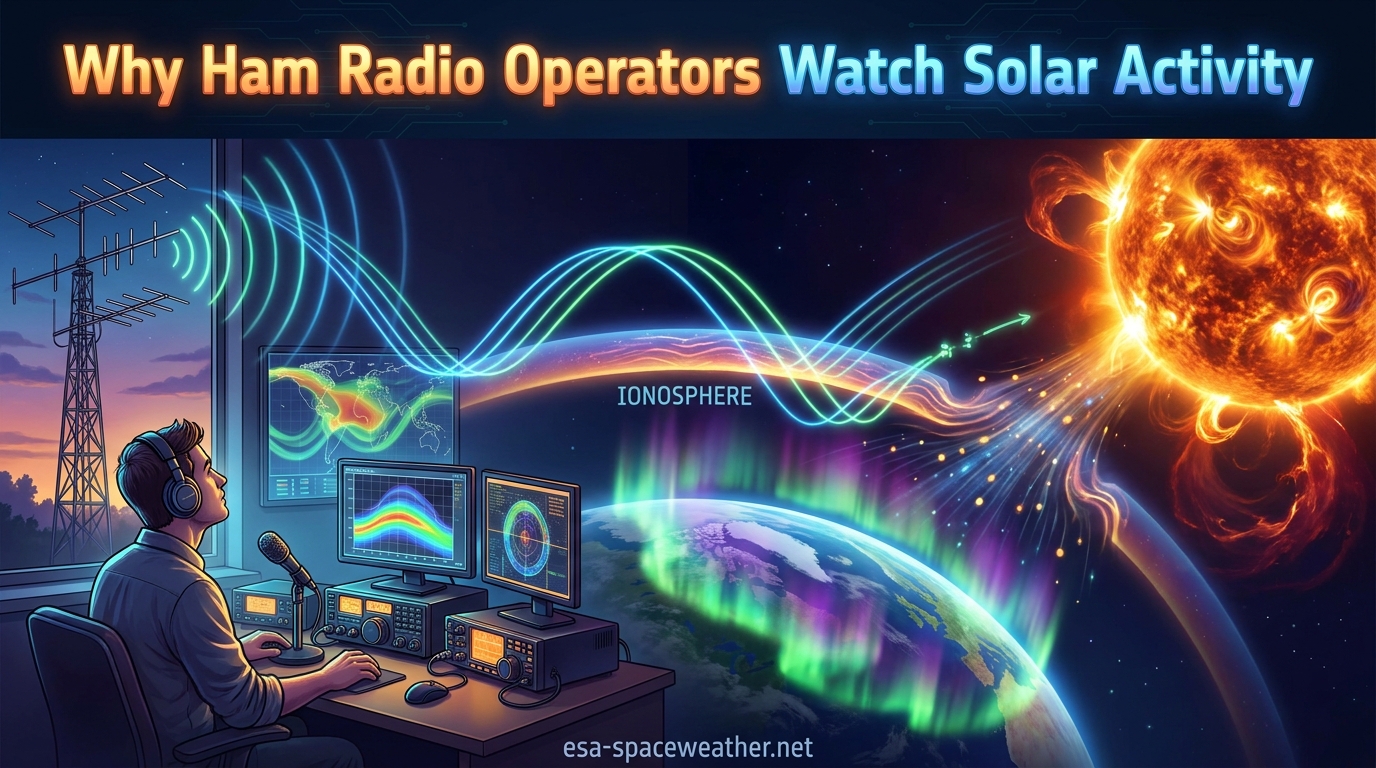
Ham radio operators watch solar activity before going on the air because the Sun’s radiation directly controls the ionosphere, the charged layer of Earth’s upper atmosphere that reflects radio signals back toward the ground for long-distance communication. When solar activity shifts, the ionosphere changes within minutes to hours, opening some frequency bands while closing others.
I learned this lesson the hard way years ago. I spent an entire afternoon calling CQ on 10 meters during what I assumed was a great opening, only to discover later that a geomagnetic storm had rolled in and wiped out the band entirely. That day I started checking space weather data before every operating session, and the difference in my DX success rate was night and day.
Understanding why ham radio operators watch solar activity before going on the air transforms radio from a hobby of chance into a hobby of informed strategy. This guide breaks down the science behind solar-driven propagation, explains every key index you need to monitor, and gives you a practical pre-operating checklist you can use starting today. Whether you are chasing rare DX contacts, preparing for a contest weekend, or running emergency communications, the Sun is your most important variable.
Table of Contents
How the Ionosphere Connects the Sun to Your Radio
The ionosphere is a region of Earth’s upper atmosphere, sitting roughly 30 to 260 miles above the surface, where solar ultraviolet and X-ray radiation strip electrons from gas molecules. This creates a layer of free electrons and ions that can refract, or bend, high-frequency (HF) radio signals back toward Earth. Without the ionosphere, your HF signal would shoot straight into space and your long-distance contacts would be impossible.
The ionosphere has several distinct layers, and each one responds to solar input differently:
D-Layer (30 to 60 miles): This lowest ionospheric layer forms during daylight hours when the Sun is up. It absorbs low-frequency HF signals, which is why the 160-meter and 80-meter bands go quiet during the day. At night, the D-layer dissipates and those lower bands open up for thousands of miles.
E-Layer (60 to 70 miles): The E-layer reflects signals in the lower HF range and sometimes VHF during seasonal sporadic E events. It follows a strong day-night cycle, peaking at local noon.
F-Layer (90 to 260 miles): This is the workhorse of HF propagation. During the day, the F-layer splits into two sub-layers called F1 and F2. The F2 layer is the highest and most ionized, and it is responsible for bouncing signals on the 20-meter, 15-meter, 12-meter, and 10-meter bands across continents and oceans. At night, the F1 and F2 layers merge into a single F-layer.
Here is what makes this relevant to your operating decisions: the F2 layer’s ionization level depends almost entirely on solar activity. More solar radiation means more ionization, which means higher frequencies can be refracted back to Earth. During periods of high solar activity, the 10-meter band can stay open for global contacts well past sunset. During solar minimum, that same band goes dead.
This is why experienced operators treat the Sun as a real-time band condition indicator. When solar radiation increases, the ionosphere becomes a better reflector for higher frequencies. When a solar flare erupts, the sudden burst of X-rays can supercharge the D-layer and absorb signals across entire HF bands in a matter of minutes.
The 11-Year Solar Cycle: Solar Minimum vs Solar Maximum
The Sun does not produce a constant output of energy and radiation. It follows an approximately 11-year cycle of rising and falling activity, driven by the winding and unwinding of its magnetic field. During this cycle, sunspot counts, solar flare frequency, and overall solar radiation swing between extremes.
At solar minimum, sunspots are rare or absent, solar radiation drops to its lowest levels, and the F2 layer becomes weakly ionized. The higher HF bands (10m, 12m, 15m) close down for long-distance work. Operators during solar minimum rely heavily on 40 meters and 80 meters, where signals can still reflect off the less-ionized ionosphere, especially at night.
At solar maximum, sunspots appear in large numbers, solar radiation surges, and the F2 layer becomes densely ionized. The 10-meter band opens for worldwide contacts, sometimes lasting all day. Even operators running very low power (QRP) with simple wire antennas can work stations thousands of miles away.
Solar Cycle 25 began in late 2019 and reached its peak around 2026. Activity has been significantly stronger than early predictions forecasted, giving operators some of the best HF propagation conditions in over a decade. According to NOAA and the Royal Observatory of Belgium, sunspot numbers during this cycle exceeded prediction models, making the current period particularly rewarding for DX hunters.
Here is a quick comparison of conditions across different cycle phases:
| Condition | Sunspots | SFI Range | Best Bands Open | DX Potential |
|---|---|---|---|---|
| Solar Minimum | 0 to 20 | 65 to 75 | 40m, 80m, 30m | Limited on higher bands |
| Rising/Falling | 20 to 80 | 75 to 120 | 20m, 30m, 40m, occasional 15m | Moderate, improving |
| Solar Maximum | 80 to 200+ | 120 to 250+ | 10m, 12m, 15m, 17m, 20m | Excellent worldwide |
| Current (Cycle 25 Peak) | 100 to 180 | 130 to 200+ | 10m through 40m wide open | Very high |
The cycle position tells you which bands to expect. But day-to-day conditions depend on specific solar indices, which is what operators check before every session.
Key Solar Indices Every Ham Operator Should Know
Monitoring solar data means understanding a handful of numbers that summarize what the Sun is doing right now. These indices are published continuously by NOAA, broadcast over WWV, and displayed on dozens of ham radio websites and apps. Here are the ones that matter most.
Solar Flux Index (SFI)
The Solar Flux Index measures the radio noise the Sun emits at a wavelength of 10.7 centimeters (a frequency of 2800 MHz). This measurement correlates closely with sunspot activity and F2-layer ionization. Higher SFI means better conditions on the upper HF bands.
SFI below 70: Very poor for upper HF. Stick to 40m and 80m.
SFI 70 to 90: Marginal. 20m may work, higher bands unreliable.
SFI 90 to 120: Decent. 20m and 15m can produce good DX.
SFI 120 to 160: Good conditions. 10m and 12m start opening.
SFI above 160: Excellent. All HF bands from 10m through 20m can support worldwide contacts.
Sunspot Number (SSN)
The Sunspot Number counts visible dark spots on the Sun’s surface. More sunspots mean more magnetic activity, which means more solar radiation reaching the ionosphere. The Smoothed Sunspot Number (SSN) averages daily counts over 13 months to smooth out short-term fluctuations.
During Solar Cycle 25’s peak, daily sunspot counts have regularly exceeded 150, with some days pushing past 200. Compare that to solar minimum, where zero sunspots was the norm for weeks at a time.
K-Index
The K-index measures short-term geomagnetic disturbance on a scale from 0 to 9, updated every three hours at monitoring stations worldwide. It tells you how much Earth’s magnetic field is being disrupted by solar wind and coronal mass ejections.
K0 to K1: Quiet geomagnetic conditions. Excellent for HF, especially polar routes.
K2 to K3: Unsettled. Still workable but expect some signal flutter.
K4: Active. Higher bands may weaken, especially on north-south paths.
K5: Minor geomagnetic storm. HF conditions degrade noticeably on paths crossing auroral zones.
K6 to K7: Moderate storm. Many DX paths become difficult or impossible.
K8 to K9: Severe to extreme storm. HF blackout likely on most bands except the lowest.
A common mistake beginners make is assuming high SFI alone means great conditions. If the K-index is elevated (K4 or above), even a high SFI will not save your signal from absorption along polar paths.
A-Index
The A-index is the daily average of geomagnetic activity, derived from the eight daily K-index values. It provides a broader picture of the day’s overall geomagnetic stability. The A-index ranges from 0 to 400, though values above 50 indicate a significant storm.
A0 to A7: Quiet. Great HF conditions expected.
A8 to A15: Unsettled. Minor degradation on some paths.
A16 to A29: Active. Expect noticeable absorption on higher bands.
A30 to A49: Minor storm. DX work becomes challenging.
A50 to A99: Major storm. Stick to lower bands.
A100+: Severe storm. HF largely unusable except on 80m and 160m at night.
X-Ray Flux Classification
Solar flares are classified by their X-ray brightness using a lettered scale: A, B, C, M, and X. Each class is ten times stronger than the one before it.
A-class and B-class: Background flares with negligible effect on radio.
C-class: Minor flares. Brief enhancements possible on some bands.
M-class: Moderate flares. Can cause short-wave fadeouts on the dayside of Earth lasting minutes to hours.
X-class: Strong flares. Capable of causing widespread HF blackouts (Sudden Ionospheric Disturbances) and triggering geomagnetic storms if accompanied by a CME.
Here is a quick reference table combining all key indices for rapid band selection:
| SFI | K-Index | A-Index | Overall Conditions | Recommended Bands |
|---|---|---|---|---|
| Above 160 | 0 to 2 | 0 to 7 | Excellent | 10m, 12m, 15m wide open |
| Above 160 | 3 to 4 | 8 to 15 | Good but watch geomagnetics | 15m, 17m, 20m |
| 120 to 160 | 0 to 2 | 0 to 7 | Good | 15m, 17m, 20m, 12m occasional |
| 90 to 120 | 0 to 2 | 0 to 7 | Fair | 20m, 30m, 40m |
| 70 to 90 | 0 to 2 | 0 to 7 | Marginal | 30m, 40m, 80m at night |
| Any | 5 or above | 30+ | Poor (storm) | 40m, 80m, 160m (lower bands) |
How Solar Events Affect HF Propagation
Day-to-day solar indices tell you one story, but discrete solar events can change conditions in minutes. Understanding the four major types of solar disturbances helps you recognize what is happening when the bands suddenly go quiet.
Solar Flares and Sudden Ionospheric Disturbances (SIDs)
A solar flare releases a burst of X-rays and ultraviolet radiation that reaches Earth in about eight minutes. When this radiation hits the dayside ionosphere, it dramatically increases D-layer ionization. The result is a Sudden Ionospheric Disturbance, or SID, which absorbs HF signals on the sunlit side of the planet.
If you are in a QSO and the band suddenly drops out with no warning, check for recent solar flares. An M-class or X-class flare can cause a total HF blackout lasting 30 minutes to several hours on the dayside path. Nightside paths are unaffected because the D-layer is not illuminated.
Coronal Mass Ejections (CMEs) and Geomagnetic Storms
A coronal mass ejection is a massive eruption of plasma and magnetic field from the Sun’s surface. Unlike flares, CMEs take one to three days to reach Earth. When they arrive, they compress the magnetosphere and trigger geomagnetic storms, driving the K-index up and the A-index with it.
Geomagnetic storms cause the F2 layer to lose ionization and shift equatorward. This degrades HF propagation, especially on paths that cross the polar regions. Transatlantic and transpolar contacts become noisy or impossible. After a strong geomagnetic storm, it can take 24 to 48 hours for conditions to recover.
Coronal Holes and High-Speed Solar Wind
Coronal holes are darker, cooler regions of the Sun’s corona where magnetic field lines open outward, allowing high-speed solar wind to escape. These streams are not as dramatic as CMEs, but they are more common and more predictable. When a coronal hole stream reaches Earth, the K-index typically rises to 3 or 4 over the course of a day or two.
Coronal hole effects are usually moderate. Higher bands weaken slightly, but 20 meters and below remain usable. Operators who track coronal hole positions on the Sun can anticipate these disturbances several days in advance.
Polar Cap Absorption (PCA) Events
A Polar Cap Absorption event occurs when energetic protons from a major solar flare spiral along Earth’s magnetic field lines into the polar regions. These protons increase D-layer ionization over the poles, absorbing HF signals on any path that crosses high latitudes.
PCA events can last for days, making transpolar routes (such as North America to Europe via the great circle path) completely unusable. Operators may need to shift to longer, non-polar routing or wait for proton flux levels to subside.
Band Selection: Which Frequencies Work Best Under Different Solar Conditions
Choosing the right band for current conditions is where solar knowledge pays off. Here is a practical framework for matching frequency to solar state.
During high SFI (above 150) and low K-index (0 to 2): This is prime time for the upper HF bands. The 10-meter band (28 MHz) can deliver worldwide contacts from morning through late afternoon. The 12-meter and 15-meter bands offer strong daytime DX with excellent signal strength. The 17-meter band is a reliable all-day performer. Evening brings good 20-meter openings for contacts extending well past midnight.
During moderate SFI (90 to 150) and low K-index: Focus on 20 meters as your primary DX band. It opens after sunrise and often stays active well into the evening. The 15-meter band may open briefly around midday. The 30-meter band provides a stable option for digital modes and CW throughout the day.
During low SFI (below 90): The upper bands will likely be closed. Shift your attention to 40 meters during the day for regional contacts, and 80 meters at night when the D-layer dissipates. The 30-meter band often remains workable as a compromise frequency.
During a geomagnetic storm (K-index 5 or above): Higher bands will suffer from absorption and signal scatter. Switch to the lower bands, which are less affected by geomagnetic activity. The 40-meter band often remains usable during moderate storms, while 80 meters and 160 meters (at night) are your most reliable options. Avoid polar paths entirely.
Time of day matters as much as solar indices: The F2 layer strengthens during daylight hours and weakens at night. Daytime favors 10m through 20m. Nighttime favors 20m through 80m. The transition periods around sunrise and sunset often produce the best DX openings of the day, a phenomenon operators call the grayline.
Your Pre-Operating Solar Check Routine: A Step-by-Step Guide
No competitor article gives you a concrete, step-by-step routine for checking solar conditions before you transmit. This is the gap I wanted to fill. Here is the exact process I follow before every operating session, whether it is a casual evening on 20 meters or a serious DX-pedition weekend.
Step 1: Check the current SFI. Open NOAA SWPC or hamqsl.com and read the Solar Flux Index. If it is above 120, you have good conditions for the upper bands. If it is below 80, plan to operate on 40m or 80m instead.
Step 2: Check the K-index. Look at the current planetary K-index. If it is 0 to 2, conditions are geomagnetically quiet and you can expect clean signals. If it is 4 or above, expect degradation on higher bands and polar paths.
Step 3: Check the A-index. The daily A-index tells you if the day has been stormy overall. An A-index above 30 means a minor storm has been in progress, and recovery may still be underway.
Step 4: Check for recent solar flares. Look at the GOES X-ray flux data for the last 24 hours. Any M-class or X-class flare in recent hours may have caused shortwave fadeouts. If a large flare occurred within the last few hours, the dayside HF bands may still be recovering.
Step 5: Check for Earth-directed CMEs. Review NOAA’s CME forecast. If a CME impact is predicted within 24 to 48 hours, plan your operating accordingly. Get your DX contacts in before the storm arrives.
Step 6: Select your band based on the data. Use the Solar Conditions Quick Reference Table above to match the indices to the recommended bands.
Step 7: Monitor conditions while operating. Conditions can change during your session. Keep a browser tab open with live solar data or tune to WWV at the top of the hour for updated readings.
Here is a condensed checklist you can bookmark or print:
| Check | What to Look For | Action |
|---|---|---|
| SFI | Above 120 good, below 80 poor | Choose upper or lower bands |
| K-Index | 0 to 2 quiet, 5+ stormy | Avoid polar paths if elevated |
| A-Index | Below 15 calm, above 30 stormy | Lower bands if stormy |
| X-Ray Flux | M-class or X-class recent | Wait for recovery from SID |
| CME Forecast | Impact expected soon | Operate before arrival |
| Time of Day | Day favors high bands, night favors low | Match band to illumination |
| Band Noise Level | Listen before transmitting | Adjust frequency or band |
Sporadic E and Other Exceptions to the Solar Rule
Not all propagation depends on the solar cycle. Sporadic E propagation occurs when dense patches of ionization form in the E-layer at mid-latitudes, typically during late spring and summer. These patches can reflect signals on the 6-meter, 2-meter, and sometimes 10-meter bands, creating short but intense openings that have nothing to do with sunspot counts or SFI.
Sporadic E can produce contacts of 800 to 1,500 miles on VHF bands that normally only support line-of-sight communication. These openings are unpredictable but tend to cluster in May through August in the Northern Hemisphere. Operators who only check solar indices and skip the VHF bands during solar minimum are missing out on some of the most exciting propagation the hobby offers.
Auroral propagation is another exception. During geomagnetic storms, auroral ionization in the polar regions can reflect VHF and UHF signals. Operators in northern latitudes sometimes work contacts through the aurora, though signals have a distinctive raspy quality. While geomagnetic storms are generally bad for HF, they can briefly open unusual paths on higher frequencies.
The lesson here is that solar indices are your primary planning tool, but they are not the whole story. Stay alert for seasonal and event-driven propagation modes that defy the solar cycle.
Best Resources for Monitoring Space Weather
You do not need expensive equipment to track solar conditions. Here are the resources I and most experienced operators rely on.
NOAA Space Weather Prediction Center (swpc.noaa.gov): The authoritative source for SFI, K-index, A-index, solar flare data, and CME forecasts. Updated continuously with both current conditions and 3-day outlooks.
WWV and WWVH Time Signal Stations: Station WWV (Fort Collins, Colorado) broadcasts at 2.5, 5, 10, 15, and 20 MHz. At 18 minutes past the hour, WWV reads current geomagnetic conditions including the K-index and A-index. WWVH (Hawaii) does the same at 45 minutes past the hour. These broadcasts are accessible with any HF receiver.
hamqsl.com Solar Banner: A widely used widget that displays current SFI, sunspot number, A-index, K-index, X-ray background, and helium line in a single graphic. Many ham radio websites embed it, and there is a mobile-friendly version.
SolarHam.com: A popular ham radio space weather site that aggregates NOAA data, solar imagery, and propagation forecasts in a format specifically designed for amateur radio operators.
HamSCI (Ham Science Citizen Investigation): A citizen science project that connects amateur radio operators with professional space weather researchers. HamSCI gathers propagation data from operators to improve scientific understanding of ionospheric behavior.
Mobile Apps: Apps like Proton Flux, SpaceWeatherLive, and Ham Clock put real-time solar data on your phone or tablet, so you can check conditions before you even reach your shack.
Common Misconceptions About Solar Activity and Ham Radio
Over years of operating and participating in ham radio forums, I have noticed several myths that persist about solar activity and propagation. Let me address the most common ones.
Misconception: More solar activity is always better for ham radio. This is only partly true. High solar flux improves F2-layer ionization and opens upper HF bands. But high solar activity also means more solar flares, more CMEs, and more geomagnetic storms. A week with an SFI of 200 and a K-index of 2 is fantastic. A week with an SFI of 200 and a K-index of 7 is a disaster. The combination matters more than any single number.
Misconception: A high SFI guarantees good band conditions today. SFI is a general indicator of ionization potential, not a guarantee of real-time conditions. A high SFI paired with elevated geomagnetic activity still means poor propagation. Always check the K-index alongside SFI.
Misconception: Solar flares only hurt radio communications. Strong flares can actually enhance D-layer ionization on the dayside, briefly improving low-band propagation before absorption takes over. Some operators report brief signal enhancements during the initial phase of a flare event before the fadeout begins.
Misconception: The lower bands are always available regardless of solar conditions. The 40-meter and 80-meter bands are more resilient than the upper HF bands, but they are not immune. During severe geomagnetic storms (K-index 8 or 9), even 40 meters can become noisy and unreliable. The 160-meter band at night is typically the last refuge during extreme conditions.
Misconception: Solar minimum means ham radio is dead. Solar minimum is actually the best time for low-band DXing. The 160-meter, 80-meter, and 40-meter bands produce excellent nighttime contacts. Low atmospheric noise levels during winter months make these bands even more productive. Solar minimum requires a different operating strategy, not a retirement from the air.
FAQs
Do solar panels interfere with ham radio?
Solar panels and their charge controllers can generate radio frequency interference (RFI), especially on HF bands. The switching electronics in inverters and charge controllers produce broadband noise that can raise your noise floor significantly. Proper installation with shielded cables, ferrite chokes, and adequate grounding reduces this interference substantially.
What is the 3-3-3 rule for radios?
The 3-3-3 rule is a guideline for emergency radio communication: check your radio every 3 hours, monitor for 3 minutes, and transmit on channel 3 (or your designated frequency). It helps coordinate communication during disasters and ensures stations maintain contact without draining batteries through continuous monitoring.
Can a solar flare cause an EMP?
A solar flare itself does not cause an EMP in the same way a nuclear detonation does. However, a powerful coronal mass ejection from a strong flare can induce geomagnetically induced currents in power grids and long conductors, potentially damaging transformers and causing widespread power outages. The 1859 Carrington Event is the most famous historical example.
Will ham radios work if the grid goes down?
Yes, ham radios are designed to operate independently of the power grid. Battery-powered, solar-charged, and generator-backed stations can transmit and receive without grid electricity. A simple QRP transceiver with a wire antenna and a battery pack can maintain communication during extended outages, which is why amateur radio is central to emergency communications networks.
What is a good SFI number for ham radio?
An SFI above 120 indicates good conditions for upper HF bands like 10m, 12m, and 15m. An SFI above 160 signals excellent worldwide DX potential. An SFI below 80 means upper bands will likely be closed and operators should focus on 40m and 80m. Always check the K-index alongside SFI, as high geomagnetic activity can negate good solar flux.
How long do solar storm effects on radio last?
A Sudden Ionospheric Disturbance from a solar flare typically lasts 30 minutes to a few hours on the dayside of Earth. Geomagnetic storm effects from a CME can persist for 24 to 72 hours as the magnetosphere recovers. Polar Cap Absorption events can disrupt transpolar HF paths for several days. Monitor NOAA updates to track recovery progress.
Conclusion
Understanding why ham radio operators watch solar activity before going on the air comes down to one simple truth: the Sun controls the ionosphere, and the ionosphere controls your signal. By checking SFI, K-index, A-index, and recent flare activity before you transmit, you can choose the right band, avoid frustrating blackouts, and dramatically increase your chances of making that rare DX contact.
Building a pre-operating solar check routine takes less than five minutes, and it will change the way you experience amateur radio. You will stop wasting time on dead bands and start being in the right place at the right time, consistently. Bookmark the resources above, print the checklist, and make solar monitoring a habit before every session. The Sun is always talking. All you have to do is listen.