
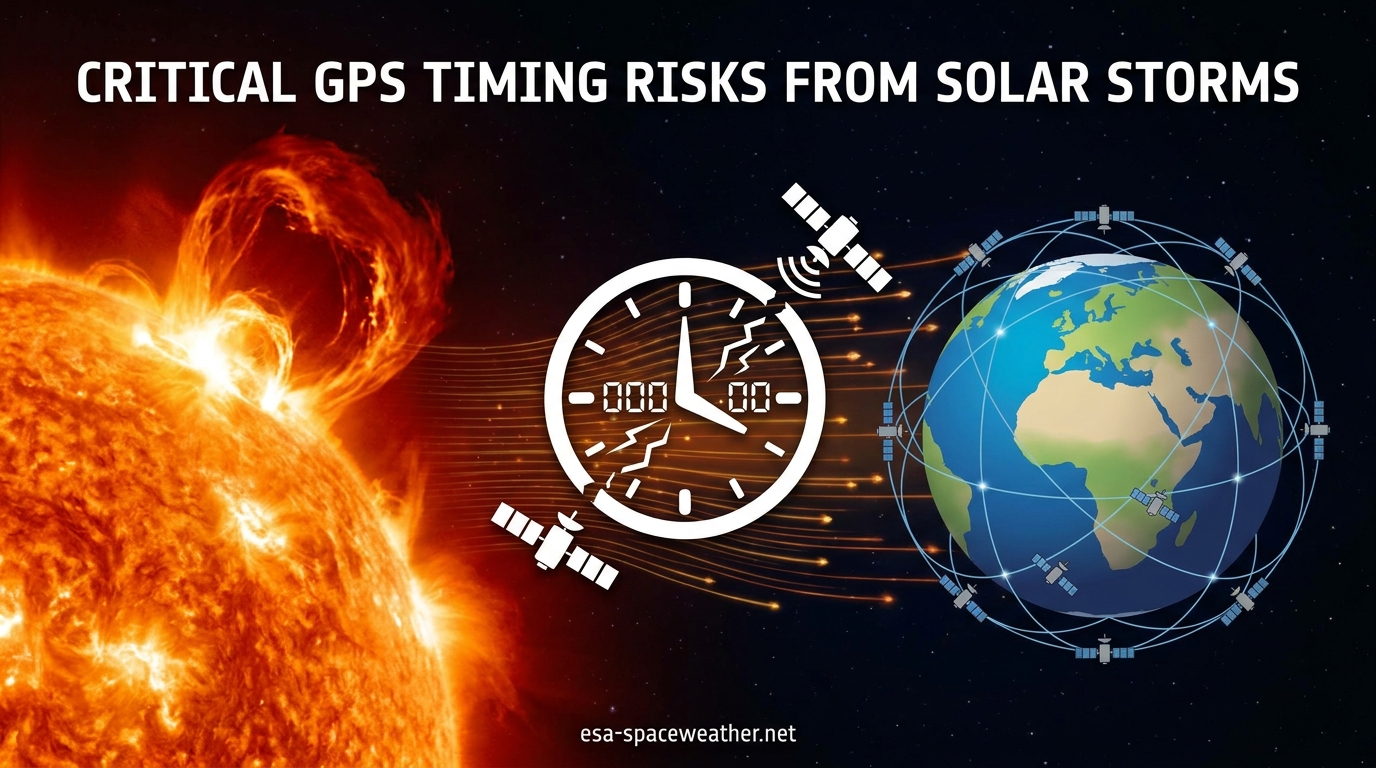
Every time you tap your card at a coffee shop, transfer money online, or watch stock prices tick across a screen, there is an invisible thread holding the entire system together. That thread is GPS timing. And right now, as we move through the peak of Solar Cycle 25, the Sun is actively testing how strong that thread really is.
GPS timing failures from solar storms disrupt banking in ways most financial institutions have never planned for. When the Sun hurls charged particles toward Earth, those particles scramble the GPS signals that banks, exchanges, and payment networks rely on to timestamp and synchronize every transaction. Even a few milliseconds of timing drift can cause trades to fail, payments to stall, and fraud detection systems to misfire.
This article explains exactly how this chain reaction works. Readers will learn why modern banking cannot function without GPS timing, how solar storms corrupt those signals, which banking sectors face the greatest risk, what historical events already showed us, and what institutions can do to protect themselves before the next big storm arrives.
We are currently in the solar maximum window, which means elevated geomagnetic activity through at least late 2026. The February 2024 G5 storm and the December 2025 G4 storm have already given us real-world previews of what happens when space weather meets financial infrastructure. The question is not whether another major storm is coming. The question is whether banking systems will be ready.
Table of Contents
Executive Summary: The Hidden Dependency
Modern banking runs on precision timing, and that timing comes primarily from GPS satellites orbiting 20,000 kilometers above Earth. Every financial transaction, from a stock trade executed in nanoseconds to a cross-border SWIFT payment, depends on accurate timestamps to maintain order, prevent fraud, and comply with regulations.
Solar storms disrupt this system by injecting massive amounts of charged particles into Earth’s ionosphere. That ionospheric disturbance delays GPS signals, causes receivers to lose satellite lock, and introduces timing errors that cascade through every system relying on those signals.
No competitor analysis, no regulatory framework, and no industry standard currently addresses this specific vulnerability in a comprehensive way. The banking sector’s GPS timing dependency is a blind spot hiding in plain sight, and the solar maximum makes it an urgent concern for 2026.
How GPS Timing Works in Banking
Most people think of GPS as a navigation tool, the thing that tells your phone how to get to the nearest ATM. But for the financial industry, GPS is primarily a clock. Each GPS satellite carries multiple atomic clocks that broadcast incredibly precise time signals down to Earth. Financial systems use those signals to synchronize their own clocks to within nanoseconds of universal time.
This matters because banking is fundamentally about sequencing. If two transactions arrive at a clearinghouse within the same millisecond, the system needs to know which one came first. That requires every computer in the network to agree on what time it is, down to the microsecond. GPS makes that possible.
The Role of PTP and NTP in Financial Networks
Two timing protocols dominate financial infrastructure: the Network Time Protocol (NTP) and the Precision Time Protocol (PTP). NTP can synchronize clocks to within a few milliseconds, which is adequate for general IT systems and payment processing. PTP goes much further, achieving sub-microsecond accuracy, which high-frequency trading platforms require.
Both protocols ultimately trace their time reference back to GPS. NTP servers typically pull time directly from GPS receivers. PTP grandmaster clocks, which serve as the authoritative time source for trading floors and data centers, also rely on GPS as their primary reference. When GPS timing degrades, every downstream system inherits that degradation.
Timestamping: The Backbone of Financial Integrity
Every financial transaction gets a timestamp. That timestamp determines transaction ordering, enables audit trails, supports regulatory compliance, and feeds into fraud detection algorithms. The European MiFID II regulation, for example, requires timestamping accuracy to within 100 microseconds for high-frequency trading. The SEC has similar requirements under Regulation NMS and the Consolidated Audit Trail.
If GPS timing becomes unreliable, those timestamps become unreliable. Transactions could appear to execute out of order. Audit trails could show gaps or overlaps. Fraud detection systems, which flag unusual activity partly based on timing patterns, could generate false positives or miss real threats.
Global Synchronization Across Payment Networks
When you send money internationally, that payment passes through multiple intermediaries: your bank, a correspondent bank, a clearing system, and the recipient’s bank. Each hop requires precise coordination, and that coordination depends on synchronized clocks. SWIFT, the messaging network that handles cross-border payments between 11,000 financial institutions, relies on consistent timing to sequence and validate messages.
If one bank’s clock drifts even slightly due to GPS timing degradation, it can cause message ordering errors, settlement delays, or failed transactions. In a system processing millions of messages per day, even a small percentage of timing-related failures translates to enormous financial impact.
How Solar Storms Disrupt GPS Signals
To understand why GPS timing failures from solar storms disrupt banking, it is necessary to understand what happens between the Sun and a GPS receiver. The critical zone is the ionosphere, the layer of charged particles in Earth’s upper atmosphere sitting roughly 60 to 1,000 kilometers above the surface.
Under normal conditions, the ionosphere has a relatively stable density of free electrons. GPS signals pass through it with predictable, correctable delays. During a solar storm, that stability vanishes.
Total Electron Content and Signal Delay
GPS signals travel at the speed of light, but when they pass through the ionosphere, those signals slow down slightly because of the free electrons in their path. Scientists measure this electron density using a metric called Total Electron Content, or TEC. Under normal conditions, TEC is predictable, and GPS receivers apply correction models to account for the delay.
Solar storms cause TEC to spike dramatically. A coronal mass ejection hitting Earth’s magnetosphere can compress and distort the ionosphere, creating dense pockets of electrons that GPS signals were never expected to encounter. The correction models fail. Signals arrive late. Timing errors accumulate.
Ionospheric Scintillation: When Signals Scatter
TEC delays are bad enough, but ionospheric scintillation is worse. Scintillation occurs when irregular patches of ionospheric density cause GPS signals to fluctuate rapidly in phase and amplitude. Think of it as trying to read a barcode through rippling water. The receiver struggles to maintain lock on the satellite signal.
During intense scintillation events, GPS receivers can lose lock entirely. They stop receiving timing data from that satellite. If enough satellites are affected simultaneously, the receiver cannot compute a position or maintain accurate time. For a banking data center relying on that receiver for PTP grandmaster synchronization, a loss of lock means the clock starts drifting.
Coronal Mass Ejections and Solar Flares
Two solar phenomena drive these disruptions. Solar flares are intense bursts of electromagnetic radiation that arrive at Earth in about eight minutes. They cause sudden increases in ionospheric ionization, particularly on the sunlit side of Earth. A strong X-class flare can degrade GPS signals across an entire hemisphere within minutes.
Coronal mass ejections, or CMEs, are massive eruptions of plasma and magnetic field from the Sun’s corona. They take one to three days to reach Earth, but when they arrive, they compress the magnetosphere and trigger geomagnetic storms that can last for days. The March 2024 and May 2024 storms were both driven by CMEs and caused measurable GPS degradation worldwide.
The Signal Loss Cascade
The disruption cascades into banking through a clear chain. First, the ionosphere becomes disturbed and TEC spikes. Next, GPS receivers experience signal delays and scintillation. Then, some receivers lose satellite lock entirely. The PTP grandmaster clock, now without its GPS reference, enters holdover mode and begins drifting. Within minutes, trading systems are working from slightly inaccurate timestamps. Within hours, the drift could exceed regulatory tolerances.
Banking Sectors Most Vulnerable to GPS Timing Failures
Not all banking operations face the same level of risk from solar storm GPS disruption. Some systems can tolerate a few milliseconds of timing error with minimal consequences. Others would fail catastrophically.
High-Frequency Trading (HFT)
High-frequency trading firms are the most timing-sensitive entities on Earth. Their algorithms execute trades in microseconds, sometimes nanoseconds, capitalizing on price differences that exist for fractions of a second. To do this, every trading server must agree on time to within a few microseconds.
HFT systems depend on PTP synchronization, which in turn depends on GPS. If GPS timing degrades during a solar storm, the PTP grandmaster clock drifts. Trading servers receive slightly incorrect timestamps. Orders that should have been sequenced one way get sequenced another. At best, this means missed opportunities and reduced profit. At worst, it means trades execute in the wrong order, creating losses and compliance violations.
During the December 2025 G4 geomagnetic storm, financial markets showed measurable sentiment impacts. While no exchange publicly attributed trading anomalies to GPS timing errors, the correlation between space weather events and unusual market behavior has been noted by multiple financial analysts.
Payment Card Processing
Every time you swipe, dip, or tap a payment card, a complex chain of authorization messages races between the merchant terminal, the payment processor, the card network, and your bank. That entire process typically completes in under two seconds, and it depends on consistent timestamps to prevent double-processing and fraud.
GPS timing degradation does not necessarily stop payment processing. NTP-based systems can tolerate several milliseconds of drift before problems arise. But during a severe solar storm, drift can accumulate to the point where transaction logs become inconsistent. Fraud detection systems may flag legitimate transactions as suspicious because the timing patterns look anomalous.
For payment processors handling thousands of transactions per second, even a 0.1% error rate from timing issues translates to thousands of affected transactions per hour. Customer complaints spike. Dispute resolution teams get overwhelmed. The financial and reputational costs add up quickly.
ATM Networks
ATMs are often overlooked in discussions about GPS timing, but they are surprisingly dependent on precise synchronization. Modern ATMs communicate with bank networks using encrypted connections that require authenticated handshakes, and many of those authentication protocols use time-based tokens. If an ATM’s clock drifts too far from the bank’s clock, the authentication fails and the ATM goes offline.
Some ATM operators use GPS directly for timing at remote locations where network connectivity is unreliable. For those machines, a solar storm that disrupts GPS could mean the ATM simply stops dispensing cash. During the February 2024 solar storm, GPS-guided agricultural equipment experienced widespread disruption. ATMs in rural areas with GPS-dependent timing face similar vulnerability.
SWIFT and Cross-Border Payments
SWIFT processes millions of financial messages daily between banks in over 200 countries. Each message includes timestamps that determine processing priority, settlement windows, and regulatory reporting. When a payment crosses time zones and passes through multiple correspondent banks, consistent timing is essential for correct reconciliation.
If GPS timing degrades during a solar storm, banks in the affected region may generate messages with slightly inaccurate timestamps. The receiving bank, still operating on accurate time, sees inconsistencies. Messages may be rejected, delayed, or flagged for manual review. In a system built for speed and automation, manual intervention is expensive and slow.
Clearing and Settlement Systems
Clearinghouses sit between buyers and sellers in financial markets, guaranteeing that trades settle correctly. They depend on precise timing to match trade records from both parties. If one exchange’s timestamp disagrees with another’s because of GPS timing drift, the clearinghouse cannot automatically match the trades.
Unmatched trades require manual resolution, which slows down settlement and ties up capital. During periods of high market volatility, which often coincide with major news events that could include severe space weather alerts, the clearing system is already under stress. Adding timing-related mismatches compounds the problem.
Historical Precedents: What Past Solar Storms Tell Us
History gives us plenty of evidence that solar storms can disrupt technology. What it does not give us, yet, is a clear example of a solar storm causing a large-scale banking failure. But the ingredients are all there, and recent events have come uncomfortably close.
The Carrington Event of 1859
The Carrington Event remains the most powerful geomagnetic storm in recorded history. Telegraph operator reports from the time describe sparks flying from equipment, papers catching fire, and systems operating even when disconnected from power sources. The aurora was visible as far south as Cuba and Hawaii.
In 1859, there was no GPS, no banking electronics, and no power grid. But the Carrington Event affected over 200,000 kilometers of telegraph lines, the high-tech communication network of its era. If a storm of that magnitude hit today, the ionospheric disturbance would be catastrophic for GPS-dependent systems. Banking infrastructure would not be spared.
The Quebec Blackout of 1989
In March 1989, a severe geomagnetic storm caused the entire Hydro-Quebec power grid to collapse in just 92 seconds. Six million people lost electricity for up to nine hours. The storm induced currents in power lines that overwhelmed protective systems and caused cascading failures.
While the 1989 storm did not directly affect banking systems through GPS disruption, it demonstrated how quickly infrastructure can fail when space weather strikes. GPS was not yet operational for civilian use in 1989, but had it been, the ionospheric disturbance would have caused significant signal degradation. Any bank relying on GPS timing during that event would have experienced drift and potential synchronization failures.
The Bastille Day Storm of 2000
On July 14, 2000, an X5-class solar flare and a massive CME hit Earth, creating a G5 geomagnetic storm. The storm caused extensive satellite anomalies, including GPS satellite imaging noise and communication disruptions. Some satellites experienced temporary loss of orientation, and several required days of recovery.
By 2000, GPS was already in widespread commercial use, including in financial systems. While no major banking failures were publicly reported, the storm demonstrated that severe space weather can directly affect the satellite constellation itself, not just ground-based receivers. If the storm had been slightly more intense or lasted longer, banking systems dependent on GPS timing would have felt the impact.
Recent Storms: February 2024 and December 2025
The February 2024 solar storm reached G5 intensity and disrupted GPS-guided agricultural equipment across North America. John Deere tractors experienced positioning errors during critical planting season operations. The May 2024 storms produced visible auroras as far south as Florida and caused measurable GPS signal degradation worldwide.
In December 2025, a G4 geomagnetic storm caused what financial analysts at Ideapips described as measurable capital markets disruption. While the exact mechanism was not definitively linked to GPS timing errors, the timing correlation between the storm’s peak and unusual trading patterns raised significant concern among risk officers at major financial institutions.
These recent events confirm the threat is not theoretical. It is happening now, during the current solar maximum, and the banking sector needs to pay attention before a larger storm arrives.
Mitigation and Resilience Strategies for Financial Institutions
Solutions exist to mitigate GPS timing failures from solar storms, but most financial institutions have not implemented them specifically for space weather resilience. Here is what banks, exchanges, and payment processors should be doing right now.
Backup Timing Sources: Atomic Clock Holdover
The most immediate defense against GPS timing failure is local atomic clock holdover. High-quality rubidium or cesium oscillators can maintain accurate time for days or even weeks without GPS input. When a PTP grandmaster loses its GPS reference, a good holdover clock keeps the system running with minimal drift.
The challenge is cost. Enterprise-grade atomic clocks suitable for data center deployment can cost tens of thousands of dollars each, and a large financial institution may need several for redundancy. But compared to the cost of a trading halt or a settlement failure cascade, the investment is straightforward risk management.
Multi-Constellation GNSS Receivers
GPS is not the only satellite navigation system. Europe’s Galileo, Russia’s GLONASS, and China’s BeiDou all provide timing signals. Multi-constellation receivers can pull timing from multiple satellite systems simultaneously, reducing the impact of GPS-specific disruptions.
However, during a major geomagnetic storm, the ionospheric disturbance affects all GNSS signals, not just GPS. Multi-constellation receivers help with satellite-specific outages and localized interference, but they do not eliminate the risk of ionospheric scintillation during a severe solar storm.
Fiber-Based Time Distribution
Some financial networks are moving toward fiber-based time distribution, where precise timing signals are sent over dedicated fiber optic connections from a secure, hardened time source. This approach eliminates the wireless vulnerability entirely for sites with fiber connectivity.
The limitation is infrastructure cost and geographic coverage. Fiber time distribution works well between major data centers in financial hubs, but it does not help remote ATMs or branch offices without fiber access. It is a strong solution for the core of the financial network, not the edges.
Regulatory Action and Industry Standards
Financial regulators are beginning to address operational resilience, including technology infrastructure risks. The EU’s Digital Operational Resilience Act (DORA) requires financial entities to identify and mitigate ICT-related risks. In the United States, the Federal Reserve and OCC have issued guidance on operational resilience for large institutions.
However, none of these regulatory frameworks specifically mention GPS timing dependency or space weather as a threat vector. Insurance companies are starting to model space weather as a quantifiable risk, but standardized coverage and pricing remain in early stages. The banking sector needs industry-wide standards for timing resilience before the next major storm forces the conversation.
GPS Timing Failures From Solar Storms and Banking
The convergence of solar activity, GPS signal degradation, and financial infrastructure vulnerability represents a growing risk that spans multiple sectors. Understanding GPS timing failures from solar storms and their impact on banking systems is essential for risk managers, technology leaders, and policymakers preparing for the challenges of the current solar maximum.
FAQ: GPS Timing Failures From Solar Storms and Banking
How do solar storms affect GPS?
Solar storms affect GPS by releasing charged particles and electromagnetic radiation that interact with Earth’s ionosphere. This creates a disturbed layer of free electrons that delays and scatters GPS signals, causing receivers to lose lock or report inaccurate positions and timing. During intense storms, the effect can cause complete GPS signal loss lasting minutes to hours.
What is the biggest source of error for GPS?
The biggest source of error for GPS is ionospheric delay caused by Total Electron Content (TEC) in Earth’s upper atmosphere. During solar storms, TEC increases dramatically, causing signals to slow down and scatter unpredictably. This can introduce positioning errors of several meters and timing errors of microseconds to milliseconds.
Could the US turn off GPS?
While the US government could technically degrade GPS signals, as was done with Selective Availability until 2000, a complete GPS shutdown is highly unlikely. GPS is critical to global infrastructure including banking, aviation, military operations, and emergency services. Shutting it down would cause immediate worldwide economic disruption.
Can solar flares disrupt cell service?
Yes, solar flares can disrupt cell service. The radio energy from solar flares can overwhelm radio signals used by cellular networks, and geomagnetic storms can induce electrical currents that damage undersea cables and ground-based infrastructure that cell towers depend on for backhaul connectivity.
How long would a GPS timing outage need to be to affect trading?
High-frequency trading systems can be affected within seconds of GPS timing loss because they require microsecond precision. Without atomic clock holdover, a PTP grandmaster begins drifting immediately. Within minutes, drift can exceed the 100-microsecond tolerance required by regulations like MiFID II. Longer outages of 30 minutes or more would force exchanges to halt trading entirely.
Do banks have backup timing systems if GPS fails?
Some large financial institutions have atomic clock holdover systems that maintain accurate time for hours to days without GPS. However, many smaller banks, payment processors, and ATM networks lack dedicated backup timing. There is no industry-wide standard requiring GPS timing redundancy, and adoption of backup timing varies significantly across the banking sector.
Conclusion: The Clock Is Ticking
Understanding why GPS timing failures from solar storms disrupt banking is no longer an academic exercise. The solar maximum is here, recent storms have already demonstrated real-world impacts on technology infrastructure, and the financial sector’s dependency on GPS timing only grows deeper each year.
The chain is clear: solar storms disturb the ionosphere, the disturbed ionosphere degrades GPS signals, degraded GPS signals cause timing errors, and timing errors cascade through trading platforms, payment networks, ATM systems, and cross-border settlement infrastructure. The question every financial institution should be asking is not if the next major storm will test their systems, but when.
GPS timing failures from solar storms represent a systemic risk that demands immediate attention. If organizations relying on GPS timing have not assessed their vulnerability to space weather, now is the time. Invest in backup timing sources, evaluate holdover capabilities, and advocate for industry standards that take solar storm resilience seriously. The Sun does not negotiate, and neither should infrastructure preparedness.