
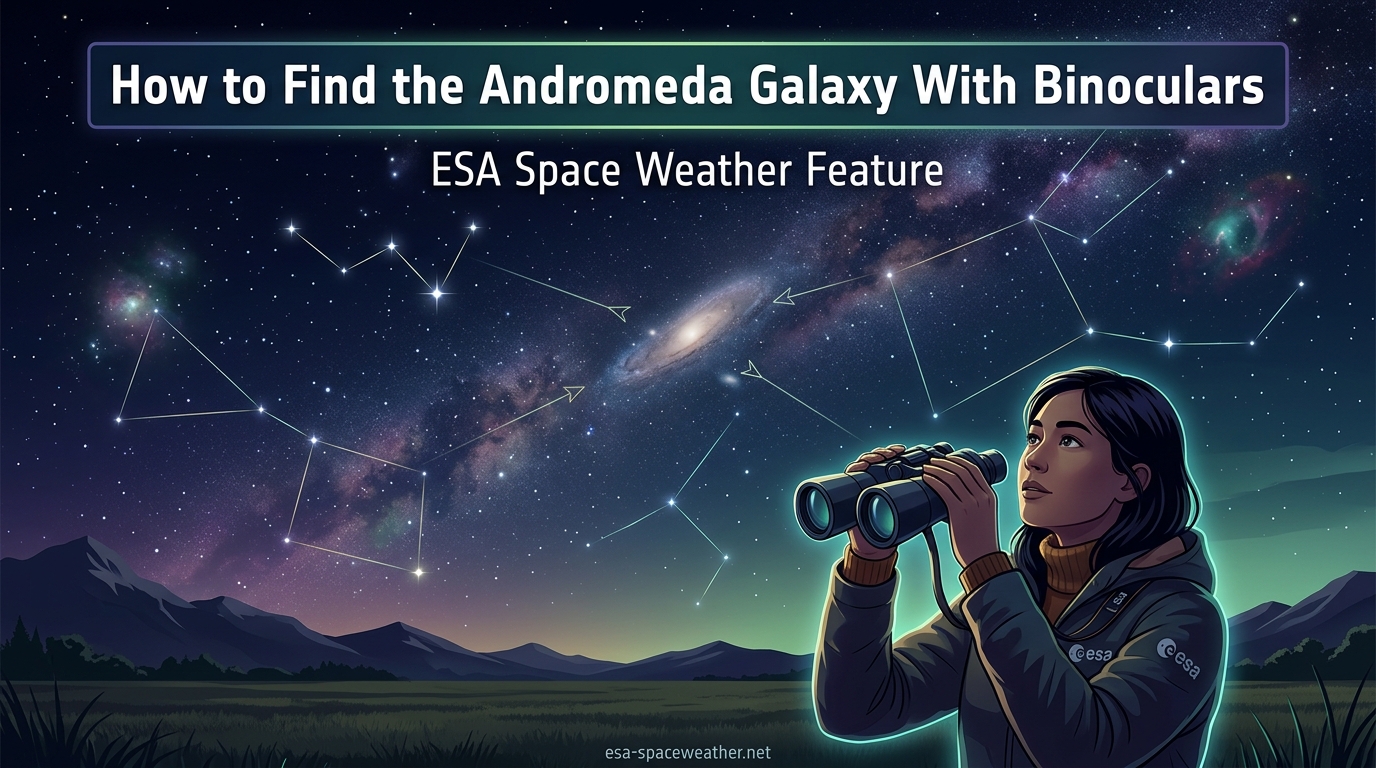
Yes, you can absolutely see the Andromeda Galaxy with binoculars. In fact, it is one of the most rewarding targets for amateur astronomers because it spans roughly six full Moon diameters across the sky, making it ideally suited for the wide field of view that binoculars provide. The Andromeda Galaxy, also known as M31, is a barred spiral galaxy sitting about 2.5 million light-years from Earth, and it is the nearest major galaxy to our own Milky Way.
Learning how to find the Andromeda Galaxy with binoculars is a rite of passage for anyone getting started in deep-sky observing. Unlike faint nebulae or tiny distant star clusters, Andromeda is bright enough to spot from a reasonably dark suburban backyard. Once you know where to look and what to expect, you will return to it year after year.
I remember my first successful sighting. I was standing in a friend’s backyard on a crisp October evening with a basic pair of 10×50 binoculars, and after twenty minutes of frustrated sweeping, a faint glow suddenly appeared in my field of view. That pale, ghostly oval was light that had traveled 2.5 million years to reach my eyes. No telescope required, no expensive equipment, just patience and a clear night.
This guide walks you through everything you need: two reliable star-hopping methods, the best observing conditions, realistic expectations, binocular specs, seasonal timing, and practical tips that forum veterans wish someone had told them on their first night out.
Table of Contents
What Makes the Andromeda Galaxy Special
The Andromeda Galaxy is catalogued as M31 in the Messier list of deep-sky objects. Charles Messier recorded it in 1764, though it was known to Persian astronomers as early as 964 AD. At apparent magnitude 3.4, it is technically visible to the naked eye under dark skies, making it the most distant object you can see without optical aid.
Andromeda contains an estimated one trillion stars, more than double the count in our Milky Way. Its barred spiral structure stretches about 220,000 light-years in diameter. Two smaller companion galaxies, M32 and M110, orbit it and are visible in the same binocular field of view under good conditions.
For binocular observers, the most important fact is its apparent size. The galaxy spans approximately 3 degrees by 1 degree in the sky, which is roughly six times the width of the full Moon. This large apparent size is exactly why binoculars outperform telescopes for initial viewing. Most beginner telescopes have a narrow field of view that cannot fit the entire galaxy in one frame.
Andromeda is also on a collision course with our Milky Way. The two galaxies are approaching each other at about 110 kilometers per second and will merge in approximately 4.5 billion years. So when you observe Andromeda through your binoculars, you are looking at our future galactic partner.
How to Find the Andromeda Galaxy With Binoculars: Method 1, Star-Hopping from Cassiopeia
The Cassiopeia method is the most popular and reliable way to find Andromeda. Cassiopeia is one of the easiest constellations to identify because its five bright stars form a distinctive W or M shape, depending on its orientation in the sky. This constellation is circumpolar for most northern hemisphere locations, meaning it never sets below the horizon.
Here is the step-by-step process:
Step 1: Locate Cassiopeia. Face north and look up about halfway between the horizon and the zenith. You will see five bright stars arranged in a W shape. If the sky is reasonably dark, the W should be unmistakable.
Step 2: Identify the three key stars. Focus on the right side of the W (when it appears as a W). The three stars on the right side of the W form a zigzag pattern. These three stars act as a natural pointer toward Andromeda.
Step 3: Imagine a line. Draw an imaginary line using these three right-side stars, extending the direction they point. The line extends away from the W, toward the constellation Andromeda. Follow this imaginary line about three fist-widths at arm’s length.
Step 4: Look for the fuzzy patch. At the end of this pointer, you will reach the general area of M31. Scan this region slowly with your binoculars. Look for a faint, elongated oval of light that is distinctly fuzzier than the sharp pinpoints of surrounding stars.
Step 5: Confirm with the bright star nearby. The galaxy sits near the star Mirach in the constellation Andromeda. If you see a bright orange-red star in your binocular field, you are very close. The galaxy lies roughly one binocular field of view above Mirach.
The beauty of the Cassiopeia method is its simplicity. Once you have spotted the W shape, the rest is just following a straight line. I have used this method with complete beginners who had never identified a constellation before, and most find Andromeda within fifteen minutes on their first try.
One tip from experience: if you cannot see the galaxy on your first sweep, do not move your binoculars dramatically. Instead, nudge them slowly up, down, left, and right in small increments. The galaxy has low surface brightness, and sometimes a tiny shift in position brings it into view against a slightly darker patch of sky.
How to Find the Andromeda Galaxy With Binoculars: Method 2, Star-Hopping from the Great Square of Pegasus
The second method uses the Great Square of Pegasus as a starting point. This approach is especially useful on autumn evenings when Pegasus rides high overhead. The Great Square is a large, prominent square of four bright stars that dominates the southern sky during fall and winter nights in the northern hemisphere.
Follow these steps:
Step 1: Find the Great Square of Pegasus. Look south to overhead for four stars forming a large square or rectangle. The square is quite large, spanning roughly 10 to 15 degrees on each side, which is about the width of your outstretched hand at arm’s length.
Step 2: Locate Alpheratz. Focus on the star at the upper-left corner of the Great Square (when facing south). This star is Alpheratz, which technically belongs to the constellation Andromeda even though it forms part of Pegasus’s square. Alpheratz is the gateway star to the constellation Andromeda.
Step 3: Follow the chain of stars. Starting at Alpheratz, look to the left (north and east) for two curved lines of stars extending away from the Great Square. These represent the body and legs of the mythological princess Andromeda. Follow the brighter of these two star chains.
Step 4: Find Mu and Nu Andromedae. Move along the star chain from Alpheratz. You will encounter two stars called Mu Andromedae and Nu Andromedae, which appear as a close pair in binoculars. The galaxy lies beyond these two stars, continuing along the same direction.
Step 5: Arrive at Mirach. Continue along the chain to the bright star Mirach, which is the brightest star you encounter along this path. Mirach is a red giant star with a distinct orange tint in binoculars.
Step 6: Jump to the galaxy. From Mirach, look upward (toward Cassiopeia) about one binocular field of view. The Andromeda Galaxy will appear as a fuzzy, elongated glow. There is another fainter star near Mirach called Mu Andromedae, and the galaxy sits roughly between Mirach and Nu Andromedae, slightly offset.
Some observers find this method more intuitive than the Cassiopeia route because it follows a visible chain of stars rather than an imaginary line. The Great Square of Pegasus is also easier to locate for beginners who are still learning constellation patterns, since it is such a large and obvious shape.
If you struggle with either method, try practicing with a planetarium app first. Apps like Stellarium, SkySafari, or Star Walk show you exactly where Andromeda sits relative to Cassiopeia and Pegasus in real time. Spend ten minutes inside with the app before heading out, and you will have a mental map that makes star-hopping much faster.
Best Observing Conditions for Andromeda
Dark skies are the single most important factor for successfully viewing the Andromeda Galaxy. The galaxy has an integrated magnitude of 3.4, which sounds bright, but that light is spread across a large area. This means its surface brightness is quite low, making it vulnerable to light pollution.
Astronomers use the Bortle scale to classify sky darkness, ranging from Class 1 (pristine dark sky) to Class 9 (inner-city sky). Here is what to expect at different Bortle classes:
At Bortle Class 1 to 2 (truly dark rural skies), Andromeda is visible to the naked eye as a faint elongated glow. In binoculars, it is stunning, showing a bright central core surrounded by a large, misty halo extending across much of your field of view. You may also spot the companion galaxies M32 and M110.
At Bortle Class 3 to 4 (rural to suburban transition), the galaxy is easy in binoculars but difficult naked-eye. You will see the bright core clearly and some of the surrounding glow. This is where most successful beginner observations happen.
At Bortle Class 5 to 6 (suburban skies), Andromeda becomes challenging. The central core is still visible in binoculars, but the extended glow is largely lost. You will need dark adaptation and averted vision to confirm the sighting.
At Bortle Class 7 and above (urban skies), finding Andromeda is very difficult. Only the bright central core may be glimpsed in 10×50 or larger binoculars, and only on the clearest nights.
Moon phase matters enormously. A full Moon effectively raises your Bortle class by two to three levels. Even a gibbous Moon can wash out Andromeda completely. Plan your observing session for a night when the Moon has already set or has not yet risen. The week around new Moon is ideal.
Dark adaptation is essential. Your eyes need 20 to 30 minutes in complete darkness to reach maximum sensitivity. During this time, avoid all white light sources, including phone screens, flashlights, and car headlights. Use a red flashlight if you need to read a star chart, as red light preserves your dark adaptation. Many planetarium apps have a night-vision mode that turns the screen red.
Use averted vision. This is a technique where you look slightly to the side of the galaxy rather than directly at it. The center of your retina is optimized for sharp detail but is poor at detecting faint light. The edges of your retina contain more rod cells, which are extremely sensitive to dim light. By looking just off to the side of where Andromeda sits, the galaxy often pops into view more clearly. It feels counterintuitive, but it works.
What the Andromeda Galaxy Actually Looks Like Through Binoculars
This section is critical because the number one complaint on astronomy forums is disappointment. People expect to see the swirling, colorful spiral arms shown in NASA photographs. That expectation leads to frustration when the real view is a pale smudge.
Here is the honest truth about what you will see through binoculars.
The Andromeda Galaxy appears as a faint, soft, elongated oval of light. Think of a glowing cotton ball or a smear of fog on a mirror. The central region is brighter and more concentrated, appearing as a distinct brightening at the center of the oval. This is the galactic bulge, where millions of stars are densely packed.
Extending outward from the bright core, the glow gradually fades into the surrounding darkness. One side may appear slightly brighter or more extended than the other, because we view Andromeda at an angle rather than face-on. The galaxy’s tilt is approximately 77 degrees, giving it that characteristic elongated football shape.
You will not see spiral arms. You will not see individual stars. You will not see color. The human eye is not sensitive enough at these low light levels to perceive color, so everything appears in shades of gray and white.
There is a vast difference between what your eye sees and what a camera captures. Long-exposure photographs of Andromeda collect light for minutes or hours, revealing dust lanes, star-forming regions, and blue spiral arms that are completely invisible visually. If you have only ever seen Andromeda in Hubble or amateur astrophotography images, the visual view will surprise you.
But here is the thing that makes it magical. That faint smudge is real. It is not a photograph on a screen. It is light that left 2.5 million years ago, traveled across intergalactic space, passed through Earth’s atmosphere, entered your binoculars, and struck your retina. You are seeing another galaxy with your own eyes. Once you process that fact, that pale glow becomes deeply moving.
Under good dark skies with 10×50 binoculars, you may also spot the two companion galaxies. M32 appears as a small, compact fuzzy star very close to the main galaxy’s southern edge. M110 is larger and more diffuse, sitting on the opposite side of the main galaxy from M32. Spotting these companions is a rewarding challenge that adds depth to your observation.
Best Binocular Specs for Viewing the Andromeda Galaxy
Binoculars are described by two numbers, such as 10×50. The first number is magnification and the second is the diameter of the objective lenses in millimeters. Both numbers matter for deep-sky observing, but they interact in important ways.
10×50 binoculars are the consensus recommendation from astronomy forums for viewing Andromeda. The 10x magnification provides enough enlargement to make the galaxy’s core and disk clearly distinguishable. The 50mm objective lenses gather ample light for the galaxy’s faint glow. Multiple experienced observers on Cloudy Nights and Stargazers Lounge specifically recommend 10×50 as the sweet spot for Andromeda.
7×50 binoculars are the traditional astronomy choice. They offer a wider field of view, which can fit the entire galaxy in one frame along with its companion galaxies. The 7x magnification provides a steadier image for handheld viewing since image shake is less pronounced at lower magnifications. However, the lower magnification makes the galaxy appear smaller and less detailed.
The 7×50 configuration has a 7.1mm exit pupil, which is ideal for younger observers whose pupils can dilate fully. For observers over age 40, the eye’s pupil may only dilate to 5 or 6mm, meaning some of the light gathered by 7×50 binoculars goes unused.
8×42 binoculars are a popular general-purpose size that also works for astronomy. The 5.3mm exit pupil is well-matched to most adult eyes, and 8x magnification offers a good balance between detail and field of view. Some forum users report success spotting Andromeda with 8×42 binoculars in dark skies, though the view is less detailed than through 10×50.
Understanding exit pupil is helpful for choosing binoculars. Exit pupil is the diameter of the beam of light that exits the eyepiece and enters your eye. You calculate it by dividing the objective lens diameter by the magnification. A 10×50 binocular has a 5mm exit pupil (50 divided by 10). A 7×50 has a 7.1mm exit pupil.
The ideal exit pupil matches your eye’s pupil diameter when fully dark-adapted. Young people may dilate to 7 or 8mm, but most adults over 40 max out around 5mm. This is why 10×50 binoculars with their 5mm exit pupil work so well for a wide range of observers.
Wider aperture options like 15×70 or 20×80 binoculars gather even more light and show more detail, but they are heavy and difficult to hold steady by hand. If you go above 10×50, consider mounting the binoculars on a tripod using an L-bracket adapter. A stable view reveals far more detail than a shaking one.
Image-stabilized binoculars are a premium option worth mentioning. Models from Canon, such as the 10×30 IS or 15×50 IS, use electronic stabilization to eliminate handshake. They provide dramatically steadier views of deep-sky objects, but at a significantly higher cost. For beginners, a standard pair of 10×50 binoculars mounted on a basic camera tripod achieves similar steadiness for a fraction of the price.
Regardless of which size you choose, optical quality matters. Look for binoculars with multi-coated lenses and Bak-4 prisms. These features improve light transmission and image contrast, both of which help when hunting faint deep-sky targets.
When to Observe: Seasonal Timing for Andromeda
Andromeda is a large constellation, and the galaxy within it follows a predictable path across the sky depending on the season. For northern hemisphere observers, the best viewing window runs from late summer through mid-winter.
Here is a month-by-month breakdown of when Andromeda is well-placed for evening observation:
August: Andromeda rises in the northeast after dark and climbs through the evening. By midnight, it is high enough for good observation. This is the start of observing season, though summer haze and humidity can reduce sky transparency.
September: The galaxy is visible from about 9 PM onward and reaches a good altitude by 11 PM. Cooler autumn air often brings improved transparency compared to summer. This is one of the best months for Andromeda observation.
October: Andromeda is high overhead by 10 PM, making this prime viewing time. The galaxy is at its maximum altitude, meaning you look through less atmosphere. October new Moon weekends are ideal for planning an observing session.
November: The galaxy is already high in the sky at full darkness, around 8 PM. Nights are longer and darker, providing extended observing windows. November is arguably the single best month for Andromeda in the northern hemisphere.
December: Andromeda starts the evening high overhead and moves toward the northwest as the night progresses. Cold temperatures are the main challenge, but winter skies can be extremely clear and transparent. Dress warmly.
January: The galaxy is still visible but begins the evening lower in the northwest. You have a shorter window before it sinks too low. Clear winter nights can still provide excellent views early in the evening.
February through July: Andromeda is either very low in the north or below the horizon during evening hours. It returns to the early morning sky in late spring and re-enters the evening sky in late summer.
For southern hemisphere observers, Andromeda is much more challenging. From latitudes below about minus 30 degrees, the galaxy barely rises above the northern horizon. Observers in southern Australia, South Africa, and South America can glimpse it very low in the north during October through December, but atmospheric distortion near the horizon degrades the view significantly. For the best Andromeda observation, you really need to be in the northern hemisphere.
Regardless of season, always check the Moon phase before heading out. A clear night during a full Moon is worse for Andromeda viewing than a hazy night during a new Moon. Use a lunar calendar or astronomy app to plan around the Moon’s schedule.
Tips for First-Time Andromeda Observers
After helping many first-time observers find Andromeda, I have collected a set of practical tips that make the difference between success and frustration.
Practice finding the constellations before dark. Spend ten minutes during daylight or twilight identifying Cassiopeia and the Great Square of Pegasus using a planetarium app. Having a mental picture of the constellation patterns before you step outside saves enormous time and confusion in the dark.
Use an app to confirm the position. Stellarium is free on desktop and mobile. SkySafari and Star Walk are excellent paid options. Open the app, search for M31 or Andromeda Galaxy, and note its position relative to the constellations for your specific location and time.
Bring a blanket or reclining chair. Standing with your neck craned back to look overhead gets uncomfortable fast. A reclining lawn chair or even a simple blanket on the ground lets you look up comfortably for extended periods. Comfort directly affects how long you can observe effectively.
Dress warmer than you think you need. Even on mild evenings, standing still under an open sky causes body temperature to drop quickly. Wear layers, a warm hat, and gloves. Being cold is the number one reason people abandon observing sessions early.
Brace your binoculars. Resting your elbows on a fence, car roof, or the back of a chair dramatically reduces handshake. For the steadiest view, mount your binoculars on a tripod using an L-bracket adapter, which costs about fifteen dollars. A stable image reveals significantly more detail in faint objects.
Find it with your eyes first. Under a dark sky, try to spot Andromeda as a faint smudge with your naked eye before raising the binoculars. Once your eyes have identified the spot, slowly bring the binoculars to your eyes without moving your gaze. This technique, recommended by EarthSky, is the most reliable way to center the galaxy in your binoculars.
Sweep slowly. If you cannot find the galaxy immediately, scan the area in slow, deliberate sweeps. Move the binoculars in small horizontal or vertical arcs. Quick movements make faint objects impossible to detect. Patience is essential.
Verify you found the right thing. A common question from beginners is how to confirm they are looking at Andromeda rather than a faint cloud or optical artifact. Here is the test: the galaxy stays fixed relative to the background stars. If it drifts quickly across your field, it is an internal reflection or a satellite. Andromeda will hold its position among the stars as the Earth’s rotation slowly carries everything westward. The galaxy’s fuzzy, extended appearance with a brighter center is also distinctive. No star will look like that.
Do not rush dark adaptation. Give your eyes a full 20 to 30 minutes in darkness before attempting the most challenging observations. During this time, avoid looking at any light source. If you must check your phone, use a red filter or night mode and keep the brightness at minimum.
Bonus Objects Near Andromeda
Once you have found M31, take time to explore the surrounding area. There are several interesting objects in the same region of sky that are visible in binoculars.
M32 is a compact elliptical galaxy sitting very close to the southern edge of Andromeda. In 10×50 binoculars, it looks like a moderately bright fuzzy star. Its compact size and round shape distinguish it from surrounding stars.
M110 is a larger, more diffuse elliptical galaxy on the opposite side of Andromeda from M32. It is fainter and harder to spot, requiring dark skies and dark-adapted eyes. Look for a faint, round glow.
Gamma Andromedae (Almach) is a beautiful double star in the constellation Andromeda. The primary star is golden orange and the companion is blue-green. In binoculars with 10x or higher magnification, you may be able to split the pair, though a telescope shows the color contrast more clearly.
NGC 404 (Mirach’s Ghost) is a small galaxy that sits very close to the star Mirach. It is challenging to see because Mirach’s bright glare overwhelms it. Under dark skies with averted vision, experienced observers report detecting it as a tiny fuzzy spot just beside the star. This is an advanced challenge object.
The Triangulum Galaxy (M33) is another nearby spiral galaxy in the same general region. It sits below the constellation Andromeda in Triangulum. M33 is larger but has even lower surface brightness than Andromeda, making it paradoxically harder to see despite being technically brighter in total magnitude. Under dark skies, it appears as a very faint, large, round glow.
FAQs
Can you see Andromeda through binoculars?
Yes, the Andromeda Galaxy (M31) is visible through binoculars. A pair of 10×50 or 7×50 binoculars will reveal it as a faint, elongated fuzzy patch roughly the size of the full moon. It appears as a brighter central core surrounded by a fainter glow, but you will not see spiral arms or color detail. Dark skies and moonless conditions are essential for the best view.
How can I locate the Andromeda Galaxy?
Locate the Andromeda Galaxy by star-hopping from either the constellation Cassiopeia or the Great Square of Pegasus. From Cassiopeia, use the three right-side stars of the W-shape as a pointer toward the galaxy. From Pegasus, start at the star Alpheratz in the Great Square and follow the chain of stars in Andromeda through Mu and Nu Andromedae to Mirach, then look one binocular field above Mirach.
What direction to look for the Andromeda Galaxy tonight?
From the northern hemisphere, look toward the constellations of Cassiopeia and Andromeda, between the W-shape of Cassiopeia and the Great Square of Pegasus. In autumn (September through November), Andromeda is highest in the sky around 10 PM to midnight, roughly overhead or slightly to the south. Use a planetarium app to pinpoint its exact position for your location and time.
Can you see Andromeda with 10×50 binoculars?
Yes, 10×50 binoculars are the ideal choice for viewing the Andromeda Galaxy. The 10x magnification provides enough detail to distinguish the bright central core and elongated disk, while the 50mm objective lenses gather enough light to reveal the galaxy’s faint glow. You will see an oval-shaped smudge of light about the size of the full Moon with a brighter center.
What does the Andromeda Galaxy look like through binoculars?
Through binoculars, Andromeda appears as a faint, soft, elongated oval of gray-white light with a brighter central core. It looks like a glowing cotton ball or a smear of fog. You will not see spiral arms, dust lanes, or color. Under dark skies, the companion galaxies M32 and M110 may also be visible as small fuzzy spots near the main galaxy.
Can I see the Andromeda Galaxy from the city with binoculars?
From a bright urban sky (Bortle Class 7 or higher), the Andromeda Galaxy is extremely difficult to see even with binoculars. Only the bright central core may be visible on the clearest nights. For a good view, travel to a suburban or rural location with darker skies. Even a Bortle Class 4 or 5 sky makes a dramatic difference compared to a city center.
What is the best time of year to see the Andromeda Galaxy?
The best time to observe the Andromeda Galaxy is from September through January in the northern hemisphere. November is widely considered the peak month because the galaxy is high overhead by mid-evening and the Moon schedule often provides dark windows. October and December are also excellent. Avoid nights with a bright Moon.
How far away is the Andromeda Galaxy?
The Andromeda Galaxy is approximately 2.5 million light-years from Earth. The light you see through your binoculars left the galaxy 2.5 million years ago. It is the nearest major galaxy to our Milky Way and is moving toward us at about 110 kilometers per second, with a merger expected in roughly 4.5 billion years.
Conclusion
Knowing how to find the Andromeda Galaxy with binoculars opens a door to deep-sky observing that no other target quite matches. It is the most distant object your eyes can perceive, the closest major galaxy to our own, and a sight that rewards every minute spent under a dark sky. Whether you star-hop from Cassiopeia or navigate from the Great Square of Pegasus, the key ingredients are the same: dark skies, dark-adapted eyes, steady binoculars, and realistic expectations.
Start with a pair of 10×50 binoculars on a moonless autumn night, give your eyes thirty minutes to adjust, and sweep slowly through the constellation Andromeda. When that faint glow finally appears in your field of view, you will be looking at light from a trillion stars in another galaxy. That moment of discovery is what amateur astronomy is all about, and it is waiting for you on the next clear, dark night.