
In May 2024, something extraordinary happened. The northern lights painted skies across all 50 states, with confirmed sightings as far south as Alabama, northern Florida, and even parts of Texas. Social media exploded with photos of pink and green aurora over backyards in places that had never seen such displays. It felt like the rules had changed.
But here is the reality check that most headlines skipped: that event was a G5 extreme geomagnetic storm, the kind that hits Earth maybe once or twice per decade. The question on everyone’s mind is simple: how far south can the Northern Lights be seen in the US under more typical conditions? Understanding the answer means understanding the science, the Kp index, and why your phone camera sees things your eyes cannot.
We have spent years tracking space weather data from NOAA’s Space Weather Prediction Center, analyzing aurora reports from communities across Reddit and aurora-chasing groups, and decoding the gap between what forecast maps show and what the naked eye actually sees. This breakdown gives you the realistic picture, state by state, with no sensationalism.
Solar maximum is happening right now, in 2026, which means the next 12 to 18 months represent the best window for southern aurora viewing in over a decade. But that does not mean every night will deliver. Let us separate the science from the hype.
Table of Contents
How Far South Can the Northern Lights Be Seen in the US? The Quick Answer
Under normal geomagnetic conditions, the northern lights are visible in the contiguous US only above approximately 50 degrees north latitude, which covers far northern portions of Washington, Idaho, Montana, North Dakota, Minnesota, Wisconsin, Michigan, and Maine. During moderate geomagnetic storms (Kp 6 to Kp 7), the aurora can extend to roughly 45 degrees north, reaching cities like Minneapolis, Milwaukee, and Portland, Oregon.
During strong storms (Kp 8 to Kp 9), the aurora pushes down to about 35 to 40 degrees north, making it visible from New York, Chicago, Denver, and Salt Lake City. During extreme G5 storms like the May 2024 event, auroral visibility can reach as far south as 25 to 30 degrees north latitude, which means Alabama, Mississippi, northern Florida, and even parts of Mexico become potential viewing areas.
The key takeaway: anything south of 35 degrees north latitude requires a significant geomagnetic storm. If you live in Tennessee, Arkansas, or Oklahoma, you need at least a G4 storm for a realistic chance of seeing anything.
What Is the Aurora Borealis?
The aurora borealis is a natural light display created when charged particles from the sun collide with gases in Earth’s upper atmosphere. These particles, carried by the solar wind, are redirected by Earth’s magnetic field toward the polar regions. When they slam into oxygen and nitrogen molecules at altitudes between 60 and 250 miles above the surface, those molecules release energy as visible light.
The color of the aurora depends on which gas is involved and at what altitude the collision occurs. Oxygen at lower altitudes (about 60 to 90 miles) produces the most common green aurora. Oxygen at higher altitudes (above 150 miles) creates rare red aurora. Nitrogen produces blue and purple light, often seen at the edges of auroral displays.
This interaction happens constantly, but it is concentrated in a ring around each magnetic pole called the auroral oval. The auroral oval is normally centered over the Arctic Circle, which is why Alaska, northern Canada, and Scandinavia see the lights regularly. When solar activity intensifies, the oval expands southward, pushing aurora into lower latitudes.
Every aurora display starts with the sun. Solar flares and coronal mass ejections (CMEs) launch massive clouds of charged plasma toward Earth. When those clouds arrive one to three days later, they compress Earth’s magnetic field and inject energy into the upper atmosphere, intensifying the aurora and pushing it equatorward.
The Kp Index Explained: The Number That Determines Southern Visibility
The Kp index is the single most important number for predicting how far south the northern lights will be visible in the US. Developed by the German geophysicist Julius Bartels in 1949, the Kp index measures global geomagnetic activity on a scale from 0 to 9, with 9 being the most extreme. NOAA’s Space Weather Prediction Center updates the Kp forecast in near real-time, making it the go-to tool for aurora chasers.
Here is how the Kp index maps to approximate southern visibility in the United States:
Kp 1 to Kp 2 (Quiet to Unsettled): Aurora stays well above the US-Canada border. Only Alaska and far northern Canada see the lights. No visibility in the lower 48 states.
Kp 3 (Active): Aurora reaches extreme northern portions of the contiguous US on the horizon. Northernmost Montana, North Dakota, and northern Minnesota might catch a faint green glow low on the northern horizon under very dark skies.
Kp 4 (Active to Unsettled): Aurora becomes visible along the entire US-Canada border. Locations in northern Washington, Idaho, Montana, North Dakota, Minnesota, Wisconsin, the Upper Peninsula of Michigan, and northern Maine can see aurora on the horizon if skies are dark and clear.
Kp 5 (Minor Storm, G1): Aurora extends to approximately 55 to 57 degrees magnetic latitude. Visible overhead in northern-tier states and on the horizon as far south as central Minnesota, southern Wisconsin, and southern Michigan.
Kp 6 (Moderate Storm, G2): Aurora reaches roughly 52 degrees magnetic latitude. Visible overhead across the northern third of the contiguous US and on the horizon from the Pacific Northwest through the Great Lakes to New England.
Kp 7 (Strong Storm, G3): Aurora pushes to about 48 degrees magnetic latitude. This is where it gets exciting for the Midwest. Aurora becomes visible on the horizon from Oregon, Idaho, Wyoming, South Dakota, Iowa, Illinois, Indiana, Ohio, Pennsylvania, New Jersey, and southern New England.
Kp 8 (Severe Storm, G4): Aurora extends to approximately 45 degrees magnetic latitude, roughly the latitude of Minneapolis, Chicago, and Portland, Oregon. Visible on the horizon as far south as northern California, Nevada, Utah, Colorado, Kansas, Kentucky, Virginia, and North Carolina.
Kp 9 (Extreme Storm, G5): Aurora reaches 35 degrees magnetic latitude or even lower. This is when you get sightings in Alabama, Mississippi, Georgia, South Carolina, and potentially northern Florida. The May 2024 storm reached Kp 9, as did the October 2003 Halloween storms and the March 1989 storm that knocked out power across Quebec.
For practical purposes, if you live south of 40 degrees north latitude (roughly the latitude of Denver, Philadelphia, and Columbus), you need a Kp 7 or higher to have any realistic chance of seeing the aurora. And even then, you will be looking at a low horizon glow, not the towering curtains of green light that photographers capture in Alaska or Norway.
Magnetic Latitude vs Geographic Latitude: Why Your Map Lies
Here is a detail that almost no aurora articles explain: the magnetic pole is not in the same place as the geographic North Pole. Earth’s magnetic field is tilted and offset, meaning the magnetic pole currently sits in the Arctic Ocean north of Canada, hundreds of miles from the geographic pole.
This offset means that two cities at the same geographic latitude can have very different aurora visibility. For example, Seattle, Washington (47.6 degrees north geographic) and Duluth, Minnesota (46.8 degrees north geographic) are at nearly the same geographic latitude. But Duluth sits at a significantly higher magnetic latitude than Seattle because the magnetic pole tilts toward North America’s interior.
Practically, this means the upper Midwest sees aurora more frequently than the Pacific Northwest at the same geographic latitude. Minnesota, Wisconsin, and Michigan get aurora displays on nights when Washington and Oregon see nothing. The same effect gives New England and the Northeast a slight advantage over states at similar latitudes in the central US.
The auroral oval does not form a perfect circle around the geographic pole. It is an irregular ring that sits closer to North America on one side. This is why places like Whitehorse in Canada’s Yukon see aurora almost every clear night, while locations at the same geographic latitude in Siberia see it less often.
If you want to know your true aurora potential, look up your magnetic latitude, not your geographic latitude. NOAA provides geomagnetic latitude maps that give a much more accurate picture of how frequently aurora will reach your location.
Northern Lights Visibility by State: A Realistic Breakdown
Not all states are created equal when it comes to aurora viewing. Here is a state-by-state breakdown categorized by how often you can realistically expect to see the northern lights, based on historical Kp data and confirmed sighting reports.
Category 1: Regular Visibility (Multiple Times Per Year)
These states see aurora displays multiple times per year, especially during solar maximum. No major storm is required, just moderately active geomagnetic conditions (Kp 4 or higher).
Alaska: The undisputed king of US aurora viewing. Northern and interior Alaska see aurora on more than 200 nights per year. Even southern Alaska around Anchorage gets regular displays from September through April.
Northern Minnesota, Northern Wisconsin, Michigan Upper Peninsula, North Dakota, Northern Montana, Northern Maine: These areas see aurora anywhere from 10 to 40 nights per year during solar maximum, primarily as a green glow on the northern horizon. The Upper Peninsula of Michigan and the Boundary Waters region of Minnesota are legendary among aurora chasers in the lower 48.
Category 2: Occasional Visibility (Several Times Per Solar Maximum)
These locations see aurora a handful of times per year during solar maximum, typically requiring Kp 5 to Kp 6 conditions. You need dark skies and a clear northern horizon.
Washington (northern), Idaho (northern), Oregon (occasionally), South Dakota, Southern Minnesota, Southern Wisconsin, Lower Michigan, Vermont, New Hampshire, Northern New York, Montana (central): These areas benefit from their proximity to the Canadian border and relatively high magnetic latitude. Aurora appears on the horizon rather than overhead in most cases.
Category 3: Rare Visibility (Only During Strong Storms)
These states see aurora only during G3 or stronger geomagnetic storms, which happen perhaps once or twice per year during solar maximum. Expect a faint glow on the northern horizon, not overhead aurora.
New York (central and southern), Pennsylvania, Ohio, Illinois, Iowa, Nebraska, Indiana, New Jersey, Connecticut, Massachusetts, Rhode Island, Colorado (northern), Utah (northern), Wyoming: During a Kp 7 storm, these states can see aurora on the northern horizon from dark-sky locations. Light pollution in major metro areas like Chicago, New York, and Boston makes urban viewing nearly impossible.
Category 4: Extreme Event Only (G4-G5 Storms, Once or Twice Per Decade)
These are the states that make headlines. Aurora sightings here are genuinely rare and always tied to major geomagnetic storms. If you see the northern lights from these locations, you are witnessing something that happens once in a generation.
Tennessee, Arkansas, Oklahoma, Kansas (southern), Missouri, Kentucky, West Virginia, Virginia, Maryland, Delaware, North Carolina, Northern California, Nevada, Arizona (rare): These states need Kp 8 or Kp 9 conditions. Even then, the aurora typically appears as a reddish or pinkish glow low on the northern horizon, not the classic green curtains.
Category 5: Almost Never (Only During Historical G5 Events)
Alabama, Mississippi, Georgia, South Carolina, Louisiana, Northern Florida, Texas (northern), New Mexico: These are the headline-making states. Aurora here is visible only during the most extreme storms, perhaps once every 10 to 20 years. The May 2024 event brought aurora to Alabama and parts of Florida for the first time since 2003.
Historical Records: The Southernmost US Aurora Sightings
To understand how far south the northern lights can truly reach, it helps to look at the historical record. The most extreme aurora events in recorded history pushed the lights to truly astonishing latitudes.
The Carrington Event (September 1859): The most powerful geomagnetic storm in recorded history. Aurora was reported as far south as Cuba, Hawaii, and even northern South America. Newspapers in the southern United States reported aurora bright enough to read a newspaper by at midnight. This was a G5 storm of intensity that has not been matched since.
February 1872 Storm: Aurora was visible across the southern United States, with reports from ships in the Caribbean and observers in India and Egypt. This storm demonstrated that even pre-industrial solar activity could produce global aurora displays.
March 1989 Quebec Storm: A G5 storm that collapsed the Hydro-Quebec power grid, leaving 6 million people without electricity for 9 hours. Aurora was visible as far south as Texas and Florida. This event remains a benchmark for modern infrastructure vulnerability to space weather.
October-November 2003 Halloween Storms: A series of powerful solar flares and CMEs produced aurora visible across most of the United States, including sightings in Florida, Texas, and the Mediterranean. These storms also disrupted satellites and forced airlines to reroute polar flights.
March 2015 St. Patrick’s Day Storm: A G4 storm that pushed aurora as far south as Colorado, Virginia, and the Carolinas. Widely photographed across the northern and central United States.
May 10-11, 2024 G5 Storm: The most powerful geomagnetic storm since 2003. Aurora was visible in all 50 states, with confirmed sightings in Alabama, Mississippi, northern Florida, Texas, and even Mexico. This was the storm that made aurora a national news story and introduced millions of Americans to their first northern lights experience.
October 2024 Storms: Multiple G4 storms during the fall of 2024 produced aurora visible across the northern two-thirds of the contiguous US, with sightings reported as far south as northern Texas and Tennessee.
The pattern is clear: truly extreme southern sightings cluster around solar maximum and require G4 or G5 conditions. These events are memorable precisely because they are rare.
The 11-Year Solar Cycle and Why 2026 Matters
The sun operates on an approximately 11-year cycle of magnetic activity, swinging between solar minimum (quiet, few sunspots, minimal solar flares) and solar maximum (active, many sunspots, frequent flares and CMEs). We are currently in Solar Cycle 25, which began in December 2019.
Solar maximum for Cycle 25 was predicted to arrive in mid-2025, but updated NOAA and NASA forecasts suggest the peak may extend through late 2026. This is fantastic news for aurora enthusiasts in the United States. The current solar maximum has been stronger than initially predicted, with sunspot counts exceeding forecast levels throughout 2024 and 2025.
What does this mean for how far south the northern lights can be seen? During solar maximum, G3 and G4 storms happen several times per year rather than once or twice per year. The window for southern US aurora viewing is wider right now than it has been since the early 2000s, and wider than it will be again until the 2030s.
However, solar maximum does not guarantee nightly aurora. Even during peak solar activity, quiet stretches of Kp 2 to Kp 3 can last for weeks. The sun also rotates every 27 days, meaning active regions face Earth periodically rather than continuously. The best approach is ongoing monitoring rather than waiting for a specific date.
NOAA’s Space Weather Prediction Center provides daily updates, 3-day forecasts, and 30-minute nowcasts for geomagnetic activity. These tools are free and accessible to anyone, and they are the same resources professional aurora chasers use to plan their outings.
Realistic Expectations vs Social Media Hype
If there is one section you should read carefully, it is this one. One of the most common pain points we see in aurora-chasing communities is the gap between what people expect and what they actually experience. Here is the unfiltered truth.
The NOAA map problem: NOAA’s experimental aurora viewline shows where aurora is theoretically visible given sufficient darkness and clear skies. But the viewline represents where the aurora could be seen on the horizon, not where it will appear overhead. Many people in mid-latitude states see the viewline dipping over their location, go outside, and see nothing. The aurora may be below the horizon, too faint, or obscured by light pollution.
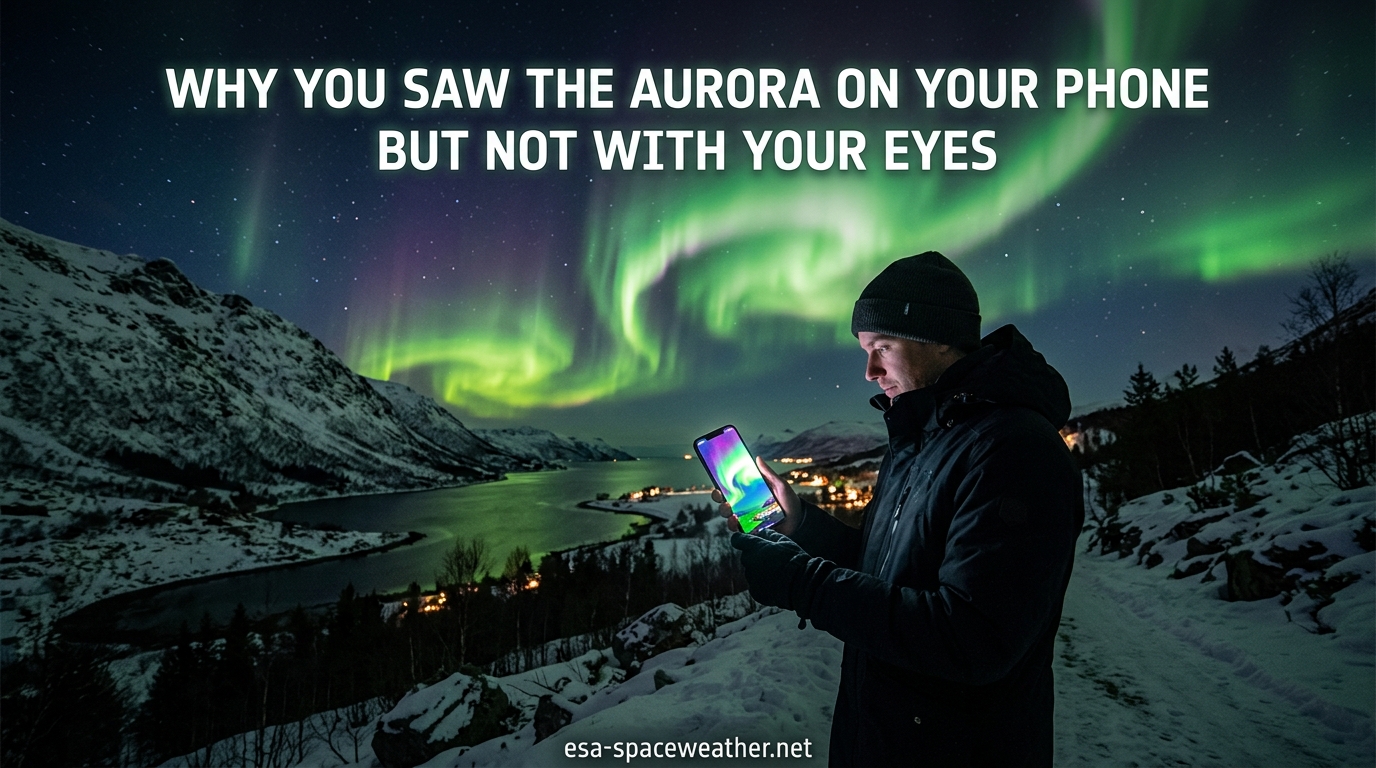
The camera trap: Modern smartphones and digital cameras are far more sensitive to aurora light than the human eye. Long-exposure photos can capture green and pink aurora that looks invisible to the naked eye. This creates a feedback loop: someone posts a stunning phone photo of “aurora” on social media from a location where the lights were actually invisible without a camera. Others see the photo, expect the same visual experience, and are disappointed.
The color exaggeration: Social media aurora photos are often color-enhanced, saturation-boosted, or taken with long exposures that bring out colors the human eye cannot perceive. To the naked eye, most aurora in the contiguous US appears as a faint white or grayish-green glow, not the vivid green and magenta curtains you see on Instagram. During strong storms, colors become more visible, but even then, the real experience is subtler than photos suggest.
The horizon reality: For most of the contiguous US outside Alaska and the extreme northern tier, aurora appears on the northern horizon, not overhead. You are looking at the top of the auroral oval, which appears as a band of glow along the horizon line. This can be beautiful, but it is a very different experience from standing underneath a full overhead corona in Alaska or Iceland.
The takeaway: set your expectations based on your latitude and the current Kp index. If you are in Tennessee during a Kp 7 storm, do not expect to see overhead curtains of light. Expect a possible faint glow on the northern horizon, best captured with a long-exposure phone photo from a dark-sky location. That is the realistic experience.
Factors That Affect Whether You Will Actually See the Aurora
Even when the Kp index is high enough for your latitude, several factors determine whether you will actually see the northern lights. Getting all of these right can make the difference between a magical night and a frustrating one.
1. Light pollution: This is the single biggest factor for most US viewers. The aurora is relatively faint compared to city lights, and even suburban light pollution can wash it out entirely. You need to get to a location rated Bortle Class 3 or darker on the Bortle Dark-Sky Scale. Resources like lightpollutionmap.info can help you find dark-sky locations within driving distance of your area.
2. Cloud cover: Aurora happens at 60 to 250 miles above the surface, well above any clouds. If it is overcast, you will see nothing regardless of how strong the storm is. Check cloud forecast maps before heading out. Services like NOAA’s National Weather Service and Clear Outside provide hour-by-hour cloud cover forecasts for your location.
3. Moon phase: A bright full moon produces significant sky brightness that can overwhelm faint aurora, especially at lower latitudes where the aurora is already near the visibility threshold. The best viewing happens during new moon or when the moon has set. During a G5 storm, moon phase matters less, but for moderate events, it can make or break your night.
4. Time of night: Aurora can occur at any time, but the most intense displays typically happen between 10 PM and 2 AM local time. This is when the auroral oval tends to be most active and when the night side of Earth is best positioned relative to the solar wind. Plan your viewing sessions for this window whenever possible.
5. Clear northern horizon: If you are south of the auroral oval, you need an unobstructed view to the north. Trees, hills, buildings, and city glow on the northern horizon will block your view. Lakes, fields, and hilltops facing north are ideal viewing locations for mid-latitude aurora chasers.
How to Check If the Northern Lights Will Be Visible Tonight
Checking aurora forecasts is easier than ever. Here is a simple step-by-step process you can follow every time you want to know if tonight is the night.
Step 1: Check the current Kp index. Visit NOAA’s Space Weather Prediction Center SWPC dashboard (swpc.noaa.gov) and look at the current estimated Kp index. If it is below Kp 4 and you live south of the northern-tier states, your chances are very low.
Step 2: Check the 30-minute forecast. NOAA’s OVATION aurora forecast model predicts auroral intensity 30 minutes ahead based on real-time solar wind data from the DSCOVR satellite. This is the most accurate short-term forecast available and is the tool aurora chasers monitor during active nights.
Step 3: Check the 3-day forecast. SWPC issues 3-day geomagnetic forecasts that predict Kp levels in 3-hour windows. This helps you plan ahead and know which nights to prioritize. Look for windows where Kp is forecast to reach 5 or higher.
Step 4: Monitor space weather alerts. SWPC issues alerts for CME arrivals, solar radiation storms, and radio blackouts. When a CME arrival is predicted, that is your signal to pay close attention for the next 24 to 48 hours. You can subscribe to SWPC email alerts or follow aurora notification services.
Step 5: Join a community. Reddit communities like r/auroraborealis and r/northernlights, along with local aurora-chasing Facebook groups, are invaluable for real-time sighting reports. When someone in your region posts that they can see aurora, it is time to head outside immediately. These communities often catch displays before official forecasts update.
Step 6: Use your phone camera. Even when the aurora is too faint for your eyes to detect, a modern smartphone in night mode or with a long-exposure app can reveal green or pink glow on the northern horizon. Take test shots pointed north and review them at full brightness. This technique has helped thousands of people see their first aurora from locations where it was invisible to the naked eye.
What’s the farthest south you can see the northern lights?
During extreme G5 geomagnetic storms, the northern lights can be seen as far south as 25 to 30 degrees north latitude, which includes Alabama, Mississippi, northern Florida, and even parts of Mexico. Under normal conditions, aurora visibility stays above 50 degrees north latitude. The key variable is the Kp index: Kp 9 events push aurora to the deep southern US, while Kp 4 or lower keeps it near the Canadian border.
How far south have the northern lights been visible?
The southernmost confirmed aurora sightings in US history occurred during the 1859 Carrington Event, when aurora was reported as far south as Cuba and Hawaii. In modern times, the May 2024 G5 storm produced sightings in Alabama, Mississippi, northern Florida, and Texas. The October 2003 Halloween storms and March 1989 storm also pushed aurora into the southern US.
What states in America can see the northern lights?
Alaska sees the northern lights regularly. Northern-tier states including Washington, Montana, North Dakota, Minnesota, Wisconsin, Michigan, Vermont, New Hampshire, and Maine see aurora multiple times per year during solar maximum. During strong storms, visibility extends to New York, Pennsylvania, Ohio, Illinois, Iowa, and Nebraska. During extreme events, aurora reaches as far south as Alabama, Mississippi, and northern Florida.
Will aurora be strong in 2026?
Yes, 2026 remains within the solar maximum window for Solar Cycle 25, meaning elevated geomagnetic activity and more frequent aurora displays than typical years. NOAA and NASA predict above-average solar activity through late 2026, with G3 and G4 storms occurring several times. This creates the best opportunity for southern US aurora viewing in over a decade, though individual storm strength still varies night to night.
Can you see the northern lights in Tennessee?
Tennessee sits at roughly 35 to 36 degrees north latitude, which means you need a G4 or G5 geomagnetic storm (Kp 8 or Kp 9) for any chance of seeing the aurora. During the May 2024 G5 storm, aurora was visible from parts of Tennessee as a reddish glow on the northern horizon. Under normal conditions, Tennessee is too far south for aurora viewing.
What Kp index do you need to see the northern lights in the US?
For northern-tier states (Alaska, northern Minnesota, northern Michigan, northern Maine), Kp 3 to Kp 4 can produce visible aurora. For mid-latitude states like Wisconsin, Oregon, and New York, you typically need Kp 5 to Kp 7. For southern states like Tennessee, Oklahoma, or Virginia, you need Kp 8 or Kp 9. Check the current Kp index at swpc.noaa.gov before planning a viewing session.
Conclusion: Your Realistic Aurora Outlook
Understanding how far south the Northern Lights can be seen in the US comes down to one number: the Kp index. Northern-tier states enjoy regular displays, mid-latitude states need moderate storms, and southern states require once-in-a-decade extreme events. With solar maximum continuing through 2026, now is the best time in years to chase aurora from US soil.
Set realistic expectations, check NOAA’s SWPC forecast regularly, find dark skies, and use your phone camera to capture what your eyes might miss. The aurora does not need to be overhead to be unforgettable. Even a faint green glow on the northern horizon, seen from a field in Iowa or a hilltop in Oregon, is a connection to the vast forces of space weather that shape our planet every day.