
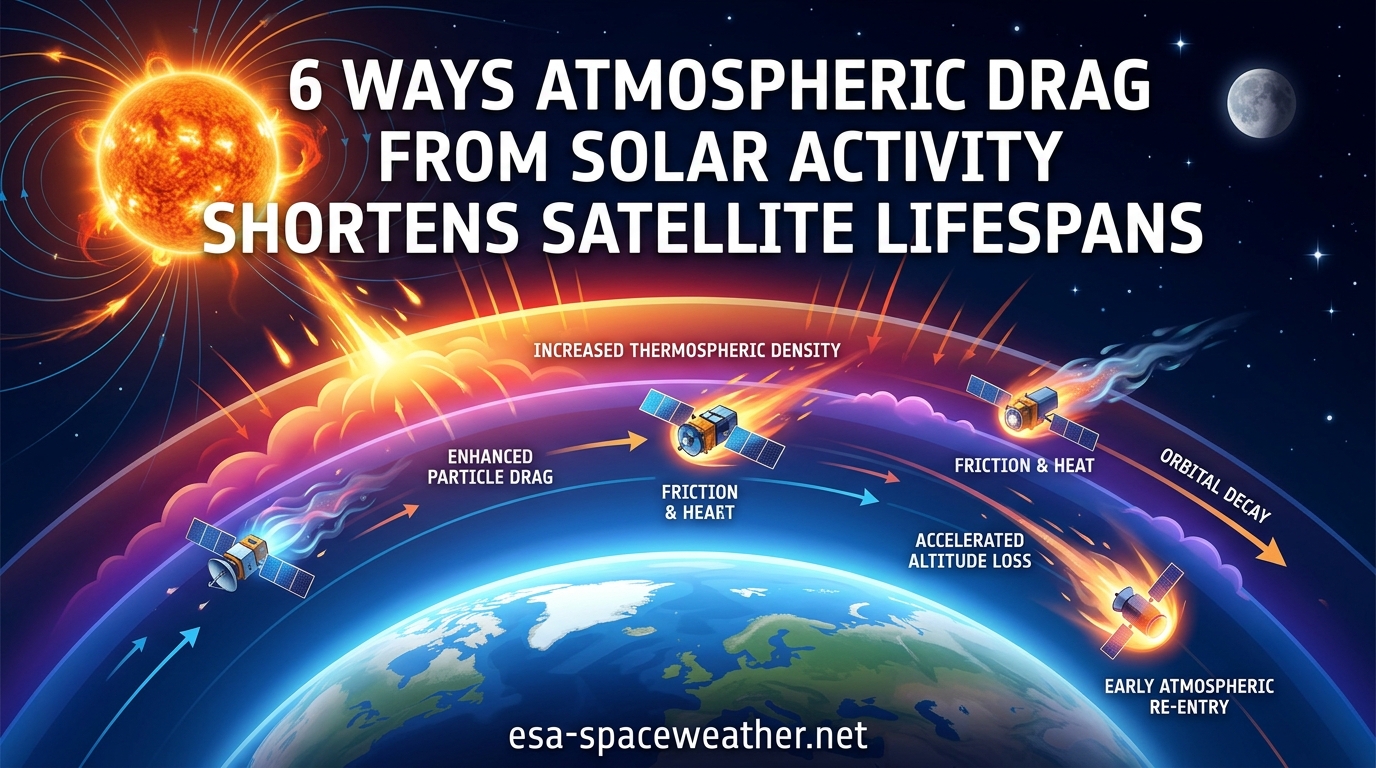
In February 2022, SpaceX watched helplessly as up to 40 brand-new Starlink satellites failed to reach their target orbits after a geomagnetic storm. The cause was not a rocket malfunction or a software bug. It was something far more fundamental: the Sun had heated and expanded Earth’s upper atmosphere, increasing atmospheric drag on the satellites to a level nobody anticipated during launch.
Understanding how atmospheric drag from solar activity shortens satellite lifespans is one of the most practically important topics in modern space operations. Every satellite in low Earth orbit (LEO) battles this invisible force daily. During solar maximum, that battle becomes a war of attrition that can strip years off a satellite’s operational life.
Our team has studied the physics, the historical data, and the operational challenges satellite operators face during periods of high solar activity. The story connects solar physics, orbital mechanics, atmospheric chemistry, and real-world engineering in ways that few resources explain clearly in one place.
In this guide, we break down the full causal chain from a solar flare on the Sun’s surface to a satellite losing altitude and burning up in the atmosphere years ahead of schedule. We cover the drag force equation in plain English, the role of the ballistic coefficient, real-world impacts on the ISS and Starlink constellation, and how scientists predict these effects using models like NRLMSISE-00 and JB2008.
Whether you are a satellite operator, an aerospace student, or simply curious about how the Sun affects the technology orbiting overhead, this article gives you the complete picture of atmospheric drag from solar activity and its impact on satellite lifespans.
Table of Contents
What Is Atmospheric Drag in Low Earth Orbit?
Atmospheric drag is the force exerted on a satellite as it moves through the thin but measurable gas molecules present in Earth’s upper atmosphere. Even at altitudes of 400 to 600 kilometers, where the International Space Station and many operational satellites orbit, the atmosphere is not a perfect vacuum. Trace amounts of gas molecules, primarily atomic oxygen and nitrogen, are still present in small but significant quantities.
When a satellite travels through this thin gas at orbital velocities of approximately 7.8 kilometers per second, it collides with these molecules. Each collision transfers a tiny amount of momentum from the satellite to the molecule. Individually, each collision is negligible. Collectively, across billions of collisions per second, the effect is powerful enough to gradually slow the satellite down.
As the satellite slows, its orbital altitude decreases. This is the fundamental mechanism of orbital decay. The lower the satellite drops, the denser the atmosphere becomes, which in turn increases the number of collisions and the drag force. This creates a positive feedback loop that accelerates the decay process as the satellite loses altitude.
The key insight is that atmospheric drag at orbital altitude is caused by frequent collisions of gas molecules with the satellite. The denser the atmosphere at a given altitude, the more molecules there are to collide with, and the faster the satellite decays.
This is why atmospheric drag is the dominant force affecting satellite lifespans in low Earth orbit. Above roughly 1,000 kilometers, the atmosphere is thin enough that drag becomes negligible and satellites can remain in orbit for centuries. Below 600 kilometers, drag is a constant, daily battle that operators must account for throughout the mission.
The 11-Year Solar Cycle: Solar Minimum vs Solar Maximum
The Sun does not output a constant level of energy. It follows an approximately 11-year cycle of rising and falling activity known as the Schwabe cycle, or simply the solar cycle. This cycle is the single most important factor determining how much atmospheric drag satellites experience over their operational lifetime.
During solar minimum, the Sun is relatively quiet. Sunspot numbers are low, solar flares are rare, and the total energy output from the Sun, particularly in the extreme ultraviolet (EUV) portion of the spectrum, is at its lowest level. The thermosphere contracts and cools, reducing atmospheric density at LEO altitudes.
During solar maximum, the situation reverses dramatically. Sunspot numbers peak, coronal mass ejections become frequent, and solar EUV irradiance increases significantly. The thermosphere absorbs this extra energy, heats up, and expands upward. This expansion pushes denser air to higher altitudes, directly into the orbital paths of LEO satellites.
Satellite operators describe the difference between solar minimum and solar maximum as night and day. During solar minimum, a satellite at 400 kilometers altitude might need a reboost maneuver, which uses thrusters to restore altitude, only a few times per year. During solar maximum, that same satellite might need reboosting every two to three weeks.
One of the most useful indicators scientists use to track the solar cycle is the F10.7 cm radio flux. This is a measurement of the radio energy the Sun emits at a wavelength of 10.7 centimeters, which correlates closely with solar EUV output. Higher F10.7 values mean more EUV radiation reaching the thermosphere, which means more heating, more expansion, and more drag on satellites.
As of 2026, the Sun is in the active phase of Solar Cycle 25, which means satellite operators are dealing with elevated drag conditions right now. Understanding where we are in the solar cycle is essential for predicting satellite behavior months and years ahead.
How Solar Activity Heats and Expands the Thermosphere
The thermosphere is the layer of Earth’s atmosphere extending from roughly 80 kilometers to 600 kilometers and beyond. It is where most LEO satellites operate, including the ISS, Hubble Space Telescope, and the Starlink constellation. Despite being extremely thin, the thermosphere is where the atmospheric drag story plays out.
Here is the chain reaction, step by step. Solar activity, particularly in the form of extreme ultraviolet radiation and X-ray emissions, deposits energy into the thermosphere. This energy is absorbed by the sparse gas molecules, primarily atomic oxygen, molecular nitrogen, and helium, causing them to move faster and heat up.
When gas heats up, it expands. This is basic thermodynamics. As the thermosphere heats, it expands upward, pushing the boundary between thin and slightly-less-thin air to higher altitudes. The practical consequence is that at a fixed altitude, say 400 kilometers, the atmospheric density can increase by a factor of 10 or even 100 during periods of high solar activity compared to solar minimum.
This density increase is what directly shortens satellite lifespans. More atmospheric density means more gas molecules per cubic meter. More molecules mean more collisions with the satellite per second. More collisions mean more drag force. More drag force means faster orbital decay.
Geomagnetic storms, triggered by coronal mass ejections from the Sun hitting Earth’s magnetosphere, can supercharge this process. A single strong geomagnetic storm can increase thermospheric density at LEO altitudes by a factor of 5 to 10 within hours. This is exactly what happened during the February 2022 event that claimed 40 Starlink satellites.
The Kp index, a scale from 0 to 9 that measures geomagnetic disturbance, is one of the tools operators watch closely. A Kp of 5 or higher indicates a geomagnetic storm capable of significantly increasing atmospheric drag in a short period. During the March 1989 storm, the Kp index reached 9, the maximum value.
The Drag Force Equation Explained Simply
To understand atmospheric drag from solar activity at a deeper level, we need to look at the drag force equation. Only one of our three main competitors covers this, so we want to make it accessible. The equation is:
FD = one-half times rho times v-squared times Cd times A
Let us break down each variable. FD is the drag force, measured in newtons, pushing against the satellite’s motion. Rho is the atmospheric density at the satellite’s altitude, measured in kilograms per cubic meter. V is the velocity of the satellite relative to the atmosphere, roughly 7,800 meters per second for LEO. Cd is the drag coefficient, a dimensionless number typically between 2.0 and 2.2 for satellites. A is the cross-sectional area of the satellite facing the direction of motion.
The most striking feature of this equation is the velocity term, which is squared. This means that drag force increases with the square of velocity. At orbital speeds, even a tiny increase in atmospheric density produces a large increase in drag force because the velocity multiplier is so enormous.
This is why solar activity is so impactful. When the thermosphere expands and atmospheric density increases by a factor of 10, the drag force on a satellite also increases by roughly a factor of 10, because velocity remains constant. There is no buffer, no mitigation in the equation itself. The only variable an operator can control is whether they fire thrusters to compensate.
For satellites without thrusters, such as CubeSats and many small satellites, the equation tells a stark story. They have no way to counteract increased drag. Every increase in solar activity directly translates to a shorter operational lifespan, with no recourse.
Think of it like driving a car. At 30 miles per hour on a calm day, you feel some air resistance. Now imagine the air suddenly becomes ten times denser, like driving through water. That is what happens to a satellite when solar activity spikes. The satellite is still moving at the same speed, but the medium it is traveling through has become dramatically thicker.
Ballistic Coefficient: Why Some Satellites Decay Faster
One factor that none of our three main competitors explain is the ballistic coefficient. This is a critical differentiator that determines why some satellites are affected by solar activity far more severely than others, even at the same altitude. Understanding it gives you insight that most resources skip entirely.
The ballistic coefficient is defined as B equals mass divided by drag coefficient times cross-sectional area. In formula form: B = m / (Cd times A).
A satellite with a high ballistic coefficient is heavy and compact. It has a lot of mass relative to its frontal area. Think of a bowling ball. It cuts through resistance efficiently and loses altitude slowly even during solar maximum. Military reconnaissance satellites and dense, well-designed communications satellites tend to have high ballistic coefficients.
A satellite with a low ballistic coefficient is light and has a large surface area relative to its mass. Think of a sheet of paper. It catches the air easily and slows down quickly. CubeSats, small satellites with deployed solar panels, and large but lightweight structures all have low ballistic coefficients and are disproportionately affected by increased atmospheric drag.
This is why the February 2022 Starlink event was so devastating. The Starlink satellites had just been deployed and were still in a low-altitude insertion orbit. They had large solar arrays deployed, giving them a large cross-sectional area, but their mass was relatively low compared to a mature satellite. Their ballistic coefficient was unfavorable, and when the geomagnetic storm hit, the increased drag overwhelmed their limited propulsion capability.
For satellite designers, the ballistic coefficient is a design consideration from day one. Increasing mass is expensive because every kilogram launched into orbit costs thousands of dollars. Reducing cross-sectional area can mean smaller solar panels, which means less power. There is always a tradeoff between drag resilience, power generation, and launch cost.
Altitude and Orbital Decay Timeframes
Altitude is the single most important variable in determining how long a satellite will survive in orbit. The relationship between altitude and orbital decay time is not linear. It is exponential, with small changes in altitude producing enormous differences in expected lifetime.
Here is a reference table based on widely cited atmospheric models. These figures represent approximate decay times for a typical satellite under average solar conditions. During solar maximum, decay times at lower altitudes can be dramatically shorter.
- 100 km: approximately 2 hours before reentry
- 150 km: approximately 1 day before reentry
- 200 km: approximately 1 week before reentry
- 300 km: approximately 1 month before reentry
- 400 km: approximately 1 to 2 years (ISS altitude, requires active reboost)
- 500 km: approximately 2 to 5 years
- 600 km: approximately 10 to 20 years
- 800 km: approximately 100 to 200 years
- 1,000 km: approximately 1,000+ years
The dramatic difference between 400 kilometers and 800 kilometers illustrates why orbital altitude is such a critical mission planning decision. A satellite at 400 kilometers, like the ISS, requires constant reboosting to stay in orbit. A satellite at 800 kilometers could remain operational for over a century.
However, there is a catch that connects directly to our topic. These decay times assume average solar conditions. During an extreme solar maximum, a satellite at 500 kilometers that would normally last 5 years might reenter in 2 years or less. The 11-year solar cycle introduces enormous variability into these estimates, and satellite operators must plan for worst-case solar conditions, not average ones.
This is also why the space debris community is concerned about the growing population of satellites at 500 to 600 kilometer altitudes. Objects at these altitudes will eventually decay, but the timescale is long enough that they pose a collision risk for decades. Solar activity can accelerate their removal, but unpredictably and in ways that are difficult to forecast with precision.
Real-World Impact on Satellites: ISS, Starlink, and Hubble
The physics we have covered so far becomes vivid when you look at how actual satellites and space missions deal with atmospheric drag from solar activity. Let us examine three of the most prominent examples.
The International Space Station
The ISS orbits at approximately 400 kilometers, which places it firmly in the zone where atmospheric drag is a daily concern. Under normal solar minimum conditions, the station loses about 50 to 100 meters of altitude per day and requires a reboost maneuver roughly four times per year.
During solar maximum, the situation changes dramatically. Atmospheric density at 400 kilometers can increase by a factor of 5 to 10, and the ISS may need reboosting every two to three weeks. Each reboost consumes propellant that must be delivered by cargo spacecraft, adding cost and logistical complexity to the mission. Operators describe solar maximum periods as requiring constant attention to orbital maintenance.
The Starlink Constellation
The Starlink constellation, with thousands of satellites in LEO, is perhaps the most visible example of solar activity affecting satellite lifespans. SpaceX operates its primary constellation at approximately 550 kilometers, an altitude chosen to balance coverage with a reasonable operational lifetime of roughly 5 years.
Why do Starlink satellites only last about 5 years? The answer is a combination of altitude and solar cycle exposure. At 550 kilometers, atmospheric drag is present but manageable under normal conditions. However, the satellites are designed with a limited propellant supply for orbit maintenance and collision avoidance. Once that propellant is exhausted, the satellite must be decommissioned and deorbited.
During solar maximum, propellant is consumed faster because reboost maneuvers are needed more frequently. A satellite designed to last 7 years under solar minimum conditions might only last 4 to 5 years if it spends significant time operating during solar maximum. This is not a design flaw. It is a deliberate tradeoff between cost, coverage, and orbital debris mitigation.
The Hubble Space Telescope
Hubble orbits at approximately 540 kilometers and has been operational since 1990. Over its lifetime, it has experienced multiple solar cycles and has required periodic reboosting, originally performed by Space Shuttle missions. Without reboost, Hubble’s orbit would eventually decay to the point of uncontrolled reentry.
The concern for Hubble is that without the Space Shuttle, reboost options are limited. Atmospheric drag from solar activity during Solar Cycle 25 could bring Hubble’s reentry date closer than originally projected. This has prompted discussions about commercial reboost missions to extend the telescope’s orbital lifetime.
Historical Solar Storms That Dropped Satellites
History provides some of the most compelling evidence for how atmospheric drag from solar activity shortens satellite lifespans. Two events stand out as case studies that satellite operators study closely.
The March 1989 Geomagnetic Storm
In March 1989, one of the most powerful geomagnetic storms of the 20th century struck Earth. The Kp index reached 9, the highest possible value. The storm caused widespread effects on the ground, including the collapse of the Hydro-Quebec power grid in Canada, leaving millions without electricity.
In orbit, the effects were equally dramatic. NASA’s Solar Maximum Mission satellite, launched in 1980 to study the Sun, experienced such a sudden increase in atmospheric drag that operators described it as having dropped as if it hit a brick wall. The satellite lost significant altitude in a matter of hours. NORAD, the military command responsible for tracking objects in orbit, had to re-identify hundreds of objects whose orbits had changed so dramatically that they could no longer be matched to their catalogued positions.
This event demonstrated that atmospheric drag is not always a slow, gradual process. A sufficiently powerful geomagnetic storm can produce step-function changes in satellite orbits that catch operators off guard and overwhelm tracking systems.
The February 2022 Starlink Event
In February 2022, SpaceX launched 49 Starlink satellites into a low insertion orbit at approximately 210 kilometers. The plan was for each satellite to use its onboard ion propulsion to raise its orbit to the operational altitude of 550 kilometers.
A geomagnetic storm struck the day after launch. The storm increased atmospheric density at 210 kilometers to levels that the satellites’ ion propulsion could not overcome. Despite the satellites being placed into a safe mode to minimize drag, up to 40 satellites were doomed. They reentered the atmosphere within days, creating a spectacular but costly failure.
This event is now studied as a textbook case of how atmospheric drag from solar activity can defeat satellite operations. It also highlighted the importance of accounting for space weather forecasts in launch planning, particularly for satellites inserted into low initial orbits where atmospheric density is highest.
How Scientists Track and Predict Atmospheric Drag
Predicting atmospheric drag on satellites is one of the most challenging problems in orbital mechanics. The difficulty stems from the fact that atmospheric density at LEO altitudes is influenced by solar activity, which is itself inherently unpredictable beyond a few days.
Scientists use atmospheric density models to estimate drag. The two most widely used empirical models are NRLMSISE-00, developed by the US Naval Research Laboratory, and JB2008, developed by the US Air Force Space Command. Both models take solar and geomagnetic indices as inputs and output atmospheric density as a function of altitude, latitude, and time.
NRLMSISE-00 is considered the standard model for general-purpose orbit propagation. It accounts for seasonal variations, latitudinal differences, and the effects of solar EUV heating. JB2008 was designed to improve accuracy during periods of high solar activity, particularly for the types of density variations that occur during geomagnetic storms.
A newer approach uses physics-based models such as the Whole Atmosphere Model with Ionosphere, Plasmasphere, and Electrodynamics (WAM-IPE), developed by NOAA. Unlike empirical models that rely on historical data correlations, physics-based models simulate the actual physical processes that drive thermospheric density changes. NOAA now offers real-time WAM-IPE products that satellite operators can access for operational planning.
Despite these advances, significant uncertainty remains. Atmospheric drag is the largest source of uncertainty in orbit determination for LEO satellites. Predictions of a satellite’s position can be off by kilometers after just a few days, especially during active solar periods. This uncertainty makes collision avoidance more difficult and increases the operational burden on satellite operators.
NORAD’s Space Surveillance Network tracks over 25,000 catalogued objects in Earth orbit, along with an estimated 500,000 smaller uncatalogued debris pieces. After major geomagnetic storms, NORAD faces the task of re-acquiring and re-cataloguing objects whose orbits have shifted beyond their predicted positions. This operational challenge underscores why better atmospheric drag prediction is a priority for both civilian and military space organizations.
Growing LEO Constellations and Space Weather Risk
The rapid growth of LEO satellite constellations in 2026 and beyond is creating a new risk landscape for atmospheric drag from solar activity. SpaceX’s Starlink constellation alone has thousands of satellites in orbit. Amazon’s Project Kuiper, OneWeb, and numerous national constellations are adding hundreds more each year.
More satellites mean more objects exposed to atmospheric drag simultaneously. During a major geomagnetic storm, dozens or hundreds of satellites across multiple constellations may need to perform collision avoidance maneuvers at the same time, straining operator resources and communication bandwidth.
Small satellites and CubeSats are particularly vulnerable. Many have no propulsion at all and rely entirely on natural orbital decay for end-of-life disposal. During solar maximum, these satellites decay faster than planned, which can actually help clear orbital debris. But the unpredictability of the timing creates challenges for operators who need to maintain service continuity.
This connects to the Kessler Syndrome, a theoretical scenario in which the density of objects in LEO becomes so high that collisions cascade, creating debris that causes more collisions. Atmospheric drag is actually one of the natural forces that helps prevent the Kessler Syndrome by clearing debris from lower altitudes. However, the growing population of satellites at 500 to 600 kilometers, where drag is weaker, means debris at these altitudes will persist much longer.
For the future, satellite operators and regulators are paying increasing attention to space weather preparedness. The 25-year rule for satellite deorbiting, established by international guidelines, requires that satellites in LEO be removed from orbit within 25 years of end of life. Solar activity plays a direct role in whether natural decay will achieve this or whether active deorbiting is required.
Planning satellite missions around the solar cycle is becoming a standard practice. Launching a satellite just before solar minimum gives it the longest possible lifetime before drag intensifies. Launching during solar maximum means accepting higher fuel costs and potentially shorter operational life from day one.
How Atmospheric Drag From Solar Activity Shortens Satellite Lifespans: Key Takeaways
The mechanism is straightforward even if the physics is complex. Solar activity heats the thermosphere, the thermosphere expands, atmospheric density at satellite altitudes increases, more molecules collide with satellites, drag force goes up, and satellites lose altitude faster. This chain reaction is the primary driver of orbital decay in low Earth orbit.
For operators, the practical implications are clear. During solar maximum, expect reboost frequency to increase by a factor of 5 to 10. Plan propellant budgets for worst-case solar conditions, not average ones. Monitor space weather forecasts from NOAA’s Space Weather Prediction Center and be prepared to act quickly during geomagnetic storms.
For those designing satellites, the ballistic coefficient matters. Heavy, compact satellites survive longer than light, large-area satellites. Every design decision involving mass, surface area, and propulsion capability affects how vulnerable a satellite will be to solar-driven atmospheric drag.
As LEO constellations continue to grow in 2026 and beyond, understanding and predicting atmospheric drag from solar activity will only become more important. The Sun’s 11-year cycle is an unavoidable fact of life for everyone working in low Earth orbit, and respecting its impact is essential for mission success.
FAQs
What are the effects of atmospheric drag on satellites?
Atmospheric drag on satellites causes gradual orbital decay by slowing the satellite through collisions with gas molecules in the upper atmosphere. As the satellite slows, it loses altitude, which increases atmospheric density and accelerates further decay. This shortens the satellite’s operational lifespan and, if uncorrected by reboost maneuvers, leads to atmospheric reentry.
What is the 25 year rule for satellites?
The 25-year rule is an international guideline requiring that satellites in low Earth orbit be deorbited or removed from orbit within 25 years after the end of their operational mission. This rule, established by the Inter-Agency Space Debris Coordination Committee (IADC) and adopted by the FCC and other regulators, is designed to limit the growth of orbital debris. Natural orbital decay from atmospheric drag helps many LEO satellites comply, but satellites at higher altitudes or during solar minimum may require active deorbiting.
Why do Starlink satellites only last 5 years?
Starlink satellites last approximately 5 years because they operate at around 550 kilometers altitude, where atmospheric drag is manageable but persistent, and they carry a limited supply of propellant for orbit maintenance and collision avoidance. During solar maximum, drag increases and propellant is consumed faster for reboost maneuvers. Once propellant is depleted, the satellite is deliberately deorbited. This short lifespan is a deliberate design choice that balances coverage, cost, and space debris mitigation.
Why doesn’t the Sun melt satellites?
The Sun does not melt satellites because although solar radiation is intense in space, satellites are designed with thermal control systems including reflective coatings, insulation, and radiators that dissipate absorbed heat. The heating effect of solar activity that matters for satellites is not melting but the expansion of Earth’s thermosphere, which increases atmospheric drag. Satellites are built to withstand temperatures ranging from minus 150 to plus 150 degrees Celsius in orbit.
Can a solar storm knock a satellite out of orbit?
A single solar storm rarely knocks a healthy satellite out of orbit entirely, but it can significantly lower its altitude. During the March 1989 geomagnetic storm, satellites dropped abruptly as if hitting a wall. In February 2022, 40 Starlink satellites were lost when a storm increased drag beyond their propulsion capability at low insertion altitude. Satellites with active propulsion can usually recover, but those without fuel or at very low altitudes can be doomed.
What altitude is safe from atmospheric drag?
Above approximately 1,000 kilometers, atmospheric drag becomes negligible and satellites can remain in orbit for over a thousand years. At 800 kilometers, orbital lifetime is roughly 100 to 200 years. At 500 kilometers, it drops to 2 to 5 years. At the ISS altitude of 400 kilometers, active reboosting is required regularly. No altitude is perfectly safe, but above 1,000 kilometers the drag is so weak that it is not a practical concern for satellite lifespans.
Conclusion
Atmospheric drag from solar activity shortens satellite lifespans through a clear and well-understood chain of physical processes. The Sun heats the thermosphere, the thermosphere expands, air density at orbital altitudes rises, satellites collide with more molecules, drag force increases, and orbital decay accelerates. This is the fundamental reason why every satellite in low Earth orbit has a finite, solar-cycle-dependent operational lifetime.
Understanding how atmospheric drag from solar activity shortens satellite lifespans is essential for anyone involved in satellite operations, mission planning, or space policy. As we move deeper into Solar Cycle 25 and as LEO constellations continue to expand, this knowledge will only grow more relevant. The Sun’s influence on satellites is not a distant theoretical concern. It is a daily operational reality that shapes the economics, safety, and sustainability of activities in low Earth orbit.