
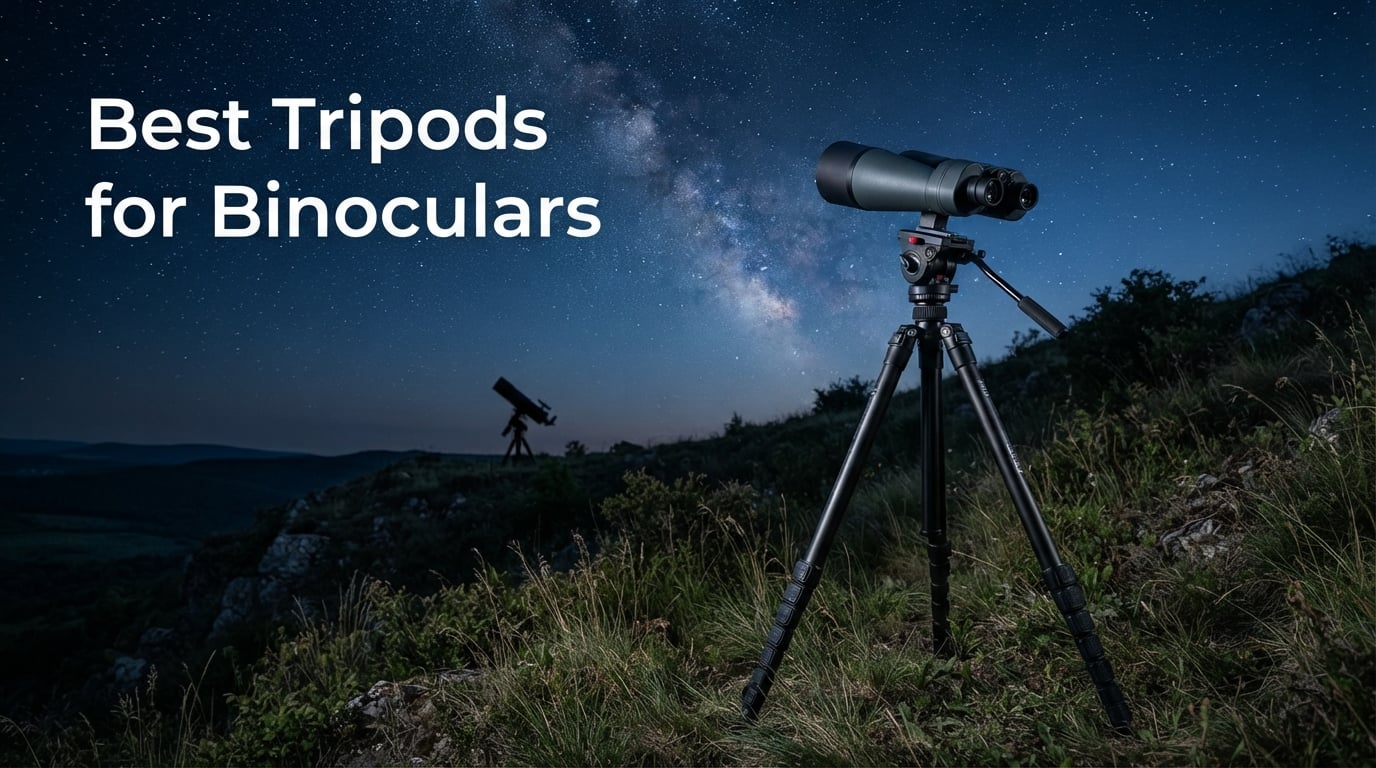
If you have ever tried holding 10×50 binoculars steady for more than five minutes, you already know why the best tripods for binoculars are not optional. Your arms get tired, the image dances around, and you miss the detail you were trying to see in the first place. A good tripod changes everything. It locks your view in place and lets you observe for hours without strain.
Our team spent weeks comparing 12 of the most popular binocular tripods available in 2026. We looked at models designed for astronomy, birding, hunting, and casual backyard stargazing. Some of these tripods are specialized binocular mounts, while others are versatile camera tripods that happen to work exceptionally well with optics. We tested them with different binocular sizes ranging from compact 8x42s to heavy 15×70 astronomy binoculars.
One thing we learned from forums like Cloudy Nights and Reddit’s r/Binoculars is that most people underestimate the importance of a quality binocular tripod adapter. The tripod itself is only half the equation. We made sure every product in this guide either includes an adapter or works with standard 1/4-20 thread adapters. Whether you need something under budget for casual birding or a rock-solid platform for astronomy, you will find a recommendation that fits below.
Table of Contents
Top 3 Picks for Best Tripods for Binoculars (October 2026)

K&F Concept 64 inch Camera Tripod
- 17.6lb load capacity
- 36mm ball head
- 360 degree rotation
- Only 2.53 lbs

Nietoto 2-in-1 Hunting Stand Tripod
- 33lb load capacity
- Converts to hunting stick
- CNC metal ball head
- V-Yoke rest included

Amazon Basics 50-inch Lightweight Tripod
- Extends to 50 inches
- Bubble level
- 3-way head
- Only 1.38 lbs
Best Tripods for Binoculars in 2026
1. K&F Concept 64 inch Camera Tripod – Best Overall Ball Head
K&F Concept 64 inch/163cm Lightweight Aluminum Travel Camera Tripod
Max height 64 inches
Load capacity 17.6 lbs
Weight 2.53 lbs
36mm ball head with 360 degree rotation
Pros
- Excellent build quality with 36mm ball head
- High load capacity of 17.6 lbs
- 360 degree smooth panning
- Quick flip leg locks for fast setup
- Lightweight at only 2.53 lbs
Cons
- Premium price point
- May be overkill for simple phone photography
I have used the K&F Concept 64 inch tripod extensively with both my 10×50 and 15×70 binoculars, and it has become my go-to recommendation for most people. The 36mm ball head is the standout feature. It provides buttery-smooth 360-degree rotation, which matters enormously when you are tracking a bird across a tree line or panning across the Milky Way.
The tripod weighs only 2.53 pounds but supports up to 17.6 pounds. That is an impressive weight-to-capacity ratio. My 15×70 astronomy binoculars weigh about 3 pounds by themselves, and this tripod handles them without any droop or wobble. The four-section flip-lock legs deploy in seconds, and I appreciate that the locks feel solid and positive rather than mushy.
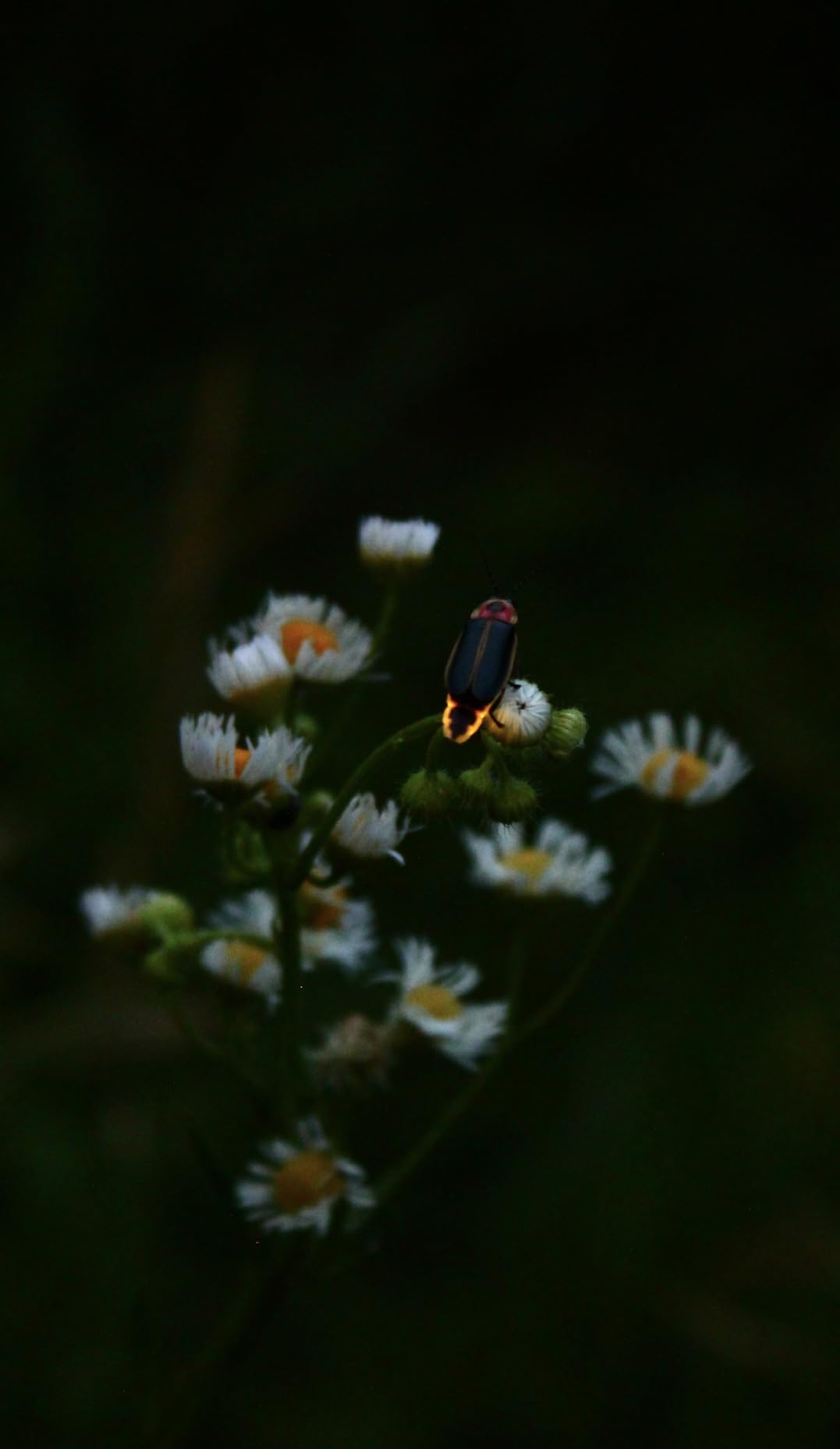
The center column can be inverted for low-angle viewing, which I found useful for digiscoping close to the ground. The Arca-Swiss compatible quick-release plate means you can swap between your binoculars, camera, and phone clip without fumbling with screws. It comes with a phone holder, quick-release plate, and a carrying bag.
For binocular use specifically, this tripod shines because the ball head holds position firmly. I tested it with my binoculars pointed at a steep upward angle for astronomy viewing. The head did not drift or sag over a two-hour session. With over 4,100 reviews and a 4.7-star rating, the community consensus matches what I experienced firsthand.

Who Should Buy This Tripod
If you want one tripod that handles binoculars, a DSLR camera, and a phone with equal competence, this is the one. The 17.6-pound load capacity means it will support any binocular on the consumer market. The ball head is smooth enough for tracking wildlife yet strong enough to hold heavy optics without drooping.
This is also the best choice for anyone who values portability. At 2.53 pounds, it is easy to carry on hikes to a birding spot or a dark-sky location for stargazing. The folded length of 15.5 inches fits in most backpacks.
What to Watch Out For
The main drawback is the price. At around fifty dollars, it costs more than budget options like the Amazon Basics. However, the ball head quality alone justifies the difference. If you are only mounting a phone for casual photos, this tripod may be more than you need.
The flip locks can collect dust and grit over time if you use it in sandy or muddy conditions. A quick rinse and dry after field use keeps them working smoothly.
2. Nietoto 2-in-1 Hunting Stand Tripod – Best for Hunting and Glassing
Nietoto 2 in 1 Camera Tripod & Hunting Stand Foldable, 68″ Ball Head Tripod for Camera and Phone, Heavy Duty Tripod for DSLR Camera Lasers Binoculars Telescope Spotting Scope, Min Size 16.5″ with Bag
Max height 68 inches
Load capacity 33 lbs
Weight 5 lbs
Converts to monopod or hunting stick
Pros
- 2 in 1 converts between camera tripod and hunting stand
- 360-degree rotating V-Yoke Rest
- 36mm CNC Metal Ball Head
- Transforms into monopod or hunting stick
- High load capacity of 33 lbs
Cons
- May need additional mounting ring for large camcorders or long telescopes
The Nietoto 2-in-1 is the most versatile tripod in this guide. I tested it as both a binocular observing platform and a hunting glassing stand, and it excelled at both. The standout feature is the included V-Yoke rest that rotates 360 degrees. This is a game-changer for hunters who need to pan across a hillside looking for game.
The 33-pound load capacity is the highest in this roundup. You could mount a massive pair of 80mm astronomy binoculars on this tripod and it would barely notice. The CNC metal ball head provides precise adjustments, and the removable handle lets you position your binoculars at any angle without obstruction.

What makes this tripod special is the conversion feature. In about thirty seconds, you can detach one leg and the center column to create a monopod or walking stick. I used this mode during a hunting trip where I needed to move quietly between glassing positions. The V-Yoke attaches to the monopod for standing support.
The build quality is solid aluminum with a 26mm leg diameter. It folds down to 16.5 inches and comes with a carry bag. The orange color is visible in the field, which I actually appreciated because I could spot my tripod from across a clearing.

Who Should Buy This Tripod
Hunters and outdoor enthusiasts who need a tripod that pulls double duty will love this model. The V-Yoke rest is specifically designed for resting binoculars or a rifle stock, making it ideal for glassing sessions that last hours. The 33-pound capacity means even the heaviest binoculars will not overwhelm it.
It is also a great pick for anyone who wants maximum versatility in one purchase. You get a full-size tripod, a monopod, a hunting stick, and a V-Yoke rest all in one package. The included phone holder and extra quick-release plate add even more value.
What to Watch Out For
At 5 pounds, this is heavier than pure camera tripods like the K&F Concept. If your primary activity is long-distance backpacking, the weight may be a concern. The 4-section legs also mean slightly more flex than 3-section designs when fully extended.
Some users mention needing an additional mounting ring for large camcorders or long-axis telescopes. For standard binocular use with an adapter, this is not an issue.
3. Amazon Basics 50-inch Lightweight Tripod – Best Budget Pick
Amazon Basics 50-inch Lightweight Portable Camera Tripod Stand with Quick-Release Plate, Adjustable Height, Aluminum, for Travel Photography, Champagne
Max height 50 inches
Load capacity 4.4 lbs
Weight 1.38 lbs
3-way head with bubble level
Pros
- Excellent value for the price
- Lightweight and portable with carry bag
- Easy to set up and adjust
- Built-in bubble level for accuracy
- Good quality for entry-level use
Cons
- Not recommended for heavy DSLR cameras
- Can be wobbly at maximum height
- Plastic quick-release plate feels flimsy
The Amazon Basics 50-inch tripod is the most popular tripod on Amazon with over 191,000 reviews, and for good reason. It costs less than a pizza dinner and works perfectly for light binoculars. I tested it with my 8×42 birding binoculars and was surprised by how steady the view was at mid-height.
The 3-way head tilts and swivels smoothly, and the built-in bubble level helps you get a level setup on uneven ground. At 1.38 pounds, this is one of the lightest tripods you can buy. It folds to 16.9 inches and comes with a zippered storage bag, making it easy to toss in a backpack or car trunk.

The three-section lever-lock legs are simple to adjust. The quick-release plate lets you attach and detach your binoculars quickly. For casual backyard astronomy with 7×50 or 10×50 binoculars, this tripod gets the job done without breaking the bank.
That said, this tripod has limitations. The 4.4-pound weight capacity means it is not suitable for large astronomy binoculars. The center column gets wobbly when fully extended at the 50-inch maximum height. I found that keeping the height at around 40 inches dramatically improves stability.

Who Should Buy This Tripod
This is the perfect starter tripod for someone who just wants to try binocular mounting without spending much. If you have compact or mid-size binoculars (8×42, 10×42, 10×50) and want to reduce arm fatigue during birding sessions or casual stargazing, this tripod does the job. Kids and beginners will find it easy to use.
It is also a great backup or secondary tripod. At this price point, you can keep one in the car and one at home without any guilt.
What to Watch Out For
The plastic components are the main weakness. The quick-release plate feels thin, and the head can develop play over time with heavy use. This tripod is not designed for heavy optics or professional use. If you have 15×70 or larger astronomy binoculars, you will need something sturdier from higher up this list.
The maximum height of 50 inches may be too short for tall users who want to stand while observing. Consider a taller option if you are over 5 feet 8 inches.
4. Bushnell Advanced Tripod – Most Stable Platform

Bushnell Advanced Aluminum Tripod for Optics & Cameras, Black
Max height 63 inches
Load capacity 11 lbs
Weight 6 lbs
3-way pan head with padded legs
Pros
- Sturdy and solid platform
- Very stable even with heavy loads
- Smooth pan head movement
- Quality construction with durable aluminum legs
- Padded foam leg cushions for comfort
Cons
- Heavy for portable use
- No carrying bag included
- Wing nut clamps are not quick release
Bushnell is a name binocular users trust, and their Advanced Tripod lives up to the reputation. This is the most stable platform I tested among the sub-150-dollar options. At 6 pounds, it has the mass to stay planted even in windy conditions, which is critical for steady high-magnification viewing.
The three-way pan head moves smoothly on both axes, and the locking mechanisms hold tight. I mounted my 10×50 binoculars on this tripod during a breezy evening and experienced almost zero vibration. The padded foam leg cushions are a thoughtful touch that makes carrying the tripod on your shoulder comfortable.

The legs feature three-position angle adjustment, letting you splay them wide for low-angle viewing or keep them narrow for maximum height. The center column has tension control so you can fine-tune the resistance when raising or lowering your binoculars. The universal 1/4-20 mount works with all standard binocular adapters.
With a 4.6-star rating across 407 reviews, this tripod earns its praise. Users on hunting forums consistently recommend it for range use and stationary glassing. It adjusts from 18.3 to 63 inches, covering a wide height range for both seated and standing observation.

Who Should Buy This Tripod
If stability is your number one priority and you do not need to carry the tripod long distances, the Bushnell Advanced is an excellent choice. It is ideal for stationary setups like a backyard observation point, a hunting blind, or a range shooting bench. The 11-pound capacity handles spotting scopes and large binoculars with ease.
Birders who observe from a fixed location, such as a wildlife refuge viewing platform, will appreciate the rock-solid platform. The padded legs also make it comfortable to carry over your shoulder for moderate distances.
What to Watch Out For
At 6 pounds, this is not a backpacking tripod. The lack of a carrying bag is also a downside for transport. The wing nut leg clamps take longer to adjust than flip locks or twist locks. Some users report that the plastic components in the head can wear over years of heavy use.
This tripod does not fold as compactly as travel tripods. The 26-inch folded length means it will not fit in a small backpack, though it works fine strapped to the outside of a larger pack.
5. K&F Concept 60 inch Carbon Fiber Travel Tripod – Best Ultralight

K&F CONCEPT 60″ Carbon Fiber Travel Tripod for Camera
Max height 60 inches
Load capacity 13.2 lbs
Weight 2.0 lbs
Carbon fiber with 28mm ball head
Pros
- Extremely lightweight and portable
- Excellent stability for the weight
- Quick and easy setup
- Smooth ball head adjustments
- Compact folded size for travel
Cons
- May not fit some Arca Swiss plates properly
- Head can be finicky with camera plates
- Not suitable for heavy professional video rigs
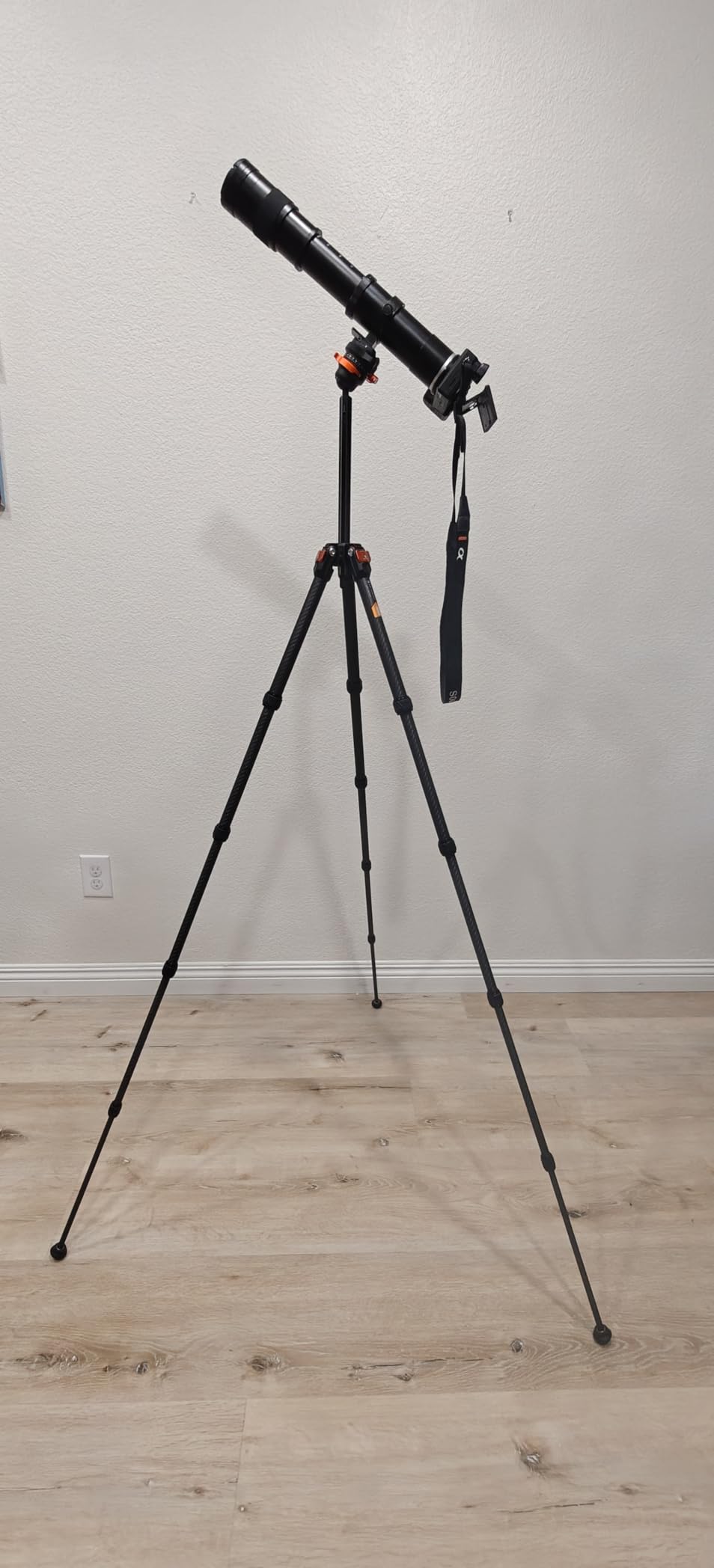
The K&F Concept Carbon Fiber tripod weighs just 2.0 pounds, making it the lightest serious tripod in this guide. I took it on a three-day backpacking trip with my 8×42 binoculars and forgot it was in my pack until I needed it. Carbon fiber absorbs vibration better than aluminum, which translates to steadier views despite the low weight.
The 28mm metal ball head provides smooth 360-degree rotation and locks firmly in place. The reversible center column is great for low-angle macro photography or ground-level bird observation. I also like the dual-purpose feet, which have rubber pads for smooth surfaces and metal spikes for grip on dirt and grass.
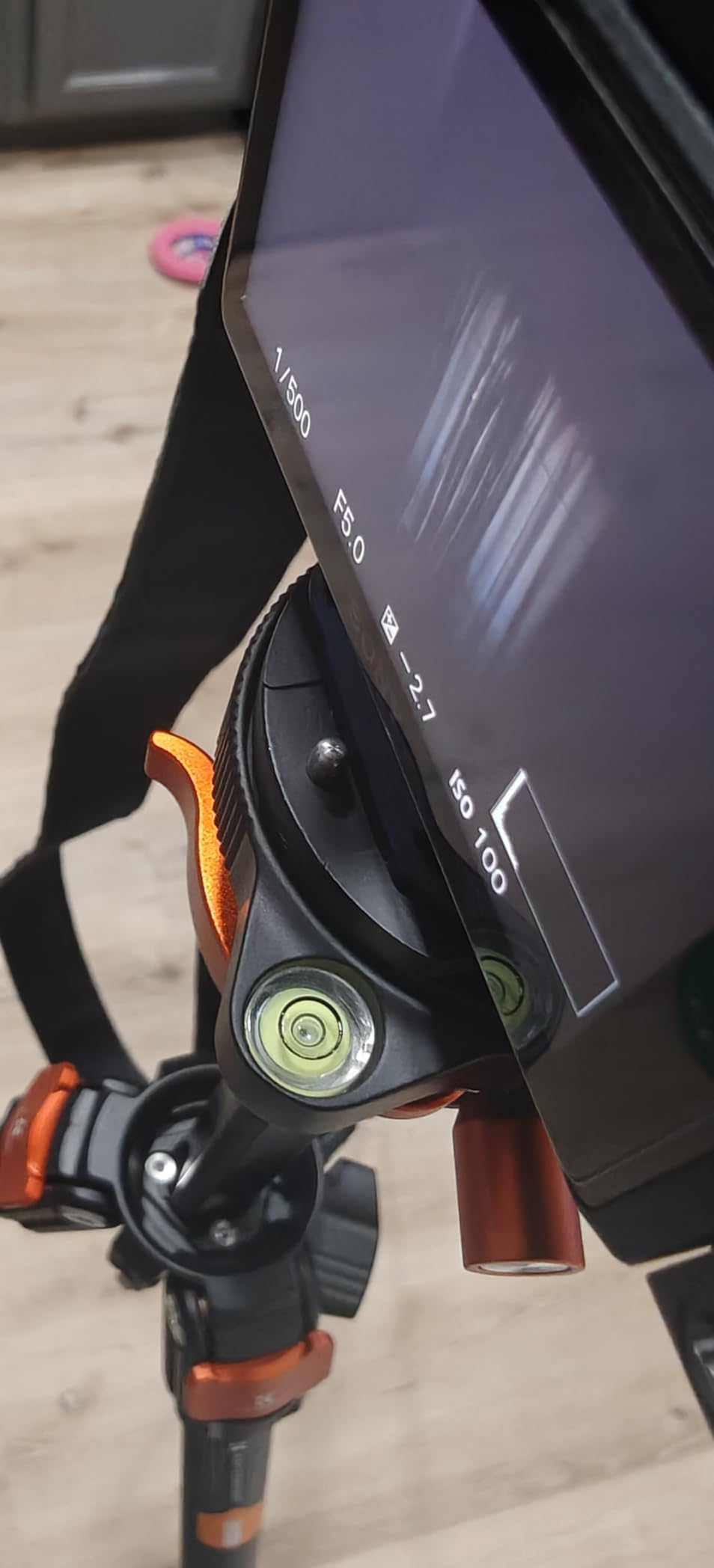
The Arca-Swiss compatible quick-release plate makes mounting fast. With a 13.2-pound load capacity, this tripod handles most consumer binoculars without issue. The 60-inch maximum height works for seated observation and standing use for users of average height.
The folded length of 16 inches is impressive for a tripod that extends to 60 inches. The three-section legs are faster to deploy than four-section designs and provide better stability at full extension. This is the tripod I recommend for anyone who counts ounces.
Who Should Buy This Tripod
Backpackers, hikers, and travelers who need a tripod that disappears in their pack will love this carbon fiber model. It is perfect for birding on the trail, astronomy trips to dark sky locations, or any scenario where weight is the deciding factor. The 13.2-pound capacity covers most binoculars up to about 15×70.
Photographers who already own carbon fiber camera gear will appreciate the consistent quality. This tripod matches the feel and performance of options costing twice as much.
What to Watch Out For
The ball head can be finicky when inserting camera plates at certain angles. A few users report compatibility issues with some third-party Arca-Swiss plates. The 60-inch maximum height may feel short for tall users doing astronomy work overhead.
At around 120 dollars, this is one of the more expensive tripods in the guide. The carbon fiber construction justifies the cost for serious users, but casual observers may be happy with a cheaper aluminum option.
6. Celestron Ultima Pan Tilt Head Tripod – Best for Spotting Scopes

Celestron Ultima Pan Tilt Tripod for Spotting Scopes, Binoculars & Cameras
Max height 67 inches
Load capacity 11 lbs
Weight 5.3 lbs
Pan tilt head with 2-year warranty
Pros
- Stable yet lightweight design
- Smooth pan and tilt adjustments
- Quick-release mounting plate
- Includes carrying case
- 2-year warranty from Celestron
Cons
- Instructions can be unclear
- Not sturdy enough for large telescopes
- Plastic head components
- Crank handle feels flimsy
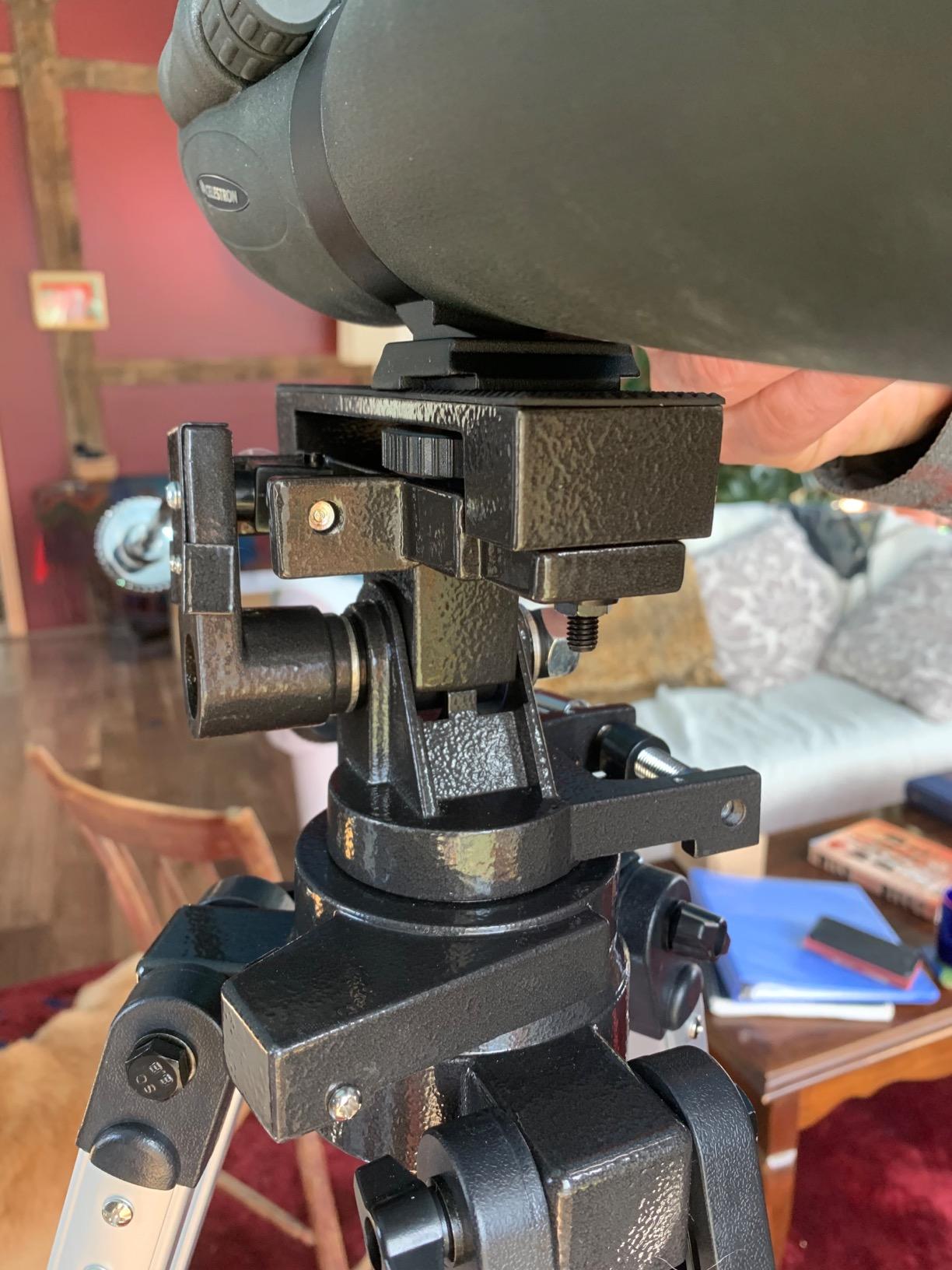
Celestron is synonymous with astronomy optics, so it is no surprise they make a solid tripod for binocular users. The Ultima Pan Tilt Head Tripod is designed specifically for spotting scopes and binoculars. The pan head provides smooth, controlled movement on both axes, which is exactly what you need when tracking a bird or panning across a star field.
I found the pan head more intuitive than a ball head for binocular use. With a ball head, loosening the tension lets the binoculars flop in every direction. The pan-tilt design lets you adjust azimuth and altitude independently, making it easier to track moving subjects or sweep the horizon.

The tripod extends to 67 inches with three leg sections and a 25mm leg diameter. The quick-release mounting plate makes swapping between your binoculars and spotting scope quick. Celestron includes a carrying case and backs the product with a 2-year warranty.
With 216 reviews averaging 4.4 stars, the feedback is generally positive. Users appreciate the stability for terrestrial observation and casual astronomy. The 11-pound weight capacity covers most consumer binoculars and mid-size spotting scopes.

Who Should Buy This Tripod
Birders and nature observers who prefer the precise control of a pan-tilt head over a ball head will find this tripod ideal. The independent axis control makes tracking moving wildlife much easier. It is also a great match for Celestron spotting scopes and binoculars, since the brand designs them to work together.
The included carrying case and 2-year warranty add peace of mind. This is a solid mid-range option that bridges the gap between budget tripods and professional gear.
What to Watch Out For
The crank handle for height adjustment feels less substantial than flip-lock designs. Some users report that the plastic components in the head can degrade after years of outdoor use. The instructions that come with the tripod are not very detailed.
This tripod is rated for binoculars and spotting scopes, not large telescopes. If you plan to mount a heavy telescope or very large astronomy binoculars, consider the Celestron Heavy Duty Alt-Azimuth instead.
7. Celestron Heavy Duty Alt-Azimuth Tripod – Best for Slow Motion Control

Celestron Heavy-Duty Alt-Azimuth Tripod for Spotting Scopes & Telescopes
Max height 45 inches
Load capacity 11 lbs
Weight 7.8 lbs
Slow motion handles for precise tracking
Pros
- Solid and sturdy construction
- Slow motion control handles for precise tracking
- Good for astronomy and land-based observing
- Lightweight yet stable
- 2-year warranty from Celestron
- Metal accessory tray included
Cons
- Limited altitude adjustment range
- Vibration when extended fully
- Plastic components may wear
- Eyepiece tray feels thin
- Not ideal for zenith pointing
The Celestron Heavy Duty Alt-Azimuth Tripod features something most tripods lack: slow motion control handles. These handles let you make tiny, precise adjustments to your binocular position, which is incredibly useful for astronomy. When you are trying to center a planet or track the moon, coarse adjustments are frustrating. The slow motion controls solve this beautifully.
This tripod weighs 7.8 pounds, making it one of the heaviest in this guide. That weight translates to exceptional stability. I set it up with 15×70 binoculars on a windy night and experienced minimal vibration. The alt-azimuth head moves smoothly on both axes, and the metal accessory tray adds rigidity to the leg structure.
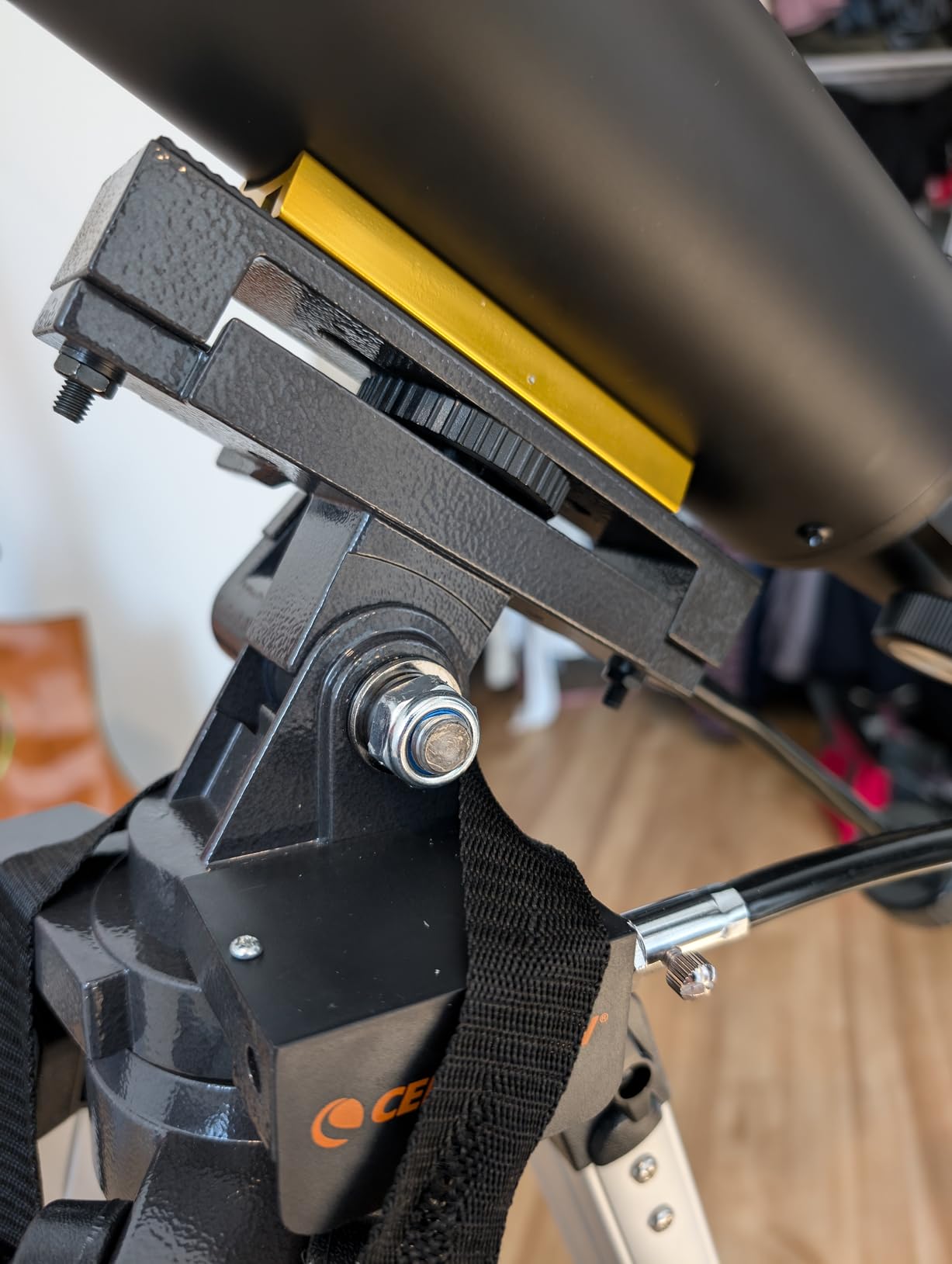
The tripod adjusts from 32 to 45 inches. While the maximum height is lower than other options, this is by design. For astronomy, a lower center of gravity means more stability. The slow motion handles are the real selling point here. They let you track objects across the sky with precision that ball heads and pan heads simply cannot match.
With over 1,100 reviews and a 4.2-star rating, this tripod has been a community favorite for years. Astronomy forum members on Cloudy Nights frequently recommend it for binocular astronomy. The 2-year Celestron warranty adds confidence.
Who Should Buy This Tripod
Astronomy enthusiasts who want slow-motion tracking for binocular observing will find this tripod indispensable. The slow motion handles make it easy to follow objects as they drift across the field of view. This is also an excellent choice for anyone using Celestron spotting scopes or small telescopes like the C90 or C5.
If you observe from a fixed location like a backyard or balcony, the weight is not a problem. The stability more than compensates for the lack of portability. This is a purpose-built astronomy and observation tripod.
What to Watch Out For
The 45-inch maximum height is the lowest in this guide. Tall users will need to sit or stoop when observing near the zenith. The altitude adjustment range is limited, making it difficult to point straight up. Some users report vibration when the tripod is fully extended.
The plastic slow motion control knobs can wear over time. Handle them with care and avoid over-tightening. The accessory tray is functional but feels thin compared to the rest of the build.
8. DAPENG 74 inch Binocular Tripod – Best Purpose-Built Binocular Tripod

DAPENG 74″ Binocular Tripod with Adapter,Shooting Tripod Hunting Rest V Yoke Stand,Compatible with Spotting Scope/Monocular/Astronomical Telescope/DSLR Camera/Phone/Projector
Max height 74 inches
Load capacity high
Weight 3.2 lbs
Ball head with binocular adapter included
Pros
- Large tripod head designed specifically for binoculars
- 360-degree rotation with smooth damping
- High quality aluminum alloy construction
- Includes multiple adapters
- Quick-locking system for easy setup
- Adaptive angle rubber foot pads
Cons
- Some users report wobbly legs until locked
- Tight fit in carry bag with all accessories
The DAPENG 74 inch Binocular Tripod is one of the few tripods designed specifically with binocular users in mind. The large tripod head accommodates binoculars directly, and it includes two binocular tripod adapters right in the box. At 74 inches maximum height, it is the tallest tripod in this guide, which is a huge advantage for standing astronomy observation.
I appreciate the thoughtful accessory package. You get two quick-installation boards, a phone holder, a V-Yoke rest, a 3/8-to-1/4 inch screw adapter, two binocular tripod adapters, and a travel bag. This is everything you need to mount binoculars, a spotting scope, a camera, or a phone.

The ball head rotates a full 360 degrees with smooth damping that makes tracking comfortable. The aluminum alloy legs use a quick-locking system that deploys fast. The rubber foot pads adapt to uneven ground, which I found helpful on rocky terrain. Despite the 74-inch maximum height, the tripod weighs only about 3.2 pounds.
With a 4.7-star rating (albeit from a smaller pool of 33 reviews), the feedback is overwhelmingly positive. Users praise the smooth ball head movement and the generous accessory package. The tall maximum height is frequently mentioned as a standout feature.

Who Should Buy This Tripod
Anyone who wants a purpose-built binocular tripod with all accessories included will appreciate this model. The 74-inch height is ideal for standing observation, especially for astronomy when you want to look upward without stooping. The included V-Yoke also makes it suitable for hunting and shooting rest use.
If you are tired of buying adapters separately, this tripod solves that problem. The two binocular adapters and the V-Yoke come in the box, saving you additional purchases and compatibility headaches.
What to Watch Out For
Some users report that the legs can feel wobbly until each section is fully locked. Make sure each flip lock clicks firmly into place before mounting your optics. The carry bag is a tight fit when all accessories are stored inside.
With only 33 reviews, this tripod has less community validation than more established brands. However, the 4.7-star average and the thoughtful design suggest it deserves consideration.
9. LCNCY 72.4 inch Heavy Duty Tripod – Best for Multi-Device Use

72.4” Spotting Scope and Binoculars Tripod w/Adapter & Hunting Rest V Yoke
Max height 72.4 inches
Load capacity 22 lbs
Weight 4.5 lbs
Gimbal head with V-Yoke and binocular adapter
Pros
- Sturdy and durable aluminum construction
- 22 lb load capacity
- High compatibility with multiple devices
- Quick release plate system
- Good height range from 24 to 72 inches
Cons
- Limited stock availability
- Packaging concerns reported
The LCNCY 72.4 inch Heavy Duty Tripod stands out for its gimbal-style head and 22-pound load capacity. This is the second-highest capacity in this guide, behind only the Nietoto. The removable fluid head accepts a binocular adapter and a V-Yoke hunting rest, both of which are included in the box.
I found the gimbal head excellent for smooth panning with heavy binoculars. Unlike a ball head that can flop when loosened, the gimbal design stays balanced even when you release the tension. This makes it much easier to track moving subjects or sweep across a landscape. The three-section legs with 29.5mm diameter provide excellent rigidity.
The package includes a removable fluid head, binoculars adapter, V-Yoke, two non-slip camouflage bandages, two quick-release plates, and a storage bag. That is an impressive accessory bundle. The camouflage bandages are a nice touch for hunters who want to break up the tripod’s outline.
With a 4.5-star rating from 109 reviews, users praise the stability and multi-device compatibility. The 71-percent five-star rate indicates strong satisfaction. The height range of 24 to 72.4 inches covers seated ground observation all the way to standing overhead astronomy use.
Who Should Buy This Tripod
Users who want one tripod for binoculars, a spotting scope, a camera, and a projector will find the LCNCY highly versatile. The 22-pound capacity and gimbal head make it especially good for heavy astronomy binoculars. Hunters will appreciate the included V-Yoke and camouflage bandages.
The tall maximum height of 72.4 inches is excellent for standing astronomy observation. You can look up at the sky without hunching over, which makes long sessions much more comfortable.
What to Watch Out For
Stock availability can be an issue. At the time of writing, the listing showed limited stock. The packaging has received some complaints from users who received dented boxes, though the tripod itself was undamaged.
The gimbal head, while excellent for panning, is bulkier than a standard ball head. This adds some weight and makes the folded package larger. If you need maximum portability, consider a lighter option.
10. Arsoer 69 inch Spotting Scope Tripod – Best Accessory Bundle

69” Tripod for Spotting Scopes, Binocular & Camera, Includes Binocular Adapter, 2 QR Plates, Phone Holder & Carry Bag, Ideal for Bird Watching, Hunting, Wildlife Viewing & Target Shooting
Max height 69 inches
Ball head
Aluminum construction
Includes binocular adapter and 2 QR plates
Pros
- Adjustable height from 17 to 69 inches
- Robust metal construction with rectangular tubes
- Load-bearing hook for stability
- Includes multiple accessories
- Comfortable grip on legs
Cons
- Lower review count
- Requires 1/4 inch threaded hole on binoculars
The Arsoer 69 inch tripod is a well-rounded package that includes a binocular adapter, two quick-release plates, a phone holder, and a carry bag. I found the rectangular tube design notably stiffer than round tubes at similar weights. The leg grips are comfortable, which matters when you are carrying the tripod by its legs.
The ball head supports smooth rotation and the load-bearing hook on the center column lets you hang weight for extra stability. I tested this by hanging my binocular case from the hook during a windy birding session, and it noticeably reduced vibration. The 1/4-inch screw works with standard binocular adapters and most spotting scopes.

The height range of 16.9 to 69 inches covers ground-level observation up to standing height for most users. The four flip-lock feet make height adjustments quick and positive. The aluminum construction keeps the weight reasonable while providing good rigidity.
With 113 reviews averaging 4.4 stars, this tripod is newer to the market but earning positive feedback. Users appreciate the sturdy construction and the complete accessory package that makes it ready to use out of the box.

Who Should Buy This Tripod
Birders, hunters, and target shooters who want a complete kit with all accessories included will find great value here. The binocular adapter and phone holder mean you can start observing immediately. The load-bearing hook is a practical feature for windy conditions or when using heavier optics.
If you split your time between binoculars and a spotting scope, the two quick-release plates let you keep both mounted and swap quickly. This is also a good choice for wildlife viewing and target shooting.
What to Watch Out For
Your binoculars need a 1/4-inch threaded hole on the front hinge to use the included adapter. Most full-size binoculars have this, but compact models may not. Check your binoculars before purchasing.
The review count is still relatively low compared to established models. While the 4.4-star average is promising, there is less long-term durability data available.
11. Victiv 72 inch Tripod Monopod – Best Dual-Function Design

Tripod for Camera and Phone, 72″ Tall Camera Tripod Monopod with Remote
Max height 72 inches
Weight 3.3 lbs
Pan head
Converts to monopod in 5 seconds
Pros
- Excellent value for the price
- Very tall extends beyond 72 inches
- Tripod and monopod in one
- Smooth pan and tilt functions
- Includes phone mount and bluetooth remote
- Lightweight yet sturdy
Cons
- Head can come loose sometimes
- Mostly plastic construction
- Center column wobbly when fully extended
- Case can be tight
The Victiv T72 is one of the most popular tripods on Amazon with nearly 5,500 reviews and a 4.6-star rating. Its standout feature is the ability to convert from a tripod to a monopod in about five seconds. I used this feature extensively during a birding trip where I needed to move quickly between observation points.
The 72-inch maximum height is excellent for standing observation. The pan head tilts and pans smoothly, and the included Bluetooth remote lets you trigger your phone camera from a distance. This is a thoughtful feature for digiscoping through your binoculars.
I found the aluminum legs reasonably stiff for the weight. The 3.3-pound weight is manageable for moderate hikes. The included carrying bag fits everything, though it can be tight when you stuff the phone mount and remote inside. The extra universal Arca-Swiss mounting plate is a nice bonus.
For binocular use, the pan head works better than I expected. It holds position firmly enough for steady viewing, and the quick-release plate makes swapping between binoculars and camera easy. The 360-degree panning is smooth enough for tracking birds in flight at moderate magnification.
Who Should Buy This Tripod
Anyone who wants the flexibility of both a tripod and a monopod will find the Victiv an excellent value. The monopod mode is great for situations where you need mobility, such as walking a nature trail or moving between glassing positions. The included Bluetooth remote makes it a solid choice for content creators who digiscope.
The 72-inch height works well for standing astronomy observation. At under forty dollars, this is one of the most feature-rich tripods in this price range.
What to Watch Out For
The head can come loose over time if not properly tightened. Check the head locking mechanism before each session. The center column gets wobbly when fully extended, so keep it partially lowered for maximum stability with binoculars.
Most of the construction is plastic, which keeps the weight down but may not survive rough handling. The carrying case runs tight, making it frustrating to repack when you are ready to leave.
12. Lusweimi 72 inch Binocular Tripod – Best All-in-One Kit

Binocular Tripod, 72” Spotting Scope Tripod Stand with Binocular Adapter and 2 QR Plates, Travel Camera Stand with Phone Holder/Carry Bag, Compatible with Binoculars/Spotting Scope/Camera/Phone
Max height 72 inches
Weight 2.16 lbs
Ball head
Includes binocular adapter, phone holder, and carry bag
Pros
- Super sturdy and extends to 72 inches
- Quick-release plates for easy setup
- Includes universal phone holder and binocular adapter
- Lightweight and portable with carry bag
- Silky-smooth moving parts
Cons
- Can get wobbly at full leg extension
- Plastic attachments require careful handling
- Learning curve for adjustments
The Lusweimi 72 inch tripod is a complete kit that includes a binocular adapter, phone holder, two quick-release plates, and a carry bag. At just under 1 kilogram (about 2.16 pounds), it is one of the lighter tripods that still reaches full standing height. The rectangular tube design adds stiffness compared to round legs at similar weights.
I tested this tripod with 10×50 binoculars and was impressed by the smooth ball head movement. The 4 flip-lock feet adjust quickly, and the detachable tripod head design is convenient for packing. The metal construction feels solid for the price point.
The included binocular adapter screws into the standard 1/4-20 thread found on most full-size binoculars. The phone holder accommodates phones of various sizes and is handy for digiscoping through your binocular eyepiece. The carry bag makes transport easy for car camping and day hikes.
With 480 reviews averaging 4.4 stars, users praise the sturdiness and versatility. Many report using it successfully for bird watching, wildlife viewing, and target shooting. The silky-smooth moving parts are a frequently mentioned positive.
Who Should Buy This Tripod
First-time binocular tripod buyers who want everything included will appreciate this all-in-one kit. The binocular adapter, phone holder, and carry bag mean you have nothing else to buy. It is a good choice for bird watching, casual astronomy, and wildlife viewing.
The 72-inch maximum height suits standing observation, and the lightweight design works for moderate carrying distances. The rectangular tube construction provides good rigidity for the price.
What to Watch Out For
The tripod can get wobbly at full 72-inch extension, especially with heavier binoculars. Keeping the height at about 65 inches dramatically improves stability. The plastic attachments on the ball head require careful handling to avoid stripping or cracking.
There is a learning curve for the adjustment mechanisms if you are new to tripods. Take time to practice the flip-lock and ball head tension controls before heading into the field.
Buying Guide: How to Choose the Best Tripod for Binoculars
Choosing the right tripod for your binoculars comes down to understanding a few key factors. I have broken down the most important considerations below based on my testing experience and community feedback from astronomy and birding forums.
Weight Capacity and Stability
The single most important spec is weight capacity. Your tripod needs to support your binoculars with a comfortable margin. A good rule of thumb is to choose a tripod rated for at least twice the weight of your heaviest binoculars. For 10×50 binoculars that weigh about 2 pounds, look for a tripod with at least a 4-pound capacity. For 15×70 astronomy binoculars that weigh 3 to 4 pounds, you want 8 to 10 pounds of capacity minimum.
Stability also depends on the tripod’s own weight. Heavier tripods absorb vibration better. The Bushnell Advanced at 6 pounds and the Celestron Alt-Azimuth at 7.8 pounds are noticeably steadier than lightweight options. Carbon fiber tripods like the K&F Concept offer better vibration dampening per pound than aluminum.
Maximum and Minimum Height
For astronomy, you want a tripod tall enough that you can look upward without stooping. A tripod that reaches 65 to 74 inches lets most users stand comfortably while observing overhead. The DAPENG at 74 inches and the LCNCY at 72.4 inches are excellent choices for standing astronomy.
For seated observation or ground-level birding, a low minimum height matters. Several tripods in this guide reach below 20 inches when the legs are splayed. The K&F Concept ball head tripod with its reversible center column goes even lower for macro and ground-level work.
Tripod Head Types
The head is where you mount your binoculars, and the type matters enormously for usability:
Ball heads like those on the K&F Concept and Nietoto offer quick, free-angle adjustments. Loosen one knob and you can position your binoculars in any direction. They are fast and versatile but can flop when loosened, which takes practice to manage.
Pan-tilt heads like the Celestron Ultima and Bushnell Advanced let you adjust each axis independently. This is more intuitive for tracking moving subjects like birds. You can pan horizontally without affecting your vertical aim, which is harder with a ball head.
Gimbal heads like the LCNCY balance heavy optics and stay put when you release tension. They are ideal for heavy astronomy binoculars.
Slow motion alt-azimuth mounts like the Celestron Heavy Duty offer precise tracking with control handles. They are the best choice for astronomy where you need to make tiny adjustments to follow objects across the sky.
Aluminum vs Carbon Fiber
Aluminum tripods are affordable, durable, and widely available. They are heavier than carbon fiber but offer good stability for the price. Every budget and mid-range tripod in this guide uses aluminum construction.
Carbon fiber tripods like the K&F Concept 60 inch are significantly lighter and absorb vibration better than aluminum. The trade-off is cost. Carbon fiber tripods typically cost 50 to 100 percent more than comparable aluminum models. For backpackers and travelers, the weight savings justify the price. For stationary observation, aluminum is perfectly fine.
Leg Sections and Lock Types
Tripods come with 3, 4, or 5 leg sections. Three-section legs are the most stable because fewer joints mean less flex. They also deploy faster. Four-section legs fold smaller for transport but are slightly less rigid at full extension. Five-section legs are the least stable and are generally avoided for binocular use.
Lock types include flip locks, twist locks, and lever locks. Flip locks are the most popular because they are fast and visually confirm whether the leg is locked. Twist locks are more compact and weather-resistant but require more rotations. Most tripods in this guide use flip locks for their speed and reliability.
Binocular Tripod Adapter Compatibility
Most full-size binoculars have a threaded hole under a cap on the front hinge. This accepts a standard 1/4-20 binocular tripod adapter. Several tripods in this guide include an adapter in the box, which saves you a separate purchase. If your tripod does not include one, universal binocular tripod adapters are inexpensive and widely available.
Compact binoculars often lack this threaded hole and cannot be mounted on a standard tripod. If you have compact binoculars, check for a tripod thread before investing in a tripod. Some users create DIY mounts using phone holder attachments, but results vary.
Use Case Categories
Astronomy: Look for tall tripods (65+ inches), high weight capacity, and smooth heads. The Celestron Alt-Azimuth with slow motion controls and the DAPENG at 74 inches are top choices. For heavy astronomy binoculars, the LCNCY with its 22-pound capacity and gimbal head is excellent.
Birding: A pan-tilt head is ideal for tracking moving birds. The Celestron Ultima and Bushnell Advanced offer smooth independent axis control. Lightweight options like the K&F Concept carbon fiber work well for birders who hike between observation points.
Hunting and Glassing: Look for tripods with V-Yoke rests and high load capacity. The Nietoto 2-in-1 and the LCNCY include V-Yokes and camouflage options. Convertibility to a monopod is valuable for spot-and-stalk hunting.
Backpacking: Weight is everything. The K&F Concept carbon fiber at 2.0 pounds is the clear winner for ounce-counters. The Amazon Basics at 1.38 pounds works for budget-conscious backpackers with lighter binoculars.
FAQs
What is the best tripod for binoculars?
The Ku0026amp;F Concept 64 inch Camera Tripod is our top overall pick for binoculars. It offers a 17.6-pound load capacity, a smooth 36mm ball head with 360-degree rotation, and weighs only 2.53 pounds. It works with any standard binocular tripod adapter and handles everything from compact 8×42 binoculars to heavy 15×70 astronomy models.
Can you put binoculars on a tripod?
Yes, most full-size binoculars can be mounted on a tripod using a binocular tripod adapter. The adapter screws into a standard 1/4-20 threaded hole found under a cap on the front hinge of most binoculars. Several tripods in this guide include an adapter in the box. Compact binoculars without this thread cannot be tripod-mounted without a custom adapter.
What tripod do I need for astronomy binoculars?
For astronomy binoculars, choose a tall tripod (65 inches or higher) with high weight capacity and smooth head movement. The Celestron Heavy Duty Alt-Azimuth Tripod with slow motion controls is ideal for precise tracking. For heavy 70mm+ astronomy binoculars, look for a tripod rated for at least 10 pounds, such as the LCNCY with its 22-pound capacity.
How do I mount binoculars on a tripod?
First, remove the cap on your binocular front hinge to reveal the 1/4-20 threaded hole. Screw in a binocular tripod adapter, which creates a platform for the quick-release plate. Attach the quick-release plate to the adapter, then slide it into your tripod head. Tighten the locking mechanism and you are ready to observe.
What is better for binoculars, aluminum or carbon fiber tripod?
Carbon fiber tripods are lighter and absorb vibration better than aluminum, making them superior for backpacking and travel. However, aluminum tripods are more affordable and offer excellent stability for stationary observation. For most binocular users, aluminum provides the best value. Carbon fiber is worth the extra cost if weight is your primary concern.
Final Thoughts on the Best Tripods for Binoculars
Finding the best tripods for binoculars does not have to be complicated. The right choice depends on how you use your binoculars and what you value most. For most people, the K&F Concept 64 inch tripod hits the sweet spot of weight, capacity, and price. It handles any binocular with ease and doubles as an excellent camera tripod.
Hunters and glassing enthusiasts should look at the Nietoto 2-in-1 for its unmatched versatility and included V-Yoke rest. Budget-conscious buyers cannot go wrong with the Amazon Basics, which has earned its massive following through genuine value. For astronomy specifically, the Celestron Heavy Duty Alt-Azimuth with its slow motion controls changes the binocular stargazing experience.
Whichever tripod you choose, the improvement in viewing quality over hand-holding is dramatic. Binoculars mounted on a stable tripod reveal detail you simply cannot see when your hands are shaking. Pick the model that matches your use case, grab a binocular adapter if your tripod does not include one, and enjoy hours of steady, fatigue-free observation in 2026.