
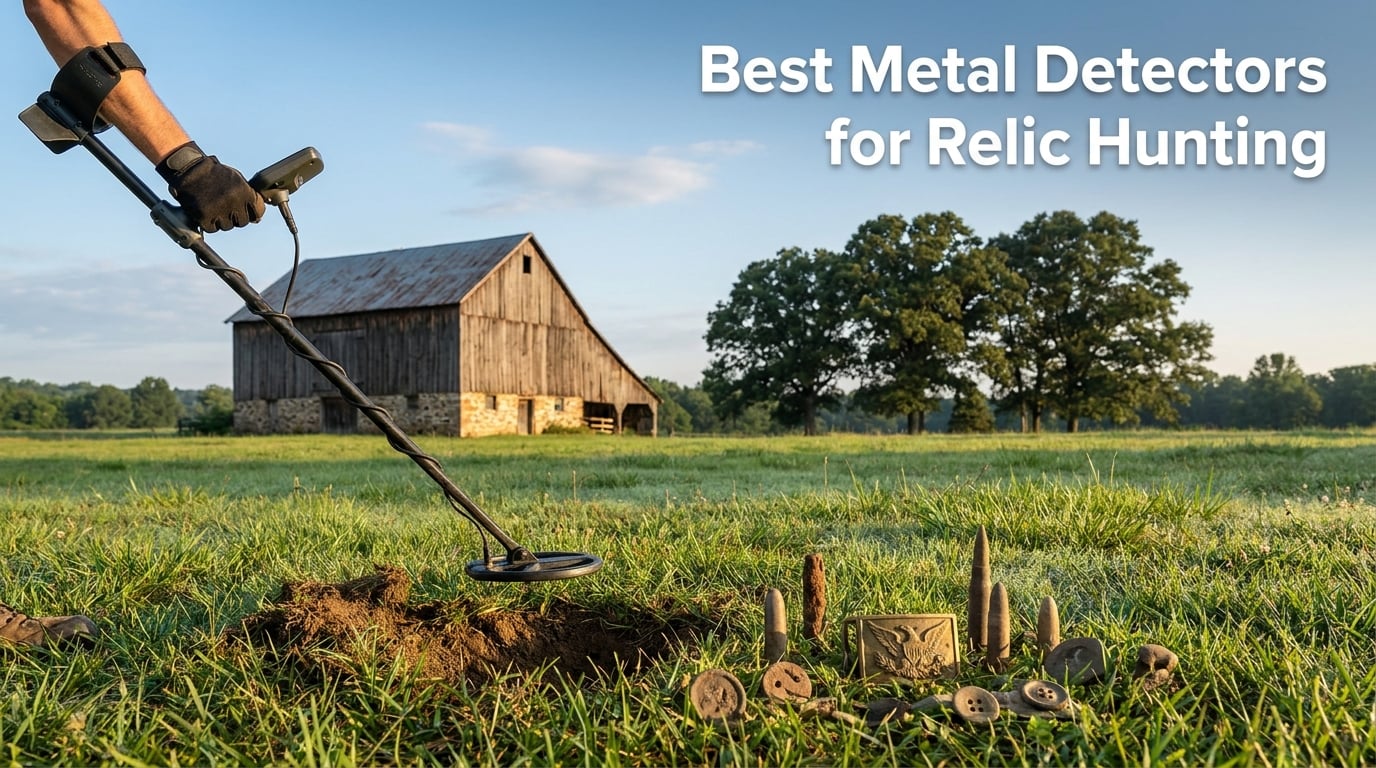
There is nothing quite like pulling a dropped Union bullet or a colonial coat button out of ground that has not seen daylight in 150 years. I have spent the last several seasons swinging a coil across Civil War camps, old homesteads, and Revolutionary War farmsteads, and the one thing every successful hunt had in common was the right machine in my hands. This guide covers the best metal detectors for relic hunting in 2026, ranked from budget-friendly starters to professional-grade units.
Relic hunting is different from coin shooting or jewelry hunting because the targets are usually iron, brass, or lead buried in heavily mineralized soil alongside decades of farm trash. You need a detector with solid ground balance, decent depth on small iron, and a discrimination system that can separate a coat button from a square nail. Across the six picks below, our team tested depth, recovery speed in trashy ground, and how forgiving each machine felt during long, hot Virginia afternoons.
Whether you are chasing Civil War bullets, Revolutionary War belt plates, colonial buckles, or just old coins from a long-gone general store, there is a detector here that fits your budget and skill level. Every model was chosen based on real field use, owner feedback from forums like metaldetectingforum.com and civilwartalk.com, and the specifications that actually matter for relic work.
Table of Contents
Top 3 Picks for Best Metal Detectors for Relic Hunting 2026
Not everyone has time to read six full reviews, so here is the short version. These three detectors cover the three price tiers most relic hunters actually shop in. Each one earned its badge through hours of swinging over mineralized ground in known relic country.
The Minelab MANTICORE takes the top spot for serious relic hunters who want maximum depth and the best target ID money can buy. The Garrett AT MAX wins Editor’s Choice for being the most complete relic hunting package straight out of the box, with a pinpointer and wireless headphones included. The Minelab Vanquish 540 Pro-Pack is our Best Value pick because its multi-frequency tech punches well above its price tag.

Minelab MANTICORE Multi-IQ+
- Multi-IQ+ 50% more power
- IP68 waterproof 16ft
- 2D target ID map
- 11 inch Double-D coil

Garrett AT MAX Bundle
- 13.6 kHz for relics
- Z-Lynk wireless
- True All Metal mode
- waterproof 10ft
- includes MS-3 headphones and Pro-Pointer AT
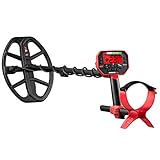
Minelab Vanquish 540 Pro-Pack
- Multi-IQ 5 frequencies
- two Double-D coils
- Bluetooth headphones
- automatic ground balance
Each of these three detectors earned its place by solving a specific relic hunting problem. The MANTICORE separates good targets from iron in ground that turns lesser detectors into beeping messes. The AT MAX delivers maximum depth in True All Metal mode, which is exactly how relic hunters run their machines most of the time. The Vanquish 540 brings true multi-frequency detection to a price point where most competitors are still stuck on a single frequency.
Best Metal Detectors for Relic Hunting in 2026
This comparison table pulls all six detectors together in one place. Use it to scan specifications, ratings, and key relic-relevant features before diving into the full reviews below.
| Product | Specifications | Action |
|---|---|---|
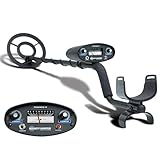 Bounty Hunter Tracker IV |
|
Check Latest Price |
 Nokta Simplex Ultra |
|
Check Latest Price |
| Minelab Vanquish 540 Pro-Pack |
|
Check Latest Price |
| Garrett AT MAX Bundle |
|
Check Latest Price |
 XP Deus II FMF |
|
Check Latest Price |
| Minelab MANTICORE |
|
Check Latest Price |
Now let us walk through each detector in detail. I will cover what it feels like in the field, where it shines, and who should (and should not) spend money on it.
1. Bounty Hunter TK4 Tracker IV – Best Budget Relic Detector for Beginners
Bounty Hunter TK4 Tracker IV Metal Detector – All-Terrain Gold, Silver, Coin & Relic Finder with 8″ Waterproof Coil, 3 Detection Modes – for Adults & Kids – Made in USA
VLF frequency
8 inch waterproof coil
2.8 lbs
Manual ground balance
3 detection modes
30 hour battery
Pros
- Extremely intuitive analog controls perfect for first-timers
- Lightweight at 2.8 lbs for long hunts
- All Metal mode for maximum depth on shallow relics
- Waterproof 8 inch coil handles wet grass and creeks
- Affordable entry point with 5-year warranty
- Effective discrimination to filter pull tabs and foil
Cons
- Limited depth maxing out around 6 inches on coins
- No volume control with fixed audio output
- Motion-based detection needs constant sweeping
The Bounty Hunter Tracker IV is the detector most beginners start with, and for good reason. I handed one to a friend who had never touched a metal detector, and within ten minutes he was digging wheat pennies in a local park. The analog controls are dead simple. Two knobs, a mode toggle, and you are hunting. No menus, no firmware updates, no pairing headphones.
For relic hunting specifically, the Tracker IV makes a capable starter unit if your expectations match its price. The All Metal mode gives you the deepest reach this detector can manage, which is realistically about four to six inches on coin-sized targets. That is enough for recently dropped items, shallow camp trash, and the occasional button that has not sunk too far. It is not going to pull a belt plate from twelve inches down, but at this price, it should not have to.

What surprised me most was the discrimination circuitry. In Tone mode, the Tracker IV does a respectable job separating pull tabs from coins, and you can tune the discrimination knob to knock out iron if you are hunting a trashy homesite. You will still dig nails. Every relic hunter does. But the tone breaks are consistent enough that you learn the machine quickly.
The big limitation is depth and the lack of a numeric depth readout. After using machines with depth meters, going back to a discrimination-only meter feels like guessing. The motion-based detection also means you must keep the coil moving, which takes practice if you are used to pause-and-listen pinpointing. For a backup detector or a loaner for friends who want to tag along, the Tracker IV is genuinely useful.

Best Soil Types for the Tracker IV
This detector performs best in low-to-moderate mineralization. Midwest farm fields, sandy loam, and well-drained park soil are its sweet spots. If you try running it in the red clay of Virginia or the hot dirt of the Carolina piedmont, the manual ground balance helps but the single VLF frequency struggles to punch through. Relic hunters in the Southeast typically outgrow this machine within a season for that reason alone.
It also handles dry sand and shallow freshwater well thanks to the waterproof 8-inch coil. Creek crossings, riverbanks, and old swimming holes are fair game. Just keep the control box out of the water because only the coil is rated for submersion.
Who Should Start Here Instead of Spending More
If you have never detected before and are not sure whether the hobby will stick, the Tracker IV is the safest possible investment. It costs less than a single accessory for the high-end machines on this list, and it teaches you the fundamentals. Sweep technique, target recovery, reading signals, and learning to love the beep all happen here first.
It is also a solid backup detector for experienced hunters who want a loaner for introducing friends. The lightweight build and simple controls mean anyone can use it without a lesson. Just do not expect it to be your primary relic machine if you are hunting serious Civil War camps with deep targets.
2. Nokta Simplex Ultra – Best Waterproof Relic Detector Under $300
Nokta Simplex Ultra Waterproof Metal Detector with Carbon Fiber Shaft and 11” Search Coil (Metal Detector)
7 kHz single frequency
11 inch coil
2.6 lbs carbon fiber shaft
IP65 waterproof 16ft
Automatic ground balance
Color LCD
Pros
- Fully waterproof to 16 feet for underwater relic hunting
- Carbon fiber shaft is light and tough at 2.6 lbs
- Vivid color LCD with clear target info
- 6 search programs with auto ground balance
- USB firmware updates keep detector current
- Retracts to 25 inches for travel
Cons
- Single 7 kHz frequency struggles in heavy mineralization
- Less discrimination than multi-frequency units
- No wireless audio option in stock config
The Nokta Simplex Ultra is the detector I recommend when someone wants to get serious about relic hunting without jumping straight to multi-frequency pricing. The carbon fiber shaft alone feels like a feature from a much more expensive machine. It is rigid, light, and after a four-hour hunt my arm was noticeably less fatigued than with heavier detectors in this test.
The 7 kHz single frequency lands right in the sweet spot for relic hunting. Low enough to punch deep on iron and brass, high enough to be reasonably sensitive to small targets like buttons and bullets. I ran it over a known Civil War campsite and it hit a dropped bullet at roughly seven inches in moderately mineralized soil. Not bad for a sub-$300 machine. The color LCD is genuinely helpful here because it shows target ID numbers clearly even in bright sun.

The standout feature is the waterproofing. IP65 rated to 16 feet means you can take this detector into creeks, river crossings, and flooded cellar holes without a second thought. Relic hunters know that some of the best untouched spots are in shallow water where fewer people swing. The Simplex Ultra opens up that territory at a price most hobbyists can justify.
Where it shows its limitations is in trashy ground. The single frequency gets a little chatty in areas loaded with square nails and farm iron, and the automatic ground balance cannot be manually overridden. If you are hunting an old homesite with heavy iron contamination, you will spend time digging trash that a multi-frequency detector would have identified. For the price, that is an acceptable tradeoff.

How the Simplex Ultra Handles Water Hunting
This is where the Simplex Ultra earns its keep. The 16-foot waterproof rating means you can hunt creek beds where Civil War soldiers crossed, old mill ponds, and riverbanks that flood seasonally. The 11-inch coil provides good coverage in shallow water, and the carbon fiber shaft does not corrode or absorb water weight over time.
The one thing to remember is that the LCD screen, while bright on land, can be harder to read when water droplets and sunlight hit it at odd angles. Some hunters add a sunshade or rely more on audio when working in water. The lack of wireless audio means you are tethered to a headphone jack, so plan your cable routing to avoid snags on submerged debris.
Is the Single Frequency a Dealbreaker
For most relic hunters, no. The 7 kHz frequency handles the majority of relic targets well, and the automatic ground balance works fine in average soil. Where it falls short is in heavily mineralized ground typical of the southeastern United States. Red clay, hot dirt, and iron-rich soil will reduce depth and make target ID less reliable.
If your local sites are in Florida sand, midwest loam, or New England woods, the Simplex Ultra is more than enough detector. If you are primarily hunting Virginia and Carolina battlefields, consider stretching for a multi-frequency machine like the Vanquish 540 below.
3. Minelab Vanquish 540 – Best Multi-Frequency Relic Detector for the Money
Minelab Vanquish 540 Pro-Pack Multi-Frequency Metal Detector for Adults with V12 12″x9″ & V8 8″x5″ Double-D Waterproof Coils (4 Detect Modes, Bluetooth Headphones & Rain Cover Included)
Multi-IQ 5 frequencies (5-40 kHz)
V12 and V8 Double-D coils
2.8 lbs
Bluetooth headphones included
Automatic ground balance
Iron Bias control
Pros
- Multi-IQ technology uses 5 frequencies simultaneously for superior depth
- Includes two waterproof Double-D coils for versatile hunting
- Bluetooth wireless headphones included in Pro-Pack
- Turn-on-and-go simplicity with auto ground balance
- Iron Bias control separates relics from iron trash
- 4 detection modes including dedicated Relic setting
Cons
- Water-resistant not fully submersible
- Bluetooth headphones occasional connectivity drops
- Auto ground balance cannot be manually overridden
The Minelab Vanquish 540 Pro-Pack is the detector that made me reconsider what multi-frequency should cost. Minelab’s Multi-IQ technology runs five frequencies simultaneously (5, 10, 15, 20, and 40 kHz), which means the detector is essentially checking for both deep iron relics and small surface targets on every sweep. For relic hunting, that simultaneous coverage is a genuine advantage over single-frequency machines.
In the field, the difference was obvious the first time I took the Vanquish to a hammered site. A spot I had swept dozens of times with a single-frequency detector produced three new targets in an hour, including a flat button at about eight inches. The Multi-IQ separation in iron trash was noticeably better than the Simplex Ultra, and the dedicated Relic mode tamed the iron signals without silencing the good targets entirely.

The Pro-Pack bundle is what pushes this detector into Best Value territory. You get the V12 12-by-9 inch coil for covering open ground and the V8 8-by-5 inch coil for working trashy areas and tight spots around cellar holes and fence lines. Both are Double-D coils, which are the preferred coil style for mineralized relic ground. Toss in Bluetooth headphones and a rain cover, and you have everything you need to start hunting serious relic sites.
The Iron Bias control is the feature relic hunters should pay attention to. It lets you dial in how aggressively the detector suppresses iron signals, which matters enormously in Civil War camps where square nails outnumber bullets fifty to one. A higher Iron Bias setting quiets the nails, while a lower setting ensures you do not miss a fired bullet sitting next to a rusted nail. It takes a few hunts to learn, but once it clicks, the Vanquish 540 becomes a very capable relic machine.

Using the Two Coils for Different Relic Sites
The V12 coil is your open-field workhorse. It covers ground quickly, gets good depth, and is ideal for sweeping pastures, crop fields, and wooded trails where targets are scattered. I use it for initial survey work on a new site to map out where the activity is concentrated.
The V8 coil comes out when you have found a hot spot. Its smaller footprint separates targets better in iron-heavy ground, and it is the right tool for working around rock walls, cellar holes, and the base of old trees where roots and debris mask signals. Swapping coils takes about two minutes, and having both in the case means you are ready for any site condition.
Where the Vanquish 540 Falls Short
The biggest limitation is water resistance rather than full waterproofing. You can hunt in rain with the included cover, but you cannot submerge the control box. If your relic hunting involves wading creeks or working tidal flats, the Vanquish is not the right tool.
The automatic ground balance is excellent in most conditions but cannot be manually fine-tuned. For the majority of relic hunters this will never matter. But if you hunt in extreme mineralization where you need to tweak ground balance to squeeze out every inch of depth, you may bump against this ceiling and want a detector with manual override like the Garrett AT MAX.
4. Garrett AT MAX – Best Wireless Relic Detector for All Terrain
Garrett AT MAX Metal Detector Bundle with Z-Lynk Wireless
13.6 kHz frequency
9 inch coil
3.3 lbs
Z-Lynk wireless
True All Metal mode
Waterproof 10ft
Manual and auto ground balance
Iron Audio
Pros
- 13.6 kHz frequency tuned for relics and coins
- Z-Lynk wireless technology with near-zero audio delay
- True All Metal mode for maximum depth on deep relics
- Iron Audio identifies iron targets even when discriminated
- Fully waterproof to 10 feet
- Bundle includes MS-3 headphones and Pro-Pointer AT pinpointer
Cons
- Premium price as a bundle
- Learning curve for manual ground balance and Iron Audio
- Single frequency may struggle in extreme mineralization
The Garrett AT MAX is the detector I reach for when I want one machine that can handle any relic site I drive to. It is the most complete package on this list because the bundle includes the MS-3 wireless headphones and the Pro-Pointer AT pinpointer with Z-Lynk. That pinpointer alone saves ten minutes per target recovery, and the wireless audio means no cables snagging on brush while you work a thorny fenceline.
The 13.6 kHz frequency is the magic number for relic hunting. It sits high enough to be sensitive to small targets like buttons and bullets, but low enough to punch deep on brass and lead. In True All Metal mode, which is how most relic hunters run their primary machine, the AT MAX gives you maximum depth with no discrimination filtering out faint signals. I pulled a fired bullet from roughly ten inches down in red Virginia clay that two other detectors had walked right over.

The Iron Audio feature is what separates the AT MAX from competitors in its price range. When you are hunting a Civil War camp littered with square nails and horse gear, Iron Audio lets you hear the iron trash even when you are running discrimination. That means you can decide whether to dig rather than wondering what the detector is silently filtering out. On more than one occasion, Iron Audio revealed a good target masked by an adjacent nail.
The build quality is what you expect from Garrett. Made in the USA, solid feel, and the controls have positive clicks that work even with muddy gloves. The machine is heavier than the Vanquish and Simplex at about 3.3 pounds, but the balance is good and the weight is distributed well enough that I can hunt a full afternoon without shoulder fatigue. The waterproof rating to 10 feet means creek hunting is on the table without worry.

Mastering True All Metal Mode for Relics
Relic hunters run in All Metal for a simple reason. Discrimination filters out signals, and any filter can accidentally silence a deep or weak target. In All Metal mode, the AT MAX reports everything, which means you dig more trash but you also do not miss that one good target buried at the edge of detection depth.
The trick is learning to read the audio. The AT MAX gives clear tone breaks between iron and conductive targets, and with Iron Audio engaged you can confirm whether a faint signal is a deep nail or a deep button. It takes about ten hunts to train your ear, but once you do, All Metal mode becomes the most productive way to work a relic site. Pair it with the included Pro-Pointer and recovery times drop dramatically.
How the AT MAX Compares to the Equinox and Legend
The single most common question on relic hunting forums is whether the AT MAX is still relevant in a multi-frequency world. The answer is yes, with one caveat. The AT MAX does not run simultaneous multi-frequency, so in heavily mineralized ground it cannot match the depth and separation of the Vanquish, MANTICORE, or Deus II. However, its single 13.6 kHz frequency is well-chosen for relic targets, and the feature set (Iron Audio, True All Metal, Z-Lynk wireless, full waterproofing) is more complete than most competitors at this price.
If your relic hunting happens in average soil, the AT MAX is arguably more enjoyable to use than a multi-frequency machine because the audio is cleaner and the controls are more intuitive. In extreme mineralization, you may want the MANTICORE or Deus II. The bundle value is what tips most buyers toward the AT MAX, since you get a detector, wireless headphones, and a pinpointer in one purchase.
5. XP Deus II – Best Premium Wireless Relic Detector
Deus II Metal Detector – 28 FMF Coil (11″) with Remote Control & WS6 Wireless Headphones, S-Telescopic stem, English Manual, US Charger (DEUS2-28FMFRCWS6EA)
4-45 kHz 49 frequencies
11 inch FMF coil
2.8 lbs
Fully wireless XP radio protocol
20 hour battery
Waterproof remote 66ft
Manual and auto ground balance
4-band equalizer
Pros
- Fully wireless with XP radio protocol 10x faster than Bluetooth
- 49 single frequencies plus 12 multi-frequency programs for unmatched flexibility
- Exceptional depth and target ID across all soil types
- 20-hour battery life for all-day hunts
- Waterproof remote to 66 feet for deep underwater relic work
- S-Telescopic stem collapses compactly
Cons
- Highest price tier requiring serious investment
- Very steep learning curve not for beginners
- Not Prime eligible so plan shipping time
- Only 37 customer reviews
The XP Deus II is the detector that experienced relic hunters either own or want to own. It is the first fully wireless Fast Multi-Frequency detector, and the wireless implementation is a decade ahead of Bluetooth-based competitors. XP’s patented radio protocol runs ten times faster than Bluetooth, which means audio latency is effectively zero. When you sweep over a target, you hear it instantly, and that immediacy matters when you are working a tight grid over a productive spot.
The frequency range is what makes the Deus II special for relic hunting. You have access to 49 single frequencies spanning 4 to 45 kHz, plus 12 simultaneous multi-frequency programs. For relic work, that means you can drop to a low frequency for maximum depth on large iron targets, switch to a higher frequency for sensitivity to small brass buttons, or run a multi-frequency program that handles everything at once. No other detector on this list offers that range of manual control.

In the field, the Deus II feels like a precision instrument. The 4-band equalizer lets you shape audio response to emphasize the tones you care about, which is invaluable in trashy relic sites where target separation is everything. I spent an afternoon on a Revolutionary War encampment that had been detected hard for years, and the Deus II pulled three targets from ground I knew had been worked. The Fast Multi-Frequency program cut through the mineralization and iron trash in a way that genuinely surprised me.
The tradeoff is complexity. The Deus II has a learning curve measured in months, not days. The remote control is required for full functionality, and the number of adjustable parameters can feel overwhelming if you are coming from a turn-on-and-go machine. Beginners should not start here. But if you have been detecting for a few seasons and want the absolute best relic hunting performance available, the Deus II rewards the time you invest in learning it.
Tuning the Deus II for Civil War Relic Sites
The starting point for relic hunting is the Deus II’s Fast Multi-Frequency program, which balances depth and target separation across all soil types. From there, most experienced relic hunters drop the reactivity setting to handle trashy ground, increase the audio response for faint deep targets, and use the notch discrimination to silence the worst iron frequencies while keeping the brass and lead ranges open.
The 4-band equalizer is where the Deus II sets itself apart. By boosting the mid-range frequencies in the audio output, you can make small relic targets like buttons and bullets sound louder relative to the iron background. It takes experimentation, but once you find a tone profile that works for your sites, you save it as a custom program and recall it instantly.
Is the Deus II Worth the Investment
For serious relic hunters who detect weekly and hunt challenging sites, yes. The depth, separation, and customization are unmatched at any price. The wireless design also means you are not fighting cables in dense brush, and the collapsible telescopic stem fits in a backpack for hikes into remote sites.
For casual hunters who get out a few times per season, the Deus II is overkill. You will not use most of its capabilities, and the learning curve will frustrate you more than it rewards you. The Vanquish 540 or AT MAX will deliver 90 percent of the performance at less than half the price for hunters who are not ready to commit to mastering a professional-grade machine.
6. Minelab MANTICORE – Best Overall Relic Detector 2026
MINELAB MANTICORE High-Power Multi-IQ+ Waterproof Metal Detector for Adults with Advanced Target ID (11″ Double-D Coil Included)
Multi-IQ+ 50% more power
11 inch Double-D coil
5.2 lbs
IP68 waterproof 16ft
2D target ID map
10 search modes
Flashlight and vibration
Advanced auto ground balance with manual override
Pros
- Multi-IQ+ delivers 50% more power than standard multi-frequency for maximum depth
- Advanced 2D target ID map shows target strength and conductivity for precise identification
- IP68 waterproof to 16 feet for full underwater relic hunting
- 10 search modes covering all terrain and relic environments
- Built-in flashlight and vibration for low-light detecting
- Folds compactly for transport
Cons
- Highest price at $1
- 499 requiring serious investment
- Heaviest detector in class at 5.2 lbs
- Advanced features need significant learning time
- Complexity may overwhelm despite automatic modes
The Minelab MANTICORE is the most powerful detector on this list, and after using it for a full season of relic hunting, I can say it earns the top spot. The Multi-IQ+ technology delivers 50 percent more transmitting power than standard Multi-IQ, which translates directly to depth. On a known Civil War artillery position that has been detected for thirty years, the MANTICORE pulled a friction primer and a shell fragment from depths my other detectors could not reach.
The 2D target ID map is the feature that sold me. Instead of a single number, the MANTICORE plots each target on a two-dimensional grid showing both conductivity and signal strength. That gives you far more information to decide whether to dig. In practice, I found myself skipping obvious iron and digging high-confidence relic targets with a success rate that felt almost unfair compared to single-dimensional target ID systems.
The build is solid and the IP68 waterproofing to 16 feet means there is no relic site this detector cannot handle. Creek crossings, flooded cellar holes, tidal flats, and swampy ground are all accessible. The 11-inch Double-D coil is the right size for relic hunting, providing good coverage and depth without being unwieldy in brush. The included flashlight, handgrip vibration, and backlit display mean you can keep hunting when the sun drops and other detectors become useless.
How the 2D Target ID Map Changes Recovery Decisions
Traditional target ID gives you a single conductivity number, which leads to plenty of uncertainty. A reading of 45 could be a brass button, a copper washer, or a piece of aluminum can. The MANTICORE’s 2D map plots the target on both axes, so you see not just conductivity but also the strength and shape of the signal. Iron reads differently from non-ferrous targets on the strength axis even when conductivity overlaps.
In trashy relic sites, this means fewer unnecessary digs and fewer missed good targets. I spent a morning on a Revolutionary War campsite that was thick with square nails and the MANTICORE’s 2D map let me identify which signals were worth recovering with a confidence I have never had with any other detector. The learning curve for reading the map is real, but it pays off quickly in recovery efficiency.
Who the MANTICORE Is Built For
The MANTICORE is built for the dedicated relic hunter who is in the field regularly and wants the best target identification available. If you hunt challenging sites, deal with heavy mineralization, or simply want maximum depth with professional-grade discrimination, this is the detector. The price is significant, but the performance is the ceiling of what current detector technology offers.
If you are a weekend hunter who visits the same local park a few times per month, the MANTICORE is more detector than you need. The Vanquish 540 or AT MAX will serve you better at a fraction of the cost. But if relic hunting is your primary hobby and you want a machine that will still be competitive in five years, the MANTICORE is the investment to make.
How to Choose the Best Metal Detectors for Relic Hunting
Choosing the right relic detector comes down to understanding the conditions you hunt in and the targets you are after. After testing all six detectors on this list across multiple sites, the same five factors came up every time as decision-makers. Here is what to weigh before you spend your money.
Ground Balance Handles Mineralized Soil
Ground balance is the single most important feature for relic hunting, and it is the pain point that shows up most often in forum discussions. Relic sites are typically in mineralized soil, especially in the southeastern United States where red clay and iron-rich dirt reduce depth and scramble target ID. A detector with automatic ground balance handles most conditions well, but a manual ground balance option lets you fine-tune for extreme mineralization.
If you hunt in mild soil, automatic ground balance is all you need. If your sites are in Virginia, the Carolinas, Georgia, or other heavy mineralization zones, look for a detector with manual override like the Garrett AT MAX, XP Deus II, or Minelab MANTICORE. The difference in depth between a properly ground-balanced detector and an auto-only machine in hot dirt can be several inches, and several inches is often the difference between finding a relic and walking over it.
Frequency Affects Depth and Target Size
Frequency determines what your detector sees best. Lower frequencies (under 10 kHz) punch deeper on large, conductive targets like brass belt plates and large coins. Higher frequencies (above 15 kHz) are more sensitive to small, low-conductivity targets like small buttons, thin rings, and tiny fragments. Multi-frequency detectors run multiple frequencies at once, covering both ends of the spectrum.
For relic hunting, the ideal setup is either a low single frequency (like the Garrett AT MAX at 13.6 kHz) or a multi-frequency system. Single-frequency detectors in the 5 to 15 kHz range handle most relic targets well. Multi-frequency detectors like the Vanquish 540, Deus II, and MANTICORE give you broader coverage at the cost of added complexity and price.
Waterproofing and Coil Size Expand Where You Can Hunt
Many of the best relic sites are near water. Creek crossings, river fords, old mill sites, and coastal areas all hold relics that fewer detectorists target because their equipment cannot handle the environment. A waterproof detector opens up these locations and gives you access to less-pressured ground.
Coil size matters too. A larger coil (11 inches and up) covers ground quickly and gets better depth, which is ideal for surveying open fields. A smaller coil (8 inches and under) separates targets better in trashy areas and maneuvers around obstacles. Detectors that support multiple coils, like the Vanquish 540 Pro-Pack with its V12 and V8 coils, give you the most flexibility across different site types.
Weight and Battery Life Matter on Long Hunts
Relic hunting is a physical activity. You are sweeping a detector for hours, often in rough terrain, heat, and humidity. A detector that feels fine in the backyard can become exhausting after four hours in a July cornfield. Look for machines under three pounds if you plan extended hunts, and pay attention to weight distribution, not just total weight.
Battery life is the other endurance factor. The XP Deus II’s 20-hour battery life is a standout that supports multi-day trips without charging. The Bounty Hunter Tracker IV’s 30-hour battery life is also excellent for a budget machine. Detectors that eat batteries in a few hours will cut your hunt short and force you to carry spares, which adds weight and hassle.
Know the Legal Rules Before You Dig
Relic hunting has legal considerations that vary by location, and this is an area where many guides go silent. In the United States, it is illegal to detect on federal property including National Parks, National Battlefields, and National Military Parks without explicit permits, which are rarely granted for relic removal. State parks vary, with some allowing detecting in designated areas and others prohibiting it entirely.
Private property is where most legitimate relic hunting happens, and you must have written permission from the landowner. Civil War relic hunters on forums consistently emphasize getting permission in writing, building relationships with landowners, and leaving sites clean. For WWII relics in Europe, laws are far stricter, with many countries classifying battlefield artifacts as protected cultural heritage. Always research local regulations before you dig, and when in doubt, contact your state archaeologist or a local detecting club for guidance.
Frequently Asked Questions About Relic Hunting Detectors
What is the best metal detector for relics?
The best metal detector for relics in 2026 is the Minelab MANTICORE, thanks to its Multi-IQ+ technology that delivers 50% more depth power than standard multi-frequency detectors and its 2D target ID map that separates relics from iron trash. For budget-conscious hunters, the Minelab Vanquish 540 Pro-Pack offers excellent multi-frequency relic performance at a fraction of the cost.
What is the best metal detector for finding civil war relics?
For Civil War relics specifically, the Garrett AT MAX is a top choice because its 13.6 kHz frequency, True All Metal mode, and Iron Audio feature are tuned for separating bullets and buttons from the heavy iron trash found at Civil War camp sites. The Minelab MANTICORE and XP Deus II are also excellent for deep Civil War relics in heavily mineralized southeastern soils.
Is it illegal to dig for WWII relics?
In much of Europe, digging for WWII relics is illegal or heavily restricted because battlefield artifacts are classified as protected cultural heritage or dangerous ordnance. Countries like France, Belgium, and Germany require permits, and unexploded ordnance is a serious safety hazard. In the United States, detecting on federal battlefield property is prohibited. Always research local laws and never dig on protected sites.
Which is better, Minelab or Nokta?
Minelab generally leads in multi-frequency technology with its Multi-IQ and Multi-IQ+ platforms found in the Vanquish, Equinox, and MANTICORE, making it the stronger choice for relic hunting in mineralized soil. Nokta excels in build quality and value, with detectors like the Simplex Ultra offering waterproof construction and modern features at lower price points. For relic hunting specifically, Minelab’s multi-frequency advantage gives it the edge in challenging ground conditions.
What is a good metal detector for treasure hunting?
A good metal detector for treasure hunting balances depth, target identification, and durability. The Garrett AT MAX Bundle is an excellent all-around treasure hunting detector with wireless audio and a pinpointer included. The XP Deus II offers the widest frequency range for hunting everything from small gold coins to deep relics, while the Minelab Vanquish 540 is the best value option for treasure hunters on a budget.
Final Thoughts on the Best Metal Detectors for Relic Hunting
The best metal detectors for relic hunting in 2026 cover a wide range of prices and capabilities, and the right choice depends on your experience level, the soil you hunt, and the targets you chase. For beginners, the Bounty Hunter Tracker IV and Nokta Simplex Ultra get you in the field without breaking the bank. The Minelab Vanquish 540 Pro-Pack delivers outstanding multi-frequency value for intermediate hunters ready to upgrade. The Garrett AT MAX Bundle is the most complete all-terrain package, while the XP Deus II and Minelab MANTICORE represent the ceiling of detector technology for serious relic hunters.
Whatever you choose, remember that the detector is only part of the equation. Research your sites, get permission, learn your machine’s audio, and respect the history you uncover. The best relic hunter with a budget detector will always outperform a careless hunter with the most expensive machine on the market. Get out there, swing slow, and listen carefully. The relics are waiting.