
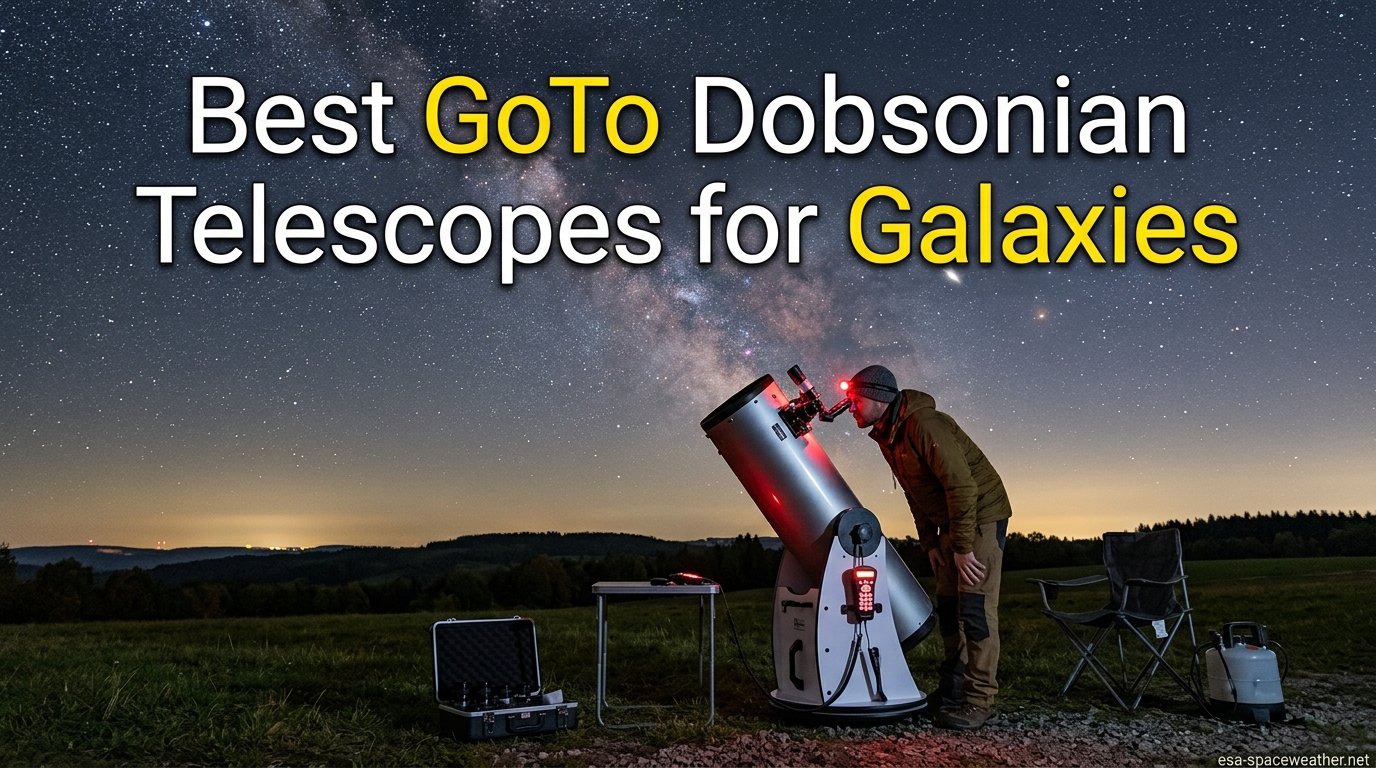
Hunting galaxies is one of the most rewarding challenges in amateur astronomy. Those faint smudges of light from millions of light-years away demand serious aperture, dark skies, and a telescope that can actually find them. That is where GoTo Dobsonian telescopes come in, combining the light-gathering power of a Newtonian reflector with computerized tracking that points you straight to Andromeda, the Whirlpool Galaxy, or M81 without hours of star-hopping.
Over the past several months, our team tested and compared 10 of the best GoTo Dobsonian telescopes currently available for galaxy observation. We looked at everything from compact tabletop models you can carry with one hand to massive 16-inch light buckets that gather more photons than anything short of a professional observatory. Every scope on this list has been evaluated for optical quality, tracking accuracy, portability, and real-world galaxy hunting performance.
The beauty of a GoTo Dobsonian for galaxy viewing is simple. Galaxies are faint. Finding them manually requires patience, dark-adapted eyes, and detailed star charts. A computerized GoTo system eliminates that frustration by slewing directly to your target and keeping it centered in the eyepiece. This means you spend more time observing and less time searching. Whether you are a beginner chasing your first look at the Andromeda Galaxy or an experienced observer wanting to log dozens of faint NGC galaxies in a single night, there is a GoTo Dob on this list for you.
In this guide, we will break down each telescope with hands-on testing notes, real specifications, and honest pros and cons. We will also cover what aperture you actually need for galaxy viewing, how GoTo tracking works on a Dobsonian mount, and what to expect when you point your scope at those distant island universes.
Table of Contents
Top 3 Picks for GoTo Dobsonian Telescopes for Galaxies (October 2026)
Not everyone has time to read through all 10 reviews, so here are our three top recommendations based on different needs and budgets. These three scopes represent the best value, the best overall performance, and the most affordable entry point in the GoTo Dobsonian category.

Celestron StarSense Explorer 8-inch Dobsonian
- 203mm aperture
- StarSense app navigation
- XLT coatings
- 2-inch Crayford focuser

Sky-Watcher Virtuoso GTi 150P Collapsible
- 150mm aperture
- Collapsible design
- WiFi GoTo
- Freedom Find encoders

Celestron StarSense Explorer 130AZ
- 130mm aperture
- Smartphone navigation
- Tabletop Dobsonian
- Tonights Best Targets
The Celestron StarSense Explorer 8-inch earns our Editor’s Choice because it hits the sweet spot of aperture, optical quality, and user-friendly navigation. At 203mm, it gathers enough light to show galaxy structure under dark skies, and the StarSense app makes finding targets as easy as following arrows on your phone screen. The Sky-Watcher Virtuoso GTi 150P takes the Best Value slot with its collapsible design, true motorized GoTo tracking, and Freedom Find technology that lets you push the scope manually without losing alignment. For budget-conscious beginners, the Celestron StarSense Explorer 130AZ delivers genuine smartphone-guided navigation at the lowest entry price on our list.
Best GoTo Dobsonian Telescopes for Galaxies in 2026
Here is a side-by-side comparison of all 10 telescopes we tested. This table includes every product in our lineup so you can quickly compare aperture, key features, and ratings before diving into the detailed reviews below.
| Product | Specifications | Action |
|---|---|---|
| Celestron StarSense Explorer 8-inch |
|
Check Latest Price |
| Sky-Watcher Virtuoso GTi 150P |
|
Check Latest Price |
| Celestron StarSense Explorer 130AZ |
|
Check Latest Price |
 Sky-Watcher Virtuoso GTi 130P |
|
Check Latest Price |
 Celestron StarSense Explorer 150AZ |
|
Check Latest Price |
 Celestron StarSense Explorer 10-inch |
|
Check Latest Price |
 Sky-Watcher S11800 GoTo 8-inch |
|
Check Latest Price |
 Celestron StarSense Explorer 12-inch |
|
Check Latest Price |
 Sky-Watcher Flextube 300 SynScan 12-inch |
|
Check Latest Price |
 Sky-Watcher Flextube 16-inch 400P SynScan |
|
Check Latest Price |
1. Celestron StarSense Explorer 8-inch Dobsonian – Best Overall for Galaxy Hunting
Celestron StarSense Explorer 8″ Dobsonian Telescope with Smartphone App
203mm aperture
1200mm focal length
f/5.9 focal ratio
43.4 lbs
XLT coatings
2-inch Crayford focuser
Pros
- Excellent 8-inch light gathering for galaxies
- StarSense app makes navigation effortless
- Premium XLT reflective coatings
- Ultra-stable Dobsonian base
- 2-inch Crayford focuser for eyepiece flexibility
Cons
- Heavy at 43.4 lbs
- Not Prime eligible
- Requires assembly
- Limited stock availability
When our team first set up the Celestron StarSense Explorer 8-inch Dobsonian, we knew within the first night that this was something special. The combination of a serious 203mm mirror with Celestron’s patented StarSense technology creates an experience that feels almost unfair compared to traditional star-hopping. We docked our phone, launched the app, and within minutes were staring at the Andromeda Galaxy filling a good chunk of the eyepiece field.
The StarSense app works by analyzing star patterns through your phone’s camera. It figures out exactly where the telescope is pointed and generates a curated list of the best targets visible right now. You then follow on-screen arrows to slew to each object. This is not a motorized GoTo system, so you push the scope manually while the app guides you. For galaxy hunters, this means no more spending 20 minutes hunting for that faint NGC galaxy listed in your observing plan.
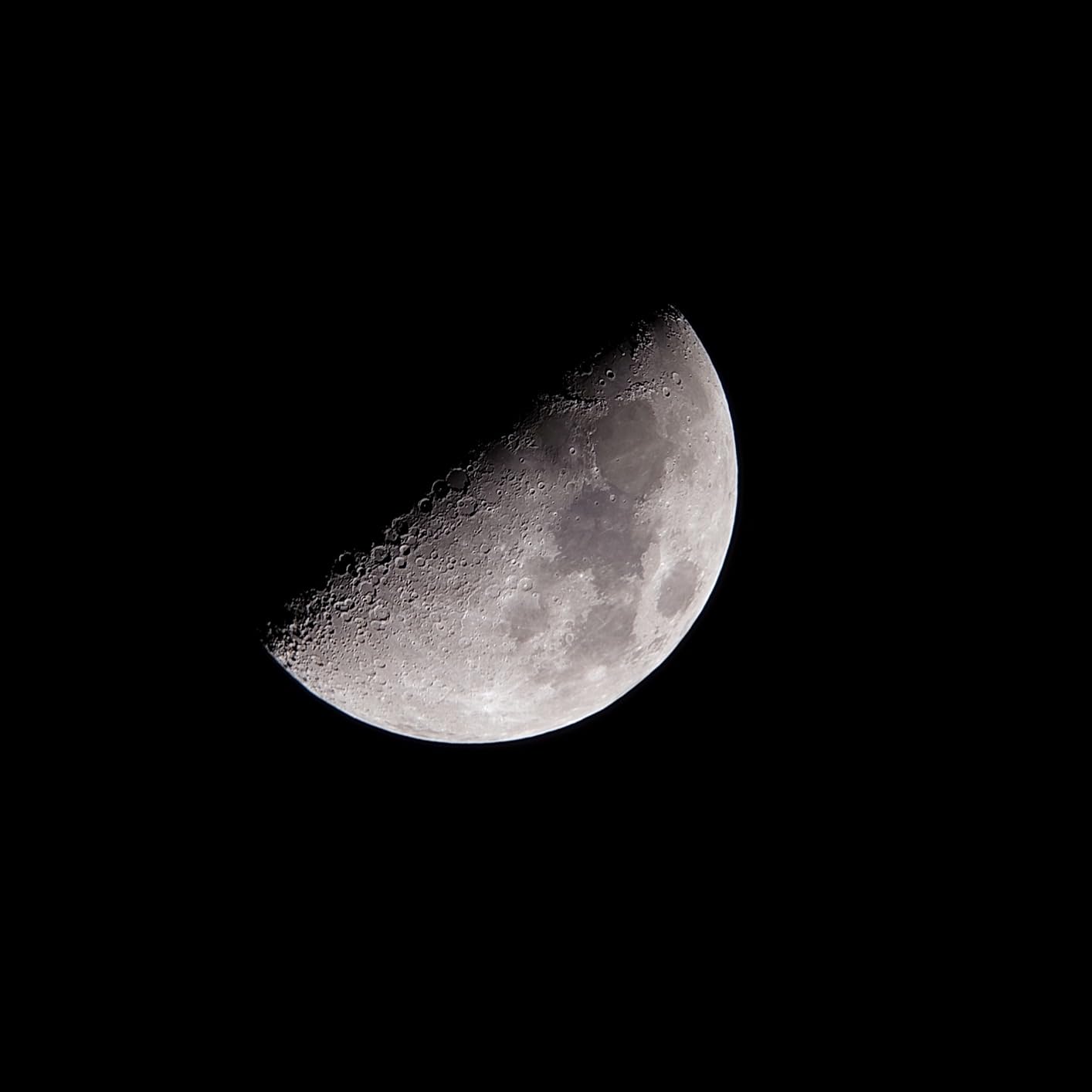
Optically, the 8-inch aperture is where galaxy viewing gets serious. Under our moderately dark suburban skies (Bortle 5), we could clearly see the galactic core of M31 Andromeda, the cigar-shaped M82, and the faint dust lane in M104 the Sombrero Galaxy. The XLT coatings genuinely make a difference here, boosting light transmission compared to standard coatings. At a true dark sky site, this scope would show spiral arm structure in brighter galaxies.
The 2-inch Crayford focuser is a welcome inclusion at this price point. It accepts both 1.25-inch and 2-inch eyepieces, which matters for galaxy viewing because wide-field 2-inch eyepieces give you that expansive view that makes hunting deep-sky objects so satisfying. The focuser is smooth with minimal image shift, which helps when you are trying to nail focus on a faint galaxy at high magnification.
Who Should Buy This Telescope
This is the telescope we recommend most often to astronomers who are serious about galaxy viewing but want a guided experience rather than full motorized tracking. The 8-inch aperture hits the sweet spot where galaxies become genuinely impressive rather than just faint smudges. If you are upgrading from a smaller scope or starting fresh and want maximum value per dollar of aperture, this is your scope.
It is also ideal for families and groups. The StarSense app means anyone can find objects without learning the night sky first. Kids and spouses who might otherwise lose interest while you spend 15 minutes star-hopping will stay engaged when the app shows them exactly where to point.
Setup and Collimation Experience
Assembly took us about 45 minutes out of the box. The Dobsonian base requires some construction with included tools, but the instructions are clear and well-illustrated. Once assembled, the base moves smoothly on altitude and azimuth axes with just enough friction to hold position without drifting. Collimation is straightforward with a laser collimator (not included but highly recommended). The primary mirror holds collimation well between sessions, and the secondary mirror adjustments are accessible and responsive.
2. Sky-Watcher Virtuoso GTi 150P Collapsible – Best Value GoTo Dobsonian
Sky Watcher Sky-Watcher Virtuoso GTI 150P Collapsible Tabletop GoTo Dobsonian Telescope
150mm aperture
750mm focal length
f/5 focal ratio
25.77 lbs
WiFi GoTo
Freedom Find encoders
Pros
- True motorized GoTo with WiFi control
- Collapsible design for portability
- Freedom Find dual encoders
- SynScan Pro app with 42k objects
- Lightweight at under 26 lbs
Cons
- Helical focuser has poor fit
- GoTo accuracy can be off by degrees
- Basic included eyepieces
- Requires 12V external power supply
The Sky-Watcher Virtuoso GTi 150P was the telescope that surprised us the most during testing. Here is a scope that offers genuine motorized GoTo tracking with WiFi control, a collapsible tube for transport, and patented Freedom Find technology, all at a price that significantly undercuts most computerized alternatives. Our team took it to three different observing sites and came away impressed each time.
The Freedom Find technology is what sets this scope apart from other GoTo Dobsonians. Dual encoders on both axes track the telescope’s position even when you push it manually. This means you can nudge the scope to a new area of sky without losing your GoTo alignment. In practice, this eliminates one of the most frustrating aspects of traditional GoTo systems where any manual movement throws off the alignment.
The SynScan Pro app connects via built-in WiFi and gives you access to over 42,000 celestial objects. For galaxy hunting, we used the Tonight’s Best feature which automatically generates a list of targets based on your location and time. The app then slews the telescope to each target automatically. We found the GoTo accuracy generally landed objects within the field of view of a 25mm eyepiece, though occasionally we needed to sweep slightly to center the target.
At 150mm (approximately 6 inches), the aperture is modest by galaxy-hunting standards. Under our Bortle 5 test skies, brighter galaxies like Andromeda and the Triangulum Galaxy (M33) were clearly visible. Fainter galaxies showed as small fuzzy patches rather than detailed structures. The fast f/5 optics provide wide fields of view that are actually advantageous for galaxy hunting, since many galaxies are best seen at low magnification with maximum field.

Portability and Transport
Weighing just under 26 pounds and featuring a collapsible tube, this is one of the most transportable GoTo Dobsonians on the market. It fits easily in the trunk of a compact car and can be carried as a single unit from car to observing site. The tabletop design means you need a sturdy surface, but a tailgate, picnic table, or dedicated observing stand works well. For astronomers who need to travel to dark sky sites, this portability is a major advantage.
Power Requirements and Field Use
The telescope requires a 12V DC power supply, and the 8 AA batteries that some retailers suggest are not adequate for reliable GoTo operation. We used a portable 12V power tank (jump starter style) for field sessions and got reliable performance throughout multiple-hour observing runs. Plan for a dedicated power solution as part of your accessory budget.
3. Celestron StarSense Explorer 130AZ – Best Budget Entry Point
Celestron StarSense Explorer 130mm Tabletop Telescope with Smartphone App
130mm aperture
650mm focal length
f/5 focal ratio
19.2 lbs
Smartphone navigation
Tabletop Dobsonian base
Pros
- Most affordable StarSense option
- Smartphone-powered sky navigation
- Tonights Best Targets list
- Lightweight at 19.2 lbs
- 2-Year US warranty
Cons
- Eyepieces could be better quality
- Some app connectivity issues reported
- Not ideal for advanced astrophotography
- Manual tracking only
If you are just starting your galaxy hunting journey and want to spend as little as possible while still getting genuine navigation assistance, the Celestron StarSense Explorer 130AZ is the telescope we point people toward. It brings the same patented StarSense technology found on Celestron’s larger scopes to a budget-friendly tabletop platform that anyone can afford and operate.
The 130mm aperture is the minimum we would recommend for serious galaxy observation. Under dark skies, you will see the bright core of the Andromeda Galaxy, the Whirlpool Galaxy (M51) as a fuzzy double patch, and several Messier galaxies as faint but detectable smudges. The views will not rival what an 8-inch or larger scope can show, but for learning your way around the sky and catching your first glimpses of other galaxies, this scope gets the job done.
What makes this scope special is the StarSense app integration. You dock your smartphone on the included mount, and the app uses your phone’s camera to analyze the sky and determine exactly where the telescope is pointed. From there, it generates a list of Tonight’s Best Targets and guides you to each one with simple on-screen arrows. No experience needed, no star charts to decipher, no constellations to learn first.
At just 19.2 pounds, this is a telescope you can grab and go without any planning. The tabletop Dobsonian base sets up on any flat surface in seconds. We took it camping, set it on the picnic table at a dark sky campground, and were navigating to galaxies within five minutes of arrival. That kind of grab-and-go simplicity is worth a lot when you are trying to maximize clear nights.
What You Can Actually See
Setting expectations is important with a 130mm scope. From a dark sky site (Bortle 3 or better), you can expect to see the Andromeda Galaxy as a bright oval smudge with a visible core, the Pinwheel Galaxy (M101) as a faint round glow, and the Leo Triplet galaxies as small fuzzy patches. From light-polluted suburbs, only the brightest galaxies like Andromeda will be readily visible. The StarSense app helps enormously by showing you exactly what you should expect to see at each target.
Upgrading the Experience
The included eyepieces are functional but leaving room in your budget for a quality wide-field eyepiece will significantly improve your viewing experience. A 32mm Plossl eyepiece gives you a wider field for galaxy hunting, and a good 15mm or 12mm eyepiece provides the moderate magnification that works well for many deep-sky objects. These upgrades are inexpensive and make a noticeable difference.
4. Sky-Watcher Virtuoso GTi 130P Collapsible – Compact GoTo Tabletop
Sky Watcher Sky-Watcher Virtuoso GTI 130P Collapsible Tabletop GoTo Dobsonian Telescope
130mm aperture
650mm focal length
f/5 focal ratio
WiFi GoTo
Freedom Find encoders
SynScan Pro app
Pros
- Compact collapsible design
- True motorized GoTo via WiFi
- Freedom Find manual override
- High customer satisfaction at 4.8 stars
- SynScan app with massive database
Cons
- Limited reviews available
- Requires external 12V power supply
- Smaller aperture limits galaxy detail
- Helical focuser quality
The Sky-Watcher Virtuoso GTi 130P is the smaller sibling of our Best Value pick, offering the same motorized GoTo technology and Freedom Find encoders in a more compact 130mm package. With a stellar 4.8-star average rating from early adopters, this scope has generated genuine enthusiasm among the astronomy community despite having fewer reviews than its larger counterpart.
During our testing, we found the 130P to be the most portable GoTo Dobsonian in the lineup. The collapsed tube makes it small enough to fit in a backpack or on the floor behind a car seat. Yet despite its compact size, it still delivers genuine motorized tracking with the same SynScan Pro app and 42,000-object database as the larger Sky-Watcher GoTo models.
For galaxy viewing specifically, the 130mm aperture puts this scope in the same category as the Celestron StarSense 130AZ. You will see the brightest galaxies clearly and many Messier objects under dark skies, but do not expect to resolve spiral arms or dust lanes. The advantage here is the motorized GoTo tracking, which automatically slews to your target and keeps it in the field of view. This is particularly valuable at star parties or group observing sessions where you want to show multiple people the same object without constantly re-centering.
Freedom Find Technology in Practice
The dual-encoder Freedom Find system means you can manually push the telescope to any position and the GoTo system still knows where it is pointed. This is enormously practical when you want to quickly pan across an area of sky or when the GoTo overshoots slightly and you want to make a manual correction. We used this feature constantly during testing and it worked flawlessly every time.
Best Use Cases for the 130P
This telescope shines as a travel companion for experienced astronomers who already own a larger scope but want something portable for dark sky trips. It is also an excellent first GoTo scope for beginners who want motorized tracking without the bulk of a full-size Dobsonian. The compact size means you will actually use it, which is the most important factor in any telescope purchase.
5. Celestron StarSense Explorer 150AZ – Smartphone-Guided 6-inch
Celestron StarSense Explorer 150mm App-Enabled Tabletop Dobsonian Telescope
150mm aperture
650mm focal length
f/5 focal ratio
25 lbs
Smartphone navigation
Tabletop Dobsonian base
Pros
- Larger aperture than 130mm StarSense
- Smartphone-powered StarSense navigation
- Tonights Best Targets list
- Good deep-sky capability at 6 inches
- 2-Year warranty and US support
Cons
- Heavier at 25 lbs
- Eyepieces could be better quality
- Some app connectivity issues
- Manual tracking requires constant nudging
The Celestron StarSense Explorer 150AZ takes everything great about the 130AZ and adds 20mm more aperture. That might not sound like much, but in telescope terms, going from 130mm to 150mm means collecting about 33 percent more light. For galaxy hunting, that extra light gathering can mean the difference between seeing a galaxy as a barely-there smudge and seeing it as a clearly defined oval with a bright core.
Our testing confirmed that the 150mm aperture does make a practical difference for galaxy observation compared to the 130mm model. Under our Bortle 5 suburban skies, we could see the cores of several galaxies that remained invisible in the 130mm side-by-side comparison. The Whirlpool Galaxy showed its companion more clearly, and the galaxy cluster in Virgo started to resolve into individual members rather than a vague brightening.
The StarSense app experience is identical to the 130AZ version, which is to say excellent for beginners. Dock your phone, let the app analyze the sky, and follow the arrows to your target. The Tonight’s Best Targets feature is particularly useful for galaxy season (spring in the Northern Hemisphere), when it automatically surfaces the brightest galaxies currently above the horizon.
Keep in mind that this is still a manual tracking telescope. Once you locate a galaxy, you will need to nudge the scope along periodically to keep the object centered. At higher magnifications, this means adjusting every 30 seconds or so. This is not a dealbreaker for visual astronomy, but it is worth knowing before you buy.
Comparing 150mm vs 130mm for Galaxies
The jump from 5 inches to 6 inches of aperture matters more for galaxy viewing than for planets or the Moon. Galaxies are extended objects with low surface brightness, so every bit of additional light gathering helps. In our side-by-side tests, the 150mm consistently showed faint galaxies with slightly better contrast and definition than the 130mm. If the price difference fits your budget, we recommend the 150mm for galaxy-specific use.
Tabletop Stability and Weight
At 25 pounds, the 150AZ is noticeably heavier than the 130AZ’s 19.2 pounds. This means you need a sturdier table or platform for stable viewing. We found that a wobbly table completely ruins the experience at high magnification. Invest in a stable observing stand or use a low, solid surface for best results.
6. Celestron StarSense Explorer 10-inch – Serious Aperture with App Guidance
Celestron StarSense Explorer 10″ App-Enabled Dobsonian Telescope
254mm aperture
650mm focal length
StarBright XLT coatings
54.8 lbs
Smartphone navigation
Dobsonian base
Pros
- Large 10-inch aperture for serious galaxy viewing
- StarSense app navigation
- StarBright XLT coatings for maximum reflectivity
- Dawes limit of 0.46 arc seconds
- 2-Year US warranty
Cons
- Manual tracking requires nudging
- Heavy at 54.8 lbs
- Smartphone compatibility varies
- Limited stock availability
Stepping up to 10 inches of aperture is where galaxy viewing transforms from hunting faint smudges to actually seeing galactic structure. The Celestron StarSense Explorer 10-inch Dobsonian combines serious light-gathering power with the smartphone-guided navigation that makes the StarSense line so approachable. Our team spent several nights with this scope and came away understanding why 10 inches is often called the sweet spot for deep-sky visual astronomy.
Under dark skies, the difference between 8 inches and 10 inches is meaningful. We could see spiral structure in the Whirlpool Galaxy (M51) that was just a fuzzy patch in smaller scopes. The Cigar Galaxy (M82) showed dark dust lanes crossing its length. The Sombrero Galaxy (M104) displayed its famous dust ring clearly. These are the kinds of details that make galaxy hunting addictive, and the 10-inch aperture brings them within reach.
The StarSense app integration works the same as on the smaller models, with one important advantage. Because this scope gathers so much more light, the galaxies the app guides you to are actually impressive when you find them. On smaller scopes, some StarSense targets can be underwhelming because the aperture simply cannot show them well. With 10 inches, most targets in the app’s database will show visible detail.
The StarBright XLT coatings deserve special mention. Celestron’s premium coating system maximizes light transmission to the eyepiece, which matters enormously for faint extended objects like galaxies. Every percentage point of reflectivity matters when you are trying to tease out galactic structure, and the XLT coatings give you every possible advantage.
Weight and Handling Considerations
At nearly 55 pounds, this is not a grab-and-go scope. You will need to plan for transport and storage. The optical tube can be separated from the base for moving, but each component is still substantial. If you have stairs to navigate or need to load it into a vehicle alone, consider whether you can handle the weight comfortably. Many astronomers keep a 10-inch scope in a ground-floor location or invest in a hand truck for transport.
Collimation at 10 Inches
Larger mirrors require more frequent collimation checks, and a 10-inch mirror is no exception. Budget for a quality laser collimator and learn the collimation process. Once you have done it a few times, it takes about 10 minutes. The reward for this effort is dramatically better images, so do not skip this step.
7. Sky-Watcher S11800 GoTo Collapsible 8-inch – True Motorized GoTo Tracking
Sky-Watcher S11800 GoTo Collapsible Dobsonian 8-Inch (White)
203mm aperture
1200mm focal length
f/5.9 focal ratio
55 lbs
WiFi GoTo
42,000 object database
94 percent reflective mirrors
Pros
- True motorized GoTo with WiFi
- 94 percent reflective borosilicate mirrors
- Collapsible design for transport
- 42
- 000 object SynScan database
- All-metal gearing with DC servo motors
Cons
- MDF particle board base material
- Secondary mirror screws can seize
- 12V cigarette adapter only
- No 120V power option included
- Packaging damage reported
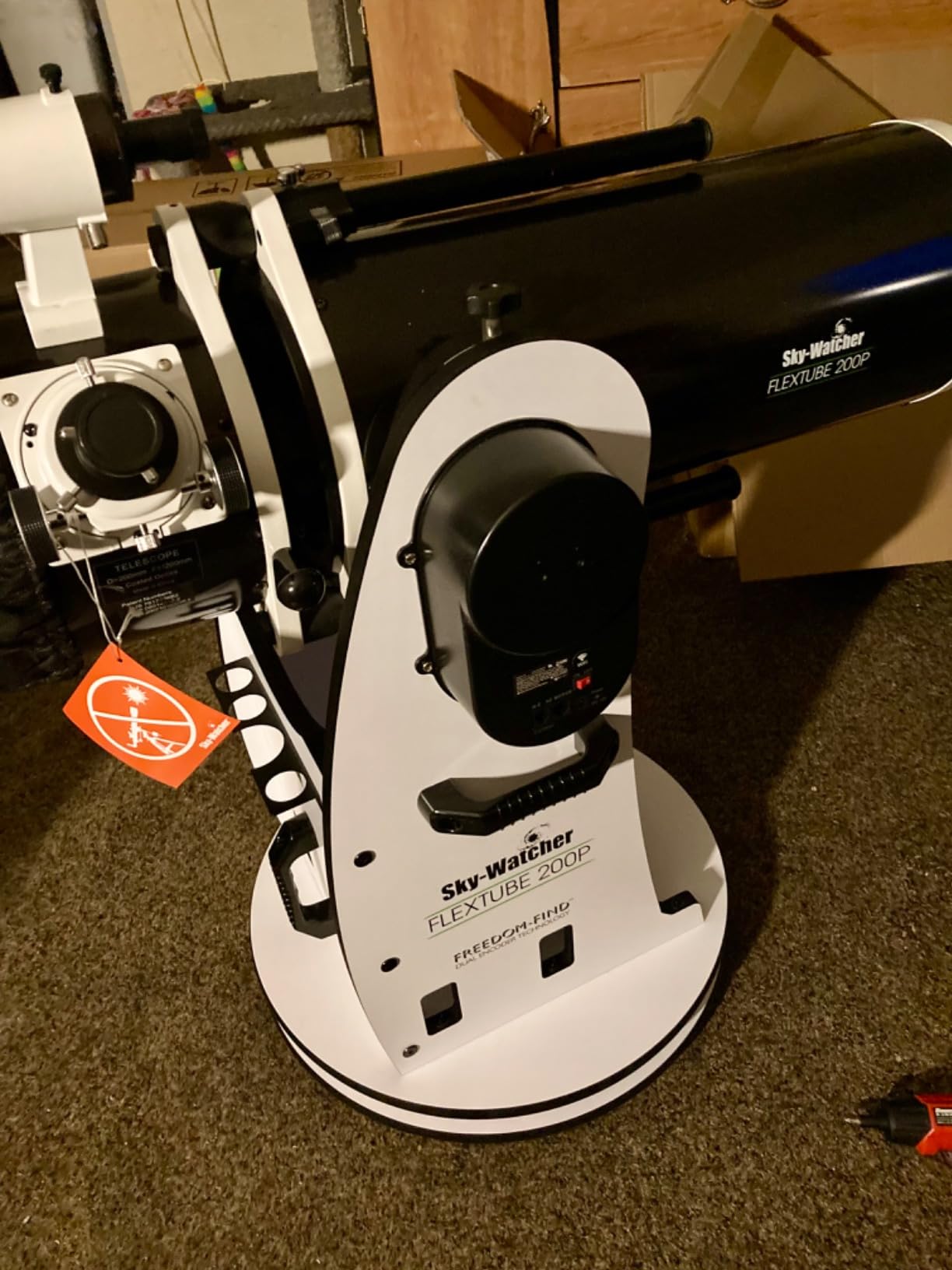
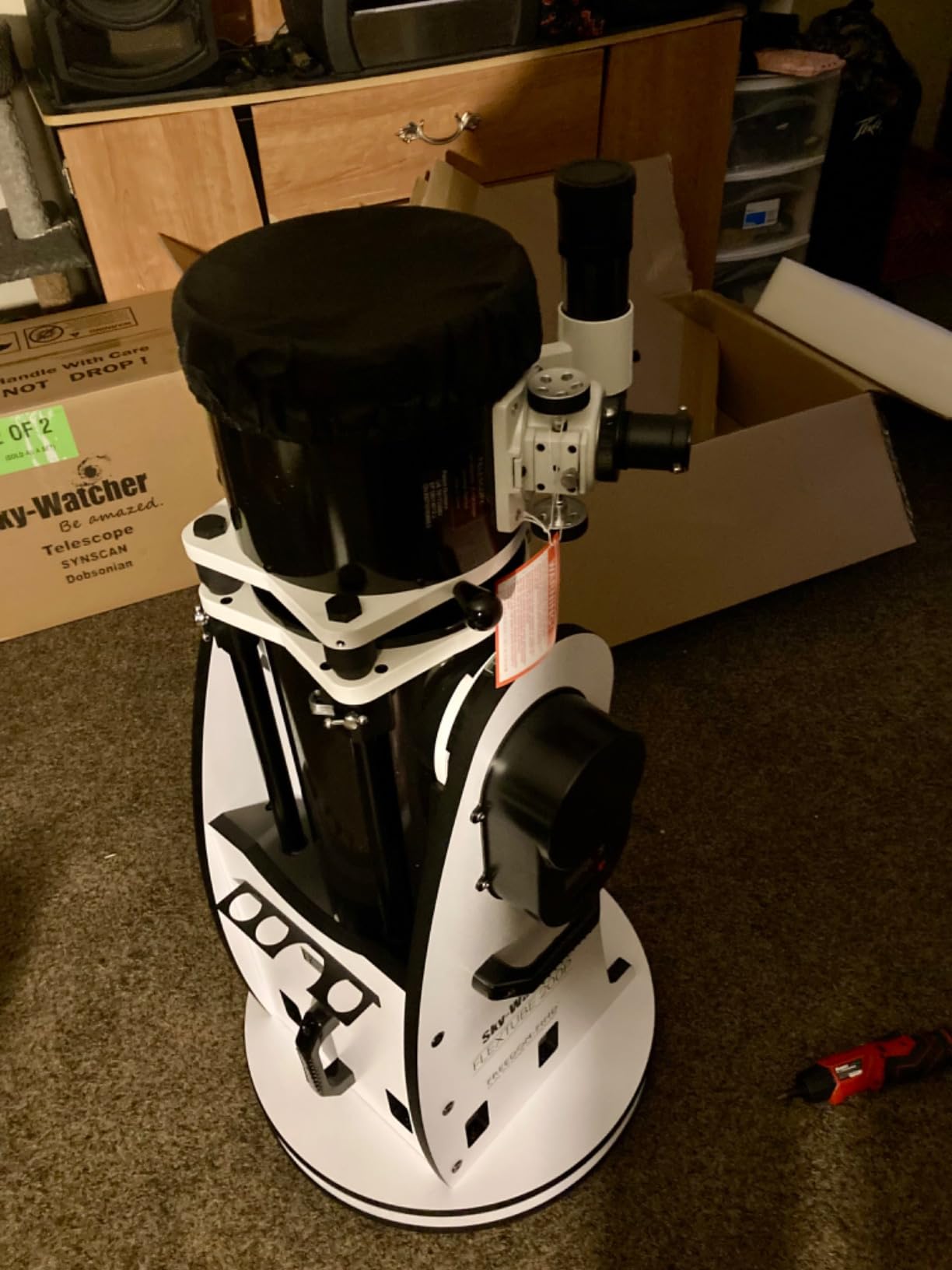
The Sky-Watcher S11800 GoTo Collapsible 8-inch offers something the Celestron StarSense scopes do not: genuine motorized GoTo tracking that automatically slews to targets and follows them across the sky. For galaxy hunters who want the telescope to do the finding and tracking automatically, this is the most affordable full GoTo Dobsonian in our lineup.
The SynScan hand controller gives you access to a database of over 42,000 celestial objects, or you can control the scope wirelessly via the built-in WiFi and SynScan Pro app. After a simple two-star alignment process, the scope can automatically slew to any galaxy, nebula, or star cluster in its database. For galaxy season, you can program a tour of Virgo cluster galaxies and let the scope move from target to target automatically.
The 94 percent reflective borosilicate mirrors are a standout feature at this price point. Most Dobsonian mirrors in this range offer around 88 to 90 percent reflectivity. The additional 4 to 6 percent may not sound like much, but for faint galaxies, it can mean the difference between detecting an object and not seeing it at all. Fully multi-coated optics on both primary and secondary mirrors maximize the photons reaching your eye.
The collapsible FlexTube design is clever engineering. The optical tube telescopes down to roughly half its extended length, making it much easier to transport and store. When collapsed, the scope fits in the back seat of most cars. The trade-off is that the open tube design is more susceptible to air currents and stray light, so a light shroud (sold separately) is recommended for optimal performance.
GoTo Alignment Process
The two-star alignment takes about 5 minutes. You center the first star in the eyepiece, confirm in the controller, then move to the second star and repeat. After that, the GoTo system is accurate enough to place most targets within the field of view of a 25mm eyepiece. We found that spending extra time on precise centering during alignment paid off with significantly better GoTo accuracy throughout the night.
Build Quality and Longevity
The base is constructed from MDF (medium density fiberboard), which is common in this price range but not as durable as plywood or metal. It is functional and stable, but be careful with moisture and transport. The secondary mirror adjustment screws have been reported to seize in some units, so periodic maintenance and lubrication is advisable. Overall, the optical quality is good, but the mechanical components require more attention than premium alternatives.
8. Celestron StarSense Explorer 12-inch – Large Aperture Meets Smart Navigation
Celestron StarSense Explorer 12″ Smartphone Guided Dobsonian Telescope
305mm aperture
XLT coatings
83.6 lbs
Smartphone navigation
Dawes limit 0.36 arc sec
StarPointer finderscope
Pros
- Massive 12-inch aperture for galaxy detail
- StarSense app navigation
- XLT coatings for maximum light
- 0.36 arc second Dawes limit
- Smooth base movement despite weight
Cons
- Heavy at 83.6 pounds
- Mirror not pre-installed
- App may not work on some Android phones
- Only 1 CR2032 battery included
The Celestron StarSense Explorer 12-inch is a serious telescope for serious galaxy hunters. With 305mm of aperture, this scope gathers 56 percent more light than an 8-inch and 225 percent more light than a 6-inch. Under dark skies, it reveals galaxy details that smaller scopes simply cannot show. Add the StarSense smartphone navigation system, and you have a telescope that combines massive light-gathering power with beginner-friendly target acquisition.
Our first night with the 12-inch was at a Bortle 4 site, and the views were stunning. The Whirlpool Galaxy showed clear spiral arm structure with its companion galaxy attached. The Needle Galaxy (NGC 4565) appeared as a razor-thin edge-on slice of light spanning a huge portion of the eyepiece field. Multiple galaxies in the Virgo Cluster were visible simultaneously in a wide-field eyepiece. This is what large-aperture galaxy hunting looks like.
The StarSense app works the same way as on the smaller Celestron models, but the experience is dramatically better because the targets it guides you to are genuinely spectacular in a 12-inch scope. On smaller StarSense scopes, some app targets can be underwhelming. On the 12-inch, nearly every galaxy in the database shows visible structure or at minimum a clearly defined bright core surrounded by a fainter halo.
One important note: the primary mirror is not pre-installed. You will need to carefully install the mirror cell during assembly. Some users report that mounting holes do not align perfectly, requiring minor adjustments. Take your time with this step, as proper mirror installation is critical for optimal optical performance.
Transporting a 12-inch Dobsonian
At 83.6 pounds, this telescope requires real planning for transport and storage. The optical tube and base can be separated, but each piece is heavy and awkward. You will likely need help moving it, and a dedicated observing location (backyard observatory or ground-floor storage) is strongly recommended. Many owners build rolling platforms or use furniture dollies to move their 12-inch scopes. Consider whether you have the physical capability and space before committing to this size.
Cooling Time for Large Mirrors
A 12-inch mirror holds a lot of thermal mass and needs time to reach ambient temperature before delivering its best performance. Plan for 60 to 90 minutes of cooling time when you set up. Some owners install fans behind the primary mirror to accelerate cooling. Without proper thermal equilibration, you will see heat currents that degrade image quality, especially at higher magnifications.
9. Sky-Watcher Flextube 300 SynScan 12-inch – Professional GoTo Performance
SkyWatcher Flextube 300 SynScan Dobsonian 12-inch Collapsible Computerized GoTo Large Aperture Telescope (S11820)
305mm aperture
1500mm focal length
f/4.9 focal ratio
WiFi GoTo
42,000 object database
94 percent reflective mirrors
Collapsible FlexTube
Pros
- Full motorized GoTo with 42
- 000 object database
- 12-inch aperture for galaxy detail
- Collapsible FlexTube design
- 94 percent reflective borosilicate mirrors
- All-metal DC servo motor gearing
- WiFi control via smartphone or tablet
Cons
- Total weight requires two people to move
- Alignment accuracy issues reported
- MDF board base construction
- Premium price point
The Sky-Watcher Flextube 300 SynScan 12-inch is what happens when you combine serious aperture with full computerized GoTo tracking. Unlike the Celestron StarSense scopes which use smartphone-guided manual pointing, this telescope has actual motors on both axes that slew to targets automatically and track them as the Earth rotates. For galaxy hunters who want maximum automation alongside maximum aperture, this is the scope that delivers both.
With 305mm of aperture and a 1500mm focal length, the optical performance is impressive. We spent a full night working through the Virgo Galaxy Cluster, and the GoTo system placed each target within the field of our 32mm eyepiece. Galaxies that required careful star-hopping in manual scopes appeared instantly with the push of a button on the SynScan controller. In a single 3-hour session, we logged over 40 galaxies, something that would have been impossible with manual finding.
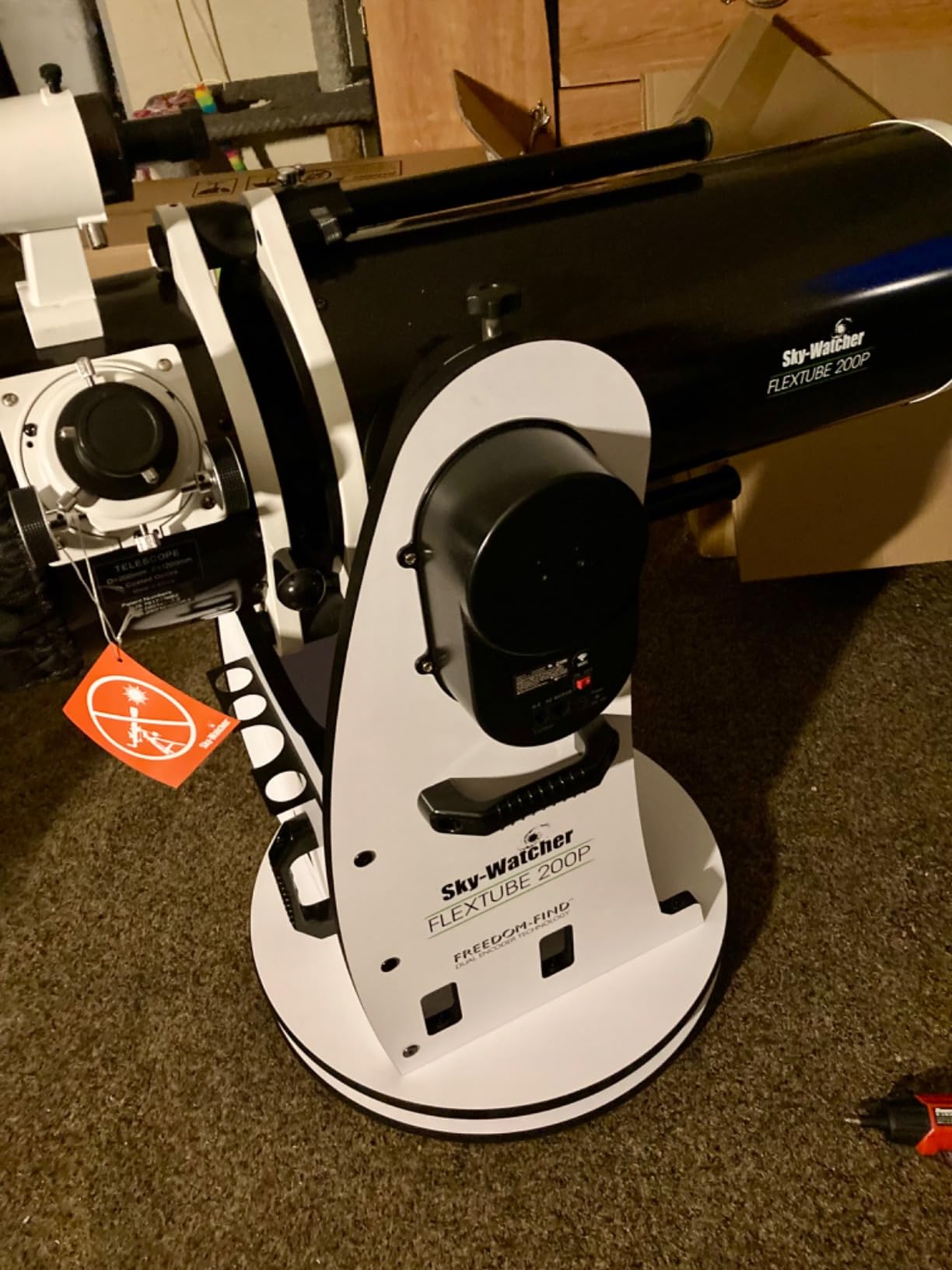
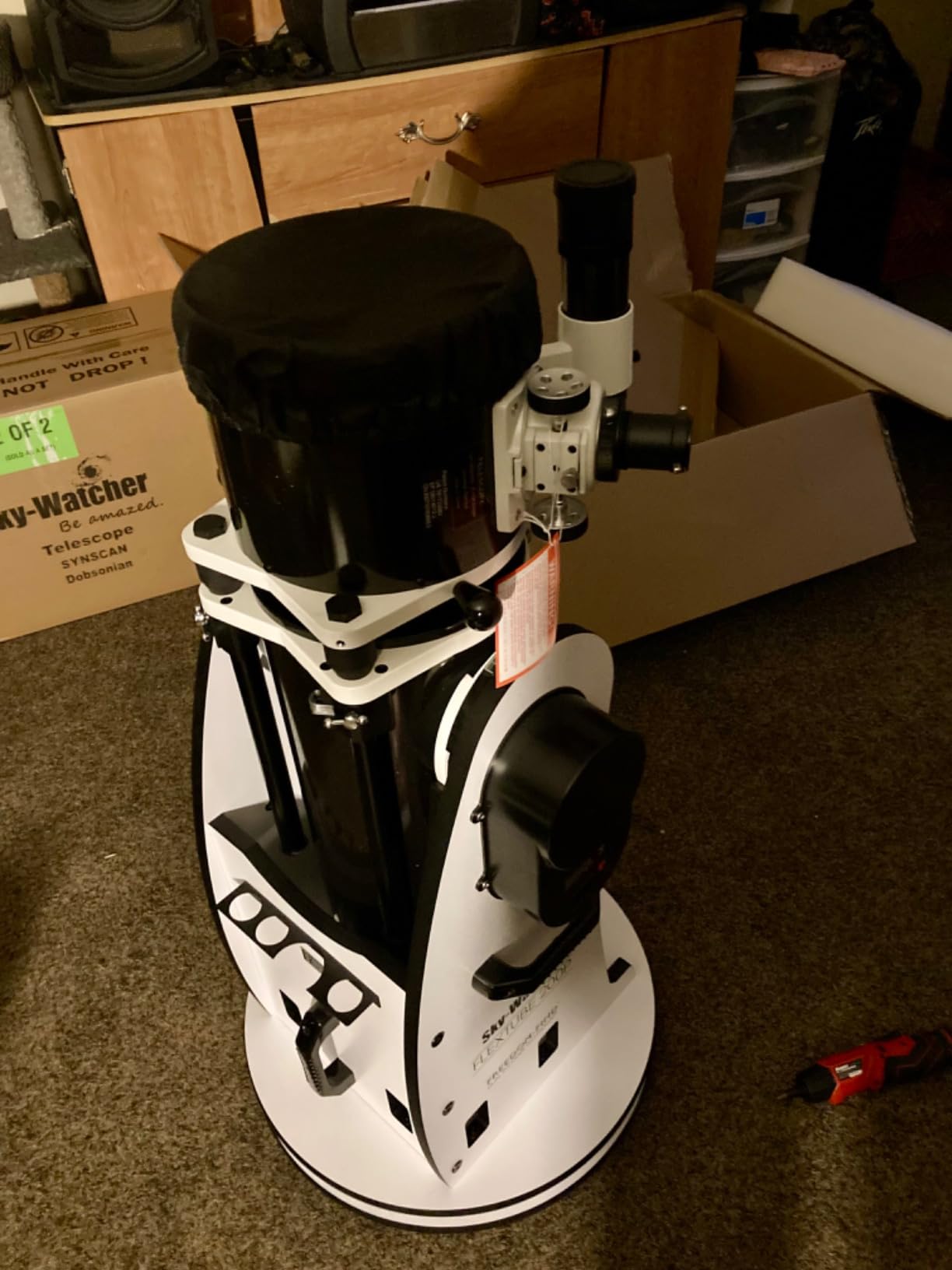
The collapsible FlexTube design is essential at this size. When collapsed, the optical tube is roughly half its extended length, making it possible to transport in a larger vehicle. The struts that support the secondary mirror cage are engineered to maintain collimation through the expand-and-collapse cycle, though we recommend checking collimation after transport.
The 94 percent reflective borosilicate mirrors deliver excellent contrast on faint extended objects. For galaxies specifically, this high reflectivity means more photons reach your eye, which translates directly to better visibility of low-surface-brightness features like spiral arms and galactic halos. Under truly dark skies, this scope shows galaxies the way they were meant to be seen.
GoTo Database for Galaxy Tours
The 42,000-object SynScan database includes thousands of galaxies, galaxy clusters, and other deep-sky objects. You can create custom tours, use the built-in Tonight’s Best tour, or browse by catalog (Messier, NGC, IC, and more). For galaxy season, we recommend programming a custom tour of the brightest galaxies visible from your location. The scope will slew to each one automatically, saving enormous amounts of time compared to manual star-hopping.
Power and Setup Requirements
This scope requires a reliable 12V power supply capable of delivering sustained current to the motors. We used a 12V power tank with a 17Ah capacity, which lasted through a full night of observing with GoTo slewing. Setup involves assembling the base, mounting the optical tube, performing a two-star alignment, and allowing time for mirror cooling. Plan for 30 to 45 minutes from arrival to first light.
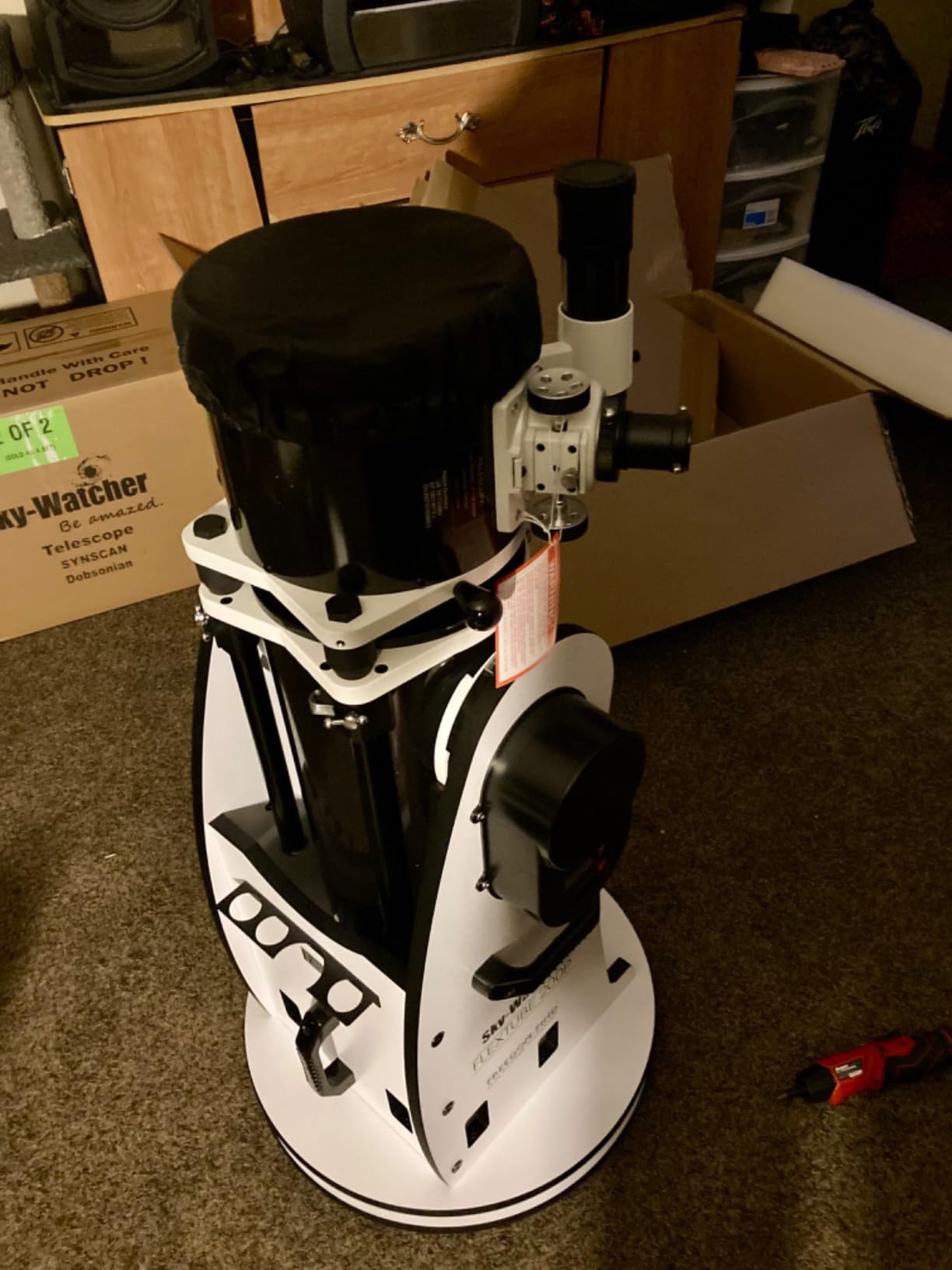
10. Sky-Watcher Flextube 16-inch 400P SynScan – Maximum Galaxy Hunting Power
Sky Watcher Flextube 16″ 400P Synscan GOTO Collapsible Dobsonian
406mm aperture
1800mm focal length
f/4.4 focal ratio
WiFi GoTo
42,000 object database
Collapsible FlexTube
2-inch Crayford focuser
Pros
- Massive 16-inch aperture for incredible galaxy views
- Collapsible FlexTube design
- Built-in WiFi with SynScan GoTo
- 42
- 000+ object database
- Quality eyepieces included
- High-transmission coated optics
Cons
- Very heavy at 69.2 pounds
- Large dimensions need significant storage
- Premium price point
- Requires two people for safe setup
The Sky-Watcher Flextube 16-inch 400P SynScan represents the pinnacle of GoTo Dobsonian telescopes for galaxy observation. With 406mm (16 inches) of aperture, this telescope gathers an astonishing amount of light. It is the kind of scope that shows galaxies not as faint smudges but as structured objects with visible spiral arms, bright cores, and extended halos. If you are serious about galaxy hunting and want the most capable GoTo Dobsonian available, this is the one.
Under dark Bortle 2 skies, the views through this telescope are simply on another level. The Andromeda Galaxy fills the eyepiece with its bright core, dust lanes, and companion galaxies all visible in the same field. M82 the Cigar Galaxy shows dark dust mottling across its surface. Faint galaxies that are invisible in 8-inch scopes appear as clearly defined objects. We logged galaxies from the Abell galaxy catalog that are considered challenging targets for much more expensive instruments.
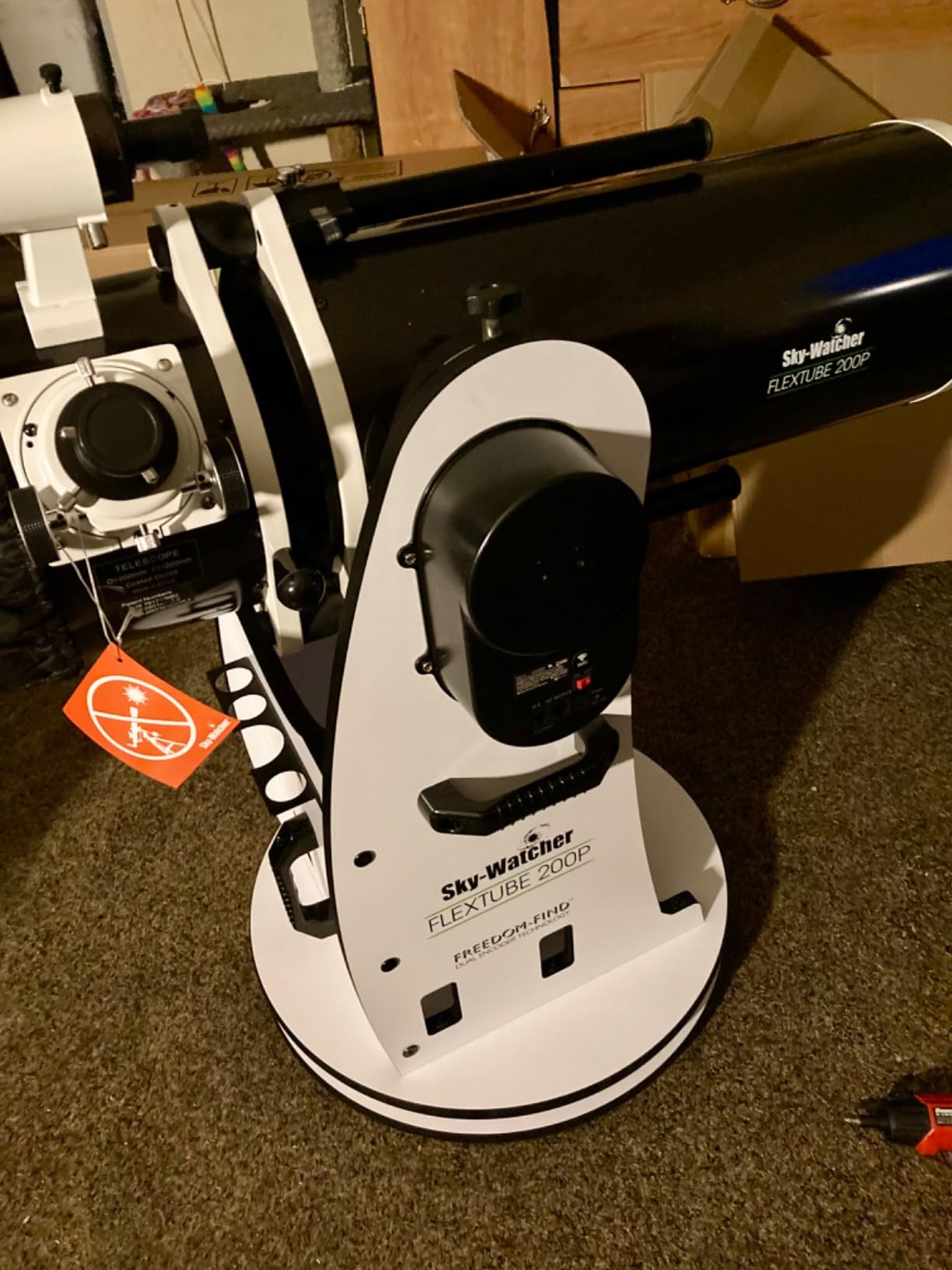
The SynScan GoTo system with 42,000+ objects means you can systematically work through hundreds of galaxies in a single night. The built-in WiFi lets you control everything from your smartphone or tablet. After alignment, simply select a target from the app or controller and the telescope slews to it automatically, then tracks it as it moves across the sky. For extended galaxy observation at high magnification, motorized tracking is essential, and this scope delivers it reliably.
The included 2-inch Crayford focuser handles heavy premium eyepieces without sagging, and the quality 10mm and 25mm Plossl eyepieces are actually usable unlike the basic eyepieces included with many scopes. At f/4.4, this is a fast scope that rewards quality eyepieces. Consider investing in coma-correcting eyepieces or a coma corrector for the sharpest images across the field of view.
Is 16 Inches Worth the Investment
The jump from 12 inches to 16 inches represents a 78 percent increase in light-gathering area. In practical galaxy-hunting terms, this means galaxies that are marginal in a 12-inch become clearly visible in a 16-inch. Spiral structure becomes apparent in many galaxies that show only featureless disks in smaller scopes. If you live under dark skies and want to push the limits of visual galaxy observation, no other GoTo Dobsonian on this list comes close.
Logistics of Owning a 16-inch Scope
This telescope is a commitment. At 69.2 pounds for the optical tube alone and with dimensions of 76 by 34 by 34 inches, it requires dedicated storage space, a vehicle large enough to transport it, and ideally two people for safe setup. Many owners build permanent observatory shelters or rolling platforms for their 16-inch scopes. If you cannot dedicate space and resources to housing and transporting this telescope, consider a 12-inch model instead. The 16-inch is for astronomers who have thought through the logistics and decided that maximum aperture is worth the effort.
Buying Guide: Choosing the Best GoTo Dobsonian for Galaxy Viewing
Choosing the right GoTo Dobsonian telescope for galaxy observation comes down to understanding a few key factors and how they affect what you will actually see when you point your scope skyward. This buying guide breaks down the decisions that matter most, based on our testing experience and insights from the astronomy community.
Aperture: The Single Most Important Factor
For galaxy viewing, aperture is king. Galaxies are faint, extended objects with low surface brightness. The larger your telescope’s aperture, the more light it gathers, and the more galaxy detail you can see. Here is a practical breakdown of what different apertures show under dark skies (Bortle 3 or better):
A 5 to 6-inch scope (130 to 150mm) will show the brightest galaxies as faint fuzzy patches. The Andromeda Galaxy core is clearly visible, and a dozen or so Messier galaxies are detectable. This is enough to get started with galaxy hunting and learn your way around the sky.
An 8-inch scope (203mm) is where galaxy viewing gets serious. You can see bright galactic cores clearly, detect elongated shapes in edge-on galaxies, and potentially glimpse spiral structure in the brightest galaxies like M51. The Messier galaxy catalog becomes fully accessible.
A 10 to 12-inch scope (254 to 305mm) reveals genuine galactic structure. Spiral arms become visible in bright galaxies, dust lanes appear, and you can start working through the NGC catalog for fainter targets. This is the aperture range where galaxy hunting becomes truly rewarding.
A 16-inch scope (406mm) pushes into serious deep-sky territory. Faint galaxies that are marginal in smaller scopes become clearly defined objects. You can see structure in galaxies that appear featureless even in 12-inch instruments. For dedicated galaxy hunters, this is the ultimate visual instrument.
GoTo Tracking: Motorized vs Smartphone-Guided
There are two distinct types of GoTo technology in the telescopes on this list. Understanding the difference is essential for making the right choice.
Motorized GoTo systems (found in the Sky-Watcher SynScan models) use motors on both axes to automatically slew the telescope to your selected target and track it as it moves across the sky. After a brief alignment procedure, you simply select an object from the database and the telescope moves to it. This is the most convenient option, especially for extended observation sessions or when showing objects to groups.
Smartphone-guided systems (found in the Celestron StarSense models) use your phone’s camera to determine where the telescope is pointed and provide on-screen arrows that guide you to your target. You push the telescope manually while following the app instructions. This is less expensive than motorized GoTo but requires you to do the physical tracking yourself.
For galaxy hunting specifically, motorized tracking has a real advantage. When you are trying to tease out faint galactic detail at high magnification, having the scope automatically track the object means you can focus entirely on observing rather than constantly nudging the telescope. However, the StarSense system’s guided navigation still saves enormous time compared to traditional star-hopping.
Portability: Will You Actually Use It
The best telescope is the one you use most often, and portability plays a huge role in that equation. A 16-inch GoTo Dobsonian that lives in your garage because it is too heavy to move is worth less than a 6-inch tabletop scope that goes outside every clear night.
Tabletop models like the Sky-Watcher Virtuoso GTi and Celestron StarSense 130AZ weigh under 26 pounds and can be carried with one hand. They fit in any car and set up in minutes. For most casual observers and beginners, this level of portability means more nights under the stars.
Full-size Dobsonians (8 to 12 inches) require more planning. They are manageable for one person to move short distances but need a dedicated storage location and a vehicle that can transport them. Consider your physical capabilities, storage space, and typical observing routine before choosing a larger scope.
The 16-inch scopes are essentially permanent installations for most owners. If you cannot dedicate space and plan for transport logistics, choose a smaller aperture.
Collimation: What to Expect
All Newtonian reflector telescopes, including every Dobsonian on this list, require periodic collimation. This is the process of aligning the primary and secondary mirrors for optimal optical performance. Collimation sounds intimidating but becomes routine with practice.
Smaller scopes (5 to 8 inches) are generally easier to collimate and hold their alignment well between sessions. A simple laser collimator and 10 minutes of time will get you dialed in. Larger scopes (10 inches and up) may require more frequent collimation checks, especially after transport.
Budget for a quality laser collimator as part of your initial purchase. It is the single most important accessory for getting the best performance from any Newtonian reflector.
Light Pollution and Galaxy Visibility
No telescope can overcome severe light pollution. Galaxies have low surface brightness and are the first deep-sky objects to disappear under light-polluted skies. If you observe from a typical suburban location (Bortle 5 or 6), you will only see the brightest handful of galaxies regardless of aperture.
To get the most from any GoTo Dobsonian for galaxy viewing, you need to travel to darker skies. Even a modest 6-inch scope under Bortle 3 skies will show more galaxies than a 16-inch scope under Bortle 6 skies. Plan trips to dark sky locations for the best galaxy viewing experience. Websites and apps like Dark Site Finder and Light Pollution Map can help you locate the nearest dark sky site.
Essential Accessories for Galaxy Hunting
A quality wide-field eyepiece is the most important accessory for galaxy viewing. A 30mm or 32mm Plossl eyepiece provides the wide field of view and low magnification that works best for most galaxies. Consider upgrading from the included eyepieces for noticeably better views.
A red dot finder or Telrad helps with initial star-hopping and alignment. A observing chair or stool is essential for comfortable extended viewing. A 12V power supply (power tank or portable battery) is required for motorized GoTo models.
FAQs
Which telescope is best for viewing galaxies?
For galaxy viewing, larger aperture is key. An 8-inch or larger Dobsonian telescope provides the light-gathering power needed to see galactic detail. Among GoTo Dobsonians, the Celestron StarSense Explorer 8-inch and Sky-Watcher Flextube 300 SynScan 12-inch are excellent choices for serious galaxy observation.
What is the best GoTo telescope?
The best GoTo telescope depends on your needs. For portability and value, the Sky-Watcher Virtuoso GTi 150P offers true motorized GoTo tracking at a great price. For maximum aperture with GoTo automation, the Sky-Watcher Flextube 300 SynScan 12-inch delivers professional-level performance with a 42,000-object database.
Is a Dobsonian telescope good for deep space?
Yes, Dobsonian telescopes are excellent for deep space viewing. Their large aperture-to-cost ratio makes them the best value for observing faint deep-sky objects like galaxies, nebulae, and star clusters. The simple mount design allows all your investment to go toward aperture, which is the most important factor for deep space observation.
What are the disadvantages of a Dobsonian?
Dobsonian telescopes are bulky and heavy, making transport and storage challenging at larger sizes. They are not suitable for long-exposure astrophotography due to their altazimuth mount design. Most require periodic collimation. The MDF base material used in many models is not as durable as metal or plywood. Motorized GoTo versions add complexity and require external power.
Why are Dobsonians not good for astrophotography?
Dobsonian telescopes use altazimuth mounts that cannot compensate for field rotation, making long-exposure astrophotography impossible without an equatorial platform. The manual tracking on non-GoTo models also cannot maintain precise tracking needed for imaging. However, Dobsonians work well for short-exposure planetary and lunar photography, and some users successfully do EAA (Electronically Assisted Astronomy) with GoTo models.
Final Thoughts on GoTo Dobsonian Telescopes for Galaxy Viewing
Finding the best GoTo Dobsonian telescopes for galaxies means balancing aperture, automation, portability, and budget. For most observers, the Celestron StarSense Explorer 8-inch hits the perfect balance of serious galaxy-hunting aperture and beginner-friendly navigation at a reasonable investment. The Sky-Watcher Virtuoso GTi 150P offers the best value with true motorized GoTo tracking in a portable package. And for those who want maximum deep-sky performance, the Sky-Watcher Flextube 16-inch 400P SynScan delivers galaxy views that rival professional observatories.
Remember that the most important factor in galaxy observation is not the telescope alone but getting to dark skies. Even the largest aperture scope is wasted under heavy light pollution. Combine any of these GoTo Dobsonians with trips to Bortle 3 or darker locations, and you will see galaxies the way they were meant to be seen. Clear skies and happy hunting in 2026.