
Choosing your first telescope feels overwhelming the moment you realize there are two completely different optical designs competing for your attention. One uses lenses, the other uses mirrors, and everyone you ask seems to give a different answer about which is better. If you are trying to figure out how to choose between a refractor and a reflector as a beginner, you are in exactly the right place.
Our team has spent years following amateur astronomy forums, reading hundreds of user experiences on Reddit’s r/telescopes and Cloudy Nights, and comparing advice from trusted sources like the Planetary Society. What we found is that most beginner guides either oversimplify the decision or bury you in technical jargon. Neither approach helps you make a confident purchase.
This guide does something different. We walk you through how each telescope type actually works, break down the real-world pros and cons, and give you a clear decision framework based on what you want to observe, your budget, and how much maintenance you are willing to handle. We also address the questions that competitors skip entirely, like realistic viewing expectations, cool-down time differences, and the mirror delamination concern that forum users keep raising.
By the time you finish reading, you will know exactly which telescope type fits your situation and why. No more second-guessing, no more contradictory advice.
Table of Contents
How to Choose Between a Refractor and a Reflector as a Beginner: The Quick Answer
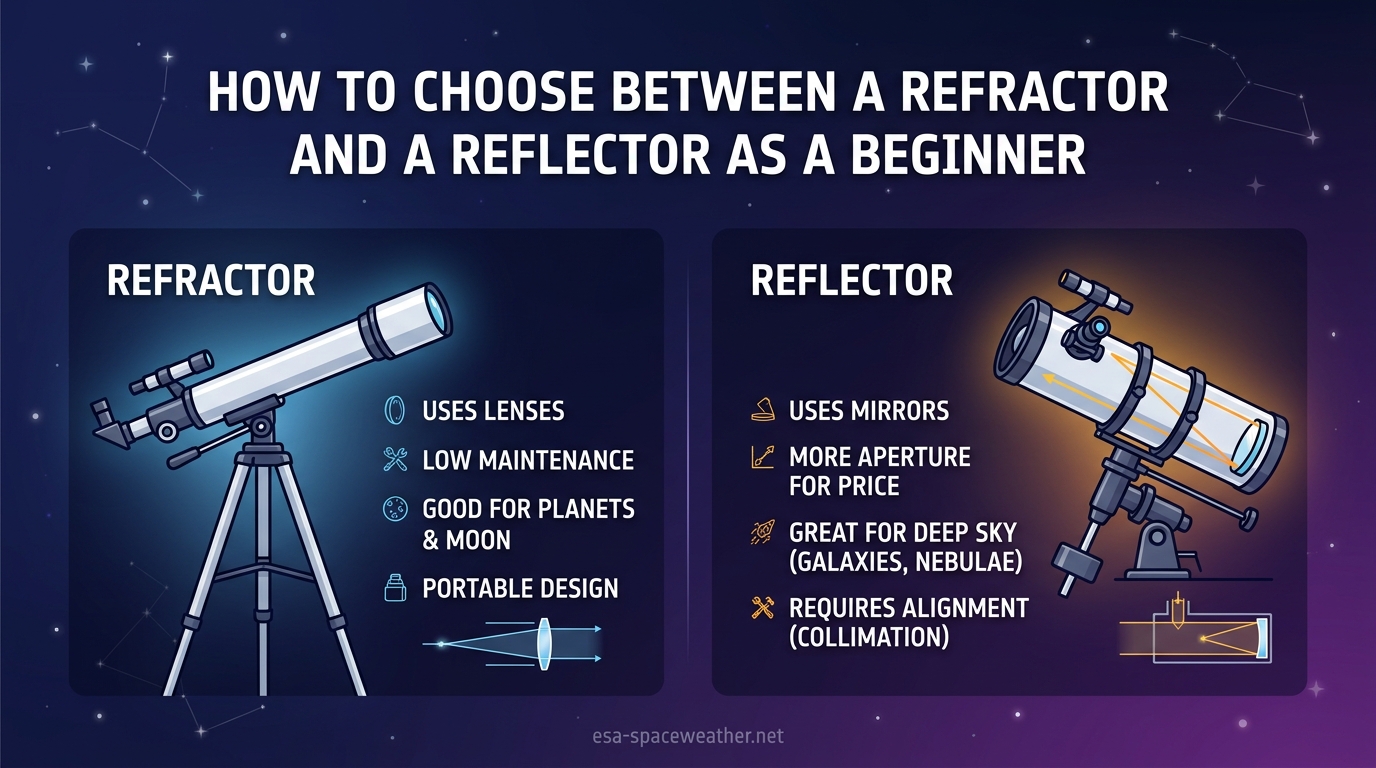
The fastest way to decide is to match the telescope type to your primary interest. If you want to view the Moon and planets with crisp, high-contrast images and minimal maintenance, choose a refractor. If you want to explore deep-sky objects like galaxies, nebulae, and star clusters while getting the most aperture for your money, choose a reflector, specifically a Dobsonian.
For most beginners on a budget under $400, the community consensus from astronomy forums points to a 6-inch Dobsonian reflector as the best all-around choice. It offers enough light-gathering power to show planets, the Moon, and brighter deep-sky objects, and it requires no tripod setup. If you want something lighter, maintenance-free, and good for terrestrial viewing too, a 70mm to 90mm refractor is the better pick.
The rest of this guide explains why these recommendations hold up and helps you figure out which side of that divide you fall on.
What Is a Refractor Telescope?
A refractor telescope uses a glass objective lens at the front of a sealed optical tube to bend, or refract, incoming light to a focal point. That focused light then travels to an eyepiece at the back of the tube, where you place your eye to view the image. It is the oldest telescope design, dating back to Galileo’s observations in the early 1600s.
The key characteristic of a refractor is its sealed tube. Because the lens sits at the front and the eyepiece at the back, the optical system is closed off from dust, air currents, and humidity. This sealed design means refractors require essentially zero maintenance. You never have to collimate or realign the optics, and the glass lens does not degrade the way reflective mirror coatings can over time.
Refractors produce images that are naturally right-side up when used with a star diagonal, which is a 90-degree mirror or prism that attaches between the eyepiece and the focuser. This makes refractors the only telescope type that works well for terrestrial viewing. You can look at distant mountains, ships, or wildlife during the day and get a correctly oriented image.
Within the refractor category, you will encounter two main types relevant to beginners. Achromatic refractors use a two-element lens (called a doublet) that brings two wavelengths of light to the same focus, which reduces but does not eliminate color fringing. Apochromatic refractors use three or more lens elements (triplet designs) with specialized extra-low dispersion glass to bring all visible colors to a single focus, producing essentially perfect images but at a significantly higher cost.
Pros and Cons of Refractor Telescopes
Advantages of Refractors
Here is what makes refractors appealing for first-time telescope buyers:
1. Zero maintenance. The sealed tube means no collimation, no mirror cleaning, and no recoating. You set it up and use it.
2. Excellent image contrast. Refractors have no central obstruction (a secondary mirror blocking part of the light path), which means brighter, higher-contrast views of planets and the Moon.
3. Fast cool-down time. Because the tube is sealed and relatively small in aperture, a refractor reaches thermal equilibrium within 15 to 30 minutes. You can start observing almost immediately.
4. Versatile for daytime use. With a star diagonal attached, refractors produce correct-orientation images suitable for terrestrial viewing, birdwatching, or scenic observation.
5. Portable and compact. A 70mm or 80mm refractor on a lightweight alt-azimuth mount is easy to carry, store in a closet, and transport to a dark-sky location.
Disadvantages of Refractors
Refractors come with trade-offs that every beginner should understand before buying:
1. Chromatic aberration. Achromatic refractors show color fringing (typically purple or blue halos) around bright objects like Venus, Jupiter, and the Moon. Apochromatic models eliminate this but cost several times more.
2. High cost per inch of aperture. A 4-inch refractor typically costs as much as a 6-inch or 8-inch reflector. If deep-sky viewing is your goal, refractors become expensive quickly.
3. Long optical tube. Refractors have longer focal ratios, which means the tube itself gets physically long. A 90mm refractor can have a tube nearly 3 feet long, making storage and transport more cumbersome than the aperture might suggest.
4. Limited aperture at beginner price points. Most affordable refractors top out at 90mm to 100mm of aperture, which limits how much light you can gather for faint deep-sky targets.
What Is a Reflector Telescope?
A reflector telescope uses a curved primary mirror at the back of an open optical tube to collect and focus light. A flat secondary mirror near the front of the tube redirects that focused light out through a hole in the side, where it reaches the eyepiece. This design was invented by Isaac Newton in 1668, and the classic configuration is still called a Newtonian reflector.
Reflectors gather light using the area of the primary mirror, and mirrors can be manufactured at large sizes for far less money than equivalent-quality lenses. This is why reflectors dominate the value category. An 8-inch reflector costs roughly the same as a 3-inch refractor, and that extra aperture translates directly into brighter, more detailed views of faint objects.
The two reflector designs beginners encounter most often are Newtonian reflectors (mounted on tripod equatorial or alt-azimuth mounts) and Dobsonian telescopes (a Newtonian optical tube mounted on a simple, low-to-the-ground rocking wooden base). Dobsonians were popularized by John Dobson in the 1970s as a way to put large mirrors into the hands of amateur astronomers at minimal cost.
Unlike refractors, reflectors have an open tube design. The front of the tube is open to the air, which means dust, humidity, and air currents can affect the optics. This open design also means the primary mirror needs to cool down to match the outside temperature before delivering its best performance, a factor we discuss in detail in the maintenance section.
Reflectors produce images that are inverted (upside down and mirror-reversed). This does not matter for astronomy, because there is no up or down in space. However, it makes reflectors unsuitable for terrestrial viewing unless you add an image-correcting accessory, which introduces its own image quality compromises.
Pros and Cons of Reflector Telescopes
Advantages of Reflectors
Here is what makes reflectors the most recommended telescope type on astronomy forums:
1. Best value per inch of aperture. Reflectors give you more light-gathering power for your dollar than any other design. A 6-inch Dobsonian typically costs between $300 and $400 and outperforms refractors costing twice as much.
2. Superior deep-sky performance. The larger aperture pulls in fainter galaxies, nebulae, and star clusters that smaller refractors simply cannot show.
3. No chromatic aberration. Mirrors do not split light into colors the way lenses do. You will never see purple fringing around bright targets with a reflector.
4. Accessible eyepiece position. The eyepiece on a Newtonian sits at the front of the tube, making it comfortable to view without crouching or using a ladder (at beginner apertures).
5. Dobsonian mounts are extremely stable. The low center of gravity and simple rocker-box design eliminate the wobbly tripod problem that plagues cheap beginner telescopes.
Disadvantages of Reflectors
Reflectors demand more from their owners in several practical ways:
1. Requires collimation. The mirrors in a reflector can shift out of alignment during transport. You will need to learn to collimate (align the mirrors), which takes about 10 minutes once you understand the process but intimidates many beginners.
2. Longer cool-down time. A reflector’s primary mirror needs 30 to 60 minutes (sometimes longer for larger mirrors) to reach ambient temperature before delivering sharp images. Refractors are ready to go almost immediately.
3. Open tube collects dust. The open front allows dust and moisture to enter. Mirror cleaning is needed occasionally, and improper cleaning can scratch the reflective coating.
4. Larger and heavier. A 6-inch or 8-inch Dobsonian takes up significant space and may not fit easily in a small car or apartment closet.
5. Mirror coating degradation. Reflective coatings on mirrors can degrade over time. Forum users report that mirror delamination can occur after 5 to 8 years in humid climates, and recoating a mirror costs $100 to $200 every 10 to 20 years as a long-term maintenance expense.
6. Images are inverted. The upside-down orientation makes reflectors impractical for daytime terrestrial viewing without accessories.
Refractor vs Reflector: Side-by-Side Comparison
Here is a direct feature-by-feature comparison to help you see the differences at a glance. This is the table no competing article provides, and it is designed to answer the most common comparison questions in a single reference.
| Feature | Refractor | Reflector |
|---|---|---|
| Optical element | Glass objective lens | Curved primary mirror |
| Maintenance level | Very low (sealed tube, no collimation) | Moderate (regular collimation, occasional cleaning) |
| Cost per inch of aperture | High | Low (best value) |
| Cool-down time | 15-30 minutes | 30-60+ minutes |
| Best for | Moon, planets, terrestrial viewing | Deep-sky objects, galaxies, nebulae, star clusters |
| Image orientation | Correct with star diagonal | Inverted (upside down) |
| Chromatic aberration | Yes in achromatic models | None |
| Portability | Good at small apertures | Bulky at larger apertures |
| Typical beginner aperture | 70mm to 90mm | 114mm to 203mm (4.5 to 8 inches) |
| Astrophotography suitability | Excellent (especially apochromatic) | Possible but more complex |
What You Will Actually See Through Each Type
One of the biggest sources of frustration for new astronomers is unrealistic expectations. Forum discussions on Reddit and Cloudy Nights repeatedly mention beginners who expect Hubble-style images and are disappointed by what they see through a small telescope. Let us set the record straight about what each telescope type actually shows you.
The Moon looks spectacular through both telescope types. Even a 70mm refractor will show craters, mountain ranges, and lunar seas in sharp detail. An 8-inch reflector will show the Moon so brightly that you may want a moon filter to reduce the glare. This is the one target where the difference between the two types is minimal.
Planets are where refractors have an edge. Jupiter’s cloud bands and four Galilean moons, Saturn’s rings, and Mars’ polar ice cap are all visible in a 90mm refractor with good contrast. A reflector of equivalent or larger aperture will show these targets too, but the central obstruction slightly reduces contrast. In practice, an 8-inch reflector shows planets better than a 90mm refractor simply because of the aperture advantage, but the refractor delivers a cleaner, higher-contrast image at equal aperture.
Deep-sky objects are where reflectors pull ahead dramatically. The Orion Nebula, the Andromeda Galaxy, the Pleiades star cluster, and the Ring Nebula are all achievable targets in a 6-inch or 8-inch reflector under reasonably dark skies. Through a 70mm refractor, these objects appear as faint, gray smudges or are invisible entirely. The extra light-gathering power of a reflector makes the difference between seeing something and not seeing it.
Important reality check: All deep-sky objects appear in shades of gray and greenish-gray through any beginner telescope. The vibrant pinks, blues, and oranges you see in astrophotography come from long-exposure imaging, not visual observation. Your eyes cannot accumulate light the way a camera sensor does. If you accept this limitation and learn to appreciate the subtle beauty of what you can see, both telescope types will reward you.
Budget Recommendations by Tier
Your budget determines how much aperture you can afford, and aperture is the single most important specification for visual astronomy. Here are specific recommendations by price tier based on what the astronomy community considers the best value at each level.
Under $200: At this price, you have two viable options. A 70mm or 80mm achromatic refractor on an alt-azimuth mount gives you a portable, maintenance-free scope for Moon and planet viewing. Alternatively, a tabletop Dobsonian reflector in the 100mm to 114mm range gives you more aperture and deep-sky capability but requires a sturdy table to rest on. Avoid full-size reflectors on cheap tripods at this price, because the mount will be too wobbly to use effectively.
$200 to $400: This is the sweet spot for beginner astronomy, and the community consensus recommendation is a full-size 6-inch Dobsonian reflector. Models from SkyWatcher, Orion, and Celestron in this range typically cost $300 to $400 and offer 150mm of aperture on a stable Dobsonian mount. If you prefer a refractor in this range, a 90mm or 102mm achromatic refractor on a decent equatorial mount is a solid choice for planetary work.
$400 to $600: At this tier, you can step up to an 8-inch Dobsonian reflector, which significantly increases your deep-sky performance over the 6-inch. This is the most commonly recommended telescope for serious beginners who want to grow into the hobby. On the refractor side, you can find a 102mm to 120mm achromatic refractor or a small apochromatic doublet for noticeably cleaner images.
$600 and above: This range opens up larger reflectors (10-inch and 12-inch Dobsonians), computerized GoTo telescopes that find objects automatically, and quality apochromatic refractors suitable for astrophotography. If you are spending this much as a beginner, a 10-inch Dobsonian remains the best visual value, while a small apochromatic refractor on a tracking mount is the best starting point for long-exposure imaging.
Maintenance, Collimation, and Cool-Down Time
The maintenance difference between refractors and reflectors is one of the most practical considerations for beginners, yet most comparison guides barely address it. Let us cover the three maintenance factors that actually matter in daily use.
Collimation is the process of aligning a reflector’s mirrors so they work together properly. When you transport a reflector, the mirrors can shift slightly, and the image quality drops until you realign them. Collimation sounds intimidating, but it becomes routine after a few sessions. You will need a collimation cap or a Cheshire eyepiece (about $30) and about 10 minutes. Refractors never need collimation because their lenses are fixed at the factory.
Cool-down time is the period a telescope needs to reach the temperature of the outside air before delivering its sharpest images. Refractors have small lenses and sealed tubes, so they typically reach equilibrium in 15 to 30 minutes. Reflectors have larger mirrors in open tubes, and a 6-inch mirror may need 30 to 45 minutes, while an 8-inch or 10-inch mirror can take an hour or more. If you take a reflector from a warm house into a cold night, the first views will be soft and blurry until the mirror cools. A cooling fan behind the primary mirror can speed this up significantly.
Mirror degradation is the long-term concern that no competitor article addresses. The reflective aluminum coating on a reflector’s primary mirror gradually degrades over time. In dry climates, coatings can last 15 to 20 years. In humid or coastal environments, forum users report coating delamination after as few as 5 to 8 years. Recoating a mirror costs approximately $100 to $200 and must be done by a specialized service. Refractor lenses, by contrast, do not degrade and essentially never need recoating. This is a real long-term cost difference that beginners should factor into their decision if they live in a humid climate.
Common Beginner Mistakes to Avoid
Before you make your purchase, here are the most common mistakes beginners make, drawn from years of forum discussions.
Chasing magnification instead of aperture. Cheap department-store telescopes advertise “600x magnification” on the box. This is meaningless marketing. The useful magnification limit of any telescope is roughly 50x per inch of aperture. A 60mm refractor maxes out around 140x, regardless of what eyepiece you use. Always prioritize aperture over magnification claims.
Ignoring the mount. A wobbly mount makes even a good telescope unusable. The most common beginner complaint on forums is that images shake too much to focus. Dobsonian mounts solve this problem with their stable rocker-box design. If you buy a refractor, make sure the tripod is sturdy enough to support the optical tube without vibration.
Skipping collimation on a reflector. Many beginners buy a reflector, never learn to collimate, and conclude the telescope produces blurry images. A misaligned reflector performs far below its potential. Take the time to learn collimation before your first serious observing session.
Expecting Hubble images. Visual astronomy is subtle and rewarding, but it does not look like astrophotography. Manage your expectations so you can appreciate what you actually see rather than feeling disappointed.
FAQs
What type of telescope should a beginner use?
A 6-inch Dobsonian reflector is the most recommended beginner telescope because it offers excellent light-gathering power, a stable mount, and great value. If you want something lighter and maintenance-free, a 70mm to 90mm refractor on an alt-azimuth mount is the best alternative choice.
Is a reflector telescope better than a refractor?
Neither type is universally better. Reflectors provide more aperture for the money and are superior for deep-sky viewing. Refractors offer better image contrast, require no maintenance, and excel at planetary and lunar observation. The right choice depends on what you want to observe and how much maintenance you accept.
Why are refracting telescopes no longer used in professional observatories?
Large refractor lenses become impractical above about 40 inches because the glass sags under its own weight, and lens imperfections cause chromatic aberration. Modern professional observatories use large reflector mirrors because they can be engineered at much larger sizes without these physical limitations.
Do scientists prefer refractive or reflective telescopes?
Scientists overwhelmingly use reflecting telescopes for professional research. Nearly all major observatories, including the Hubble Space Telescope and the James Webb Space Telescope, use mirror-based designs because mirrors can be made larger, lighter, and free of chromatic aberration.
Can I see planets with a reflector telescope?
Yes, reflectors show planets very well. An 8-inch reflector shows Jupiter’s cloud bands, Saturn’s rings, and Mars in excellent detail. The slight contrast reduction from the central obstruction is barely noticeable at typical beginner apertures and is more than compensated for by the larger light-gathering power.
How much should a beginner spend on a telescope?
Most experienced astronomers recommend spending between $300 and $400 for a first telescope, which buys a quality 6-inch Dobsonian reflector or a good 90mm refractor. Spending less risks getting a wobbly mount or poor optics, while spending more makes sense only after you know you enjoy the hobby.
Conclusion
Learning how to choose between a refractor and a reflector as a beginner comes down to three questions: What do you want to see, how much do you want to spend, and how much maintenance are you willing to handle? If your answers point to the Moon and planets with minimal upkeep, buy a refractor. If they point to galaxies and nebulae with maximum value, buy a Dobsonian reflector. Either choice opens the door to a lifetime of discovery under the night sky. The best telescope is the one you will actually use, so pick the type that fits your lifestyle and start observing.