
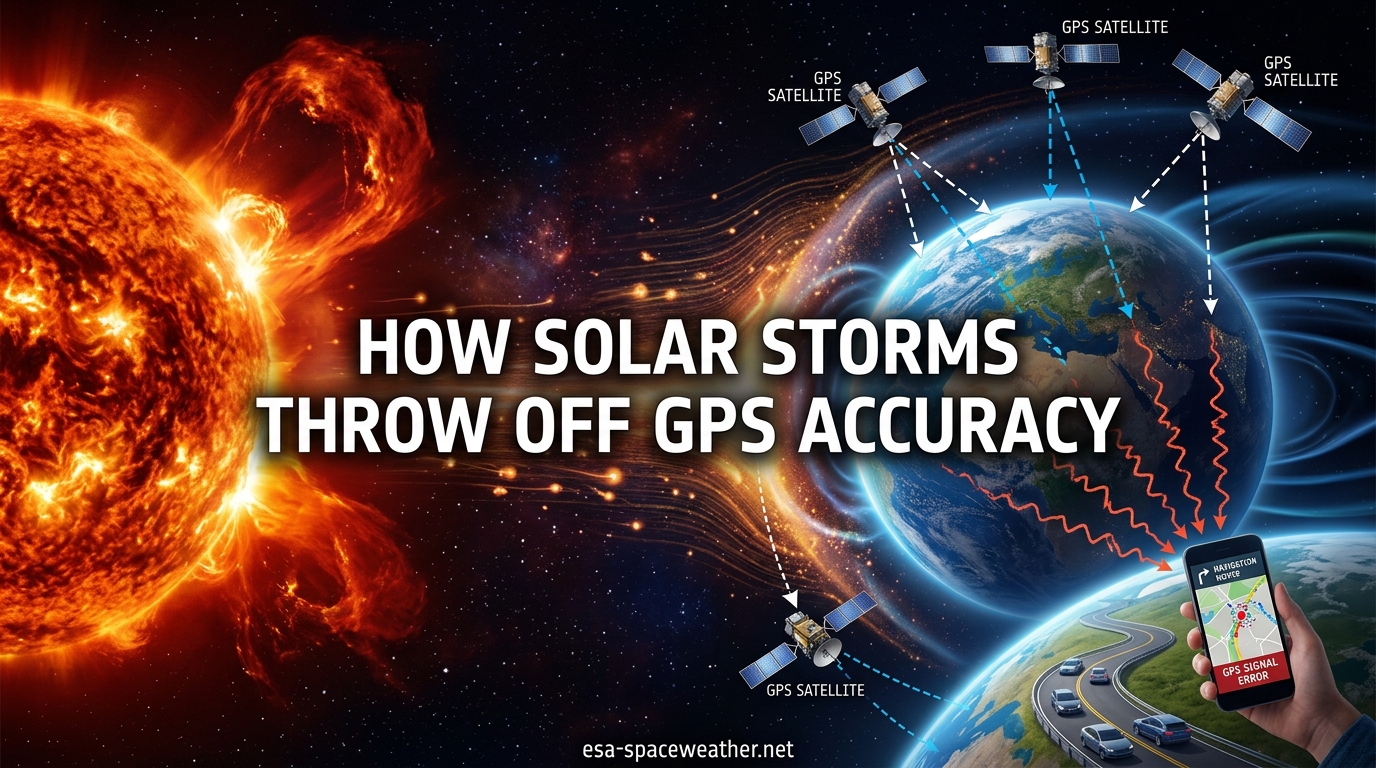
Solar storms throw off GPS accuracy by disturbing the ionosphere, the charged layer of Earth’s upper atmosphere that GPS signals must pass through. In calm conditions, a standard single-frequency GPS receiver provides position accuracy of about 3 to 10 feet (1 to 3 meters). During a severe geomagnetic storm, those errors can balloon to 30 feet, 50 feet, or even tens of meters, throwing off navigation for everyone from weekend hikers to commercial airline pilots.
I have spent years tracking space weather events and their impact on satellite navigation systems, and the pattern is consistent. Every time a coronal mass ejection slams into Earth’s magnetic field, GPS users across multiple industries report sudden, confusing accuracy problems. The May 2024 G5 storm was a wake-up call, and we are now in a period of elevated solar activity that makes understanding this phenomenon more relevant than ever.
This guide breaks down exactly how solar storms disrupt GPS signals, how much accuracy you can expect to lose, and what you can do about it. Whether you rely on GPS for farming, flying, surveying, or everyday driving, the science behind these disruptions matters.
Table of Contents
What Are Solar Storms?
Solar storms are eruptions of energy and charged particles from the Sun that interact with Earth’s magnetic field and atmosphere. They come in two main forms that affect GPS differently: solar flares and coronal mass ejections (CMEs).
Solar flares are intense bursts of electromagnetic radiation that reach Earth in about eight minutes. They cause sudden increases in ionospheric density on the sunlit side of the planet. Coronal mass ejections are massive clouds of plasma and magnetic field that take one to three days to reach Earth but deliver a much harder punch when they arrive.
When a CME’s magnetic field connects with Earth’s magnetosphere, it triggers a geomagnetic storm. These storms are ranked on a G1 through G5 scale by NOAA, with G5 being extreme. The geomagnetic storm heats and expands the upper atmosphere, dumping enormous amounts of energy into the ionosphere.
That ionospheric disturbance is what directly causes GPS accuracy problems for everyone on the ground.
How GPS Technology Actually Works
GPS (part of the broader GNSS, or Global Navigation Satellite System) works by timing how long radio signals take to travel from satellites to your receiver. Each satellite broadcasts a signal containing its position and a precise timestamp.
Your receiver picks up signals from at least four satellites and calculates the distance to each one based on signal travel time. It then uses a process called trilateration to determine your exact position on Earth.
Here is the critical part: GPS signals travel at the speed of light, and the entire system depends on measuring travel time with extraordinary precision. An error of just one microsecond translates to about 980 feet (300 meters) of positional error. The system corrects for many sources of delay, but the ionosphere remains the largest variable source of error.
GPS signals travel through about 12,000 miles of space before reaching you, and the last 200 to 400 miles pass through the ionosphere. That is where solar storms create chaos.
The Ionosphere: Where Solar Storms and GPS Collide
The ionosphere is a layer of charged particles (ions and free electrons) sitting roughly 30 to 600 miles above Earth’s surface. Under normal conditions, it has a relatively predictable density that GPS systems can model and correct for.
Solar storms change everything. When solar energy floods into the ionosphere, it dramatically increases what scientists call Total Electron Content (TEC). More electrons mean more interference for radio frequency signals passing through.
This interference affects GPS in two key ways:
Signal delay (refraction): As GPS signals pass through a denser-than-normal ionosphere, they slow down slightly. Since GPS calculates position based on signal travel time, any unmodeled delay translates directly into position error. The ionosphere is responsible for the majority of the distance measurement error in standard GPS.
Ionospheric scintillation: Rapid fluctuations in ionospheric density cause GPS signals to fluctuate in phase and amplitude. Your receiver may struggle to maintain lock on satellites, causing momentary signal loss or sudden position jumps. Scintillation is most common near the equator and in polar regions, but severe storms can trigger it at mid-latitudes too.
During quiet space weather, your GPS receiver can model the ionospheric delay reasonably well using broadcast correction data. During a storm, the ionosphere becomes too chaotic and variable for those models to keep up.
How Much Accuracy Do You Lose? The Numbers Explained
In calm space weather conditions, a standard single-frequency GPS receiver achieves horizontal accuracy of about 10 feet (3 meters) 95% of the time. Dual-frequency receivers and augmented systems like WAAS can improve that to 3 to 6 feet (1 to 2 meters).
During a moderate geomagnetic storm (G2-G3), expect your standard GPS accuracy to degrade from 10 feet to 15 to 30 feet (5 to 10 meters) of error. That is the “several feet” that most users notice. For most recreational purposes, this is annoying but manageable.
During a severe storm (G4-G5), errors can jump dramatically. Single-frequency GPS position errors can reach 30 to 100 feet (10 to 30 meters) or more. In the worst cases, receivers may struggle to maintain a position fix at all.
For RTK (Real-Time Kinematic) GPS users, the story is even more dramatic. RTK normally delivers centimeter-level accuracy, but during severe ionospheric storms, the correction signals become unreliable. Users report losing RTK fix entirely and dropping back to meter-level accuracy.
One geocacher reported during the May 2024 solar storm that their Samsung S22 GPS was off by 15 meters (about 50 feet) under clear open sky. A surveyor in the same timeframe noted they could not achieve a reliable fix at all during peak storm hours.
Single-Frequency vs Dual-Frequency GPS: Why Your Receiver Matters
Not all GPS receivers suffer equally during solar storms. The type of receiver you use dramatically affects how much accuracy you lose.
Single-frequency receivers (found in most consumer smartphones, basic car navigation, and budget handheld units) receive only one GPS frequency, typically L1. They rely on a mathematical model to estimate ionospheric delay, and that model assumes relatively calm ionospheric conditions. When a storm hits, the model breaks down and errors pile up quickly.
Dual-frequency receivers receive two GPS signals (such as L1 and L2, or L1 and L5). Because ionospheric delay is frequency-dependent, the receiver can compare the two signals and directly calculate the actual delay. This makes dual-frequency receivers far more resilient during solar storms, though they are not immune to scintillation effects.
Dual-frequency technology used to be limited to expensive surveying and military equipment. In recent years, newer satellites and modern chipsets have brought dual-frequency GPS to some premium smartphones and consumer devices, improving solar storm resilience for everyday users.
If your work depends on GPS accuracy and you live or operate during solar maximum, investing in a dual-frequency receiver is one of the most effective steps you can take.
Real-World Examples: When Solar Storms Hit GPS Hard
The May 10-11, 2024 geomagnetic storm was the strongest to hit Earth since 2003, reaching G5 (extreme) on the NOAA scale. It produced visible auroras as far south as Florida and Hawaii, but it also hammered GPS systems worldwide.
RTK networks reported significant disruption. One network operator documented that their standard single-point positioning accuracy degraded to 10 to 20 meter errors during peak storm activity, while their RTK correction fix rate dropped measurably. Some users reported complete inability to achieve RTK fix for several hours.
Pilots on aviation forums described GPS accuracy downgrades during the event. One pilot noted that there were many recent instances where aircraft GPS accuracy was downgraded, and in some cases vertical guidance on instrument approaches was unavailable. When vertical guidance drops, pilots must switch to alternative procedures, which adds workload and can delay flights.
Agricultural users felt it too. Farmers relying on RTK-guided tractors for planting and spraying reported guidance systems drifting by several feet, enough to cause skipped or overlapping rows in precision agriculture operations. For an industry where inch-level accuracy matters, a shift of several feet is a real economic problem.
Looking further back, the 1859 Carrington Event remains the most powerful geomagnetic storm on record. If a storm of that magnitude hit today, GPS disruption would be severe and potentially long-lasting. The May 2024 event gives us a relatively mild preview of what is possible.
Industries Most Affected by Solar Storm GPS Errors
Solar storm GPS errors do not affect everyone equally. Some industries are far more vulnerable because their operations demand high precision or safety margins are thin.
Aviation: Aircraft rely on GPS for navigation and instrument approaches, especially at smaller airports without ground-based navigation aids. Solar storm scintillation can cause loss of GPS lock, and the FAA’s WAAS augmentation system can be degraded. When accuracy degrades, the system downgrades or removes vertical guidance, forcing pilots to use less precise approach procedures.
Precision agriculture: Modern farming depends on RTK GPS for autosteer tractors, planter guidance, and drone crop monitoring. An error of several feet means misapplied seed, fertilizer, and chemicals. During the May 2024 storm, many farmers reported having to pause field operations until GPS accuracy recovered.
Surveying and construction: Surveyors need centimeter-level accuracy. During solar storms, RTK base station corrections become unreliable, and field crews may need to reschedule work or accept lower accuracy results.
Autonomous vehicles and drones: Self-driving systems and delivery drones use GPS as a primary positioning input. Solar storm errors of several feet could cause lane-keeping problems or waypoint navigation errors, especially in environments where GPS is already marginal.
Maritime navigation: Ships in open ocean rely on GPS for position tracking. While a few feet of error matters less in mid-ocean, harbor approaches and narrow channels require precision where solar storm errors become dangerous.
How to Protect Your GPS Accuracy During Solar Storms
You cannot prevent solar storms, but you can take practical steps to minimize their impact on your GPS accuracy.
Monitor space weather forecasts. NOAA’s Space Weather Prediction Center publishes real-time alerts and forecasts for geomagnetic storms. UAV forecast apps that include the geomagnetic Kp index are widely used by drone operators and pilots. Checking these before precision-critical work can save you from wasted effort.
Use dual-frequency receivers when possible. As explained earlier, dual-frequency GPS directly measures and corrects ionospheric delay. If your application demands accuracy, this is your best single defense against solar storm interference.
Rely on RTK and augmentation systems (with caveats). RTK corrections and systems like WAAS can improve accuracy significantly under normal conditions. However, during severe storms, even these systems can degrade. Some RTK networks maintained fix rates above 98% during the May 2024 storm by using robust correction infrastructure, but individual results vary.
Add inertial measurement units (IMUs). For critical applications, combining GPS with an IMU provides dead-reckoning capability. When GPS degrades or loses lock, the IMU can maintain position estimates using accelerometers and gyroscopes. Kalman filtering fuses the two data sources for more resilient navigation.
Time your work around storm peaks. Geomagnetic storm effects on the ionosphere often peak in the hours after the storm’s initial impact and can be worst during local afternoon and evening hours. If you can schedule precision GPS work for early morning or wait until the storm subsides, you will see better accuracy.
Collect data for post-processing. If you need precision but cannot wait, record raw GPS observations for post-processing. Precise Point Positioning (PPP) and post-processed RTK can achieve good results even from data collected during moderate storms, using precise orbit and clock data available after the fact.
Maintain realistic expectations. During a G4 or G5 storm, no consumer-grade system will deliver normal accuracy. Plan for degraded performance and have backup procedures ready for safety-critical operations.
The Solar Cycle: When to Expect the Worst GPS Disruption
The Sun goes through an approximately 11-year cycle of activity, swinging between solar minimum (quiet) and solar maximum (active). During solar maximum, the Sun produces more sunspots, more solar flares, and more coronal mass ejections.
Solar Cycle 25 began in late 2019 and reached its maximum in 2026. This means we are currently in a period of elevated solar activity with a higher probability of GPS-disrupting storms. The May 2024 G5 storm was a direct result of this solar maximum period.
If you rely on GPS for professional or safety-critical work, the next couple of years call for heightened awareness. Space weather forecasting has improved significantly, but predicting the exact timing and severity of individual storms remains challenging. The best approach is staying informed and having mitigation strategies ready.
Even after solar maximum passes, significant storms can occur during the declining phase of the solar cycle. The famous 2003 Halloween storms that disrupted GPS occurred during the declining phase of Solar Cycle 23.
FAQs
How do solar storms affect GPS?
Solar storms increase the density of charged particles in the ionosphere, which slows and scatters GPS radio signals passing through it. This creates timing errors that translate into position errors of several feet to tens of meters, depending on storm severity. In extreme cases, GPS receivers may lose signal lock entirely.
Do solar storms affect GPS?
Yes. Solar storms are one of the most significant natural sources of GPS accuracy degradation. During severe geomagnetic storms, standard GPS accuracy can degrade from about 10 feet to 30 to 100 feet or more.
Can solar storms affect airplanes?
Yes. Aircraft rely on GPS for navigation and instrument approaches. During solar storms, GPS accuracy can be downgraded and vertical guidance on approaches may become unavailable. The FAA’s WAAS augmentation system can also be degraded, forcing pilots to use alternative procedures.
What is the biggest source of error for GPS?
The ionosphere is the largest single source of GPS positioning error. Under normal conditions it causes several feet of error that the system can partially model and correct. During solar storms, ionospheric errors increase dramatically and become unpredictable, making it the dominant source of GPS inaccuracy.
Are solar flares affecting GPS today?
It depends on current space weather conditions. You can check NOAA’s Space Weather Prediction Center or UAV forecast apps with geomagnetic Kp indices for real-time status. Solar Cycle 25 is at its peak in 2026, so elevated GPS interference from solar activity is more likely now than during solar minimum.
Conclusion
Solar storms throw off GPS accuracy by disrupting the ionosphere through which all GPS signals must pass, and the impact ranges from a few extra feet during moderate storms to tens of meters of error during severe events. Understanding how solar storms affect GPS accuracy helps you plan around disruptions, choose the right equipment, and avoid costly mistakes during high-precision work.
With Solar Cycle 25 at its peak in 2026, staying aware of space weather forecasts and investing in resilient GPS technology like dual-frequency receivers is more important than ever. The Sun will keep sending storms our way, but with the right knowledge and tools, you can keep your navigation on track.