
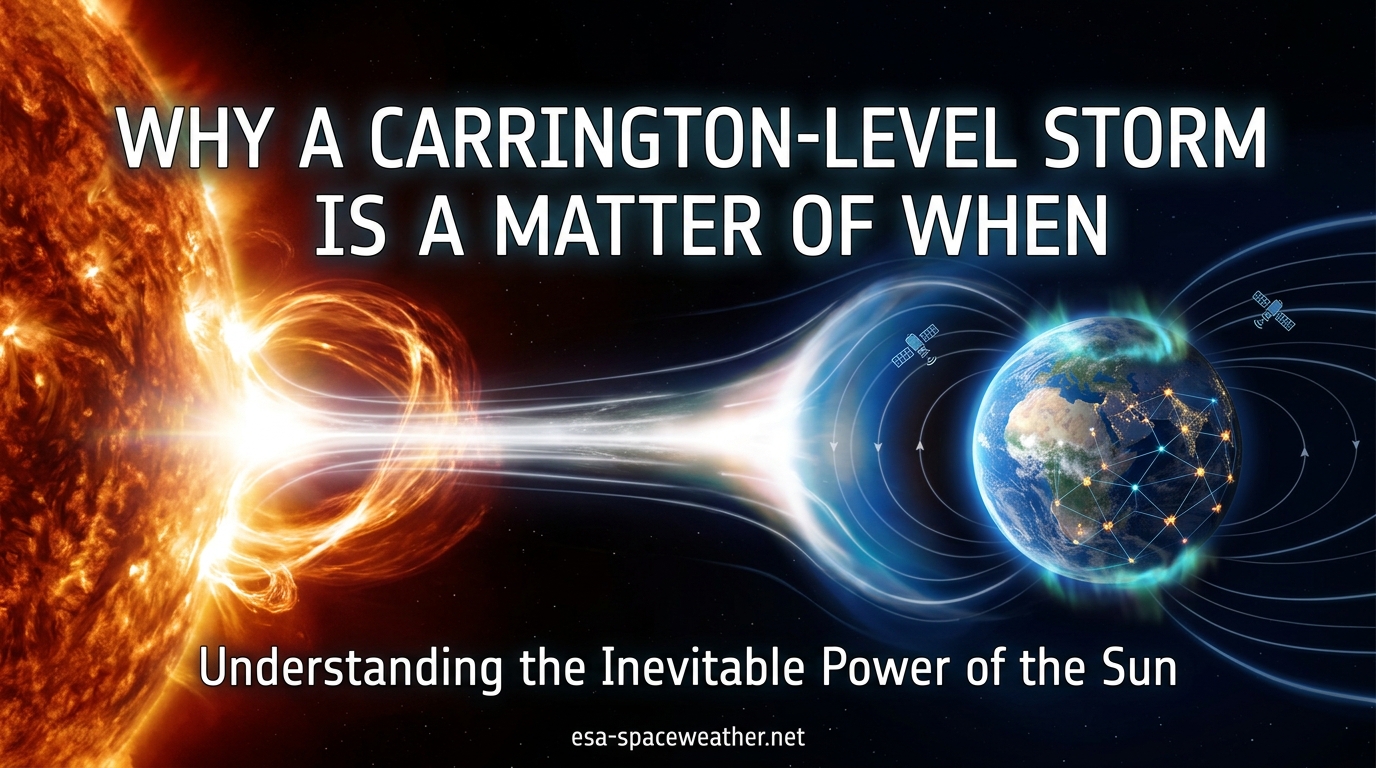
On the morning of September 1, 1859, an English astronomer named Richard Carrington watched two brilliant patches of white light erupt on the surface of the Sun. Within hours, the most powerful geomagnetic storm in recorded history slammed into Earth, setting telegraph wires on fire and painting auroras across the skies of Cuba and Hawaii. Scientists today call that event the benchmark for catastrophe. A Carrington-level storm striking our modern world has the potential to cause widespread electrical disruptions, damage the electrical power grid, disable satellites, and trigger blackouts lasting weeks or even months across entire continents. This is not speculation about a distant future. It is a question of when, not if.
Our team has spent months digging through space weather research, satellite data, and expert analyses to understand why the scientific community treats another Carrington-level storm as inevitable. The answer comes down to basic solar physics. The Sun operates on predictable cycles, and those cycles guarantee that extreme coronal mass ejections will keep happening. The only variable is whether Earth happens to be in the path.
Table of Contents
What Was the Carrington Event?
The Carrington Event of 1859 remains the most intense geomagnetic storm in recorded history. It was also the first solar flare ever observed and documented by a human being. Richard Carrington was tracking sunspots at his private observatory in Redhill, Surrey, when he witnessed what scientists now call a white-light solar flare, an extraordinarily rare and powerful burst of visible light from the Sun’s surface.
What made the Carrington Event so devastating was not just the flare itself but the coronal mass ejection (CME) that followed it. A CME is a massive cloud of magnetized plasma hurled from the Sun into space. This particular CME traveled at an estimated 2,380 kilometers per second and reached Earth in just 17 hours and 36 minutes, far faster than typical solar storms that take two to three days to make the same journey.
When that plasma cloud collided with Earth’s magnetic field, the results were spectacular and terrifying. Telegraph systems across North America and Europe malfunctioned dramatically. Operators received severe electrical shocks. Paper caught fire. Some telegraph stations continued sending and receiving messages even after being disconnected from their power supplies, running entirely on the electrical currents induced by the aurora overhead.
The auroras themselves were unlike anything anyone had seen in living memory. People in Cuba, Jamaica, and Hawaii could read newspapers by the light of the Northern Lights. In the Rocky Mountains, the glow was so bright that miners woke up and began making breakfast, thinking it was dawn. Scientists estimate the original flare at an X45-class event or higher, making it roughly ten times more powerful than the largest solar flare ever recorded by modern instruments.
No solar storm in the 167 years since has matched the raw intensity of September 1859. But smaller Carrington-class events have occurred, and they offer a preview of what a full-scale repeat would mean for our far more vulnerable civilization.
The Science Behind Solar Superstorms
Solar superstorms are not random accidents of nature. They are the predictable output of a star operating under well-understood physical laws. The Sun goes through an approximately 11-year cycle of magnetic activity, swinging from a quiet solar minimum to a violent solar maximum. During each maximum, the Sun’s magnetic field becomes tangled, twisted, and prone to sudden reorganization. Those sudden shifts are what produce solar flares and coronal mass ejections.
Think of the Sun’s magnetic field as a giant rubber band that gets increasingly twisted as the cycle progresses. Eventually, that tension snaps. When it does, enormous amounts of stored magnetic energy release in seconds. A single large solar flare can release energy equivalent to billions of hydrogen bombs. The associated CME can carry billions of tons of plasma at speeds exceeding 3,000 kilometers per second.
How Coronal Mass Ejections Create Geomagnetic Storms
A coronal mass ejection becomes dangerous to Earth only if it happens to be aimed directly at us. When a CME’s magnetic field connects with Earth’s magnetosphere, it triggers a process called magnetic reconnection. This dumps enormous amounts of energy into our planet’s upper atmosphere and induces electrical currents in the ground below.
Those ground-induced currents are what threaten infrastructure. They flow through pipelines, railway lines, and especially through the high-voltage transmission lines that form the backbone of our electrical grid. The longer the conductor, the more current is induced. Modern power grids, with their hundreds of thousands of miles of interconnected transmission lines, are essentially giant antennas waiting to absorb energy from a major geomagnetic storm.
The Sun produces CMEs every day during solar maximum. Most are small and aimed harmlessly into open space. But the Sun does not know or care where Earth is. Given enough CMEs over enough years, a direct hit from a major one becomes statistically certain. This is the fundamental reason scientists describe a Carrington-level storm as a matter of when, not if.
Why Scientists Believe Another Carrington-Level Storm Is Inevitable
The inevitability argument rests on three pillars: statistical probability, the 2012 near-miss, and direct observational data from modern spacecraft. Together, they form a case that has convinced virtually every active space weather researcher.
A widely cited 2012 study by physicist Pete Riley of Predictive Science analyzed historical records of geomagnetic storms going back 150 years. Using statistical modeling, Riley calculated that the probability of a Carrington-level storm striking Earth in any given decade is approximately 12 percent. That means within the next ten years, there is roughly a one-in-eight chance. Over a 50-year span, those odds compound to nearly 50 percent. Riley himself stated plainly: “We have a ways to go, but the probability is high enough that we need to be prepared.”
The July 23, 2012 Near-Miss
Perhaps the most compelling evidence that another Carrington-level storm is coming is the fact that one already happened and barely missed us. On July 23, 2012, a massive CME erupted from the Sun with a magnetic field intensity and speed comparable to the 1859 event. It was one of the most powerful solar storms of the space age.
Earth was not in the path. The CME erupted from a solar region that had just rotated away from our planet. Had it occurred just one week earlier, when that region was facing Earth, the storm would have delivered a direct hit. NASA scientists who analyzed the event estimated the potential damage at between $600 billion and $2.6 trillion in the United States alone. Daniel Baker of the University of Colorado, one of the researchers who studied the event, called it a “Carrington-class” storm and noted that if it had hit, we would still be picking up the pieces.
This near-miss is not ancient history. It happened in our lifetimes, during a modern solar cycle monitored by advanced satellites. It proves that the Sun is still producing Carrington-class events. We simply got lucky.
Solar Cycle 25 and Current Activity
The Sun is currently in Solar Cycle 25, which began in December 2019 and is expected to reach its maximum around 2026. This cycle has already proven significantly more active than forecasters predicted. As of 2026, we have already seen multiple X-class flares, severe geomagnetic storms, and widespread auroral displays visible far south of their normal range.
The May 2024 geomagnetic storm, triggered by a large CME from active sunspot region 3664, produced auroras visible across all 50 U.S. states and devastated farmers’ GPS systems during critical planting season. That storm was rated G5, the highest category on the NOAA scale, but it was still only a fraction of the intensity of the Carrington Event. It demonstrated that even a sub-Carrington storm can cause real, measurable damage to modern systems.
Spacecraft like NASA’s Parker Solar Probe have provided unprecedented data on how CMEs form and propagate through space. The probe flies directly into the Sun’s outer atmosphere, sending back measurements of magnetic fields and plasma that were impossible to obtain before. This data confirms that the Sun produces extreme events far more frequently than ground-based observations alone suggested.
Solar physicist consensus is clear. At conferences, in peer-reviewed papers, and in government testimony, researchers consistently state that another Carrington-level storm will happen. The Sun has not changed its behavior. It will keep producing massive CMEs, and eventually one will be aimed at us.
What Would Happen Today
If a Carrington-level storm struck Earth today, the impact would dwarf anything experienced in 1859. The difference is infrastructure. In 1859, the most advanced electronic technology on the planet was the telegraph. Today, every aspect of human life depends on electricity, satellites, and digital communication. We have built a civilization that is exquisitely sensitive to exactly the kind of electromagnetic assault that a solar superstorm delivers.
Power Grid Failure
The most immediate and severe threat is to the electrical power grid. A Carrington-level storm would induce massive electrical currents in long-distance transmission lines. These currents would flow into high-voltage transformers, the massive devices that step voltage up and down across the grid. These transformers are not off-the-shelf components. They are custom-built, each one weighing hundreds of tons and costing millions of dollars. Many are manufactured overseas, and lead times for replacements typically run 12 to 24 months under normal conditions.
In a Carrington-level scenario, dozens or even hundreds of these transformers could be damaged simultaneously across multiple continents. There is no global stockpile of replacement transformers. Repairing them under emergency conditions, with supply chains disrupted and transportation networks compromised, could take years. Some studies estimate that large portions of the affected grid could be offline for months or longer.
The North American Electric Reliability Corporation (NERC) has studied this scenario extensively. Their models show that a severe geomagnetic storm could trigger cascading failures across the grid, where the loss of one component overloads others, creating a domino effect that spreads faster than operators can respond. The 1989 Hydro-Quebec blackout, which knocked out power to six million people for nine hours from a storm far weaker than Carrington, demonstrated exactly this mechanism on a smaller scale.
Satellite Destruction
Earth orbit is home to more than 8,000 active satellites, providing GPS navigation, weather forecasting, satellite television, internet connectivity, and military communications. A Carrington-level storm would subject every one of them to extreme conditions. Increased atmospheric drag from the heated upper atmosphere would alter orbits. Electrical charging could fry onboard electronics. Solar panels would degrade rapidly under the intense particle bombardment.
The October-November 2003 “Halloween storms,” which were intense but still below Carrington levels, damaged roughly 70 percent of the satellites in orbit at the time. A full Carrington repeat could disable a significant fraction of the current satellite fleet. The economic and logistical impact of losing GPS alone would affect everything from aviation and maritime navigation to food delivery apps and ride-sharing services.
GPS timing signals also synchronize financial transactions, power grid operations, and telecommunications networks. Losing that synchronization could cause cascading failures in systems that most people never associate with space weather.
Economic Impact
Multiple economic studies have attempted to quantify the cost of a Carrington-level storm in the modern era. A 2013 analysis by Lloyd’s of London estimated the total economic damage at between $600 billion and $2.6 trillion globally. The U.S. Congressional Research Service has warned that recovery could take four to ten years in the most severely affected regions.
These estimates include not just the direct infrastructure damage but the cascading effects of prolonged power outages. Without electricity, water treatment plants stop functioning. Gas stations cannot pump fuel. Refrigeration fails, destroying food supplies. Hospitals run on generator power until fuel runs out. Supply chains freeze. The 2012 near-miss would have, by some estimates, caused economic damage exceeding Hurricane Katrina by a factor of twenty.
How We Monitor Solar Activity
Unlike earthquakes or volcanic eruptions, solar storms offer at least some warning. We can see the flare and measure the CME before it arrives, which gives us a narrow window to prepare. The question is whether that window is wide enough to matter.
The United States operates a network of satellites and ground-based observatories dedicated to monitoring the Sun. The Solar Dynamics Observatory (SDO), launched in 2010, provides continuous high-resolution images of the Sun in multiple wavelengths. It watches for flares, CMEs, and changes in magnetic fields in near real-time.
The Solar and Heliospheric Observatory (SOHO), a joint NASA-ESA mission launched in 1995, continues to provide critical data on CME direction and speed through its coronagraph instruments. SOHO’s Large Angle and Spectrometric Coronagraph (LASCO) has become the workhorse for tracking CMEs as they leave the Sun.
The DSCOVR satellite, positioned at the L1 Lagrange point about one million miles from Earth toward the Sun, provides the earliest direct measurements of solar wind conditions. When a CME passes DSCOVR, it gives Earth 15 to 60 minutes of warning before the storm arrives. That is enough time for grid operators to take protective measures like disconnecting transformers, but only if protocols are in place and executed flawlessly.
The NOAA Space Weather Prediction Center in Boulder, Colorado, serves as the central hub for these warnings. It issues alerts ranging from minor G1 storms to extreme G5 events, providing guidance to power companies, satellite operators, airlines, and emergency managers. The system works, but it has critical limitations.
Fifteen to sixty minutes is a razor-thin margin. If a CME’s magnetic field is oriented southward, which is the configuration most dangerous to Earth, the damage begins almost immediately upon arrival. Grid operators have rehearsed rapid shutdown procedures, but implementing them across an entire continent in under an hour has never been tested under real extreme conditions. And DSCOVR, launched in 2015, is well past its designed operational lifetime. A failure of that single satellite would leave a dangerous blind spot in our early warning system.
Preparing for the Inevitable
The good news is that awareness is growing and some measures are being taken. The bad news is that progress has been slow, fragmented, and nowhere near sufficient to fully protect modern infrastructure from a Carrington-level event.
On the infrastructure side, the U.S. Federal Energy Regulatory Commission (FERC) has issued standards requiring grid operators to assess their vulnerability to geomagnetic disturbances and develop mitigation plans. Some utilities have installed blocking devices that prevent induced currents from reaching transformers. Others are exploring grid segmentation strategies that would isolate damaged sections and prevent cascading failures. But implementation is inconsistent, and many smaller utilities lack the resources to make significant upgrades.
Government stockpiling of spare transformers has been discussed for years but has not been implemented at anywhere near the scale needed. The U.S. Department of Energy has explored the concept of a strategic transformer reserve, but as of 2026, the program remains in early stages with limited inventory.
What Individuals Can Do
Individual preparedness for a major solar storm looks similar to preparation for any prolonged infrastructure outage. The difference is duration. A Carrington-level event could create disruptions lasting not days but months. That changes the calculus significantly.
Basic preparedness includes maintaining a supply of non-perishable food, stored water, essential medications, and backup lighting. A solar generator or fuel-powered generator can bridge short-term outages. Battery-powered or hand-crank radios can receive information when cellular networks and internet are down. Printed copies of important documents and maps are valuable when digital systems fail.
One often-overlooked consideration is protecting electronic devices. A Faraday cage, which blocks electromagnetic fields, can shield critical electronics like backup radios and data storage devices. While a Carrington-level storm would not fry every electronic device on the ground the way an EMP from a nuclear detonation would, there is genuine uncertainty about the vulnerability of small electronics to extreme geomagnetic conditions.
The Insurance Gap
One of the most alarming gaps in our collective preparedness is insurance. Most standard property and business interruption insurance policies explicitly exclude damage caused by geomagnetic storms or solar events. This means that a Carrington-level event could destroy billions of dollars in equipment while leaving businesses and homeowners without recourse. Specialty space weather insurance exists but is expensive and purchased by only the largest corporations and satellite operators.
The insurance industry is acutely aware of this risk. Lloyd’s of London has published detailed reports modeling Carrington-level scenarios and urging both private and public investment in resilience. But translating awareness into action has been slow, and the regulatory framework for handling a space weather catastrophe remains largely unwritten.
International coordination is improving. The International Space Environment Service (ISES) connects space weather centers around the world, sharing data and alerts. The European Space Agency’s Space Weather Service Network provides monitoring tailored to European infrastructure. But true global resilience would require coordinated shutdown and recovery procedures across dozens of national grids, satellite fleets, and communication networks. That level of coordination does not yet exist.
FAQs
What would happen if a Carrington level event happened today?
A Carrington-level event today would cause widespread power grid failures, satellite damage, GPS disruption, and communication blackouts. High-voltage transformers could overheat and fail across multiple continents, with restoration taking months to years. Economic damage estimates range from $600 billion to $2.6 trillion globally.
Is a solar flare going to hit Earth in 2026?
Solar flares hit Earth regularly during periods of high solar activity. Minor to moderate geomagnetic storms are common during solar maximum. However, a full Carrington-level storm requires a specific combination of flare intensity, CME direction, and southward magnetic field alignment. Scientists estimate approximately a 12 percent chance of a Carrington-level event occurring in any given decade.
Could a solar flare wipe out humanity?
No. Solar flares and geomagnetic storms are not directly harmful to humans. Earth’s atmosphere and magnetic field protect life on the surface from solar radiation. The danger is to technology and infrastructure, not to human biology. A Carrington-level storm would cause massive economic and logistical disruption but would not threaten human survival.
What was supposed to happen on July 23, 2012?
On July 23, 2012, a massive Carrington-class coronal mass ejection erupted from the Sun. Earth was not in its path because the source region had rotated away from our planet. Had it occurred one week earlier, it would have delivered a direct hit comparable to the 1859 Carrington Event, with estimated damages between $600 billion and $2.6 trillion in the United States alone.
How big was the solar flare that caused the Carrington Event?
The Carrington Event solar flare is estimated to have been an X45-class event or higher, making it roughly ten times more powerful than the largest solar flare recorded by modern instruments. It produced a coronal mass ejection that traveled to Earth in approximately 17 hours, compared to the typical two to three day transit time for most CMEs.
Are we at risk for another Carrington Event?
Yes. Scientists consider another Carrington-level storm a statistical certainty given enough time. The Sun continues to produce extreme coronal mass ejections as part of its natural cycle. A 2012 study estimated a 12 percent probability per decade, meaning the risk is real and ongoing. The only question is when the next one will strike Earth.
Conclusion
The evidence is overwhelming. The Sun produces extreme coronal mass ejections on a regular basis as part of its natural cycle. The July 2012 near-miss proves that Carrington-class events still happen. Statistical models give us roughly a 12 percent chance of a direct hit every decade. A Carrington-level storm is not a question of if but when, and every year that passes without one is a year the odds catch up to us.
Our modern civilization is more vulnerable to space weather than any society in human history. Every power line, every satellite, every GPS receiver, every digital transaction is a potential casualty. But awareness is growing, monitoring systems are improving, and infrastructure resilience is slowly being taken seriously by governments and industry.
The most important thing any of us can do is stay informed. Space weather is real, it is measurable, and it affects everyone on this planet. Bookmark the NOAA Space Weather Prediction Center. Pay attention to solar cycle forecasts. Take basic emergency preparedness seriously. The Sun will do what the Sun has always done. The only question is whether we will be ready when it does.