
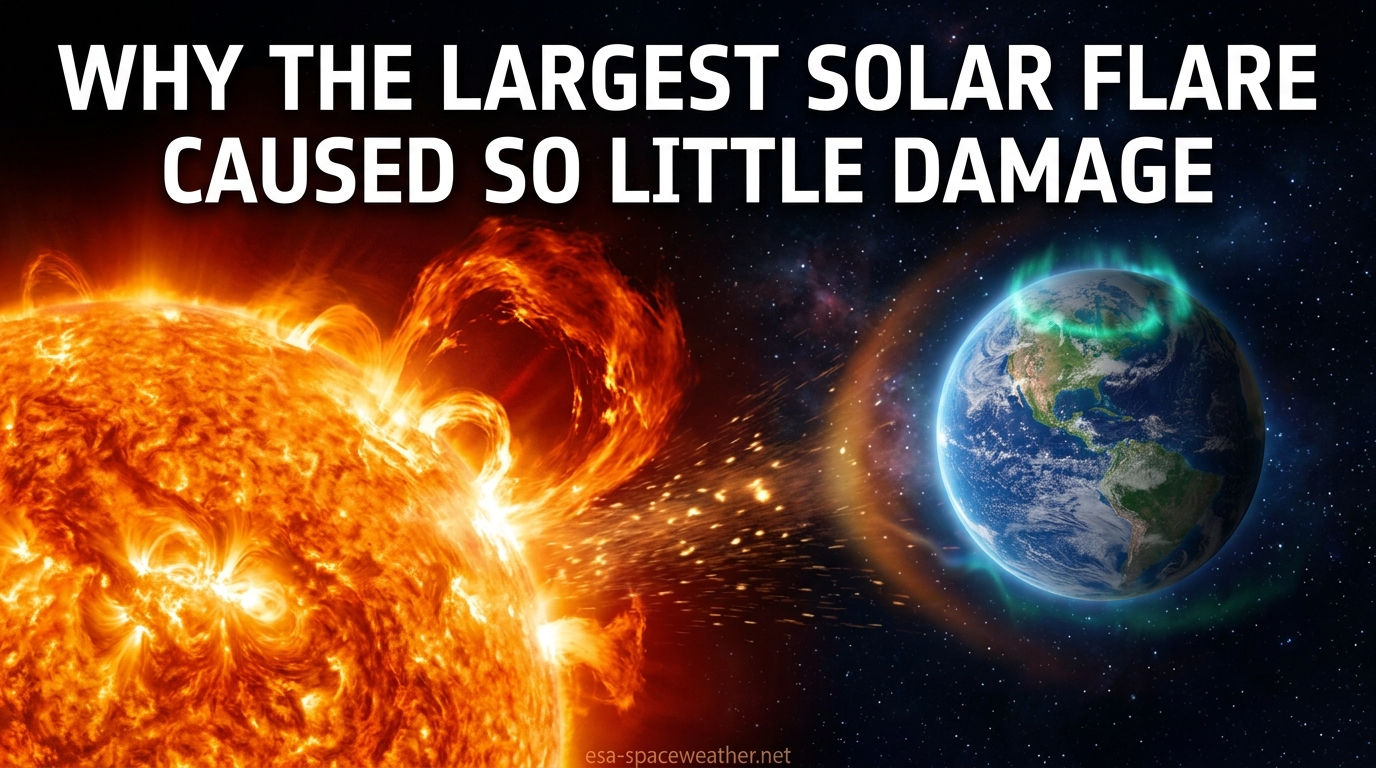
In early August 1972, the Sun unleashed one of the most violent outbursts ever recorded. Over just nine days, a single active region on the solar surface fired off a barrage of flares, coronal mass ejections, and solar proton events that ranks among the most extreme space weather episodes in human history. Yet despite the raw power involved, the damage on the ground was surprisingly modest.
People in Illinois saw auroras bright enough to read by. AT&T rushed to reroute long-distance phone traffic. And in Haiphong Harbor, dozens of magnetic sea mines detonated on their own. But there were no blackouts lasting weeks. No satellites were destroyed. No one died.
That disconnect between the Sun’s ferocity and Earth’s relatively mild experience is exactly what makes this event so fascinating. Understanding why the largest solar flare 1972 damage was so limited requires looking at several converging factors, from the direction the solar material was fired to the state of technology at the time.
In this article, we’ll walk through the full timeline of the August 1972 solar storms, document every observed effect, and then directly answer the question that scientists, space weather enthusiasts, and curious readers keep asking: why didn’t this monster event cause far more destruction?
Table of Contents
What Was the Solar Flare of 1972?
The solar flare of 1972 was a series of explosive eruptions from a single sunspot group called McMath 11976, active during the declining phase of Solar Cycle 20. Between August 2 and August 11, this active region produced at least three major flares, multiple coronal mass ejections (CMEs), and one of the most intense solar energetic particle events of the 20th century.
The standout event was a massive flare on August 7, which solar physicist Richard T. Hansen dubbed the “seahorse flare” because of its distinctive double-lobed shape in telescope imagery. While scientists at the time could not directly measure its X-ray classification the way we do today, retrospective analysis places several August 1972 flares in the X-class category, the highest tier on the solar flare classification scale.
What made the August 1972 storms truly extraordinary was not just the flare intensity. The series included a coronal mass ejection that traveled from the Sun to Earth in an estimated 14.6 hours. That is the fastest CME transit time ever recorded. For comparison, a typical CME takes between one and three days to reach our planet. The August 4 event essentially set the benchmark for how fast solar material can cover the 93 million miles between the Sun and Earth.
The storms also generated a solar proton event so intense that particle detectors on the ground registered elevated radiation levels. Ground-level events, where solar protons have enough energy to penetrate Earth’s atmosphere and reach the surface, are rare. August 1972 produced one of the most significant ground-level events of the modern era.
Put simply, the August 1972 solar storms combined extreme flare magnitude, record-breaking CME speed, and intense solar particle radiation into a single nine-day window. By every measure, this was one of the most powerful space weather events in recorded history.
Timeline of Events: August 2 to 11, 1972
The August 1972 solar storms unfolded as a rapid-fire sequence rather than a single explosive moment. Understanding the day-by-day progression helps explain both the intensity and the nature of the effects observed on Earth.
August 2, 1972: The Opening Salvo
McMath 11976 announced itself with a major flare that produced a sudden ionospheric disturbance and a radio blackout across the daylight side of Earth. High-frequency radio communications were disrupted for hours, affecting military and civilian traffic alike. This was the first signal that something unusual was brewing on the Sun.
August 4, 1972: The Record-Breaking CME
The defining moment of the entire episode arrived on August 4. A powerful coronal mass ejection erupted from the Sun and slammed into Earth’s magnetosphere in approximately 14.6 hours. This remains the fastest Sun-to-Earth CME transit time in the scientific record.
The impact triggered a sudden commencement geomagnetic storm, meaning the onset was abrupt rather than gradual. Magnetometers around the world recorded sharp jumps in the planetary magnetic field almost simultaneously, confirming a direct hit from the solar plasma cloud.
Shortly after the CME arrived, a massive solar proton event began flooding the near-Earth space environment with energetic particles. These solar protons would persist for days, creating dangerous radiation conditions for anything or anyone beyond Earth’s protective atmosphere.
August 7, 1972: The Seahorse Flare
Just as the effects of August 4 were beginning to subside, McMath 11976 produced its visually spectacular “seahorse flare.” This eruption was captured in extraordinary detail by solar telescopes and became one of the most studied flares in solar physics history. It produced another wave of electromagnetic radiation and particle output, prolonging the already intense space weather conditions.
August 9 to 11, 1972: Declining Activity
The active region continued to produce flares and proton flux through August 11, though with decreasing intensity. By mid-August, McMath 11976 rotated around the western limb of the Sun and out of direct view from Earth. The nine-day siege was over.
What Actually Happened on Earth
For an event of this magnitude, the observed effects were real but contained. Here is what people actually experienced on the ground and in orbit during August 1972.
Aurora Sightings
The geomagnetic storms pushed auroras to unusually low latitudes. Skywatchers in Illinois, Washington D.C., and other mid-latitude locations reported vivid red and green auroral displays. Some accounts describe the aurora as bright enough to cast shadows and read by, which is exceptionally rare at those latitudes.
Power and Communications Disruptions
AT&T reported disruptions to its long-distance telephone cable system. The voltage fluctuations induced by the geomagnetic storm forced the company to reroute traffic and take corrective measures to prevent equipment damage. This was one of the earliest well-documented cases of space weather affecting a major telecommunications infrastructure.
Power grid operators also observed unusual current flows in transmission lines. However, no transformers failed and no widespread blackouts occurred. The grid held up despite the electromagnetic assault.
The Haiphong Harbor Mine Detonations
One of the most dramatic and least widely known effects occurred in Haiphong Harbor, North Vietnam. On August 4, the U.S. Navy had dozens of magnetic influence sea mines deployed in the harbor. When the geomagnetic storm compressed Earth’s magnetic field, the resulting magnetic perturbations triggered the mines’ detonation sensors. Dozens of mines exploded simultaneously, with no ships nearby.
This incident was classified for years. It was only through later research, particularly the 2018 paper published in Space Weather, that the full story became public. The Haiphong mine detonations remain one of the most striking examples of space weather directly causing military hardware to malfunction.
Satellite and Space Environment Effects
Several satellites in orbit at the time experienced anomalies related to the solar proton event and increased atmospheric drag. The intense particle flux degraded solar panels and caused electronic upsets. However, no satellites were lost outright. The 1972 satellite fleet was small and relatively robust compared to the thousands of satellites in orbit today.
Why the Largest Solar Flare 1972 Damage Was So Limited
This is the question at the heart of the story. An event this powerful, with record-breaking CME transit times and intense proton radiation, should have caused far more damage than it did. So why didn’t it? The answer involves a combination of physics, timing, and the state of human technology in 1972.
Reason 1: Not All Solar Material Was Perfectly Earth-Directed
The most critical factor was the directional geometry of the coronal mass ejections. While the August 4 CME was indeed fast and powerful, its magnetic field configuration was not the most damaging possible orientation for Earth.
The most destructive geomagnetic storms occur when a CME’s embedded magnetic field points strongly southward, opposite to Earth’s protective magnetic field. This southward orientation allows solar plasma to pry open the magnetosphere and funnel energy directly into the upper atmosphere. While the August 1972 storms did produce significant geomagnetic disturbance, the magnetic orientation was not as persistently southward as the 1859 Carrington Event.
In other words, the Sun threw a devastatingly fast pitch, but it did not hit Earth at the absolute worst angle. Had the magnetic field within the CME been oriented differently, the damage would have been dramatically worse.
Reason 2: Far Less Technological Dependency in 1972
In 1972, there was no internet. There were no GPS satellites guiding everything from package delivery to airline navigation. The power grid was smaller, less interconnected, and less electrically sensitive than it is today. There were roughly a few hundred satellites in orbit compared to the thousands now circling the planet.
The infrastructure that existed was also more analog and more resilient to electromagnetic interference. Telephone networks relied on copper wires and mechanical switching systems that were inherently more tolerant of voltage fluctuations than the microprocessor-driven networks that replaced them.
This is perhaps the single most important point: the same event striking Earth today would cause vastly more damage simply because there is so much more technology to damage.
Reason 3: Magnetospheric Shielding Was Effective
Earth’s magnetosphere acted as a powerful shield during the August 1972 storms. While the CME compressed the magnetosphere significantly, pushing the boundary closer to Earth than normal, our planet’s magnetic field still deflected the majority of incoming charged particles.
The solar proton event was intense, but Earth’s magnetic field funneled most of those particles toward the polar regions, where they produced auroras rather than penetrating to populated areas. The atmosphere provided an additional layer of protection, absorbing the particle radiation before it reached the surface.
For humans on the ground, the magnetosphere and atmosphere combined to make the event essentially harmless. The concern was always for systems above the atmosphere, like satellites and astronauts, not for people standing on Earth’s surface.
Reason 4: Shorter Duration Compared to Sustained Events
The August 4 CME arrived with devastating speed, but the most intense phase of the geomagnetic storm was relatively brief. Some of the worst space weather events in history, including the Carrington Event of 1859, featured sustained periods of extreme disturbance that gave power systems and infrastructure no time to recover.
The 1972 storms were intense but shorter-lived in their peak phases. Power grid operators had a narrow window of recovery between major impacts. This brevity limited the cumulative damage to transformers, communications lines, and other infrastructure.
Reason 5: A Smaller, More Isolated Power Grid
The North American power grid in 1972 was substantially smaller and less interconnected than today’s continent-spanning network. While this meant less capacity, it also meant that a disturbance in one region was less likely to cascade into a multi-state blackout.
Modern grids are designed for efficiency, with long-distance interconnections that allow grid instability to propagate across thousands of miles. In 1972, the grid’s relative isolation served as an unintentional firewall. Localized disturbances stayed localized rather than cascading through the system.
Reason 6: No Global Internet, GPS, or Microprocessor Infrastructure
This factor cannot be overstated. The technologies most vulnerable to space weather effects did not exist in 1972. There was no global internet dependent on undersea cables and satellite links. There was no GPS constellation whose loss would ground aircraft and disrupt supply chains. There were no billions of microprocessors in everything from cars to hospital equipment.
The August 1972 event targeted a world that was largely immune to the kinds of damage a severe solar storm inflicts. The same physics slamming into today’s hyper-connected infrastructure would produce a dramatically different outcome.
The Apollo 17 Near-Miss: How Close Was Disaster?
One of the most chilling aspects of the August 1972 solar storms is where NASA’s astronauts were at the time. Apollo 16 had returned from the Moon in April 1972. Apollo 17 was not scheduled to launch until December. That timing, entirely by luck, placed no astronauts in deep space during the most dangerous period.
If astronauts had been on the Moon or in transit during the August 4 through August 7 window, they would have been exposed to the full brunt of the solar proton event without the protection of Earth’s atmosphere or magnetosphere. Radiation dose estimates for the August 1972 event suggest that astronauts on the lunar surface would have received a dose in the range of 200 to 400 rem over the course of the proton event.
For context, the threshold for mild radiation sickness begins around 50 to 100 rem. Doses above 300 rem can be fatal without medical treatment. Astronauts caught outside their spacecraft during the peak of the August 1972 proton event could have faced serious radiation sickness or worse.
This near-miss had a profound impact on NASA’s understanding of space radiation risk. It reinforced the need for radiation monitoring, storm shelters within spacecraft, and mission planning that accounts for solar flare activity. The Apollo program simply got lucky that no human was in deep space during one of the most violent solar outbursts on record.
1972 vs Carrington Event vs Modern Vulnerability
To understand the significance of the August 1972 storms, it helps to compare them to other historic events and to project what a similar storm would do today. The most famous comparison point is the Carrington Event of September 1859, the benchmark for extreme space weather.
The Carrington Event produced a geomagnetic storm so powerful that telegraph wires sparked, started fires, and operators could send messages with their equipment unplugged. Auroras were visible in Cuba, Hawaii, and even as far south as the Caribbean. While the 1972 CME traveled faster, the Carrington storm produced a more sustained and magnetically aligned geomagnetic disturbance, which is why its ground effects were more spectacular despite arriving at a slower speed.
Here is how the key events and modern risk compare across several dimensions:
- Speed: The August 1972 CME reached Earth in roughly 14.6 hours, the fastest on record. The Carrington Event CME took an estimated 17.6 hours. Both arrived far faster than a typical 1 to 3 day transit.
- Magnetic alignment: The Carrington Event’s CME had a more persistently southward magnetic field, maximizing energy transfer into Earth’s magnetosphere. The 1972 storms, while intense, had a less optimal alignment for maximum damage.
- Technology in 1859: The telegraph network was the primary vulnerable infrastructure. It was disrupted globally but did not cause cascading societal failures.
- Technology in 1972: Limited satellites, copper-wire telephone networks, and a smaller power grid meant fewer vulnerable targets.
- Technology today: Thousands of satellites, global internet infrastructure, GPS-dependent systems, interconnected power grids across continents, and microprocessors in nearly every device create exponentially more vulnerability.
If a storm identical to August 1972 struck Earth today, the consequences would be in an entirely different league. The GPS constellation could be degraded or disabled for hours or days. Satellite communications could be interrupted globally. Power grids across North America and Europe could experience transformer damage leading to rolling blackouts. Airline passengers on polar routes would receive elevated radiation doses.
Modern space weather monitoring gives us something that did not exist in 1972: warning time. Satellites like the Deep Space Climate Observatory (DSCOVR) and the Solar and Heliospheric Observatory (SOHO) can detect incoming CMEs before they arrive. But even with advance notice, the sheer scale of modern vulnerable infrastructure means that a repeat of August 1972 would be a major global event with economic costs measured in the billions.
Frequently Asked Questions
When was the strongest solar flare ever recorded?
The strongest solar flare ever recorded in terms of X-ray intensity was the X28+ flare of November 4, 2003, during the Halloween storms. However, the August 1972 solar storms are considered among the most extreme space weather events ever recorded due to their combined flare intensity, record-breaking CME transit time of 14.6 hours, and massive solar proton event. The Carrington Event of 1859 remains the benchmark for the most damaging geomagnetic storm in recorded history.
What was the solar flare of 1972?
The solar flare of 1972 was a series of explosive eruptions from sunspot region McMath 11976 between August 2 and August 11, 1972. The storms produced multiple X-class flares, the fastest coronal mass ejection ever recorded (14.6 hour Sun-to-Earth transit), and one of the most intense solar proton events of the 20th century. The August 7 eruption, known as the seahorse flare for its distinctive shape, became one of the most studied solar events in history.
What happened on August 4th, 1972?
On August 4, 1972, a coronal mass ejection from the Sun struck Earth’s magnetosphere after traveling approximately 93 million miles in just 14.6 hours, the fastest CME transit time ever recorded. The impact triggered a sudden geomagnetic storm, caused auroras visible as far south as Illinois, disrupted AT&T long-distance telephone cables, and triggered the detonation of dozens of U.S. Navy magnetic sea mines in Haiphong Harbor, Vietnam.
Could the Carrington Event happen again?
Yes, the Carrington Event could absolutely happen again. Solar physicists consider extreme events like the 1859 Carrington Event and the 1972 solar storms to be naturally recurring phenomena. Research suggests that storms of this intensity may occur roughly every 100 to 200 years. The key concern for 2026 is that the same event striking modern infrastructure, with its global internet, GPS systems, interconnected power grids, and thousands of satellites, would cause vastly more damage than it did in 1859 or 1972.
Could a solar flare wipe out humanity?
No, a solar flare cannot wipe out humanity. Solar flares and geomagnetic storms do not directly harm humans on Earth’s surface because the atmosphere and magnetosphere provide effective shielding against radiation and charged particles. The danger is to technology: power grids, satellites, GPS, and communications systems. A severe solar storm could cause widespread blackouts, economic disruption, and infrastructure damage, but it would not directly threaten human survival. The greater concern is societal disruption from prolonged power and communication outages.
What was the worst solar flare in history?
The worst solar flare in terms of recorded damage remains the Carrington Event of September 1, 1859, which caused telegraph systems worldwide to spark, catch fire, and malfunction. In terms of raw scientific intensity, the August 1972 solar storms, with their record-breaking 14.6 hour CME transit time and massive solar proton event, rank among the most extreme ever measured. The November 2003 X28 flare was the most powerful single flare ever recorded by instruments, though it was not directed squarely at Earth.
Key Takeaways
The largest solar flare 1972 damage was limited by a convergence of fortunate circumstances. The CME arrived with devastating speed but its magnetic field was not perfectly aligned for maximum destruction. Earth’s magnetosphere and atmosphere absorbed the radiation that would have been lethal to anyone beyond their protection. And the world of 1972 simply had far less vulnerable technology than the one we live in today.
The Apollo 17 near-miss reminds us that luck played a role too. Had astronauts been in deep space during the August 4 proton event, the outcome could have been tragic. And the Haiphong Harbor mine detonations show that even in 1972, the military was not immune to the Sun’s reach.
The most important lesson for 2026 is that we cannot count on those same protective factors today. A repeat of the August 1972 storms would strike a planet covered in GPS-dependent systems, global internet infrastructure, interconnected power grids, and thousands of satellites. Understanding why damage was limited in the past helps us understand exactly how much we stand to lose if it happens again.
Space weather monitoring has improved dramatically since 1972. We can now detect incoming CMEs and issue warnings. But knowing a storm is coming is only useful if we have hardened our infrastructure against it. The August 1972 solar storms remain a benchmark, a warning, and a reminder that the Sun’s power has not changed, even if our vulnerability has.