
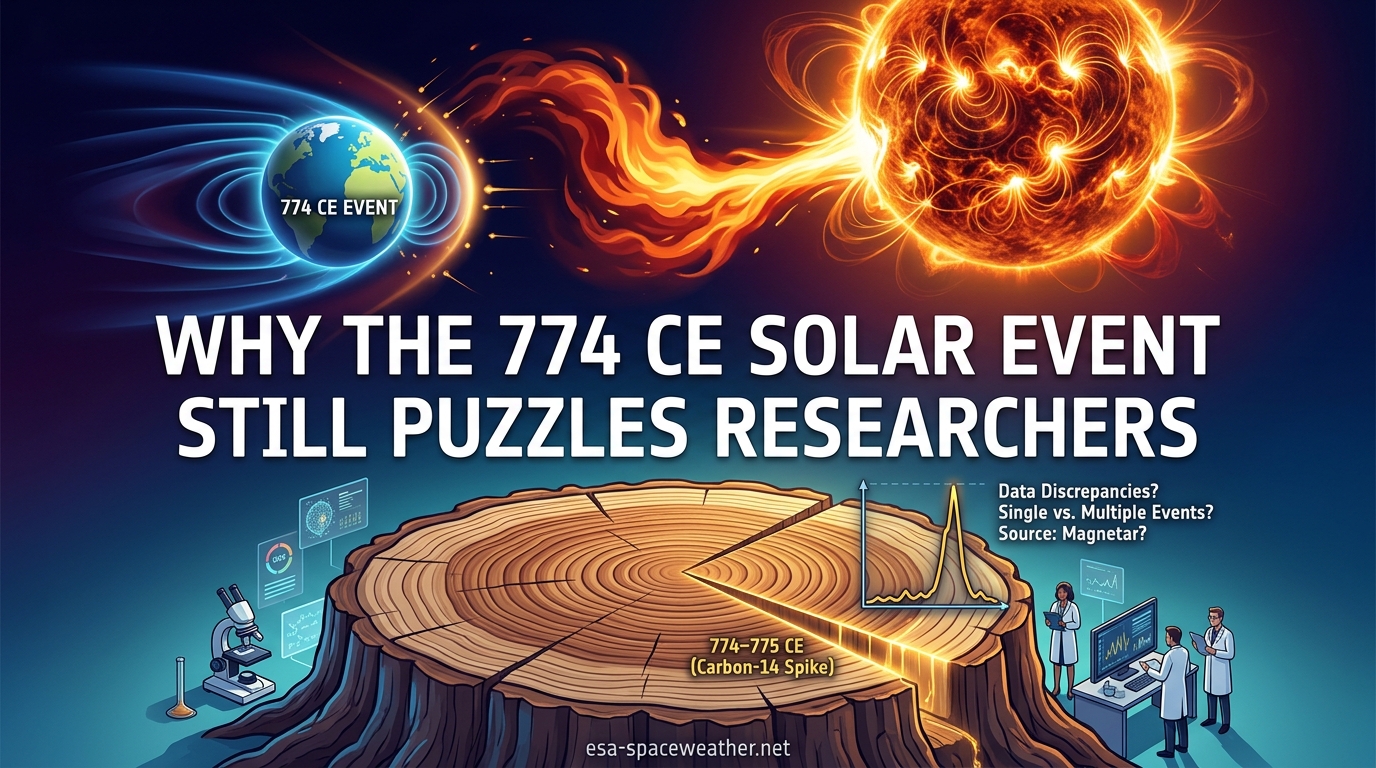
In the summer of 775 CE, something extraordinary happened to every living tree on Earth. A massive pulse of radiation slammed into the atmosphere, creating a spike in radioactive carbon that was quietly absorbed by trees from Japan to Germany to New Zealand. No chronicler recorded it. No civilization noticed. But the trees remembered.
More than 1,200 years later, a physicist named Fusa Miyake discovered that hidden signature while studying ancient Japanese cedar tree rings. What she found would challenge everything scientists thought they knew about solar storms and cosmic radiation. The 774 CE solar event, as it came to be known, was unlike anything in the observational record. It was tens of times more powerful than the most intense solar storm ever measured by modern instruments.
Over a decade later, researchers are still trying to explain what caused it.
In this article, we will walk through what the 774 CE solar event was, how it was discovered, why it defies current scientific models, and what it means for our technology-dependent civilization in 2026. The mystery sits at the intersection of astrophysics, climate science, and dendrochronology, and it may be one of the most important unsolved problems in space weather research today.
Understanding this event is not just academic curiosity. If something similar happened now, the consequences for satellites, power grids, and global communications would be catastrophic. The fact that we still cannot fully explain the 774 CE solar event means we also cannot predict when the next one will strike.
Table of Contents
What Was the 774 CE Solar Event?
The 774 CE solar event was a massive burst of cosmic radiation that struck Earth’s atmosphere in the year 774 or early 775 CE, producing the largest carbon-14 spike in the entire tree-ring record for the last 11,000 years. It is the most powerful confirmed instance of what scientists now call a Miyake event, a category of extreme radiation bursts named after the researcher who first identified them.
Here is what makes it remarkable. In a single year, atmospheric carbon-14 levels jumped by roughly 12 per mille, or about 1.2 percent above normal background levels. That may sound small, but in the world of radiocarbon science, it is enormous. Normal year-to-year variation in carbon-14 is measured in tenths of a per mille. The 774 spike was roughly 20 times larger than anything produced by ordinary solar activity.
To put the energy involved in perspective, researchers estimate the 774 CE solar event was 40 to 100 times more powerful than the largest solar particle event ever recorded by modern instruments, the Ground Level Enhancement Number 5, or GLE#5, which occurred in February 1956. It was also at least 10 times more powerful than the famous Carrington Event of 1859, the strongest geomagnetic storm in recorded human history.
Whatever caused it, the event was global. Trees on every continent that were growing at the time recorded the same carbon-14 signature. Ice cores from Antarctica and Greenland captured corresponding spikes in beryllium-10 and chlorine-36, two other cosmogenic isotopes produced when cosmic radiation hits the upper atmosphere. The evidence is consistent, abundant, and independently confirmed by laboratories around the world.
And yet, despite more than a decade of intensive study, scientists still cannot agree on what produced it.
How Was the 774 CE Solar Event Discovered?
The discovery reads almost like a detective story. In 2012, a team led by physicist Fusa Miyake at Nagoya University in Japan was measuring carbon-14 levels in ancient tree rings with unprecedented precision. They were using accelerator mass spectrometry, a technique so sensitive it can count individual radioactive carbon atoms in a sample weighing less than a gram.
Miyake and her colleagues were analyzing rings from Yaku-sugi, ancient Japanese cedar trees that can live for thousands of years on Yakushima island. When they reached the ring corresponding to the year 775 CE, the carbon-14 reading spiked off the chart. At first, the team suspected contamination or a measurement error. But when they checked samples from other trees, the same anomaly appeared, year after year, in exactly the same ring.
The finding was published in the journal Nature in June 2012, and it immediately sent shockwaves through the scientific community. No one had expected to find evidence of such an extreme cosmic event hiding in tree rings from the 8th century. Radiocarbon dating had been used for decades, but no one had measured individual tree rings with this level of precision before.
Confirmation came quickly. Within months, laboratories in Germany, Russia, the United States, Finland, and New Zealand all reported finding the same carbon-14 spike in their local tree-ring sequences. Irish oak, German pine, American bristlecone pine, and Siberian larch all told the same story. Something enormous had irradiated the entire planet in 774 CE.
The event was subsequently named a Miyake event in honor of the researcher who first detected it. Fusa Miyake and her team at Nagoya University had stumbled onto an entirely new class of astrophysical phenomenon. Since that initial discovery, several other Miyake events have been identified in the tree-ring record, including ones in 993 CE, 660 BCE, 5259 BCE, and 7176 BCE. But the 774 CE event remains the largest and most thoroughly studied of them all.
The Evidence: How Trees and Ice Record Cosmic Radiation
To understand why the 774 CE solar event is so puzzling, it helps to understand exactly what the evidence is telling us.
How Carbon-14 Forms in the Atmosphere
Carbon-14 is a radioactive isotope of carbon that forms when cosmic rays collide with nitrogen atoms in the upper atmosphere. When a high-energy neutron from a cosmic ray strikes a nitrogen-14 atom, it knocks out a proton, converting the nitrogen into carbon-14. This radioactive carbon then combines with oxygen to form carbon dioxide, which mixes throughout the atmosphere.
Plants absorb that carbon dioxide during photosynthesis. Trees incorporate it into their annual growth rings, creating a permanent record of atmospheric carbon-14 levels for each year of their lives. When cosmic radiation increases, more carbon-14 is produced, and trees lock away more of it in that year’s ring.
Under normal conditions, cosmic ray flux stays relatively stable. The Sun’s magnetic field provides some shielding, and the amount of carbon-14 produced each year varies only slightly. But during a Miyake event, the cosmic ray flux spikes dramatically, and the carbon-14 signal in tree rings jumps accordingly.
Dendrochronology: The Science of Reading Tree Time
Dendrochronology is the study of tree rings to determine exact calendar years. Because trees produce one ring per year, and because ring widths vary with growing conditions, scientists can match overlapping ring patterns from different trees to build continuous chronologies stretching back thousands of years.
This means we can date the 774 carbon-14 spike with extraordinary precision. We know it happened in the growing season of 775 CE in the Northern Hemisphere, which means the radiation pulse arrived in 774 CE or possibly early 775. The dating is confirmed by multiple independent tree-ring chronologies from different regions, all of which agree to within a single year.
Bristlecone pines from the White Mountains of California, some of which are over 5,000 years old, have proven particularly valuable for this research. Irina Panyushkina of the University of Arizona has been using bristlecone pine records to search for additional Miyake events and to extend the tree-ring chronology further back in time.
Ice Core Corroboration: Beryllium-10 and Chlorine-36
Tree rings are not the only record. Polar ice cores provide an independent line of evidence. When cosmic rays hit the atmosphere, they also produce beryllium-10 and chlorine-36 isotopes, which attach to aerosols and eventually settle out of the atmosphere onto ice sheets.
Researchers have found matching spikes in both beryllium-10 and chlorine-36 in Antarctic and Greenland ice cores corresponding to the 774 CE event. The timing and magnitude of these ice-core signals are consistent with the carbon-14 tree-ring data, confirming that the event was real, global, and extremely powerful.
The multi-isotope evidence is what makes the 774 event so well documented. Any single measurement could be questioned. But when carbon-14 in trees on five continents, beryllium-10 in Antarctic ice, and chlorine-36 in Greenland ice all tell the same story, there is no room for doubt that something extraordinary happened.
Why the 774 CE Solar Event Still Puzzles Researchers
This is where the story gets genuinely strange. Despite having some of the best-preserved evidence in all of paleoclimate science, researchers still cannot fully explain what caused the 774 CE solar event. Several specific problems keep them awake at night.
The Duration Problem
A typical solar flare or solar particle event lasts hours to days. The radiation arrives, peaks, and dissipates within a short window. But the carbon-14 spike from 774 CE appears to have built up over a period of one to two years. Some analyses suggest the event may have had a prolonged or repeated phase that lasted months.
This duration is deeply problematic for the solar flare hypothesis. A single flare, even an extremely powerful one, should produce a sharp, narrow carbon-14 peak lasting weeks at most. The broad signal observed in the tree rings suggests either multiple events, a sustained outburst, or a source that does not match any known solar behavior.
Researchers led by Benjamin Pope and Qingyuan Zhang at the University of Queensland published a study in 2022 in the Proceedings of the Royal Society A that modeled this problem in detail. They tried to reproduce the 774 carbon-14 signal using known solar flare physics and could not match the observed data. The models simply do not fit.
The Solar Cycle Mismatch
Solar flares and solar particle events are strongly correlated with the 11-year solar cycle. They cluster around solar maximum, when the Sun’s magnetic activity is at its peak. If the 774 CE solar event was caused by a solar superflare, it should have occurred during or near a solar maximum.
But when researchers reconstructed the solar cycle for the 770s CE using carbon-14 data, they found no evidence that 774 was a solar maximum year. In fact, the event does not align with any particular phase of the solar cycle at all. This finding, reported by Science News in 2022, underscored how poorly the solar flare hypothesis fits the data.
This mismatch is one of the strongest pieces of evidence against a simple solar explanation. If cosmic ray spikes of this magnitude do not follow the solar cycle, then either the Sun behaves differently during extreme events than we think, or the source is not solar at all.
The Geographic Distribution Paradox
Solar particles are guided by Earth’s magnetic field, which means they preferentially enter near the magnetic poles. This is why auroras are seen mainly at high latitudes. A solar particle event should produce a carbon-14 signal that is concentrated in polar regions and weaker near the equator.
But the 774 CE carbon-14 spike appears to be remarkably uniform across latitudes. Trees from near-polar regions like northern Scandinavia and subtropical regions like Japan show similar magnitude spikes. This geographic distribution is inconsistent with what we would expect from a solar particle event, where the polar signal should be significantly stronger.
This paradox suggests that either the radiation source was isotropic, meaning it came from all directions equally, or that the carbon-14 was mixed globally before being recorded by trees. Both possibilities raise difficult questions about the nature of the event.
The Missing Historical Records
An event this powerful should have produced spectacular auroras visible far into the tropics. The Carrington Event of 1859 produced auroras seen as far south as Cuba and Hawaii, and it was orders of magnitude weaker than the 774 event. A Miyake event should have produced auroras visible nearly worldwide.
Yet there are almost no contemporary written records of anything unusual in the skies during 774-775 CE. There is one possible reference in the Anglo-Saxon Chronicle, which mentions an appearance of a red crucifix in the sky in 774 CE, which some researchers have interpreted as an aurora description. There are also a few Chinese records of unusual celestial phenomena from around this time.
But given the scale of the event, the historical silence is deafening. This has led some researchers to wonder whether the event was not primarily visual in nature, or whether the radiation arrived in a form that did not produce widespread auroral displays.
The Intensity Without a Clear Source
Perhaps the most fundamental puzzle is simply the energy. The 774 CE solar event required a radiation burst 40 to 100 times more intense than the most powerful solar particle event in the modern instrumental record. The Sun is known to produce flares, and it may occasionally produce superflares, but no one has ever observed a solar event of this magnitude in real time.
Studies of Sun-like stars using the Kepler space telescope have shown that some stars do produce superflares thousands of times more powerful than anything our Sun produces in the modern era. But whether our own Sun is capable of such outbursts remains debated. The 774 event may be evidence that it can, or it may point to an entirely different astrophysical mechanism.
The honest answer, as the Courthouse News report on the 2022 University of Queensland study bluntly put it, is that researchers have effectively ruled out simple solar flares as the source while still lacking a definitive alternative explanation. That is the essence of the puzzle.
The Leading Theories: What Caused the 774 CE Event?
Several hypotheses have been proposed to explain the 774 CE solar event. Each has supporters and each has significant problems.
The Solar Superflare Hypothesis
The leading theory is that the Sun produced a superflare, a solar eruption vastly more powerful than anything observed in the modern era. A superflare could potentially explain the total energy budget of the event, and it would be consistent with the fact that other Miyake events have similar characteristics.
The problem is that no solar superflare has ever been directly observed. The largest solar flares recorded by modern instruments, including the famous 2003 Halloween storms, are orders of magnitude weaker than what would be needed to produce the 774 carbon-14 spike. Extrapolating from known flare physics to a superflare of this size requires assumptions that may not be valid.
Additionally, the duration and solar cycle mismatch problems described above are difficult to reconcile with even a superflare explanation. A superflare should still be a short-duration event correlated with solar maximum.
Solar Energetic Particle Events
Another possibility is that the event was caused not by a single flare but by a prolonged solar energetic particle event, a sustained period of intense particle radiation from the Sun. This could potentially explain the duration problem if the Sun remained active for weeks or months.
A 2023 study published in the Journal of Space Weather and Space Climate examined whether the 774 event could be explained by a very large SEP event. The study estimated the 774 event was 40 to 100 times larger than GLE#5, the most intense SEP event in the observational record. While the study confirmed the scale of the event, it could not definitively determine whether a solar origin was consistent with all the observed evidence.
The SEP hypothesis remains viable but unproven. It still does not fully address the solar cycle mismatch or the uniform geographic distribution of the carbon-14 signal.
Gamma-Ray Bursts
Some researchers have proposed that a gamma-ray burst from a distant supernova or other astrophysical source could have caused the 774 event. A sufficiently powerful gamma-ray burst directed at Earth could produce a global, isotropic carbon-14 spike, which would explain the uniform geographic distribution.
This theory has several attractive features. It naturally explains why the event does not correlate with the solar cycle and why the carbon-14 signal appears uniform across latitudes. A gamma-ray burst would come from all directions relative to the event source.
However, the energy requirements are extreme. The nearest known source capable of producing such a burst would likely have been close enough to be visible in historical records, yet no bright new star was reported in 774 CE. Additionally, the ice core isotope ratios for the 774 event are more consistent with a solar source than with a gamma-ray burst origin.
Cometary Impacts and Other Exotic Theories
A few more exotic hypotheses have been floated, including the possibility of a cometary impact that deposited radioactive material in the atmosphere. These theories have generally not gained traction because they struggle to explain the global uniformity of the signal and the isotope ratios, which match cosmogenic isotope production rather than direct deposition.
The reality is that none of the proposed explanations fully accounts for all the observed evidence. Each theory addresses some aspects of the puzzle while leaving others unresolved. This is precisely why the 774 CE solar event remains one of the most intriguing open questions in astrophysics.
The Carrington Event Comparison: Why 774 Was in a Different League
People often ask whether the 774 event was similar to the Carrington Event of 1859. The short answer is no. They are not even in the same category.
The Carrington Event was the most powerful geomagnetic storm in recorded history. On September 1 and 2, 1859, British astronomer Richard Carrington observed a massive solar flare, and within hours, a coronal mass ejection struck Earth. Auroras lit up the sky worldwide, telegraph operators received electric shocks, and some telegraph systems continued operating even after being disconnected from their power sources.
The Carrington Event was terrifying by 19th century standards. But in terms of radiation, it was modest. The carbon-14 spike associated with the Carrington Event, if there is one at all, is tiny compared to the 774 event. Estimates suggest the 774 CE solar event was 10 to 80 times more powerful in terms of radiation output.
Here is the critical difference. The Carrington Event was primarily a geomagnetic storm, driven by a coronal mass ejection that distorted Earth’s magnetic field. The 774 event was primarily a radiation event, driven by energetic particles or cosmic rays that directly produced isotopes in the atmosphere. They are fundamentally different types of phenomena.
The Carrington Event was not a Miyake event. It did not produce a detectable carbon-14 spike in tree rings. If anything, comparing the two underscores how much more extreme the 774 event was, and how poorly we understand the mechanisms that can produce such massive radiation bursts.
This comparison matters because it helps calibrate expectations. The Carrington Event is often used as a worst-case scenario for space weather planning. But if the 774 event represents a different and far more powerful class of phenomenon, then our current risk models may be significantly underestimating the true threat.
Timeline of Known Miyake Events
Since the discovery of the 774 event, researchers have identified several other Miyake events in the tree-ring and ice-core records. Here is what the current timeline looks like.
- 7176 BCE – The oldest confirmed Miyake event, discovered in bristlecone pine records and later confirmed in ice cores. It represents one of the largest cosmogenic isotope spikes in the entire Holocene record.
- 5259 BCE – A major event identified in subfossil tree rings from Europe. This event was important because it helped researchers extend the Miyake event timeline further back and provided a new fixed point for archaeological dating.
- 660 BCE – A significant event confirmed in multiple tree-ring chronologies. Researchers have used this event to help date archaeological sites from the Iron Age in Europe and the Near East.
- 774 CE – The largest and best-studied Miyake event. The benchmark against which all others are compared. Approximately 12 per mille carbon-14 spike, the largest in the last 11,000 years.
- 993 CE – The second Miyake event discovered by Fusa Miyake, this event is smaller than 774 but still well above normal background variation. It has been used as a dating anchor for Viking-age archaeological sites, including the settlement at L’Anse aux Meadows in Newfoundland.
Researchers estimate that Miyake events occur roughly every 400 to 2,400 years, though the spacing is highly irregular. The gap between the 660 BCE and 774 CE events is over 1,400 years. The gap between 774 and 993 CE is less than 220 years. There is no clear pattern, which makes prediction essentially impossible.
Benjamin Pope and his colleagues at the University of Queensland calculated that there is roughly a 1 percent probability of a Miyake event occurring in any given decade. That is a sobering statistic for anyone responsible for maintaining critical infrastructure. It means the chances are low in any single year but not negligible over the lifetime of a power grid or satellite constellation.
What Would Happen If a 774-Type Event Hit Earth Today?
This is the question that keeps space weather researchers, grid operators, and satellite engineers up at night. If the 774 CE solar event happened again, the consequences for modern civilization would be severe and widespread.
Satellites and Spacecraft
A radiation burst of this magnitude would deliver a massive dose of ionizing radiation to any satellite in orbit. Solar panels would degrade rapidly, electronic components would suffer radiation damage, and onboard computers could fail. Low Earth orbit satellites would be partially shielded by Earth’s magnetic field, but satellites in geostationary orbit or high-inclination orbits would be exposed to nearly the full radiation dose.
The Global Positioning System, communications satellites, weather satellites, and military assets would all be at risk. Losing even a significant fraction of the satellite fleet would disrupt navigation, communications, weather forecasting, and financial systems that rely on GPS timing signals.
Power Grids
A Miyake event would not directly damage power grids the way a geomagnetic storm like the Carrington Event does. However, the associated solar particle event could produce atmospheric ionization changes that disrupt radio communications and potentially affect high-frequency communication systems used by aviation and maritime operations.
If a Miyake event were accompanied by a major geomagnetic storm, which is possible if the source is solar, then the combined effect could overwhelm transformer infrastructure. The 1989 Hydro-Quebec blackout, which left 6 million people without power for hours, was caused by a storm far weaker than a Miyake event.
Submarine Cables and the Internet
One of the most concerning modern impacts involves submarine communication cables. These cables carry over 95 percent of international data traffic, including the internet backbone between continents. Research has shown that geomagnetic storms can induce electrical currents in long submarine cables, potentially damaging repeaters that amplify signals along the cable length.
The phrase “internet apocalypse” has been used to describe the potential impact of a Miyake-scale event on global communications. While the term is somewhat dramatic, the underlying concern is legitimate. A prolonged disruption to submarine cable networks would severely impact global commerce, financial markets, and communications.
Ozone Depletion
Calculations suggest that the nitrogen oxides produced by a 774-scale radiation event could deplete stratospheric ozone by approximately 8.5 percent. This would increase ultraviolet radiation levels at the surface, raising risks of skin cancer, damaging crops, and affecting marine ecosystems.
Ozone depletion from a Miyake event would persist for several years, as the nitrogen oxide compounds slowly settled out of the stratosphere. The 8.5 percent figure is significant. For comparison, the Antarctic ozone hole typically involves depletion of 50 to 70 percent, but only in a localized area. A global 8.5 percent depletion would affect the entire planet.
Would We Have Warning?
For a solar-origin event, we might have a few hours to days of warning. Solar observatories like the Solar Dynamics Observatory and the Parker Solar Probe monitor the Sun continuously for flares and coronal mass ejections. If a superflare were detected, satellite operators could put spacecraft into safe mode and grid operators could take protective measures.
But for a non-solar event, such as a gamma-ray burst, there would be no warning at all. Gamma-ray bursts travel at the speed of light, so the signal would arrive simultaneously with the radiation. By the time instruments detected it, it would already be over.
This uncertainty is part of what makes the unsolved mystery of the 774 event so consequential. Without knowing the cause, we cannot know how much warning we would have.
What is the 774 CE Miyake event?
The 774 CE Miyake event was the largest known burst of cosmic radiation to strike Earth in the last 11,000 years, producing a roughly 12 per mille spike in atmospheric carbon-14 that was recorded in tree rings globally. It was discovered in 2012 by physicist Fusa Miyake at Nagoya University and was an estimated 40 to 100 times more powerful than the most intense solar particle event in the modern instrumental record.
What causes a Miyake event?
The exact cause of Miyake events remains unknown. Leading theories include solar superflares, prolonged solar energetic particle events, and gamma-ray bursts from distant astrophysical sources. Each theory explains some aspects of the evidence but fails to account for all observations, including the event duration, lack of solar cycle correlation, and uniform geographic distribution of the carbon-14 signal.
What would happen if a Miyake event happened today?
A Miyake-scale event today would damage satellites, disrupt high-frequency radio communications, potentially affect power grids and submarine internet cables, and deplete stratospheric ozone by approximately 8.5 percent. The impact on satellites, GPS systems, global communications, and aviation would be severe, though the full extent depends on whether the event is solar or non-solar in origin.
Was the Carrington Event a Miyake event?
No, the Carrington Event of 1859 was not a Miyake event. The Carrington Event was a powerful geomagnetic storm caused by a coronal mass ejection, producing spectacular auroras and disrupting telegraph systems. The 774 CE Miyake event was a radiation event estimated to be 10 to 80 times more powerful, and it left a massive carbon-14 signature in tree rings that the Carrington Event did not.
When was the last Miyake event?
The last confirmed Miyake event occurred in 993 CE, approximately 220 years after the 774 CE event. Five Miyake events have been confirmed in total, occurring in 7176 BCE, 5259 BCE, 660 BCE, 774 CE, and 993 CE. Researchers estimate these events occur roughly every 400 to 2,400 years, with a roughly 1 percent probability of occurrence in any given decade.
Could a Miyake event happen again in our lifetime?
Yes, though the probability is low. Researchers estimate approximately a 1 percent chance of a Miyake event occurring in any given decade. The irregular spacing of known events means we cannot predict when the next one will occur. Given that the last confirmed event was over 1,000 years ago, the statistical likelihood slowly increases over time, but there is no way to forecast the event in advance.
Conclusion: A Mystery Written in Wood and Ice
The 774 CE solar event remains one of the most fascinating and consequential open questions in space science. We know it happened. We know roughly when it happened. We know it was enormously powerful. We just do not know why.
The evidence is written in tree rings on five continents, in Antarctic ice, and in Greenland glaciers. It is corroborated by multiple independent laboratories and published in the world’s leading scientific journals. And yet, more than a decade after its discovery, the fundamental question of cause remains unanswered.
This matters because understanding the 774 CE solar event is essential to assessing the risk it poses to our civilization. If it was a solar superflare, then we need to know whether the Sun can be monitored for warning signs. If it was something else entirely, then our entire space weather monitoring framework may be looking in the wrong direction.
For now, the trees keep their record. The ice holds its isotopes. And researchers around the world continue searching for the answer to a 1,250-year-old mystery, one that could reshape our understanding of the Sun, the cosmos, and the fragility of the technological civilization we have built in the blink of a cosmic eye.