
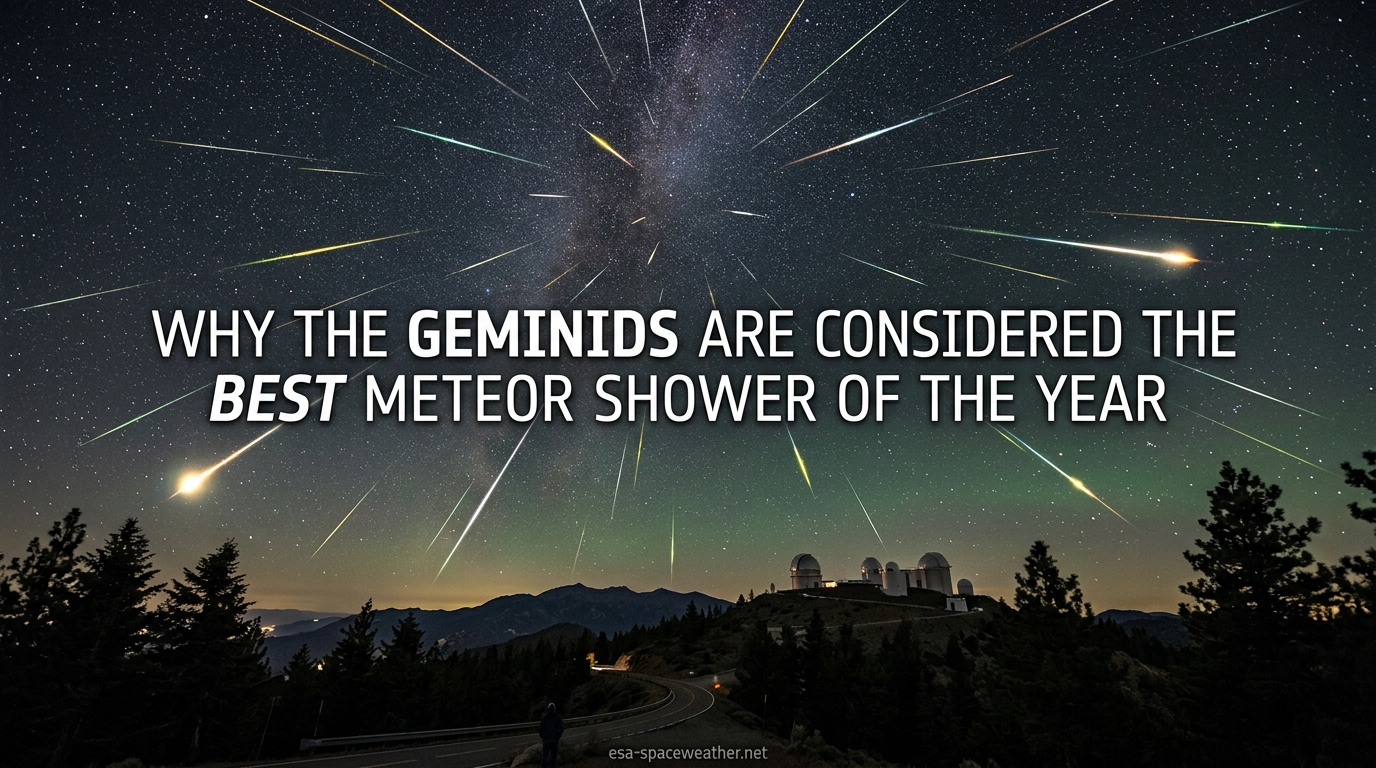
Every December, the night sky puts on a show that seasoned astronomers call the Super Bowl of meteor showers. The Geminids deliver up to 120 colorful meteors per hour under ideal conditions, with bright fireballs that can cast shadows on the ground. The combination of high meteor rates, vivid colors, reliable annual performance, and convenient before-midnight viewing makes the Geminids widely regarded as the best meteor shower of the year, surpassing even the famous August Perseids.
If you have ever stood outside in December cold and watched these fast streaks light up the sky, you already know why the Geminids are considered the best meteor shower of the year. But if you are planning your first viewing night, there are some things you should know before heading out. The gap between the advertised rates and what you actually see from a suburban backyard can be huge, and the difference comes down to timing, location, and understanding what makes this shower so unusual.
In this guide, our team breaks down everything that sets the Geminids apart from every other annual meteor shower. We will cover why they are so prolific, what makes them so colorful, where the debris comes from, and exactly when and where you should look. We will also address the viewing tips that forum communities and experienced observers agree on, plus a space weather angle that no other guide covers.
Table of Contents
Quick Facts: The Geminids at a Glance
Here are the essential numbers for the Geminid meteor shower. Use these as your quick reference when planning a viewing night.
- Peak dates: Night of December 13 into the early morning of December 14 each year.
- Active period: Roughly December 4 through December 20.
- Zenithal Hourly Rate (ZHR): 120 to 150 meteors per hour under ideal dark-sky conditions.
- Parent body: Asteroid 3200 Phaethon, a rare rock comet.
- Radiant: Constellation Gemini, near the bright stars Castor and Pollux.
- Meteor speed: Medium, around 78,000 miles per hour (35 km/s).
- Visibility: Both Northern and Southern Hemispheres, with the Northern Hemisphere favored.
- Equipment needed: None. Naked-eye viewing only.
Why the Geminids Are Considered the Best Meteor Shower of the Year
Let us get straight to the core question. Why the Geminids are considered the best meteor shower of the year comes down to five specific factors that no other annual shower combines in the same package.
1. Sheer Meteor Volume
The Geminids produce a Zenithal Hourly Rate of 120 or more meteors per hour at peak. That means two meteors every minute under perfect conditions. Only the Quadrantids in early January come close to that rate, and they peak for just a few hours instead of a full night.
The Perseids, by contrast, typically max out around 80 to 100 meteors per hour. The Geminids consistently outproduce them year after year, according to data tracked by the International Meteor Organization.
2. Bright, Slow-Moving Meteors
Geminid meteors enter the atmosphere at about 78,000 miles per hour. That is medium speed compared to the Leonids, which scream in at over 160,000 miles per hour. Slower meteors stay visible longer, giving your eyes more time to register each streak.
The result is a shower that feels deliberate and watchable rather than a fleeting flicker you might miss by blinking.
3. Frequent Fireballs
Forum users on Reddit and Cloudy Nights frequently mention fireballs as the most memorable part of the Geminids. These exceptionally bright meteors can light up the entire sky, and some are bright enough to cast shadows on the ground.
Fireballs are more common in the Geminids than in most other annual showers. This is partly because the debris from 3200 Phaethon is denser and rockier than typical cometary dust.
4. Multi-Colored Streaks
The Geminids are famous for their color variety. Observers routinely report seeing yellow, green, blue, orange, and even red meteors in a single night. We will explain the science behind those colors in detail in a later section.
Most other meteor showers produce predominantly white streaks. The Geminids put on a multicolored display that feels more like fireworks than astronomy.
5. Convenient Before-Midnight Viewing
This is the factor that makes the Geminids truly beginner-friendly. Most major meteor showers reach their best display in the hours after midnight, when the radiant is highest in the sky. That means staying up until 3 or 4 a.m. in August heat or January cold.
The Geminid radiant in Gemini rises earlier in the evening than most. You can start seeing good meteor activity as early as 9 or 10 p.m. local time. Families with kids and casual observers can catch a great show and still be in bed by midnight.
No other major shower offers this combination of high volume, bright slow meteors, fireballs, vivid colors, and convenient timing. That is why the Geminids are considered the best meteor shower of the year by NASA, the American Meteor Society, and experienced skywatchers alike.
The Strange Origin: Asteroid 3200 Phaethon
Every meteor shower has a parent body that sheds the debris Earth later plows through. For the Perseids it is Comet Swift-Tuttle. For the Leonids it is Comet Tempel-Tuttle. The Geminids are different because their parent body is not a comet at all. It is an asteroid.
What Is 3200 Phaethon?
Asteroid 3200 Phaethon was discovered in 1983 by the IRAS infrared satellite. It is a roughly 3.6-mile-wide Apollo asteroid with a highly elliptical orbit that brings it closer to the Sun than any other named asteroid. At perihelion, Phaethon passes only about 13 million miles from the solar surface.
That close solar approach is what makes Phaethon behave like something between an asteroid and a comet. As it heats up, fractures in its rocky surface crack open and release dust and debris. Astronomers call this a rock comet.
The Rock Comet Hypothesis
Normal comets are made largely of ice. When they approach the Sun, that ice sublimates into gas and creates a glowing cometary tail. Phaethon has very little ice. Instead, the extreme heat at perihelion causes thermal fracturing and the release of rocky particles.
This rocky debris is denser and tougher than typical cometary dust. Wikipedia notes the density of Geminid meteoroids at roughly 2 to 3 grams per cubic centimeter, compared to about 0.3 grams per cubic centimeter for typical cometary material. That higher density means the particles survive longer during atmospheric entry, producing brighter and longer-lasting meteors.
The 2026 Sodium Tail Discovery
In 2026, a study using data from the Parker Solar Probe revealed that Phaethon has a sodium tail. As the asteroid approaches the Sun, solar heat vaporizes sodium embedded in its rocky surface. This vaporized sodium streams behind the asteroid in a tail-like structure.
This discovery helps explain how the Geminid debris stream continues to replenish itself even though Phaethon is not a traditional comet. National Geographic covered this finding as a major step toward understanding one of the strangest objects in the solar system.
Jupiter’s Gravitational Influence
Space.com reports that Jupiter’s gravity has been gradually pulling the Geminid debris stream closer to Earth’s orbit over centuries. This gravitational nudging may explain why the shower has been getting stronger since its discovery in the 1800s. What started as a weak shower with only 20 meteors per hour in the 19th century has grown into the most prolific annual display we see today.
The Colors of Geminid Meteors
The vivid colors of Geminid meteors come from their metallic composition. Different elements burn at different wavelengths of light when they vaporize in the atmosphere. National Geographic provides the standard breakdown used by astronomers.
- Yellow: Produced by iron, one of the most common metals in the debris stream.
- Orange: Produced by calcium.
- Green: Produced by nickel.
- Blue: Produced by magnesium.
- Red: Produced by atmospheric nitrogen and oxygen glowing as the meteor superheats the air around it.
Because Phaethon’s debris is rocky rather than icy, it contains a richer mix of metals than typical cometary material. That is why the Geminids produce such a wide range of colors compared to showers like the Perseids, which tend to be mostly white or yellow.
When you see a bright green or blue Geminid streak across the sky, you are watching metallic elements from an ancient asteroid burning up at 78,000 miles per hour.
Geminids vs Perseids: Which Is Better?
The Perseids in August are the most famous meteor shower, mainly because they occur during warm summer nights when people are more willing to go outside. But among serious astronomers, the Geminids are generally considered the superior shower. Here is how they compare.
- Meteor rate: Geminids reach 120+ per hour. Perseids reach 80 to 100. Edge goes to the Geminids.
- Reliability: The Geminids produce consistently high rates every year. The Perseids are more variable depending on whether Earth passes through fresh debris trails.
- Brightness: The Geminids produce more fireballs because of their denser, rocky meteoroids.
- Color: The Geminids offer more color variety due to their metallic composition.
- Timing: The Geminids peak before midnight, making them easier to watch. The Perseids peak after 2 a.m.
- Comfort: The Perseids win here. August nights are far more pleasant than December nights.
- Moon interference: This varies by year. Check the moon phase for each shower before planning.
If you can handle the cold, the Geminids are the better show. Many forum users on Reddit put it simply: the Geminids are the best meteor shower for people who care about meteor counts and visual spectacle.
When and Where to Watch the Geminids
Timing and location make the difference between seeing 5 meteors an hour and seeing 60. Here is what you need to know.
Peak Dates
The Geminids peak on the night of December 13 into the early morning of December 14. The shower is active from about December 4 through December 20, so you have a wider window than most people realize.
If the peak night is cloudy, try the night before or the night after. Meteor rates on December 12 and December 15 are still quite high, often reaching 60 to 80 per hour. Having a backup night is one of the most practical tips forum communities share.
Best Time of Night
The Geminid radiant rises in the eastern sky around 9 to 10 p.m. local time. Meteor activity increases steadily after that, peaking around 2 a.m. when the radiant is highest in the sky.
Unlike other showers that require you to wait until the early morning hours, the Geminids start producing good rates by 10 p.m. You can catch a solid display between 10 p.m. and midnight and still get a full night of sleep.
Finding the Radiant
The Geminid radiant sits in the constellation Gemini, near the bright stars Castor and Pollux. Look toward the eastern sky in the early evening and high overhead after midnight.
However, do not stare directly at the radiant. Meteors near the radiant have very short trails because they are coming almost directly toward you. The best strategy is to look about 45 degrees away from the radiant, where meteor trails appear longer and more dramatic.
Moon Phase Considerations
The moon is the single biggest factor that can make or break a Geminid viewing night. A bright full moon will wash out all but the brightest meteors, cutting your visible count dramatically.
In years when the peak coincides with a new moon or a thin crescent, the Geminids are spectacular. In years with a full or nearly full moon, expect to see far fewer meteors. Always check the moon phase before planning your viewing night.
How to View the Geminids: Practical Tips
One of the biggest frustrations new viewers report is seeing far fewer meteors than the 120-per-hour headline. Understanding why that happens is the key to a successful viewing experience.
Understanding ZHR vs Real-World Rates
The Zenithal Hourly Rate assumes perfectly dark skies with the radiant directly overhead. Almost no one experiences those conditions. From a typical suburban location with moderate light pollution, expect to see 20 to 40 meteors per hour at peak. From a city center, you might see only 5 to 10.
This is not a failure of the shower. It is simply the reality of light pollution. The single most effective thing you can do to improve your viewing experience is to get away from city lights.
Find a Dark Sky Location
Drive at least 20 to 30 miles away from any major city. Look for parks, rural areas, or designated dark sky sites. The difference between a Bortle class 8 sky (city) and a Bortle class 3 sky (rural) is the difference between seeing 10 meteors and seeing 80.
Let Your Eyes Adapt
Give your eyes at least 20 to 30 minutes to adapt to the darkness. Avoid looking at your phone entirely. If you need light, use a red flashlight or a red screen filter. White light resets your night vision and you will have to start the adaptation process over again.
Dress for the Cold
December nights are cold, and you will be standing still for an hour or more. Wear more layers than you think you need. Bring a blanket, a reclining chair, and a thermos of something hot. Comfort is the difference between lasting 20 minutes and lasting three hours.
Be Patient
Meteors do not arrive evenly. You might see nothing for 10 minutes and then spot four in the next two minutes. Plan to stay out for at least an hour to get a true sense of the shower’s activity.
Southern Hemisphere Viewing
The Geminids are visible from the Southern Hemisphere, though the radiant rises lower in the sky. Observers in southern latitudes will see fewer meteors because the radiant never gets very high above the horizon. Still, the bright fireballs are visible from most locations worldwide.
Space Weather and the Geminids
As a space weather resource, we want to highlight something no other Geminids guide covers. Solar activity and geomagnetic conditions can influence your viewing experience in subtle ways.
During periods of high solar activity, Earth’s upper atmosphere expands slightly. This can affect the altitude at which meteors ablate and become visible. While the effect on the Geminids specifically is still being studied, it is worth checking geomagnetic conditions on your viewing night.
There is also the possibility of a double spectacle. If a geomagnetic storm coincides with the Geminid peak, observers at high latitudes might see auroras and meteors in the same sky. This is rare, but it has happened. Check the Kp index and aurora forecasts alongside your meteor viewing plans.
Solar wind conditions do not directly produce more meteors, but they can create a more dynamic and unpredictable night sky. For the most complete picture, combine meteor shower data with current space weather conditions.
Photographing the Geminids
Forum photographers agree on a standard setup for capturing Geminid meteors. You do not need expensive equipment, but you do need the right technique.
- Camera: A DSLR or mirrorless camera with manual controls.
- Lens: A wide-angle lens, ideally 14mm to 24mm, with a fast aperture of f/2.8 or wider.
- Settings: ISO 3200 to 6400, aperture wide open, shutter speed of 15 to 30 seconds.
- Support: A sturdy tripod is essential. Use a remote shutter release or a timer to avoid shaking the camera.
- Technique: Take continuous shots throughout the night. You will capture many frames with nothing, but the ones that catch a meteor are worth it.
Aim your camera about 40 to 50 degrees away from the radiant for the longest meteor trails. Stack your best shots in post-processing to create composite images showing multiple meteors from a single night.
Is the Geminid meteor shower the best?
Yes, the Geminids are widely considered the best annual meteor shower by NASA, the American Meteor Society, and experienced astronomers. They produce 120 or more meteors per hour at peak, feature bright fireballs and colorful streaks, and are visible before midnight, making them more accessible than most other major showers.
What causes the Geminid meteor shower?
The Geminids are caused by debris from asteroid 3200 Phaethon, a rare rock comet. As Phaethon approaches the Sun, heat fractures its rocky surface and releases dust and debris. When Earth passes through this debris stream each December, the particles burn up in the atmosphere as bright meteors.
Is the Geminid meteor shower rare?
No, the Geminids are not rare. They occur every December and are one of the most reliable annual meteor showers. However, what is rare is their parent body. Asteroid 3200 Phaethon is the only known asteroid that produces a significant meteor shower, making the Geminids scientifically unique.
What is the best time to view the Geminid meteor shower?
The best time to view the Geminids is between 10 p.m. and 2 a.m. local time on the night of December 13 into the early morning of December 14. The radiant rises around 9 to 10 p.m. and meteor activity increases throughout the night, peaking around 2 a.m.
Which direction should I look to see the Geminid meteor shower?
Look toward the constellation Gemini, near the bright stars Castor and Pollux, in the eastern sky during the evening and high overhead after midnight. For the best view, look about 45 degrees away from the radiant so meteor trails appear longer.
How long will the Geminid meteor shower last?
The Geminids are active from about December 4 through December 20 each year, but peak activity occurs on the night of December 13 into the morning of December 14. Meteor rates remain high for a day or two on either side of the peak.
Is the Geminid meteor shower dangerous?
No, the Geminid meteor shower is not dangerous. The meteoroids are tiny particles, most no bigger than a grain of sand, that completely burn up in Earth’s upper atmosphere. They never reach the ground and pose no risk to observers.
Conclusion
Understanding why the Geminids are considered the best meteor shower of the year comes down to a unique combination: 120-plus meteors per hour, bright rocky fireballs, vivid metallic colors, reliable annual performance, and convenient before-midnight viewing. No other shower matches all five.
Add in the strange origin story of asteroid 3200 Phaethon, the only known asteroid that produces a major meteor shower, and the Geminids become more than just a sky show. They are a reminder that our solar system is full of surprises.
Bundle up, find a dark sky site on December 13, give your eyes time to adjust, and look up. The Geminids will not disappoint.