
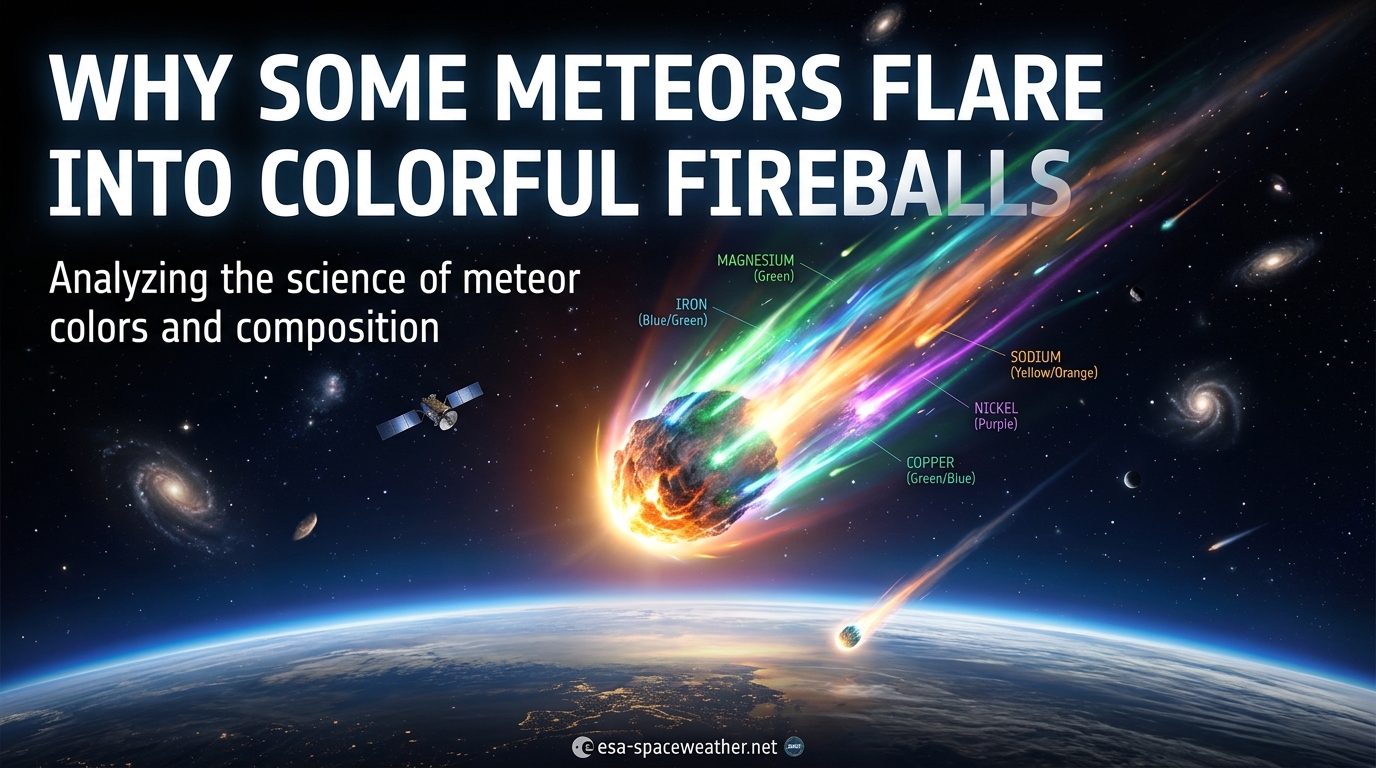
You step outside on a clear night, look up, and suddenly the sky splits open with a blinding streak of green light. For two breathtaking seconds, the meteor burns brighter than anything you have ever seen. Then it is gone, leaving a ghostly trail hanging in the air.
That was not an ordinary shooting star. That was a fireball.
Some meteors flare into colorful fireballs because of a combination of their chemical composition, their speed, and their size. When a meteoroid larger than about one meter across slams into Earth’s atmosphere at hypersonic speeds, ram pressure superheats both the rock and the surrounding air. The vaporized elements become ionized and emit light at specific wavelengths. Sodium glows yellow, magnesium burns blue-white, nickel produces green, and atmospheric nitrogen and oxygen radiate red. The result is a spectacular, colorful display that tells us exactly what the space rock is made of.
Understanding why some meteors flare into colorful fireballs requires looking at the intersection of chemistry, physics, and atmospheric science. The colors you see are not random. They are a direct chemical fingerprint of the meteoroid itself, written in light across the sky for anyone watching to read.
Our team has spent years tracking fireball reports, studying spectroscopic data from global monitoring networks, and analyzing what witnesses describe. What follows is a comprehensive breakdown of the science behind fireball colors, what causes a meteor to flare in the first place, and what those colors reveal about the space rocks that produce them.
Whether you are an amateur astronomer, a student working on a project, or simply someone who witnessed a brilliant green flash and wants to understand what you saw, this guide will walk you through everything from basic definitions to the layered ablation process that makes a single fireball shift through multiple colors during its descent.
Table of Contents
What Is a Fireball? Definitions and Classification
A fireball is a meteor that shines brighter than the planet Venus, which means it reaches an apparent magnitude of at least negative four. In practical terms, if you see a meteor and your first instinct is to shout and point, you probably just witnessed a fireball. They are the headline-makers of the meteor world, bright enough to cast shadows and frequently visible even in light-polluted urban skies.
Not every bright streak qualifies, though. The International Astronomical Union sets the magnitude threshold at negative four, which is the brightness of Venus at its peak. Anything dimmer is simply a meteor. Anything brighter crosses into fireball territory.
From there, fireballs branch into more specific categories based on brightness and behavior.
Fireball vs Bolide vs Superbolide
The classification system works in tiers. Each step up represents a significant increase in energy and visual spectacle.
Fireball: Any meteor brighter than magnitude minus four. These occur frequently enough that dedicated skywatchers see several per year from dark locations.
Bolide: A fireball that ends its visible trajectory with a brilliant terminal flash or explosion. The word comes from the Greek word for missile, and the name fits. A bolide looks like a projectile detonating in the sky.
Superbolide: A fireball brighter than magnitude minus seventeen. These are the rare, news-making events visible across entire countries. The Chelyabinsk meteor in 2013 was a superbolide, briefly outshining the sun before shattering windows across a Russian city.
Meteoroid vs Meteor vs Meteorite
These three terms describe the same object at different stages of its journey. The distinctions matter because each stage produces different phenomena, including the colors we explore in this article.
Meteoroid: The object while it is still traveling through space. A small rocky or metallic body orbiting the sun, typically ranging from a grain of dust to a boulder several meters across.
Meteor: The visible streak of light produced when the meteoroid enters the atmosphere and begins to vaporize. This is the glowing trail you see. Most meteors are caused by particles no larger than a grain of sand.
Meteorite: The surviving remnant that reaches the ground. Not all meteors produce meteorites. In fact, most burn up completely. Only larger bodies, typically those that produce fireballs, have a chance of depositing material on the surface.
A fireball occurs at the meteor stage. The colors come from the ionized atoms and molecules released during atmospheric entry. Understanding what happens during that entry requires looking at the chemistry and physics of extreme heat and high-speed collisions with air molecules.
Why Some Meteors Flare Into Colorful Fireballs: The Chemistry of Color
The short answer to why some meteors flare into colorful fireballs is that the colors come from specific chemical elements releasing energy as light. Each element emits light at particular wavelengths, and those wavelengths correspond to specific colors visible to the human eye. When you see a green fireball, you are watching nickel or magnesium ions radiating energy. When you see a yellow one, that is sodium or iron.
But the full picture is more intricate. Let us break it down element by element, then explore the physics behind why those colors appear.
The Element-to-Color Mapping
Six primary chemical elements account for the vast majority of fireball colors. Each one produces a signature hue when its atoms become ionized by the extreme heat of atmospheric entry. Here is the complete reference.
1. Sodium — Bright Yellow-Orange
Sodium is one of the most abundant volatile elements in meteoroids, and it ionizes at relatively low temperatures compared to other elements. This means sodium is often the first color to appear as a meteoroid begins to heat up. The glow is a vivid yellow-orange, similar to the color of sodium street lamps, because it is the exact same atomic process at work.
Sodium colors dominate the early phase of many fireballs. As the outer layers vaporize, sodium is released quickly and burns brightly before other elements become visible.
2. Iron — Yellow to Yellow-White
Iron is the most common metallic element in meteoroids, particularly in iron-nickel meteorites that originate from differentiated parent bodies. Iron emits light in the yellow to yellow-white range. Its contribution can be difficult to distinguish from sodium visually, but spectroscopic analysis separates them easily based on their emission line wavelengths.
Iron also contributes to the overall brightness of a fireball. Because it is so abundant, iron atoms released during ablation add significantly to the total light output.
3. Magnesium — Brilliant Blue-White
Magnesium produces one of the most striking fireball colors: a searing blue-white that looks almost electric. Magnesium is common in stony meteoroids, especially those from cometary sources. The blue-white emission is intense and tends to dominate the brightest phase of a fireball’s trajectory, when the meteoroid is at peak heating.
Many witnesses describe blue-white fireballs as looking like welding sparks or camera flashes. That comparison is apt because the underlying process, intense ionization of metallic atoms, is similar.
4. Nickel — Green
Nickel is the element most commonly responsible for green fireballs. Iron-nickel meteoroids contain significant amounts of both metals, and when nickel ionizes during atmospheric entry, it emits light in the green portion of the spectrum. Green is the most frequently reported fireball color, largely because iron-nickel meteoroids are common and nickel’s green emission is bright and easily perceived by the human eye.
The green hue can range from a subtle tint to an intense, almost neon glow depending on the nickel concentration and the meteoroid’s velocity. Higher speeds produce more energetic ionization, which intensifies the green emission.
5. Calcium — Violet to Purple
Calcium is less common in meteoroids and requires higher temperatures to ionize fully. When it does, it produces a violet to purple hue. Calcium-colored fireballs are relatively rare, partly because calcium is less abundant and partly because the violet end of the spectrum is harder for human eyes to perceive clearly in low-light conditions.
However, spectroscopic instruments regularly detect calcium emission lines in fireball spectra, even when the visual color appears different to observers.
6. Atmospheric Nitrogen and Oxygen — Red
Not all fireball colors come from the meteoroid itself. The atmosphere contributes its own signature. When a meteoroid plows through the atmosphere at hypersonic speeds, it ionizes the surrounding nitrogen and oxygen molecules in the air. These atmospheric gases emit red and orange light.
The American Meteor Society notes that approximately 95 percent of the light from a typical fireball comes from atmospheric gases, not from the meteoroid material. The meteoroid’s elements contribute the remaining 5 percent. However, that 5 percent is what produces the distinctive colors that distinguish one fireball from another.
The red glow from atmospheric nitrogen and oxygen is most visible at the edges of the fireball’s trail and during the final phases of the trajectory, when the meteoroid has slowed and the surrounding air is still intensely heated.
How Ionization Produces Light: The Emission Spectrum Explained
To understand why each element produces a specific color, we need to talk about what happens at the atomic level during a fireball. The process is called excitation and emission, and it is the same physics that makes neon signs, fluorescent lights, and fireworks work.
Every atom has electrons orbiting its nucleus at specific energy levels. When an atom absorbs energy, by being heated to thousands of degrees for example, its electrons jump to higher energy levels. This excited state is unstable. The electrons quickly fall back to their original levels, releasing the absorbed energy as photons of light.
The key insight is that each element has a unique set of energy levels. Because the gaps between those levels are different for every element, the photons released have specific, unique wavelengths. Sodium atoms always emit yellow-orange light. Magnesium atoms always emit blue-white light. The color is a direct consequence of the atom’s structure.
Scientists call this an emission spectrum. Each element has a fingerprint-like pattern of emission lines at specific wavelengths. When astronomers use spectrographs to analyze fireball light, they can identify exactly which elements are present in the meteoroid by reading these spectral fingerprints.
This is not just academic curiosity. Meteor spectroscopy has practical value. By analyzing the emission spectrum of a fireball, scientists can determine the meteoroid’s composition, infer its parent body type (asteroid or comet), and even make predictions about whether any surviving material might reach the ground as a recoverable meteorite.
There is also a continuum spectrum component. In addition to the sharp emission lines from individual elements, the hot, dense cloud of vaporized material around the meteoroid produces a broad spectrum of white light. This is why very bright fireballs often appear white or nearly white to the eye, even though their spectra contain strong emission lines from multiple elements. The continuum light washes out the individual colors at peak brightness.
The Role of Velocity in Color Intensity
Speed matters enormously. A meteoroid traveling at 70 kilometers per second produces very different colors from one traveling at 11 kilometers per second, even if their chemical compositions are identical.
Faster meteoroids generate more kinetic energy. When they collide with atmospheric molecules, the impacts are more violent, producing higher temperatures and more complete ionization. This means that fast meteors tend to show more blue and green colors, because those emissions require higher excitation energies.
Slow meteors, by contrast, tend to appear yellow, orange, or red. At lower speeds, the temperatures are not high enough to fully ionize elements like magnesium and nickel. Instead, the dominant emissions come from sodium, which ionizes at lower temperatures, and from atmospheric nitrogen and oxygen, which produce red and orange light.
This is why meteor showers associated with cometary debris, which typically hits the atmosphere at high speeds, often produce colorful fireballs. The Perseid shower, for example, has meteors entering at about 59 kilometers per second, which is fast enough to produce vivid blue-white and green colors.
The Leonid shower is even more extreme. Leonid meteors enter the atmosphere at about 71 kilometers per second, making them among the fastest of any regular shower. Observers frequently report brilliant green and blue-white fireballs during Leonid peaks.
Conversely, the Taurid shower produces slower meteors at around 28 kilometers per second. Taurid fireballs tend to appear orange or yellow, dominated by sodium emission. Their reputation for producing slow, bright, colorful fireballs is well earned among skywatchers.
Why Colors Shift During a Single Fireball’s Descent
One of the most fascinating aspects of fireball observation is that a single fireball can change colors as it descends through the atmosphere. You might see a meteor start out blue-white, shift to green, and finish with a red trail. This is not an optical illusion. It is a direct consequence of the meteoroid’s layered composition and the physics of ablation.
Meteoroids are not uniform chunks of rock. They have layered structures, much like Earth has a crust, mantle, and core. Different minerals are concentrated at different depths. As the meteoroid descends and heats up, it loses material layer by layer in a process called ablation.
Here is what happens step by step. The outer surface heats first. Volatile elements like sodium, which vaporize at relatively low temperatures, are released immediately. This is why many fireballs begin with a yellow-orange phase dominated by sodium emission.
As the outer layer erodes, the next layer of material is exposed. This layer might contain higher concentrations of magnesium or iron-nickel compounds. The dominant color shifts accordingly, perhaps to blue-white from magnesium or green from nickel.
Finally, as the meteoroid slows and cools during the terminal phase of its trajectory, the remaining glow comes increasingly from heated atmospheric gases. Nitrogen and oxygen emissions dominate, producing a reddish or orange fade as the fireball dims.
This layered ablation process explains why the most memorable fireballs are described as cycling through multiple colors. It also explains why some fireballs seem to end with a brilliant flash of a completely different color from the main trajectory. That terminal flash, when present, marks the moment the meteoroid fractures and exposes its core material all at once.
No major competitor covering this topic explains this color-shifting phenomenon in depth. It is one of the most common questions asked on astronomy forums, and the answer lies in the geological layering of the meteoroid itself.
The Green Fireball Phenomenon: A Deep Dive
Green is the most commonly reported fireball color. Reddit users, amateur astronomers, and casual skywatchers all describe the same experience: a brilliant green flash that seems impossibly vivid against the night sky. Why is green so dominant, and what does it tell us about the space rocks that produce it?
The primary source of green in fireballs is nickel. Iron-nickel meteoroids are abundant in the near-Earth environment, and nickel’s green emission is particularly well-matched to the peak sensitivity of the human eye. Our visual system is most sensitive to green wavelengths, which means even moderate nickel emissions can appear stunningly bright.
There is a secondary source of green that is less well known. When meteoroids travel at very high velocities, they can excite atmospheric oxygen to produce a green emission at a wavelength of 557.7 nanometers. This is the same atomic oxygen emission that produces the green color in auroras. Fast meteors, particularly those from cometary sources, can trigger this atmospheric green glow in addition to the nickel green from the meteoroid itself.
This dual-source explanation resolves a common confusion. Some sources attribute green fireballs to nickel, others to ionized oxygen. Both are correct, depending on the meteoroid’s speed and composition. A slow iron-nickel meteoroid produces green primarily from nickel. A fast cometary fragment can produce green from both nickel and atmospheric oxygen simultaneously.
Green fireballs also have a cultural footprint. The term “green fireballs” was used in the late 1940s and early 1950s to describe a series of unusual green sightings over New Mexico that prompted a military investigation called Project Twinkle. While those objects were likely natural meteors, the term stuck and added an air of mystery to green fireball sightings that persists today.
For modern observers, there is nothing mysterious or threatening about a green fireball. It simply means you are watching an iron-nickel meteoroid or a fast-moving cometary fragment vaporizing in the upper atmosphere. The green color is a sign of common, well-understood physics at work.
What Recovered Meteorites Tell Us About Fireball Colors
The connection between fireball colors and meteorite composition is not purely theoretical. Scientists have repeatedly confirmed the relationship by analyzing fireball spectra and then recovering the surviving meteorite from the ground.
The Peekskill meteorite of 1992 is a classic example. Witnesses described a brilliant green fireball that traveled across the eastern United States before a surviving chunk crashed through the trunk of a parked car in Peekskill, New York. Laboratory analysis confirmed the meteorite was an ordinary chondrite rich in iron and nickel, consistent with the green color reported by observers.
This kind of confirmation has happened dozens of times through programs like the European Fireball Network, the Desert Fireball Network in Australia, and NASA’s All-Sky Fireball Network. These programs use automated cameras to track fireball trajectories, record their spectra, calculate where surviving material likely fell, and then send teams to recover it.
The recovered meteorites consistently match the compositions predicted by the fireball spectra. Green fireballs yield iron-nickel meteorites. Blue-white fireballs tend to be associated with magnesium-rich carbonaceous chondrites. Yellow-dominated fireballs often correspond to sodium-rich enstatite chondrites.
This makes fireball color observation a genuine citizen science tool. When you report the color of a fireball to the American Meteor Society, you are providing data that helps scientists predict what kind of material entered the atmosphere and whether a meteorite recovery mission would be worthwhile.
Meteoroid vs Atmospheric Contributions: Sorting Out the Sources
A common source of confusion, frequently raised on astronomy forums, is the relative contribution of meteoroid material versus atmospheric gases to fireball colors. The American Meteor Society states that approximately 95 percent of a fireball’s light comes from atmospheric gases, while only 5 percent comes from the meteoroid’s own elements.
This seems contradictory. If the atmosphere produces 95 percent of the light, why do we attribute specific colors to meteoroid composition?
The answer lies in the difference between total brightness and color character. The atmospheric contribution produces mostly continuum light, a broad white glow from heated nitrogen and oxygen that contributes enormously to overall brightness but has little color character. The meteoroid contribution, while smaller in total light output, produces the specific emission lines that give a fireball its distinctive hue.
Think of it like a colored filter on a white light. The white light provides the brightness, but the filter determines the color you perceive. In a fireball, the atmospheric gases provide the raw brightness, while the vaporized meteoroid elements provide the color information.
Red is the exception. Atmospheric nitrogen and oxygen do produce specific red emission lines, particularly at the edges of the fireball and during the terminal phase. So red fireball colors can come from either atmospheric gases or meteoroid elements, depending on the phase of the trajectory.
This distinction matters for anyone trying to determine a meteoroid’s composition from its observed color. During the bright main phase of a fireball, the color reflects the meteoroid’s elements. During the fading terminal phase, the color increasingly reflects atmospheric emissions.
What Makes a Meteor Flare Into a Fireball
Not every meteor becomes a fireball. In fact, the vast majority do not. A typical meteor is caused by a particle no larger than a grain of sand, which produces a brief, dim streak that lasts less than a second. So what turns an ordinary meteor into a spectacular fireball?
Three factors determine whether a meteor flares into a fireball: size, speed, and entry angle. Let us examine each.
Size: The Primary Factor
The single most important factor is the size of the meteoroid. A particle the size of a grain of sand produces a faint meteor. A marble-sized object produces a bright meteor. To produce a fireball brighter than Venus, the meteoroid typically needs to be at least the size of a golf ball, and many fireballs are caused by objects ranging from basketball-sized to automobile-sized.
Larger objects have more mass to ablate, which means more material is vaporized and more light is produced. The relationship between size and brightness is roughly proportional, though it also depends on the meteoroid’s density and composition. A dense iron-nickel meteoroid produces more light per unit of mass than a fragile, porous cometary fragment because it has more metallic atoms available for ionization.
The largest fireballs, those reaching superbolide status, are caused by objects several meters across. These are rare but not negligible. NASA estimates that dozens of meter-scale objects impact Earth’s atmosphere each year, most going unobserved because they occur over oceans or during daylight hours.
Speed: The Energy Multiplier
Speed amplifies everything. The kinetic energy of a meteoroid is proportional to the square of its velocity, which means doubling the speed quadruples the energy available for light production.
Meteoroids enter Earth’s atmosphere at speeds ranging from 11 to 72 kilometers per second. The minimum speed of 11 kilometers per second corresponds to an object that was barely accelerated by Earth’s gravity. The maximum of 72 kilometers per second corresponds to a head-on collision with an object in a retrograde orbit.
Fast meteoroids produce brighter, more colorful fireballs because they generate higher temperatures and more complete ionization. They also tend to produce more dramatic color shifts, as the intense heating strips away layers rapidly enough for observers to see the transitions in real time.
Entry Angle: The Trajectory Factor
The angle at which a meteoroid enters the atmosphere affects how long its trajectory lasts and how much atmosphere it traverses. A shallow entry angle, close to parallel to the ground, produces a long, grazing trajectory that can span hundreds of kilometers. These Earth-grazing fireballs are among the most spectacular because they remain visible for many seconds rather than the typical one to three seconds.
A steep entry angle, close to perpendicular to the ground, produces a shorter but more intense trajectory. These meteoroids plunge deep into the atmosphere quickly, generating extreme heating that can produce explosive fragmentation events.
The Physics of Ram Pressure
One common misconception is that meteors burn because of friction with the atmosphere. In reality, the primary heating mechanism is ram pressure, not friction.
Ram pressure is the pressure exerted on a body moving through a fluid medium. When a meteoroid hits the atmosphere at hypersonic speeds, it compresses the air in front of it faster than the air can flow around it. This compression heats the air to thousands of degrees through adiabatic heating, the same process that heats the air in a bicycle pump when you compress it rapidly.
The superheated air, in turn, heats the meteoroid’s surface through radiation and conduction. The surface material vaporizes and ionizes, producing the glowing trail we see as a meteor or fireball. This is why even fragile, porous meteoroids can produce brilliant fireballs. It is the air being heated by compression that does most of the work.
Temperatures at the leading edge of a fireball can exceed 4,000 degrees Kelvin, which is hot enough to vaporize virtually any known mineral. At these temperatures, all the elements we discussed, sodium, iron, magnesium, nickel, calcium, are fully ionized and emitting their characteristic colors.
Step-by-Step: How a Meteoroid Becomes a Fireball
Here is the sequence of events from atmospheric entry to final fade.
Step 1: First Contact. The meteoroid enters the upper atmosphere, typically at an altitude of 80 to 120 kilometers in the thermosphere and upper mesosphere. At this point, the air is extremely thin, but the meteoroid is moving so fast that even sparse atmospheric molecules create significant ram pressure.
Step 2: Initial Heating. Ram pressure builds rapidly. Within a fraction of a second, the compressed air in front of the meteoroid reaches temperatures sufficient to vaporize the outer surface. Volatile elements like sodium are released first, producing the initial yellow or orange glow.
Step 3: Full Ablation. As the meteoroid descends into denser atmosphere, ablation intensifies. The surface melts and vaporizes continuously, releasing a stream of ionized material. This is the brightest phase, where magnesium and nickel emissions produce vivid blue-white and green colors.
Step 4: Fragmentation. If the meteoroid is large enough, thermal stress and ram pressure may cause it to fracture. Each fragment produces its own trail, creating a spectacular breakup display. The terminal flash of a bolide typically occurs at this stage.
Step 5: Deceleration and Dark Flight. As the meteoroid (or its fragments) slows to terminal velocity, ablation ceases. The surviving material enters dark flight, falling under gravity alone. No more light is produced. Any surviving fragments eventually reach the ground as meteorites.
Fireball Season: When and How Often Fireballs Occur
Fireballs can occur on any night of the year, but they are not evenly distributed. There is a recognized period of increased fireball activity that astronomers call fireball season, and it occurs between February and April each year.
NASA reported in March of 2026 that fireball activity increases by roughly 10 to 30 percent during this period. The cause is related to the geometry of Earth’s orbit and the distribution of meteoroid populations in near-Earth space. During the Northern Hemisphere’s spring, Earth’s orbital motion carries it through regions with higher concentrations of asteroid-derived meteoroids.
Fireball season coincides with several minor meteor showers that are known for producing bright fireballs rather than high rates of faint meteors. The Virginid shower complex, the delta Cancrids, and the Lyrids all fall within or adjacent to this window.
How Often Do Fireballs Actually Occur?
More often than most people think. Several thousand fireballs occur in Earth’s atmosphere every single day. The vast majority go unobserved because they happen over oceans, uninhabited land, or during daylight hours.
Of those daily fireballs, approximately 2 to 12 are bright enough to be potentially visible to human observers in favorable conditions. A fireball reaching magnitude minus six, which is bright enough to cast faint shadows, is expected roughly every 200 hours of observing time from a dark location.
Put another way, about 1 in every 1,000 meteors is a fireball. If you watch the sky during a meteor shower peak and count a hundred meteors, statistically one of them should qualify as a fireball.
Superbolides, the brightest category, are much rarer. Events on the scale of Chelyabinsk occur roughly once every 30 to 60 years. Smaller but still spectacular fireballs, bright enough to make national news, occur several times per year somewhere in the world.
Why More Fireballs Are Being Reported Now
Fireball reports have increased dramatically in recent years, but this does not mean more fireballs are occurring. The increase is driven by technology.
Smartphones have put capable cameras in nearly every pocket. Dashboard cameras are ubiquitous in many countries. Security cameras and doorbell cameras continuously monitor the sky from millions of locations. When a bright fireball occurs over a populated area, within minutes there are dozens of video recordings posted online.
The American Meteor Society now receives thousands of fireball reports per year, compared to a few hundred a decade ago. The actual rate of fireball occurrence has not changed measurably. What has changed is our ability to detect, record, and share sightings.
Global fireball monitoring networks have also expanded. Programs like NASA’s All-Sky Fireball Network in the United States, the Desert Fireball Network in Australia, the European Fireball Network, and FRIPON in France now systematically record fireball trajectories, calculate orbits, and predict meteorite fall locations with increasing accuracy.
Notable Colorful Fireball Events in History
Throughout recorded history, certain fireballs have stood out for their brilliance, their colors, or their impact on the ground. These events serve as case studies for the science we have been discussing.
Chelyabinsk, Russia — February 15, 2013
The Chelyabinsk fireball is the most thoroughly documented fireball event in history. A roughly 20-meter asteroid entered the atmosphere over the Russian city of Chelyabinsk at a speed of about 19 kilometers per second.
Witnesses described the fireball as initially white, then shifting to a vivid green before producing a blinding terminal flash brighter than the sun. The air burst shattered windows across the city and injured approximately 1,500 people, mostly from flying glass. The color sequence, from white to green to flash, is a textbook example of the layered ablation process. The green phase corresponded to the exposure of nickel-rich interior material as the outer layers ablated.
Recovered meteorite fragments were classified as ordinary chondrites, consistent with the observed iron and nickel emission lines in the fireball spectrum.
Peekskill, New York — October 9, 1992
The Peekskill meteorite is famous not only for its brilliant green fireball but also for its dramatic ending. The fireball was visible across multiple states as it traveled from Kentucky to New York, described by thousands of witnesses as a bright green object that lit up the evening sky.
A surviving fragment, weighing about 12 kilograms, crashed through the trunk of a parked Chevrolet Malibu in Peekskill, New York. The meteorite was recovered and identified as an ordinary chondrite with high iron-nickel content, confirming the composition suggested by the green fireball color.
The Peekskill event remains one of the best-documented cases linking fireball color directly to recovered meteorite composition.
Other Notable Events
The Bone meteor of 2009, observed over Norway, produced a spectacular blue-white fireball attributed to high magnesium content and high entry velocity. Fragments were recovered and confirmed the spectroscopic predictions.
The Wisconsin fireball of April 14, 2010, produced a brilliant multi-colored display witnessed across several Midwestern states. Spectroscopic analysis detected emission lines from sodium, magnesium, iron, and calcium simultaneously, producing a complex color display that observers described as shifting from yellow to green to blue-white.
More recently, numerous bright fireballs captured on smartphone and dashcam video have gone viral on social media, bringing public attention to the phenomenon. The March 17 event referenced by NASA in their 2026 fireball season coverage is one example, a bright fireball over Ohio that generated hundreds of reports to the American Meteor Society.
How to Observe and Report a Fireball
If you see a bright, colorful fireball, your observation has scientific value. Here is what to note and where to report it.
What to Look For
Pay attention to several key characteristics. Note the color or colors and whether they changed during the trajectory. Estimate the brightness compared to familiar reference points like Venus, the moon, or the sun. Note the duration of the event in seconds. Observe whether the fireball left a visible trail or smoke train after it faded. Listen for any sounds, particularly delayed sonic booms that may arrive minutes after the visual event.
If the fireball ended with a bright flash, note whether the flash was the same color as the main trajectory or different. As we discussed, a color change at the terminal flash can indicate the composition of the meteoroid’s core.
How to Report Your Sighting
The American Meteor Society operates the primary fireball reporting system used in North America. Their website allows anyone to file a fireball report with details about location, time, direction, brightness, and color. These reports are aggregated to calculate trajectories and determine whether a meteorite fall is likely.
If you are outside North America, equivalent organizations include the International Meteor Organization, the British Astronomical Association’s meteor section, and various national astronomy organizations that participate in global fireball tracking networks.
When filing a report, include as much specific detail as possible. The color information you provide directly contributes to scientific understanding of meteoroid composition. Even a single-word color description from a credible observer can help spectroscopists cross-check their instrumental data.
Why do some meteors become fireballs?
Meteors become fireballs when the meteoroid is large enough and fast enough to produce a brilliant flash of light. A fireball is defined as any meteor brighter than the planet Venus, meaning it reaches an apparent magnitude of at least negative four. Meteoroids larger than a golf ball entering the atmosphere at speeds between 11 and 72 kilometers per second generate enough ram pressure to vaporize significant amounts of material, producing light bright enough to qualify as a fireball.
How rare is a fireball meteor?
Fireball meteors are more common than most people realize. Several thousand fireballs occur in Earth’s atmosphere every day, but most happen over oceans or during daylight and go unobserved. Of those, roughly 2 to 12 per day are bright enough to be visible to human observers in favorable conditions. Statistically, about 1 in every 1,000 meteors qualifies as a fireball.
What does it mean if you see a fireball meteor?
Seeing a fireball means you witnessed a meteor brighter than Venus entering Earth’s atmosphere. The meteoroid was likely larger than a grain of sand, often the size of a golf ball or bigger. The colors you observed reveal the chemical composition of the space rock. You can report your sighting to the American Meteor Society, where your observation contributes to scientific tracking of fireball trajectories and meteorite recovery efforts.
Why do meteors burn different colors?
Meteors burn different colors because of the chemical elements in the meteoroid that become ionized during atmospheric entry. Sodium produces bright yellow-orange light, iron glows yellow, magnesium burns blue-white, nickel produces green, and calcium emits violet. Red colors typically come from atmospheric nitrogen and oxygen. The meteoroid’s speed also affects which colors appear, with faster meteors producing more blue and green emissions.
What causes green fireballs?
Green fireballs are caused primarily by nickel ions emitting light in the green portion of the spectrum. Iron-nickel meteoroids are common in near-Earth space, and nickel’s green emission aligns well with the peak sensitivity of human vision. At very high entry speeds, atmospheric oxygen can also produce a green glow at 557.7 nanometers, the same emission that creates the green color in auroras.
Can a fireball change colors as it falls?
Yes, a fireball can change colors during its descent because meteoroids have layered compositions. As the outer surface ablates, volatile elements like sodium are released first, producing yellow or orange. Deeper layers then expose magnesium, iron, and nickel, shifting the color to blue-white or green. During the terminal phase, atmospheric nitrogen and oxygen emissions can produce a reddish fade. This layered ablation process explains why the most memorable fireballs cycle through multiple colors.
What is the difference between a meteor, fireball, and bolide?
A meteor is any visible streak of light produced by a meteoroid entering the atmosphere. A fireball is a meteor brighter than Venus, reaching an apparent magnitude of at least negative four. A bolide is a fireball that ends with a brilliant terminal flash or explosion, while a superbolide is brighter than magnitude negative seventeen. The classification system is based on brightness and behavior, not on the object’s composition.
Conclusion: Fireball Colors Are a Cosmic Fingerprint
Understanding why some meteors flare into colorful fireballs comes down to a simple truth. The colors are a chemical fingerprint of the space rock, written in light by the same atomic physics that governs every glowing object in the universe. Sodium burns yellow. Magnesium burns blue-white. Nickel burns green. The atmosphere itself contributes red from nitrogen and oxygen.
The next time you see a brilliant colored streak across the night sky, you will know exactly what you are looking at. Not just a pretty light, but a real-time spectroscopic analysis of cosmic material, performed for free by the atmosphere. If you note the colors and report them, you contribute to a scientific record that stretches back centuries and continues to teach us about the composition of our solar system.
That green flash you saw last week was not random. It was nickel, or ionized oxygen, or both, telling you that an iron-nickel rock from the asteroid belt or a cometary fragment just ended a journey of millions of years in a few seconds of brilliant, colorful light.