
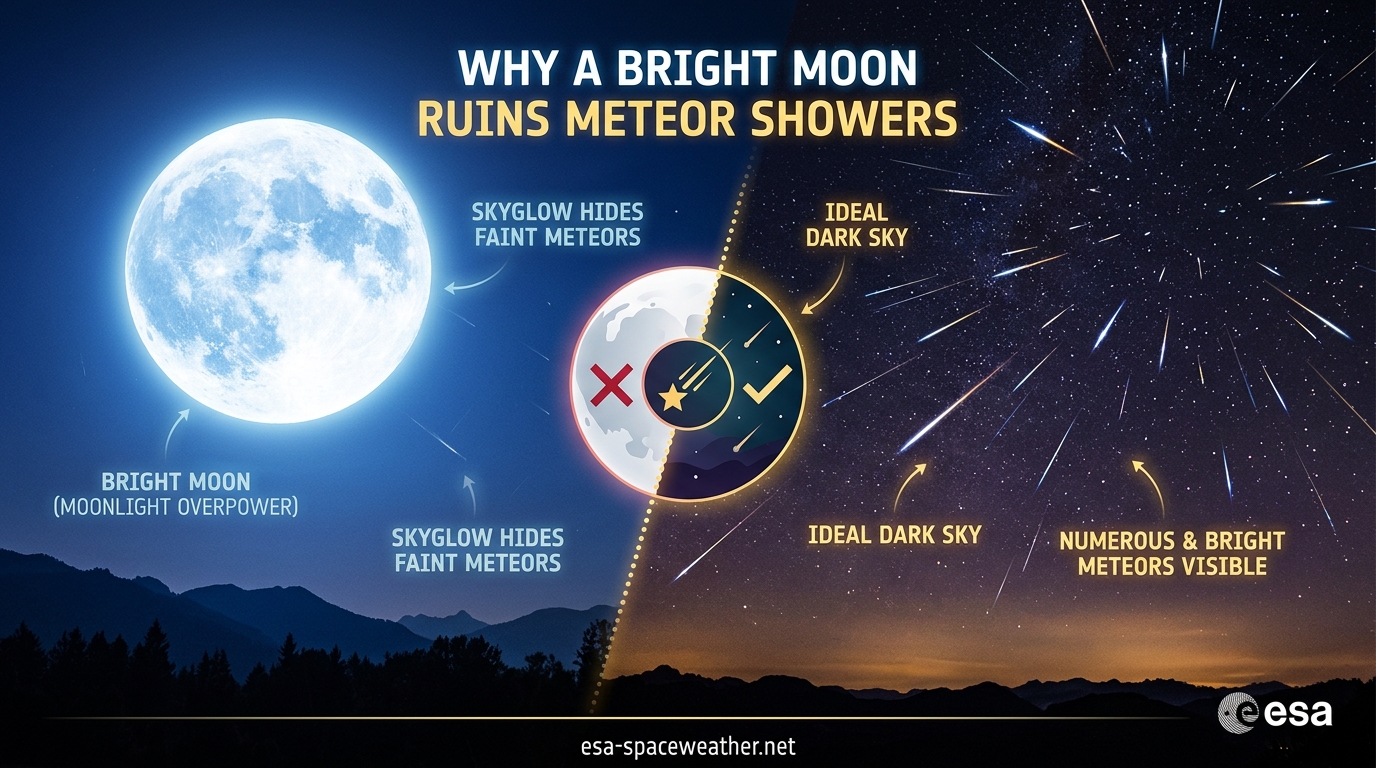
You plan for weeks. You drive an hour to a dark sky location, set up your lawn chair, look up, and see almost nothing streaking across the sky. The culprit? A fat, glowing moon hanging overhead like a spotlight. If you have ever wondered whether a bright moon ruins meteor showers, the short answer is: yes, it significantly cuts what you can see, but it does not completely destroy the experience.
Understanding why a bright moon ruins meteor showers, and knowing the practical workarounds, can mean the difference between a magical night under the stars and a frustrating drive home. In this guide, I will walk you through the science behind moonlight interference and the strategies our team uses to salvage a moonlit meteor watch.
Table of Contents
Why a Bright Moon Ruins Meteor Showers: The Science
A bright moon ruins meteor showers because it floods the night sky with scattered light, raising the background brightness and wiping out the contrast needed to see faint shooting stars. The moon does not block or absorb meteors. It simply makes the sky too bright for your eyes to pick up anything but the most intense flashes.
The Physics of Sky Glow and Light Scattering
When moonlight enters Earth’s atmosphere, it collides with nitrogen and oxygen molecules. This process, called Rayleigh scattering, redirects the light in every direction. The same physics that makes the daytime sky blue works at night on a smaller scale, painting the entire sky a faint silvery glow.
This sky glow is the enemy of meteor watching. A meteor is a tiny grain of comet or asteroid debris burning up at high altitude, producing a brief streak of light. If the background sky is bright from moonlight, the faint streaks blend in and disappear. The contrast between the meteor and the sky simply drops below what your eye can detect.
Think of it like trying to see a flashlight beam from across a field at noon versus midnight. The flashlight is the same brightness in both cases, but the bright daytime background drowns it out entirely.
The Magnitude Cutoff: Which Meteors Survive Moonlight
Astronomers measure brightness using a scale called magnitude. Lower numbers are brighter. The faintest stars most people can see under a dark sky are around magnitude 6. The full moon shines at magnitude minus 12.7, which is roughly 400,000 times brighter than the faintest visible star.
Under a dark, moonless sky, you can spot meteors down to about magnitude 5 or 6. When a bright moon is up, that threshold jumps to roughly magnitude 3. That means every meteor dimmer than magnitude 3 becomes invisible. Sky and Telescope and experienced observers on astronomy forums agree: moonlight selectively removes the fainter meteors, leaving only the brighter ones.
The practical result is that you lose the majority of meteors during a bright moon. Most meteor showers produce far more faint meteors than bright ones. When the faint ones vanish, your hourly count drops dramatically, sometimes by 70 to 80 percent.
How Much Does a Bright Moon Reduce Visibility?
Forum discussions on Reddit’s astronomy communities provide real-world numbers. Under ideal dark skies during the Perseids peak, observers report seeing around 60 to 100 meteors per hour. When a bright waning gibbous or full moon is up, that same observer might see only 15 to 25 per hour.
One Reddit user who watched the Geminids under a dark sky logged roughly one meteor per minute. Under a bright moon at the same location, they estimated one meteor every four to five minutes. That is roughly an 80 percent reduction, and it matches what experienced observers report across multiple showers and decades.
Here is a rough breakdown of how different moon phases affect meteor visibility compared to a moonless sky:
- New moon: 100 percent visibility. Ideal conditions for any meteor shower.
- Crescent moon (sets early): 80 to 95 percent visibility if you view after moonset.
- First quarter (sets around midnight): 70 to 90 percent visibility for predawn viewing windows.
- Gibbous moon (waxing or waning): 30 to 50 percent visibility. Significant washout of faint meteors.
- Full moon: 15 to 30 percent visibility. Only bright fireballs and the occasional magnitude 2 meteor break through.
These numbers assume a reasonably dark sky location away from city light pollution. If you combine a bright moon with urban sky glow, the effect compounds and you may see only a handful of meteors all night.
Seven Ways to Work Around a Bright Moon During Meteor Showers
A bright moon reduces what you can see, but it does not have to ruin your night. Our team has tested these strategies over years of meteor watching, and each one can meaningfully improve your results when the moon is working against you.
1. Position yourself in the moon’s shadow. This is the single most effective technique. Find a building, hill, dense tree line, or even a parked vehicle that blocks the moon from your direct view. When the moon is physically hidden behind an obstacle, your local sky darkens considerably and your eyes can begin to recover some sensitivity. The key is to get the obstacle between you and the moon without blocking the rest of your viewing sky. A tall barn, a wall, or a cliff edge works well. Stand close enough that the obstacle covers the moon’s disk completely but leave yourself a wide view of the sky on the opposite side.
2. Wait for the post-moonset window. The moon sets at a predictable time each night, and the hour after moonset can be spectacular. Check a moon phase app for your location and note when the moon dips below the horizon. The sky will rapidly darken once the moon is gone, and you get a genuine dark-sky window even during a bright moon phase.
3. Watch during the predawn hours. Many meteor showers produce their highest rates in the hours before dawn, when the radiant point is highest in the sky. If the moon is a waning gibbous, it may set before dawn, giving you a dark window right when meteor activity peaks. Even if the moon is still up, it sits lower in the sky near dawn, reducing its sky glow effect.
4. Face away from the moon. Meteors can appear anywhere in the sky, not just near the radiant point. Position yourself so the moon is behind you or off to one side. The half of the sky opposite the moon will be noticeably darker, and that is where you should concentrate most of your attention.
5. Get as far from light pollution as possible. Moonlight is bad enough on its own. When you add streetlights, porch lights, and city sky glow, the combination is brutal. Drive to a truly dark location, the darkest you can reasonably reach. Under a bright moon, every increment of darkness matters more than ever.
6. Hunt for earthgrazers in the early evening. Earthgrazers are long, slow, dramatic meteors that skim horizontally through the upper atmosphere near the horizon. They are most common in the early evening when the radiant point is low. During a bright moon phase, earthgrazers can still be visible because they tend to be bright and long-lasting. They often produce memorable, colorful trails that cut right through the moonlit sky.
7. Defocus your gaze. Instead of staring intently at one spot, let your eyes relax and take in a wide area of sky. This technique, recommended by experienced observers, uses your peripheral vision, which is more sensitive to faint light and motion. A soft, wide-field gaze catches meteors you would miss by staring hard at a single point.
Building a Meteor Shower Viewing Strategy Around the Moon
When the peak of a major shower coincides with a full or near-full moon, you need a plan. Do not just write off the entire shower. Meteor showers last for days or even weeks, and the peak is only the center of a broader activity window.
The best approach is multi-night planning. Most major showers, including the Perseids, Geminids, Quadrantids, and Leonids, show elevated activity for two to three nights before and after their stated peak. Check the moon phase for each night. If the peak night has a full moon but the night before has a moonset at 2 AM, plan your session for that post-moonset window on the earlier night. You will see slightly fewer meteors than at absolute peak, but the darker sky more than compensates.
Some showers are better bets under a bright moon than others. Showers known for producing bright fireballs, like the Perseids and the Geminids, are more rewarding during moonlit conditions because their brighter meteors survive the sky glow. Showers dominated by faint meteors, like the Taurids at their typical rates, become nearly invisible. When planning around a bright moon, prioritize fireball-rich showers.
Protecting your night vision is also critical. Avoid white light from phones, flashlights, and car headlights entirely. Use a red light if you need to see your surroundings. It takes your eyes 20 to 30 minutes to fully dark-adapt, and a single white-light exposure resets that clock. Under a bright moon, your dark adaptation is already compromised, so any additional light makes things worse.
Bring the right comfort gear. A reclining lawn chair or sleeping pad lets you look up comfortably for an extended period. Dress warmer than you think necessary, because meteor watching is a stationary activity and temperatures drop fast. A warm drink, a blanket, and patience complete the setup. Experienced observers know that meteors come in bursts followed by lulls, so plan to stay out for at least an hour, preferably two.
Will the moon ruin the meteor shower?
A bright moon will significantly reduce the number of meteors you can see, often cutting visible rates by 70 to 80 percent, but it will not completely ruin the shower. Bright fireballs and magnitude 2 or brighter meteors can still penetrate moonlight and put on a memorable show.
Can you see meteors during a full moon?
Yes, but only the brightest ones. A full moon raises the sky background so high that meteors dimmer than about magnitude 3 become invisible to the naked eye. You can still catch fireballs and occasional bright meteors, but expect 70 to 85 percent fewer than under a dark sky.
What direction should I face when watching meteors with a bright moon?
Face away from the moon. Position yourself so the moon is behind you, behind an obstacle like a building or tree, or off to one side. The half of the sky opposite the moon will be the darkest and offers your best chance of spotting meteors.
What is the best time to watch a meteor shower with a bright moon?
The best time is after moonset and before dawn. Check a moon phase app for your location. If the moon sets before dawn, that window combines peak meteor activity with a dark sky. Predawn hours are also ideal because the radiant point is highest and meteor rates are naturally higher.
How much does a full moon reduce meteor shower visibility?
Under a full moon, expect to see roughly 15 to 30 percent of the meteors you would see under a dark, moonless sky. Observers report rates dropping from 60 to 100 meteors per hour down to 15 to 25 per hour. The fainter meteors vanish entirely, leaving only the brightest fireballs.
Conclusion: A Bright Moon Is Not the End of the Show
A bright moon ruins meteor showers in the sense that it wipes out the faint majority and slashes your visible rates dramatically. But it does not end the show entirely. The brightest fireballs, the long earthgrazers, and the occasional meteor with a persistent train can all punch right through the lunar glare.
The key is knowing why moonlight interference happens and having a plan to work around it. Use the moon’s shadow, chase the post-moonset window, face away from the glare, and hunt during the predawn hours when rates peak. With realistic expectations and the right strategy, even a bright moon meteor shower can deliver a night worth remembering.
So the next time a bright moon threatens to ruin meteor showers on your calendar, do not cancel your plans. Pack the lawn chair, grab a warm drink, find that shadow, and look up. The sky always has something to offer those who are patient enough to watch.