
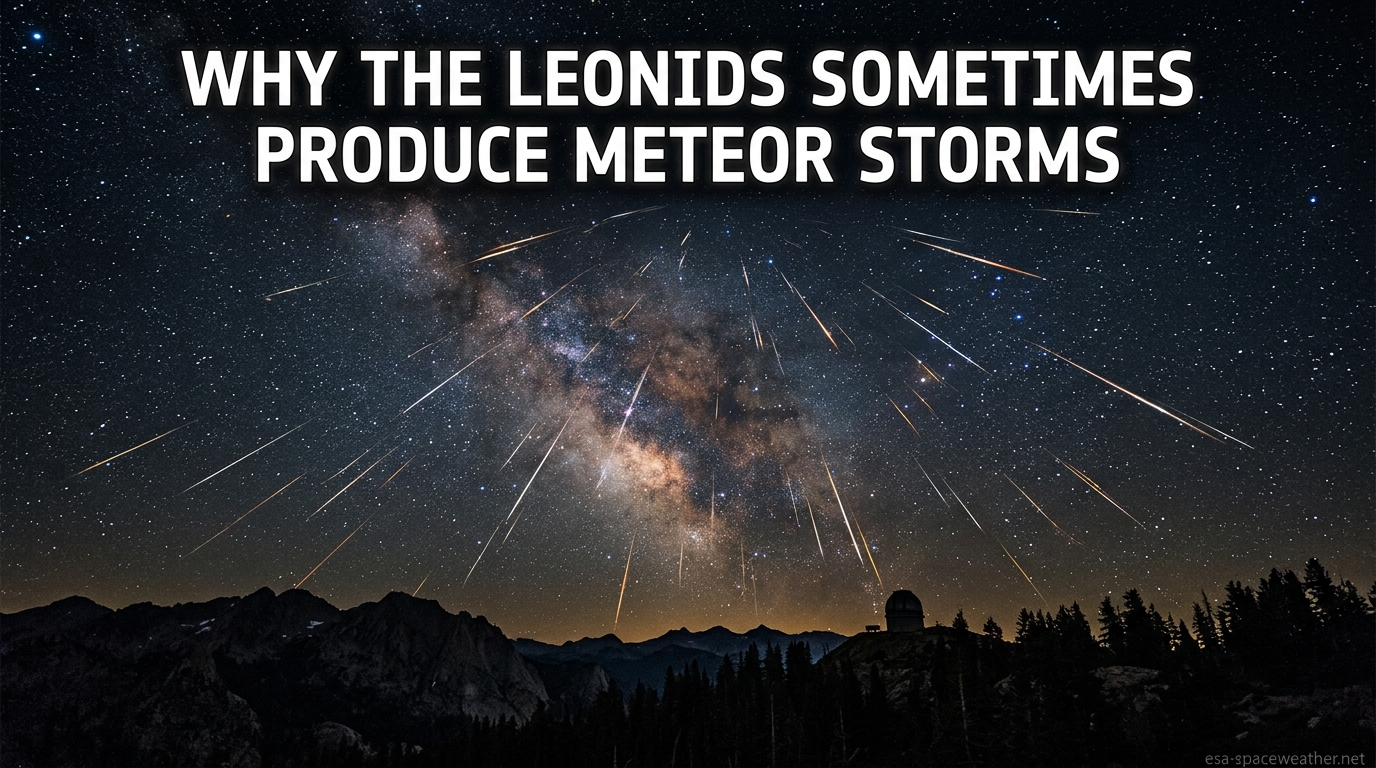
Sometimes the Earth plows directly into a dense ribbon of comet debris, and the sky erupts in thousands of meteors per hour. Sometimes our planet passes through the gaps between those debris trails, and barely a handful of Leonid meteors appear all night. That contrast, in a nutshell, is why the Leonids sometimes produce meteor storms and sometimes fizzle into an ordinary November shower.
The answer comes down to the structure of the debris left behind by comet 55P/Tempel-Tuttle. This comet sheds dust and rocky particles each time it swings near the Sun on its 33-year orbit. But that debris does not spread out evenly. It clumps into narrow, dense filaments, some only about 35,000 kilometers wide, that drift through space along the comet’s orbital path like invisible ribbons.
When Earth happens to intersect one of these young, dense ribbons head-on, the result is a meteor storm. When our planet threads the gap between ribbons, the Leonids look like any other modest annual shower with 5 to 10 meteors per hour.
In this article, I will walk you through the science behind this phenomenon, from the comet that creates the Leonids to the debris filaments that explain the “sometimes” in our title. We will also explore the great storms of 1833 and 1966, the famous disappointments of 1899 and 1933, and what astronomers predict for the next Leonid storm window around 2031 to 2034.
Table of Contents
What Are the Leonids?
The Leonids are an annual meteor shower that peaks around November 17 each year, when Earth passes through the orbital path of comet 55P/Tempel-Tuttle. Tiny particles shed by the comet, most no bigger than a grain of sand, slam into our atmosphere at blistering speed and vaporize in a flash of light that we call a meteor.
The shower gets its name from the constellation Leo, because all Leonid meteors appear to radiate from a point within Leo’s sickle-shaped asterism. This radiant point rises in the east after midnight in November, which is why the best Leonid viewing always comes in the pre-dawn hours.
Leonid meteors are the fastest of any major meteor shower. They hit the atmosphere at roughly 71 kilometers per second (about 44 miles per second), a blistering pace caused by the comet’s retrograde orbit, meaning it travels around the Sun in the opposite direction from Earth. That head-on collision geometry doubles the effective impact speed compared to meteors from prograde-orbit comets.
That extreme velocity makes Leonid meteors spectacular even when they are small. A typical Leonid particle the size of a grain of sand can produce a streak as bright as Venus. Larger fragments produce brilliant fireballs that light up the entire sky and leave glowing vapor trains that persist for minutes.
In a normal year, the Leonids produce a modest peak of about 10 to 15 meteors per hour under ideal dark-sky conditions. That is a pleasant shower but nothing extraordinary. The drama comes when the Leonids decide to escalate from a shower into something far more dramatic.
Meteor Shower vs. Meteor Outburst vs. Meteor Storm
Astronomers use a measurement called the Zenithal Hourly Rate, or ZHR, to describe meteor shower intensity. ZHR represents the number of meteors a single observer would see per hour under perfect conditions: dark skies, clear horizon, and the radiant directly overhead.
A typical meteor shower, including the Leonids in a quiet year, has a ZHR between 10 and 20. A meteor outburst is a temporary enhancement above normal levels, perhaps reaching ZHR 50 to several hundred for a brief period. A meteor storm is defined as any event where the ZHR exceeds 1,000 meteors per hour.
The Leonids are one of the very few meteor showers capable of producing true meteor storms. When they do, the numbers defy imagination. The 1833 storm may have reached 240,000 meteors per hour. The 1966 storm peaked at an estimated 144,000 meteors per hour, which works out to about 40 meteors every single second.
Most meteor showers never reach storm levels. The Perseids, Geminids, and Quadrantids are reliable annual performers but max out around ZHR 100 to 150. Only the Leonids and a handful of other showers associated with specific comets can produce the kind of sky-filling spectacle that eyewitnesses describe as unforgettable.
The Parent Body: Comet 55P/Tempel-Tuttle
Every Leonid meteor begins as a particle of dust or ice on the surface of a comet called 55P/Tempel-Tuttle. This comet is the parent body of the Leonid meteoroid stream, and understanding its behavior is the key to understanding why the Leonids sometimes produce meteor storms.
Comet 55P/Tempel-Tuttle was independently discovered by two astronomers in the 1860s. Ernst Tempel spotted it from Italy in December 1865, and Horace Tuttle found it independently from Harvard Observatory in January 1866. Later orbital calculations revealed that earlier astronomers had glimpsed it in 1699 and 1862 without recognizing it as periodic.
The comet follows a highly elliptical orbit that carries it from the outer solar system, just beyond the orbit of Uranus, down to a close approach to the Sun called perihelion, which lies just inside Earth’s orbit. One complete orbit takes approximately 33.8 years, which is why the Leonids have a strong tendency to produce storms on a roughly 33-year cycle.
How the Comet Sheds Debris
When 55P/Tempel-Tuttle approaches perihelion, solar heating intensifies dramatically. The comet’s nucleus, which is a dark, dusty snowball roughly 3.6 kilometers (about 2.2 miles) across, begins to warm. Frozen ices, particularly water ice and carbon monoxide, undergo thermal sublimation, meaning they transition directly from solid to gas without becoming liquid.
As these gases jet outward from the nucleus, they carry dust and rocky particles along with them. This material is extraordinarily fragile. Astronomers describe it as friable material, a fluffy conglomerate of dust and ice sometimes called a dustball. The particles range from microscopic specks to pea-sized pebbles, and they get ejected at relatively gentle speeds of a few meters per second relative to the comet.
Because the ejection speeds are low, the debris initially stays close to the comet’s orbital path. Over time, it spreads out into a long, thin stream of meteoroids that traces the comet’s route around the Sun. But here is the critical part: the debris does not spread evenly.
Each perihelion passage produces a separate batch of debris. Think of it as the comet leaving a distinct trail of breadcrumbs every 33 years. These trails are initially narrow and densely packed with particles. They orbit the Sun in a loose formation following the comet, but gravitational forces from the planets, particularly Jupiter, gradually nudge them into slightly different orbits over time.
The Retrograde Orbit and Extreme Velocity
One of the reasons the Leonids are so spectacular is the comet’s retrograde orbit. Most solar system objects, including Earth, travel around the Sun in a counterclockwise direction when viewed from above the north pole. Comet 55P/Tempel-Tuttle goes the other way.
This means Earth and the Leonid meteoroids are essentially flying toward each other on a collision course. The combined closing velocity produces those extreme 71 km/s impact speeds. No other major meteor shower matches this combination of high particle density during storms and extreme atmospheric entry velocity.
The result is that even tiny Leonid particles, which would be invisible in a slower shower, produce brilliant meteor streaks. During a storm, the sky fills with fast, bright meteors that often leave persistent trains glowing for 30 seconds or more.
The Secret of the Filaments: Why the Leonids Sometimes Produce Meteor Storms
Now we arrive at the heart of the question. Why do the Leonids sometimes produce meteor storms? The answer lies in the architecture of the debris stream left by comet 55P/Tempel-Tuttle.
The debris does not form a uniform cloud or belt around the comet’s orbit. Instead, it organizes itself into a series of narrow, dense filaments, sometimes called dust ribbons, one for each perihelion passage of the comet. These filaments are staggeringly narrow by astronomical standards, some only about 35,000 kilometers wide, which is less than three times the diameter of Earth.
Earth’s orbit crosses the comet’s orbital plane at a single point each November. Whether we get a storm or a dud depends entirely on whether any of those dense filaments happen to be sitting at that crossing point when Earth arrives.
Young Trails vs. Old Trails: The Aging Process
This is the part that most explanations gloss over, but it is the single most important concept for understanding the “sometimes” in our title. Not all debris trails are created equal. They age, and aging changes everything.
A young trail is one recently ejected by the comet, typically within the last one or two orbital periods. Young trails are narrow and densely packed with particles because the debris has not had time to spread out. When Earth hits a young trail, the particle density is enormous, and a meteor storm results.
An old trail is one ejected many orbital periods ago, perhaps centuries ago. Over time, several forces act on the particles and cause the trail to widen and thin out. The trail that started as a dense, narrow ribbon gradually puffs up into a broad, diffuse cloud with far fewer particles per cubic kilometer. When Earth passes through an old trail, we might see a modest enhancement in meteor rates, but not a storm.
This aging process is driven by several physical mechanisms. The Poynting-Robertson effect, a consequence of solar radiation pressure acting on moving particles, causes smaller dust grains to spiral inward toward the Sun over time. The Yarkovsky effect, driven by uneven thermal radiation from rotating particles, adds a small but persistent force that gradually shifts particle orbits. Differential gravitational perturbations from Jupiter and the other giant planets stretch and distort the trails, spreading the debris over a wider volume of space.
The net result is beautifully simple to state even though the physics is complex: young trails produce storms, old trails produce ordinary showers, and the difference between the two is largely a matter of time.
Jupiter’s Gravitational Influence
Jupiter deserves special attention because it is the single most important gravitational influence on the Leonid debris stream after the Sun itself. Jupiter’s enormous mass perturbs the orbits of both comet 55P/Tempel-Tuttle and its debris trails, gradually shifting their positions over decades and centuries.
These gravitational perturbations can move a dense filament closer to or farther from Earth’s orbital crossing point. A trail that Earth intersected perfectly a century ago might be nudged just far enough away by Jupiter’s gravity that we now miss it entirely. Conversely, a trail that was previously offset might drift into our path.
This is why the Leonid storm cycle is not perfectly clockwork. The 33-year orbital period of the comet sets the rough rhythm, but Jupiter’s perturbations add an element of unpredictability. Sometimes a storm arrives right on schedule. Sometimes it arrives a year or two early or late. And sometimes, as we will see, it fails to arrive at all.
How a Meteor Storm Develops: Step by Step
If we zoom in on the mechanics, here is the sequence that produces a Leonid meteor storm:
Step 1: Comet 55P/Tempel-Tuttle approaches perihelion and ejects a fresh batch of dust and rocky particles through thermal sublimation of its ices.
Step 2: The freshly ejected debris forms a narrow, dense filament along the comet’s orbital path, initially only about 35,000 kilometers wide.
Step 3: Over the following months and years, gravitational perturbations from Jupiter and the other planets nudge the filament slightly but it remains narrow and dense because it is young.
Step 4: Earth’s orbit carries our planet through the comet’s orbital plane in mid-November each year. If the young, dense filament happens to be positioned at the crossing point, Earth plows through it.
Step 5: The extremely high particle density, combined with the retrograde encounter speed of 71 km/s, produces thousands of meteors per hour as the particles vaporize in the upper atmosphere.
Step 6: In years when no dense filament sits at the crossing point, Earth passes through only sparse, dispersed debris, and the Leonids produce their ordinary rate of 5 to 15 meteors per hour.
This is the complete answer to why the Leonids sometimes produce meteor storms. It is not random. It is not magic. It is the predictable result of whether Earth’s orbit intersects a young, dense debris filament or misses all of them.
Historical Leonid Storms: A Timeline of Spectacle
The Leonids have been producing spectacular displays for centuries, but a few events stand out as the greatest meteor storms in recorded history. Each one tells us something important about how the debris filament system works.
The 1833 Storm: The Night the Stars Fell
On the night of November 12 to 13, 1833, the most spectacular meteor storm in recorded history erupted over the eastern United States. Eyewitnesses described meteors falling like snowflakes in a blizzard. Modern estimates put the peak rate between 100,000 and 240,000 meteors per hour, meaning observers saw dozens of meteors every second.
The event had enormous cultural impact. Many people who saw it believed the world was ending. Enslaved people in the American South interpreted it as a sign of liberation. Religious leaders cited it as a portent. The storm so impressed a young Abraham Lincoln that he referenced it decades later. Frederick Douglass later connected the storm to the abolitionist movement in his autobiography.
The 1833 storm was historically significant for another reason: it marked the birth of modern meteor astronomy. Yale professor Denison Olmsted collected eyewitness reports from across the country and realized that the meteors all radiated from a single point in Leo. This was the first time the concept of a radiant was clearly demonstrated, proving that meteor showers were a real astronomical phenomenon and not random atmospheric events.
The 1866 Storm: Confirming the Pattern
After the 1833 display, astronomers calculated that a similar event might recur in about 33 years. The prediction was fulfilled in 1866, when observers in Europe and the Middle East recorded Leonid rates of roughly 5,000 to 10,000 meteors per hour. This confirmed the 33-year cycle and led directly to the discovery of comet 55P/Tempel-Tuttle later that same year.
The 1899 and 1933 Disappointments: When the Filaments Drifted Away
Based on the 33-year pattern, astronomers confidently predicted major Leonid storms in 1899 and again in 1932 or 1933. Both predictions failed spectacularly. The Leonids produced ordinary rates, and public confidence in meteor storm prediction collapsed.
We now understand exactly why these predictions failed. Jupiter’s gravitational perturbations had shifted the dense debris filaments away from Earth’s orbital crossing point. The filaments were still there, but they no longer intersected Earth’s orbit at the right time. This is a perfect illustration of the filament aging and displacement process we discussed earlier.
The 1899 disappointment was so public that it actually damaged the reputation of meteor astronomy for decades. Newspapers mocked the failed prediction. The lesson was clear: the 33-year comet cycle is necessary but not sufficient for a storm. The exact position of the debris filaments matters just as much.
The 1966 Storm: 40 Meteors Per Second
After two consecutive disappointments, expectations were low heading into the 1965 to 1966 Leonid window. But on the morning of November 17, 1966, the western United States was treated to one of the most intense meteor storms ever recorded.
Observers reported peak rates of 40 meteors per second, which translates to approximately 144,000 meteors per hour. One observer described it as “like driving through a snowstorm at night with headlights on,” except the snowflakes were streaks of light falling from every direction.
A Reddit user whose father witnessed the 1966 storm shared this description: “My dad said it looked like fire and the embers were falling.” Eyewitness accounts from across the American Southwest consistently describe a sky so full of meteors that it was difficult to process what was happening.
The 1966 storm was caused by Earth passing through a particularly dense filament of debris ejected by comet 55P/Tempel-Tuttle during its 1899 perihelion passage. That trail, which had been a dud in 1899 because it was positioned wrong, had drifted into the perfect position by 1966.
The 1999 to 2002 Storm Window
The most recent major Leonid storm window arrived in the late 1990s and early 2000s, following the comet’s perihelion in February 1998. Unlike previous storms, which peaked in a single night, this window produced multiple impressive displays over several years.
In 1999, observers in Europe and the Middle East recorded a strong Leonid outburst with rates near 5,000 meteors per hour. In 2001, observers in the Americas, East Asia, and Australia witnessed spectacular displays with peak rates estimated at 1,000 to 3,000 meteors per hour. A Reddit user who saw the 2001 display “deep in the Australian outback” called it “the most amazing thing I have ever seen.”
The 2002 Leonids produced another impressive storm, with rates again exceeding 1,000 to 2,000 meteors per hour in some locations. This made the 2001 to 2002 period one of the most rewarding Leonid windows for modern observers, since multiple regions got good displays across two consecutive years.
The 2001 and 2002 storms were significant because they were the first major Leonid storms observed with modern digital cameras and scientific instrumentation. Data from this window dramatically improved our understanding of debris filament dynamics and refined the prediction models developed by astronomers like David Asher, Robert McNaught, Mikhail Maslov, and Esko Lyytinen.
Storm Year to Comet Perihelion Mapping
The connection between comet perihelion passages and resulting storms becomes clearer when we map them out. Each major storm corresponds to Earth hitting a specific debris trail ejected during a previous perihelion passage of 55P/Tempel-Tuttle.
The 1833 storm was caused by debris from the 1800 perihelion passage. The 1866 storm drew from the 1733 trail. The 1966 storm was triggered by the 1899 trail. The 2001 storms involved debris from the 1767 passage, while the 2002 storms came from the 1866 trail. This pattern shows that the trail age matters: trails from roughly 33 to 166 years before a storm year can still produce significant displays if they happen to intersect Earth’s orbit.
Notice that the 1899 trail was involved in both a disappointment (1899 itself) and a spectacular storm (1966). Same trail, different outcome. The difference was entirely about whether the trail’s position intersected Earth’s orbit at the right time. This is the strongest possible evidence for the filament displacement theory.
Predicting the Next Leonid Storm
After the success of predictions during the 1999 to 2002 window, astronomers have continued refining their models. The leading prediction frameworks come from several independent research teams, all of which trace debris trails forward in time using sophisticated orbital dynamics calculations.
The Asher and McNaught model, developed in the late 1990s, maps individual dust trails and calculates whether Earth will cross each one. Mikhail Maslov of Russia and Esko Lyytinen of Finland have developed independent models that incorporate additional forces like radiation pressure and the Poynting-Robertson effect. These models agree on the broad picture but sometimes differ on specific timing and intensity estimates.
The 2031 to 2034 Outlook
Comet 55P/Tempel-Tuttle passed through perihelion most recently in 1998, and its next perihelion is expected around 2031. This means the late 2020s through the mid-2030s represent the next theoretical storm window.
However, current models suggest the 2031 perihelion cycle may not produce storms comparable to 1833 or 1966. The debris trails that Earth will encounter are mostly older trails that have had time to disperse. Some modest enhancements are possible, perhaps reaching outburst levels of a few hundred meteors per hour, but a true storm exceeding 1,000 per hour appears unlikely based on current calculations.
The next genuinely favorable Leonid storm window may not arrive until around 2099, when Earth is projected to encounter particularly dense trails from the 1932 and 1965 comet passages. That is a long wait, but meteor storm prediction is an imperfect science, and unexpected encounters with unmapped trails are always possible.
Why Predictions Are Difficult
Several factors make Leonid storm prediction genuinely hard. First, the debris filaments are invisible. We cannot point a telescope at them and measure their position directly. We can only infer their location from the behavior of past storms and from computer models of orbital dynamics.
Second, the non-gravitational forces acting on small particles are difficult to quantify precisely. The Poynting-Robertson effect, radiation pressure, and the Yarkovsky effect all depend on particle size, composition, and rotation rate, none of which are known for individual meteoroids. Small errors in these parameters compound over decades of orbital integration.
Third, Jupiter’s perturbations are complex and chaotic over long timescales. A tiny displacement in a trail’s position 50 years ago can mean the difference between a direct hit and a near miss today.
Spacecraft Hazards and the Space Weather Connection
There is one more reason scientists care deeply about predicting Leonid storms: spacecraft safety. During a meteor storm, the flux of meteoroids can be thousands of times higher than normal. A Leonid particle hitting a satellite at 71 km/s carries enormous kinetic energy for its size and can damage solar panels, sensors, or protective shielding.
ESA’s European Space Operations Centre (ESOC) and other space agencies closely monitor Leonid predictions to take protective measures during storm events. Satellites can be reoriented to present their smallest cross-section to the meteoroid stream. Sensitive instruments can be powered down or shielded during peak storm hours. The International Space Station and its crew can take shelter in protected modules.
The 1999 to 2002 Leonid window prompted the most intensive spacecraft protection campaign in history. Space agencies coordinated worldwide to minimize risk to the growing fleet of communication, navigation, and scientific satellites in orbit. No major spacecraft losses were attributed to Leonid impacts during this period, a testament to the effectiveness of the prediction and protection models.
This is where the science of Leonid meteor storms intersects directly with the field of space weather. Understanding when and why the Leonids sometimes produce meteor storms is not just an academic curiosity. It is operational intelligence that protects billions of dollars of orbital infrastructure and human lives in space.
How to Watch the Leonids
Even in non-storm years, the Leonids are worth watching. Here is how to get the best experience when November rolls around.
The Leonids are active from roughly November 6 to 30 each year, with peak activity around November 17. The radiant point in the constellation Leo rises in the east after midnight local time, so the best viewing window is from about 1:00 AM until dawn.
Find the darkest sky location you can, as far from city lights as possible. Allow 20 to 30 minutes for your eyes to fully dark-adapt. Lie back on a reclining chair or blanket and look about 30 to 45 degrees away from the radiant in Leo, not directly at it. Meteors near the radiant appear shorter due to foreshortening, while those farther from the radiant produce longer, more dramatic streaks.
In a normal year, expect to see about 10 to 15 Leonids per hour at peak under dark skies. The fast, bright meteors often leave persistent trains, and you may catch a fireball or two. If prediction models suggest enhanced activity for a given year, it is well worth making the effort to observe.
FAQs
How often do Leonid meteor storms occur?
Leonid meteor storms occur roughly every 33 years, matching the orbital period of parent comet 55P/Tempel-Tuttle. In most years, the Leonids produce only 5 to 15 meteors per hour. But when Earth passes through a dense filament of recently ejected comet debris, the rate can exceed 1,000 or even 100,000 meteors per hour. The most recent major storm window was 1999 to 2002.
Has there ever been a Leonid meteor storm?
Yes, multiple times. The most famous Leonid meteor storms occurred in 1833 (estimated 100,000 to 240,000 meteors per hour), 1866 (roughly 5,000 to 10,000 per hour), 1966 (over 40 meteors per second, or about 144,000 per hour), and 2001 to 2002 (peak rates of 1,000 to 3,000 per hour). The 1833 storm over North America was so intense that observers believed the stars were falling from the sky.
What was the most intense meteor shower in history?
The 1833 and 1966 Leonid meteor storms are considered the most intense meteor displays ever recorded. The 1833 storm may have reached 240,000 meteors per hour, while the 1966 storm peaked at approximately 144,000 meteors per hour (40 per second). No other meteor shower in documented history has matched these rates. The next comparable Leonid storm is not expected until around 2034 at the earliest, or possibly 2099.
Why did the 1833 meteor storm terrify America?
The 1833 Leonid storm erupted without warning over the eastern United States on the night of November 12 to 13, with estimated rates exceeding 100,000 meteors per hour. To people unfamiliar with meteor science, it appeared as though the stars were literally falling from the sky or the heavens were on fire. Many believed it signaled the end of the world. The event also marked the birth of modern meteor astronomy thanks to systematic observations by Yale professor Denison Olmsted.
When is the next Leonid meteor storm predicted?
Current prediction models from astronomers including Mikhail Maslov and the Asher-McNaught team suggest modest Leonid enhancements around 2031 to 2034, coinciding with the next perihelion of comet 55P/Tempel-Tuttle. However, a true storm exceeding 1,000 meteors per hour is considered unlikely in that window. The next genuinely favorable storm opportunity may not arrive until approximately 2099, when Earth is projected to cross particularly dense debris trails.
What is the difference between a meteor shower and a meteor storm?
A meteor shower is an annual or periodic increase in meteor rates, typically producing 10 to 100 meteors per hour at peak. A meteor storm is defined as any event where the Zenithal Hourly Rate (ZHR) exceeds 1,000 meteors per hour. The Leonids are one of the few showers capable of reaching storm levels, doing so roughly every 33 years when Earth intersects a dense, young debris filament from comet 55P/Tempel-Tuttle.
Conclusion
The reason why the Leonids sometimes produce meteor storms comes down to a simple but profound fact about the solar system: comet debris does not spread evenly. The dust shed by comet 55P/Tempel-Tuttle organizes into narrow, dense filaments only about 35,000 kilometers wide, each one corresponding to a specific perihelion passage. When Earth’s November orbit happens to intersect one of these young, dense ribbons, we get a storm of thousands of meteors per hour. When we miss them all, the Leonids produce their quiet annual rate of a dozen or so meteors.
The 33-year orbital period of the comet sets the rhythm, but Jupiter’s gravitational perturbations, the Poynting-Robertson effect, and the natural aging of debris trails add the element of unpredictability. The great storms of 1833 and 1966 were spectacular hits. The disappointments of 1899 and 1933 were near misses. Each event, whether spectacular or subdued, confirms the same underlying filament model.
The next time you watch the Leonids in November, whether you see 10 meteors in an hour or 10 meteors in a second, you will know exactly why. The invisible ribbons of comet dust are always out there, orbiting the Sun in patient silence, waiting for Earth to cross their path once again.