
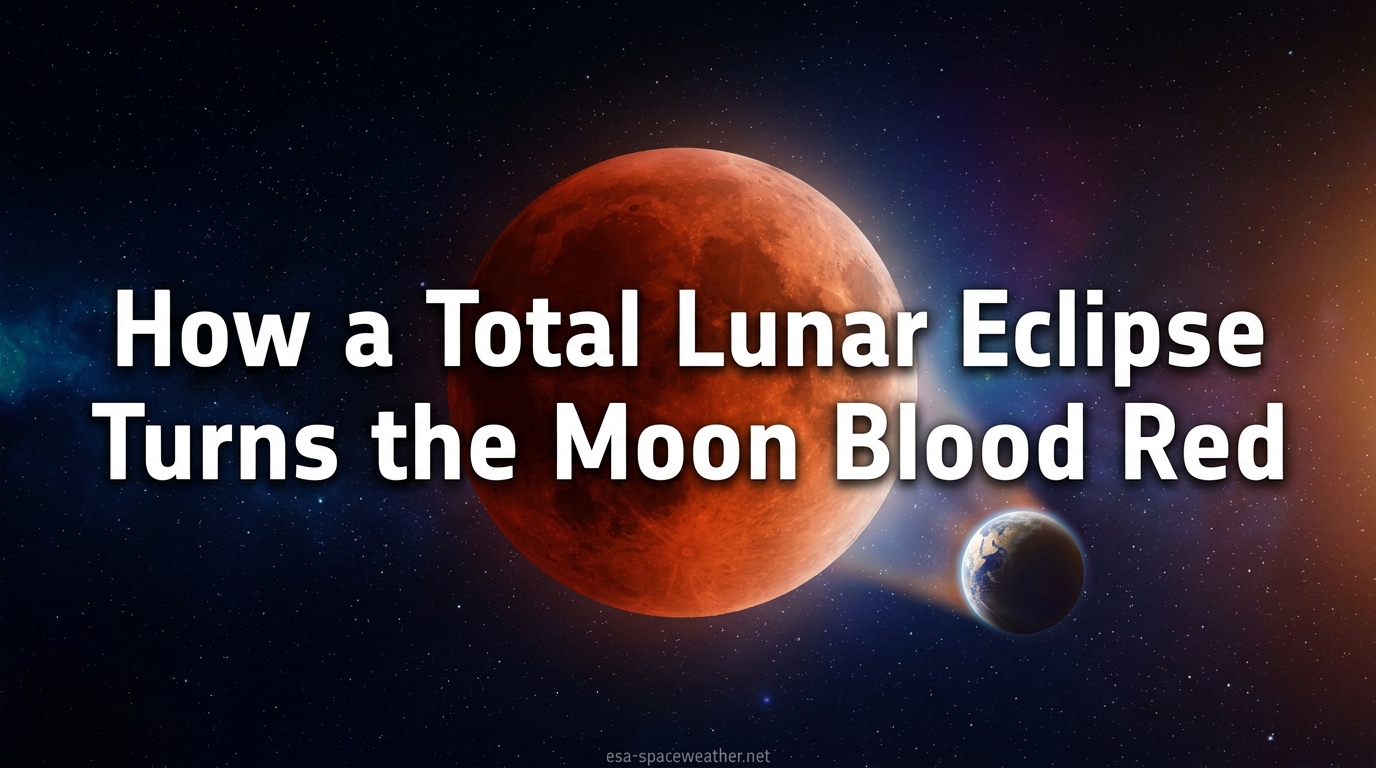
A total lunar eclipse turns the Moon blood red through the same phenomenon that makes our sky blue and our sunsets red: a process called Rayleigh scattering, where Earth’s atmosphere scatters shorter blue wavelengths of sunlight while bending longer red wavelengths onto the lunar surface. When the full Moon passes completely into Earth’s shadow, direct sunlight is blocked. The only light reaching the Moon has traveled through Earth’s atmosphere, which filters out blue and green wavelengths and lets red and orange light pass through. That filtered sunlight paints the Moon in shades of deep crimson, copper, and burnt orange.
If you have ever stood outside during a total lunar eclipse and watched the familiar white Moon slowly transform into an eerie red disk, you already know how mesmerizing the experience is. But the science behind this color shift is even more fascinating than the spectacle itself. In this guide, our team breaks down exactly how a total lunar eclipse turns the Moon blood red, what makes one blood moon brighter or darker than another, and why this astronomical event is completely safe to watch with your bare eyes.
Whether you are a casual skywatcher, a student working on a science project, or an amateur astronomer planning your next eclipse chase, this article walks you through the physics, the phases, and the practical viewing tips you need.
Table of Contents
What Is a Total Lunar Eclipse?
A total lunar eclipse happens when the Sun, Earth, and Moon align perfectly in a straight line, with Earth sitting right in the middle. Earth casts a shadow into space, and when the full Moon orbits directly behind us, it passes through that shadow. No sunlight strikes the Moon directly, and the lunar surface goes dark — but not completely dark, as we will explain shortly.
This alignment only occurs during a full moon, and only when the Moon is near one of its orbital nodes — the two points where the Moon’s tilted orbit crosses the plane of Earth’s path around the Sun. Most full moons miss Earth’s shadow entirely because the Moon’s orbit is tilted about 5 degrees relative to Earth’s orbital plane. That tilt is why we do not get a lunar eclipse every single month.
Earth actually casts two distinct shadows, and understanding the difference between them is key to understanding how eclipses work:
- Penumbra: The outer, lighter shadow where Earth only partially blocks the Sun. A moon in the penumbra dims slightly but does not change color dramatically.
- Umbra: The inner, dark cone-shaped shadow where Earth completely blocks direct sunlight. When the Moon enters the umbra, the color transformation begins.
There are three types of lunar eclipses, and only one produces the full blood moon effect:
- Penumbral lunar eclipse: The Moon passes through Earth’s penumbra only. The dimming is so subtle that most people cannot notice it without photographic comparison.
- Partial lunar eclipse: Part of the Moon dips into the umbra. That portion darkens and takes on a reddish tint, while the rest of the Moon remains bright.
- Total lunar eclipse: The entire Moon moves into the umbra. Every trace of direct sunlight is blocked, and the full disk of the Moon glows red, copper, or dark orange. This is what we call a blood moon.
The Five Phases of a Total Lunar Eclipse
A total lunar eclipse unfolds in five distinct phases, each lasting anywhere from a few minutes to over an hour. Understanding these phases helps you know what to expect if you are planning to watch one.
Phase 1 — Penumbral beginning: The Moon first enters Earth’s penumbra. The dimming is barely perceptible, but keen-eyed observers may notice the Moon’s edge starting to look slightly less bright.
Phase 2 — Partial beginning: The Moon starts crossing into the umbra. A visible dark “bite” appears on one edge of the Moon, and that portion takes on a reddish-orange tint as direct sunlight is cut off.
Phase 3 — Totality (maximum eclipse): The entire Moon is inside the umbra. This is when the blood moon effect reaches its peak. The Moon can glow anywhere from bright copper-orange to deep dark red, depending on atmospheric conditions. Totality typically lasts 30 to 90 minutes.
Phase 4 — Partial ending: The Moon begins to exit the umbra. The red color retreats from one side as bright white sunlight returns to the lunar surface.
Phase 5 — Penumbral ending: The Moon leaves the penumbra completely, and the eclipse is over. The Moon returns to its normal full brightness.
How a Total Lunar Eclipse Turns the Moon Blood Red: Rayleigh Scattering
The short answer to how a total lunar eclipse turns the Moon blood red comes down to one physical process: Rayleigh scattering. This is the same atmospheric phenomenon that makes the daytime sky look blue and gives sunrises and sunsets their warm red and orange tones.
Here is what happens step by step during totality. When the Moon is fully inside Earth’s umbra, no direct sunlight reaches it. However, sunlight that grazes the edges of Earth passes through our atmosphere before continuing on to the Moon. Earth’s atmosphere acts like a giant lens, bending or refracting that sunlight inward toward the center of our shadow cone.
But the atmosphere does more than just bend the light. It also filters it. Sunlight contains a full spectrum of wavelengths, from short violet and blue waves to long orange and red waves. When sunlight hits the gases and particles in Earth’s atmosphere, the shorter wavelengths — blue, indigo, violet — get scattered in every direction. This scattered blue light goes off into space or bounces around the sky, which is why the sky looks blue during the day.
The longer wavelengths — red, orange, deep red — pass through the atmosphere with far less scattering. They travel in a more direct path, getting bent or refracted by the atmosphere toward the center of Earth’s shadow. So the light that actually reaches the Moon during totality is almost entirely red and orange. When that filtered red light reflects off the lunar surface and travels back to your eyes, the Moon looks blood red.
NASA described this beautifully: the red light illuminating the Moon during a total lunar eclipse is the combined glow of every sunrise and every sunset on Earth, all projected onto the lunar surface at once. That single image — every sunrise and sunset in the world wrapped around the Moon — captures the physics perfectly.
Why Doesn’t the Moon Go Completely Black?
This is one of the most common questions people ask, and it is a great one. If Earth’s umbra fully blocks direct sunlight, you might expect the Moon to vanish into pitch darkness.
The reason it does not is refraction. Earth’s atmosphere bends sunlight around the curve of our planet. Even though direct sunlight is blocked, a small fraction of sunlight gets refracted through the atmosphere and funneled into the umbra. Think of Earth’s atmosphere as a ring of glass surrounding a dark sphere — light skims through that ring and gets focused inward.
Without an atmosphere, the Moon during totality would be almost invisible. If Earth had no air, no dust, no gases — just a bare rocky surface — the umbra would be truly black and the Moon would disappear from the sky during every total lunar eclipse. Our atmosphere is the reason the blood moon glows.
What Affects the Shade of Red During a Blood Moon
Not every blood moon looks the same. Some glow a bright, vivid orange-copper, while others take on a dark, almost brownish maroon that is hard to see clearly. The shade depends entirely on what is floating around in Earth’s atmosphere at the time of the eclipse.
Our atmosphere is never perfectly clean. It contains varying amounts of dust, water vapor, aerosols, pollution, and volcanic ash. These particles affect how much red light makes it through to the Moon. Here are the main factors:
- Volcanic ash: After a major volcanic eruption, ash and sulfur dioxide particles spread through the upper atmosphere and can linger for months or years. These particles block even more light than usual, producing unusually dark eclipses. After the eruption of Krakatoa in 1883, lunar eclipses were so dark that the Moon nearly disappeared. The 1991 eruption of Mount Pinatubo had a similar effect, producing very dark blood moons for over a year afterward.
- Dust and aerosols: Normal atmospheric dust, smoke from wildfires, and industrial aerosols all scatter additional light. More particles in the air generally means a darker, deeper red Moon.
- Cloud cover along the terminator: The “terminator” is the line dividing day and night on Earth. Since the sunlight reaching the Moon passes through this ring, cloud cover along the terminator can reduce the amount of red light that makes it through, darkening the eclipse.
- How deep into the umbra: The Moon’s path through the shadow matters. A Moon that passes through the dead center of the umbra appears darker red than one that just grazes the inner edge, because the center of the shadow receives the least refracted light.
The Danjon Scale: Measuring Eclipse Brightness
Astronomers use a tool called the Danjon Scale to rate the brightness and color of a total lunar eclipse. Developed by French astronomer Andre-Louis Danjon, the scale runs from L0 (darkest) to L4 (brightest). It gives observers a standardized way to compare one eclipse to another.
- L0 — Very dark: The Moon is almost invisible, especially at mid-eclipse. Dark gray or brownish. Typically occurs after major volcanic eruptions.
- L1 — Dark: Deep red or rust-colored Moon. Details on the lunar surface are hard to see.
- L2 — Dark red or rusty: The Moon has a dark red center with a brighter orange rim. This is what most people picture when they hear “blood moon.”
- L3 — Brick red: A bright, clearly visible red or orange Moon. The lunar surface features (maria and highlands) are easy to distinguish.
- L4 — Bright: The Moon is a vivid copper-orange or bright orange. Very easy to see, with a lighter, almost yellowish rim. These eclipses occur when the atmosphere is relatively clear of dust and ash.
The Turquoise Blue Band: A Surprise From the Ozone Layer
Many skywatchers are surprised to learn that blood moons are not entirely red. If you look closely during the partial phases — just before and just after totality — you may notice a thin band of turquoise or light blue light on the edge of Earth’s shadow where it falls on the Moon.
This blue band comes from the ozone layer. While most of the atmosphere scatters blue light away, ozone absorbs red and orange light in a specific wavelength range. Light passing through the upper ozone layer has some of its red component removed, leaving a subtle blue-teal tint. This creates a brief but beautiful turquoise fringe on the Moon’s edge that is visible for only a few minutes during the transition into and out of totality. Astrophotographers often capture this band, and it is one of the most sought-after details to photograph during an eclipse.
What a Blood Moon Looks Like From the Moon
If you could stand on the Moon during a total lunar eclipse, the view would be unforgettable. From the lunar surface, you would see Earth as a dark disk completely blocking the Sun — but surrounded by a thin, glowing ring of deep red and orange light.
That glowing ring is every sunrise and sunset on Earth happening at once, refracted through the atmosphere. The light from that ring is what illuminates the lunar surface in red. An astronaut on the Moon during totality would see the landscape around them bathed in a dim, reddish-orange glow, as if lit by a distant, dark fire.
This is also why the Moon never turns bright, vivid red like a stop sign. The amount of light that actually makes it through Earth’s atmosphere and across space to the Moon is tiny compared to normal sunlight. The blood moon is essentially being lit by the faint glow of a thin ring of atmospheric light.
Selenelion: When the Sun and Eclipsed Moon Are Visible Together
One of the rarest and most mind-bending phenomena associated with a total lunar eclipse is called a selenelion. This occurs when you can see the Sun and the fully eclipsed Moon above the horizon at the same time — which seems geometrically impossible, since a lunar eclipse requires the Sun and Moon to be on opposite sides of Earth.
The explanation is atmospheric refraction again. Earth’s atmosphere bends light from both the rising Sun and the setting Moon just enough to lift both above the apparent horizon in your field of view. This only works during a narrow window of a few minutes when the Moon is setting and the Sun is rising simultaneously. Observers report it as an almost surreal sight: a red blood moon hanging in the sky while the morning sun climbs the opposite horizon.
Blood Moon vs. Red Moon Near the Horizon: What’s the Difference?
A common source of confusion, especially for newer skywatchers, is the difference between a blood moon and a regular red-looking moon. The Moon can appear orange or reddish when it is low on the horizon during any full moon — no eclipse required. This happens because moonlight passes through a thick layer of atmosphere near the horizon, and the same Rayleigh scattering process filters out blue light.
The key difference is the cause. A horizon red moon is lit by direct sunlight filtered through atmosphere in a single pass. A blood moon during eclipse is lit only by sunlight refracted through Earth’s atmosphere after direct light has been completely blocked. The blood moon is typically much darker and more uniformly red, while a horizon red moon is brighter and fades to white as it climbs higher in the sky.
How to Safely View and Photograph a Blood Moon
Unlike a solar eclipse, which requires special eye protection, a total lunar eclipse is completely safe to view with your bare eyes. The Moon reflects only a fraction of the light it receives, and during an eclipse, that light is reduced even further. You can stare at a blood moon as long as you like without any risk to your vision.
This is one of the reasons blood moons are such great events for families, schools, and community gatherings. No special equipment is needed. Binoculars or a small telescope will enhance the view and bring out the color and detail of the lunar surface, but they are not required.
Tips for Photographing a Blood Moon
Capturing a great blood moon photo is challenging but doable with almost any camera, including a smartphone, if you follow a few basic principles:
- Use a tripod: During totality, the Moon is very dim. You need a longer exposure, which means any camera shake will blur the image. A sturdy tripod is essential.
- Use a telephoto lens: The more you can zoom in, the more detail you will capture. A 300mm lens or longer is ideal for filling the frame with the Moon.
- Manual settings: Set your camera to manual mode. Start with an ISO around 800 to 1600, an aperture of f/8 or wider, and a shutter speed of 1 to 4 seconds during totality. Adjust based on how bright or dark the eclipse is.
- Capture the phases: The most dramatic photos show the progression from partial to total eclipse. Take shots throughout the event and consider assembling a composite image showing the Moon at different stages.
- Shoot in RAW: RAW files give you far more flexibility for adjusting exposure and bringing out the red tones during post-processing.
If you are using a smartphone, the results during totality will be limited because phone cameras struggle with the low light. But you can still capture the overall scene and the red glow, especially if your phone has a night mode or a telephoto lens. Many photographers successfully capture blood moons by holding their phone up to a telescope eyepiece — a technique called digiscoping.
FAQs
Is it safe to see blood moons?
Yes, it is completely safe to view a blood moon with your naked eyes. Unlike solar eclipses, lunar eclipses only involve reflected moonlight, so no special eye protection is needed. Binoculars and telescopes are also safe to use.
How rare is a red blood moon?
Total lunar eclipses are not extremely rare — they typically occur about twice a year somewhere on Earth. However, any given location only gets to see a total lunar eclipse roughly every 2.5 years on average, since the timing and visibility depend on the Moon’s position and local weather conditions.
Why is the blood moon so special?
The blood moon is special because it demonstrates Rayleigh scattering in action — the same physics that makes the sky blue and sunsets red — on a cosmic scale. It is also one of the few major astronomical events that is completely safe to watch without any equipment, making it accessible to everyone.
What does the Bible say about blood moons?
The Bible mentions the Moon turning to blood in passages like Joel 2:31 and Acts 2:20, which some interpret as prophetic signs. However, from a scientific standpoint, the blood moon is simply the result of Rayleigh scattering during a total lunar eclipse. The reddish color has a well-understood physical cause and has been observed throughout human history.
How long does the Moon stay red during a total lunar eclipse?
The Moon stays red during totality, which typically lasts between 30 and 90 minutes depending on how deeply the Moon passes through Earth’s umbra. The entire eclipse event, including partial phases, can last several hours.
Why is the Moon red without an eclipse?
The Moon can appear red or orange when it is low on the horizon because its light passes through a thick layer of Earth’s atmosphere, which scatters away blue wavelengths. This is the same Rayleigh scattering effect but caused by the viewing angle rather than Earth’s shadow.
Conclusion
Understanding how a total lunar eclipse turns the Moon blood red comes down to one elegant process: Rayleigh scattering. Earth’s atmosphere scatters blue light away while bending red light inward, painting the Moon in shades of copper, orange, and crimson during totality. The exact shade you see depends on atmospheric conditions, volcanic activity, and how deeply the Moon passes through Earth’s shadow.
The next time a total lunar eclipse is visible from your location, step outside and take a look. No equipment is needed, no eye protection is required, and you will be witnessing the combined glow of every sunrise and sunset on Earth projected onto the Moon. That is a sight worth staying up for.
Keep an eye on upcoming eclipse forecasts for 2026 and beyond, and consider bringing a camera — capturing a blood moon is one of the most rewarding challenges in astrophotography. Clear skies, and happy skywatching.